
A nurse practitioner supervision or collaboration agreement defines how clinical authority, physician involvement, delegated duties, and regulatory responsibilities operate in practice. Depending on the jurisdiction and practice setting, the document may address chart review, cosignatures, prescriptive authority, consultation, reporting, telehealth, and procedures requiring physician involvement. These provisions can affect an NP’s daily workflow, professional autonomy, productivity, and ability to comply with state-specific practice requirements.
The agreement may also create financial and professional risks that are not obvious from its clinical language. Supervision requirements can influence compensation metrics, while malpractice, indemnification, termination, repayment, and restrictive covenant provisions can create obligations extending beyond the working relationship. Chelle Law provides attorney-led Nurse Practitioner Supervision and Collaboration Agreement Review services nationwide. We review the agreement alongside related employment or independent contractor terms, explain how the provisions operate together, identify compliance and liability concerns, and recommend terms that may require clarification or negotiation before the NP signs.
Key Supervision and Collaboration Agreement Considerations
- Treat a nurse practitioner supervision and collaboration agreement review as a risk-management measure that protects income, licensure, and career mobility.
- Confirm that scope-of-practice, delegation, and prescriptive authority language corresponds with applicable state requirements.
- Identify the malpractice policy type and any tail obligations, indemnification duties, or responsibility for defense costs.
- Determine whether chart review, cosignatures, or other oversight requirements could reduce collections, RVU production, or bonus eligibility.
- Review restrictive covenants, reporting lines, termination rights, and repayment provisions before signing.
Why Nurse Practitioner Practice Agreements Matter

A supervision or collaboration agreement operates at the intersection of clinical regulation and contract law. Financially, its terms may affect how productivity is measured, whether negative accrual reduces future pay, and whether bonus targets are achievable. From a licensure perspective, unclear delegation or prescriptive authority provisions may create disciplinary exposure. Restrictive covenants and post-termination duties can also limit where and how the NP works after the relationship ends.
Employers frequently use standardized provisions designed around operational control and institutional risk. A line-by-line review can identify income effects, compliance gaps, liability allocation, and long-term restrictions before they become disputes. The practical issue is not merely what a clause says, but how it will affect patient care, documentation, scheduling, compensation, and professional responsibility in the actual practice setting.
How Supervision and Collaboration Models Structure Oversight
Employment and Independent Contractor Arrangements
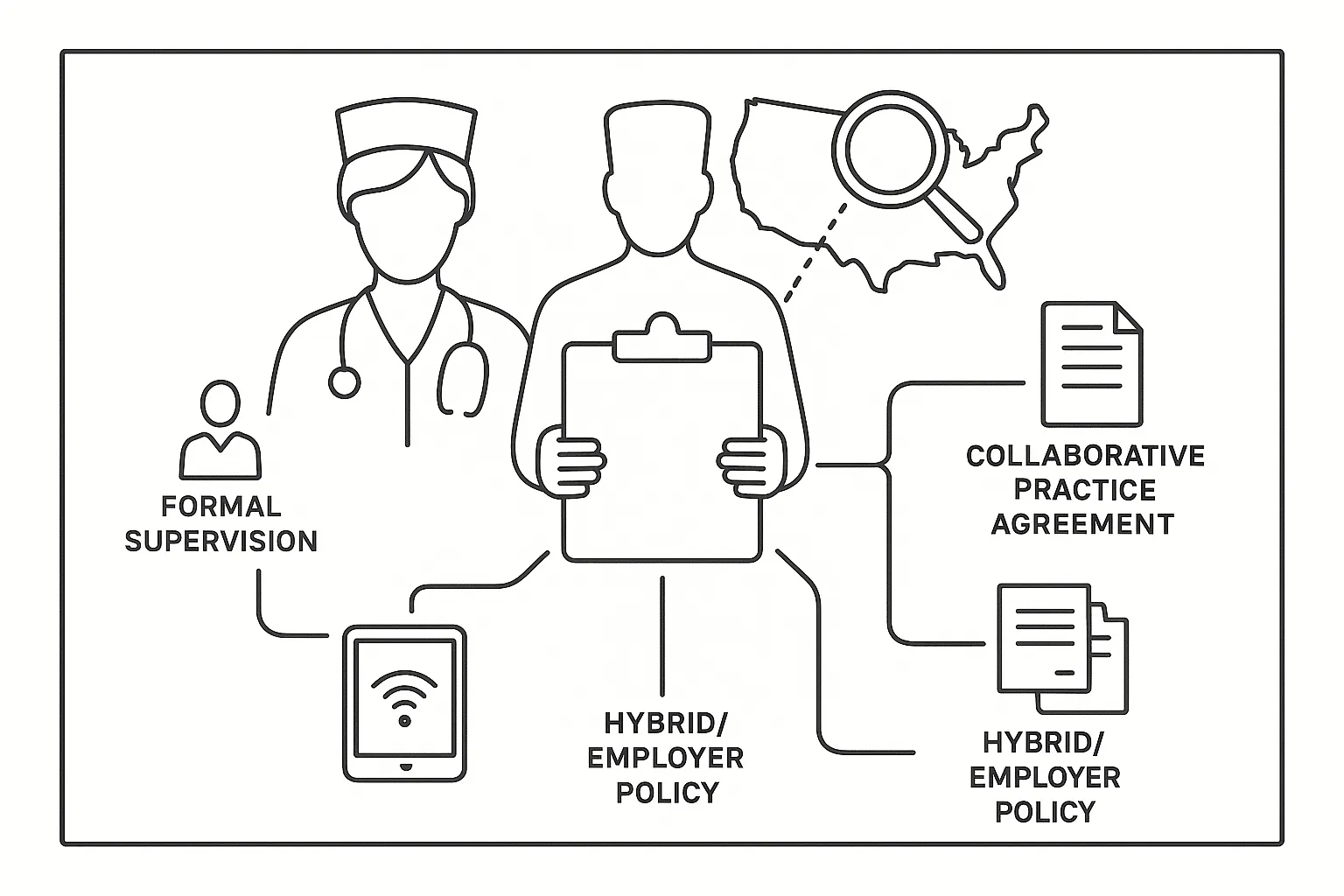
Supervision and collaboration models vary by state and employer. Common structures include formal supervision agreements defining physician duties, collaborative practice agreements describing shared protocols, and health-system models that layer internal policies over regulatory requirements. The terminology alone does not establish what the parties must do, so the document should be reviewed against the rules and actual operations of the practice.
Employed NPs are often subject to internal supervision policies as well as applicable state requirements. Independent contractor arrangements may instead require the NP to maintain a separate relationship with a collaborating physician and assume additional expenses or administrative duties. Because classification affects taxes, benefits, control, and contractual responsibility, the supervision document should be considered together with the underlying independent contractor agreement.
Remote Supervision and Telehealth Practice
Remote supervision can add licensing, operational, and documentation concerns, particularly when an NP provides telehealth services across jurisdictions. The agreement should identify where the NP may practice, how consultations will occur, what records must be reviewed, and who is responsible for satisfying requirements in each jurisdiction.
An arrangement may satisfy a regulatory requirement while still imposing more demanding employer standards, such as frequent chart review, mandatory availability, or additional approval procedures. These obligations should be compared with the employer’s expected patient volume and technology so the NP can determine whether the proposed oversight model is workable.
Clinical Authority and Liability Terms
Scope of Practice, Delegation, and Reporting Lines
Scope-of-practice provisions should correspond with the requirements governing the state where the NP will practice. Delegation clauses may determine which procedures require physician approval, which orders need direct involvement, and when consultation or referral is mandatory. A detailed scope-of-practice review can reveal language that is ambiguous, inconsistent with the intended role, or more restrictive than the employer represented during recruitment.
Contractual requirements for signoffs, consultations, or referral pathways can limit clinical autonomy and slow patient care. Dual reporting may create another problem when an NP answers to both a clinical director and a supervising or collaborating physician. The agreement should establish clear authority, escalation procedures, and decision-making thresholds so conflicting instructions do not create unnecessary professional exposure.
Malpractice Coverage, Tail Insurance, and Indemnification
Malpractice coverage and tail obligations can create significant hidden costs. Claims-made policies generally cover claims reported while the policy or an applicable extended reporting endorsement is active, while occurrence policies generally cover incidents occurring during the policy period regardless of when the claim is filed. A focused malpractice and tail insurance review should identify the policy type, limits, covered services, and responsibility for coverage after termination.
An employer may provide insurance but shift tail responsibility to the NP through termination or repayment language. Indemnification provisions can separately allocate defense costs and settlement responsibility, potentially expanding exposure beyond the insurance policy. We review whether the NP must indemnify the employer for matters within the employer’s control and whether the employer agrees to defend and cover the NP for work performed within the authorized role.
Compensation, Termination, and Career Mobility
Productivity Metrics and Compensation Risk
Compensation models often intersect with supervision requirements. Base salary plus productivity may include clawbacks tied to chart audits or charge adjustments. Collections-based pay can expose the NP to billing delays and retroactive changes, while RVU compensation may become less attainable when physician cosignatures, extra documentation, or mandatory consultations slow workflow. An NP compensation review can evaluate how the supervision requirements affect the formulas and performance standards in the employment agreement.
Negative accrual and reconciliation provisions may convert temporary underperformance into future pay reductions. The contract should define the measurement period, applicable conversion factor, credit for personally performed services, access to supporting data, and treatment of employer-caused disruptions. Expected chart review cadence, patient volume, staffing, and supervisory availability should also be documented because each can affect whether a target is realistically achievable.
Repayment Duties and Post-Employment Restrictions
Repayment obligations tied to signing bonuses, relocation assistance, training, or other advances can make departure expensive. The supervision agreement and employment contract should be reviewed together to determine which events trigger repayment, whether the amount is prorated, and whether the obligation applies when the employer ends the relationship.
Noncompete and nonsolicitation restrictions may further limit future employment. Even where enforceability depends on state law and specific circumstances, broad geographic, duration, or activity restrictions can discourage prospective employers. A non-compete review can identify restrictions and financial penalties that should be clarified or narrowed before signing, while the termination provisions should explain notice requirements and obligations continuing after departure.
Common Supervision and Collaboration Agreement Red Flags
Common red flags in nurse practitioner supervision and collaboration agreements include:
- Vague scope-of-practice language that gives the employer or supervising physician unrestricted authority without objective standards.
- Delegation, prescriptive authority, chart review, or cosignature requirements that conflict with the intended clinical role or impair productivity.
- Broad indemnification or cost-sharing provisions requiring the NP to pay employer-related liability or defense expenses.
- Unclear malpractice coverage or language shifting tail costs to the NP after any form of termination.
- Negative accrual, retroactive clawbacks, or reconciliation mechanisms that reduce future compensation.
- Restrictive covenants with undefined geography, duration, restricted activities, or financial penalties.
- Unclear reporting lines, physician availability standards, or procedures for resolving conflicting clinical instructions.
An initial review should confirm the applicable state requirements, malpractice policy type and limits, tail responsibility, repayment triggers, performance formulas, restrictive covenant terms, and termination rights. It should also compare the written provisions with the employer’s actual practices, including chart review cadence, expected volume, physician availability, and on-site or remote oversight. A clause that appears reasonable in isolation may become problematic when applied to the proposed workload or compensation structure.
Frequently Asked Questions
What should a nurse practitioner review in a supervision or collaboration agreement?
A nurse practitioner should review scope-of-practice provisions, physician supervision or collaboration requirements, delegated duties, chart review and cosignature requirements, prescriptive authority, reporting obligations, malpractice insurance, compensation implications, termination rights, and any duties that continue after the relationship ends.
What is the difference between a supervision agreement and a collaborative practice agreement?
The terminology and legal requirements vary by state. A supervision agreement may establish specific physician oversight responsibilities, while a collaborative practice agreement may define protocols or responsibilities shared between the nurse practitioner and collaborating physician. The agreement should reflect the requirements of the state where the NP practices.
Can supervision requirements affect a nurse practitioner’s compensation?
Yes. Requirements for physician cosignatures, additional documentation, mandatory chart review, consultations, or other supervisory steps may affect patient volume, collections, or RVU production. If compensation is productivity-based, the contract should be reviewed to determine whether supervision requirements could make productivity targets more difficult to achieve.
Who is responsible for malpractice and tail insurance under a supervision or collaboration agreement?
Responsibility depends on the contract and insurance arrangement. The agreement should identify who provides malpractice coverage, whether the policy is claims-made or occurrence, the applicable limits, and who is responsible for tail coverage if claims-made insurance ends when the relationship terminates.
How do telehealth and remote supervision affect nurse practitioner agreements?
Telehealth and remote supervision can create additional licensing, scope-of-practice, and supervision issues when care is provided across jurisdictions. The agreement should identify where the NP may practice, how physician oversight will occur, and who is responsible for complying with applicable state requirements.
Does Chelle Law review nurse practitioner supervision and collaboration agreements nationwide?
Yes. Chelle Law provides nurse practitioner supervision and collaboration agreement review services nationwide. Because scope-of-practice, physician supervision, collaborative practice, prescriptive authority, and related requirements vary by state, the agreement should be evaluated based on the jurisdictions in which the nurse practitioner will practice.
Understand Your Supervision and Collaboration Obligations
Scope of practice, physician oversight, chart review, prescriptive authority, malpractice coverage, compensation, and termination terms can all affect how you practice. Chelle Law reviews nurse practitioner supervision and collaboration agreements nationwide so you can understand the obligations and risks before signing.
Request a Supervision Agreement ReviewExplore More Nurse Practitioner Contract Guidance
Review additional nurse practitioner contract services, practical resources, and state-specific guidance involving compensation, malpractice insurance, restrictive covenants, termination, and other NP contract terms.