
An Arkansas nurse practitioner contract can shape clinical authority, compensation, liability, scheduling, and career mobility long after the agreement is signed. The Arkansas State Board of Nursing regulates advanced practice registered nursing licensure and practice, and Arkansas requirements are particularly important when a position includes prescriptive authority. Prescriptive authority is not automatic with an APRN license. Unless an APRN qualifies for statutory full practice authority, an approved and current collaborative practice agreement is generally required for prescriptive authority and must address matters such as consultation, protocols, coverage, and quality assurance. These requirements can affect contract terms for positions in Little Rock, Fayetteville, Fort Smith, and other Arkansas healthcare markets. Attorney review can determine whether the written duties, prescribing provisions, collaboration obligations, compensation structure, and termination language align with the proposed role and identify terms that may create avoidable financial, licensing, or professional risk.
Contracts may also allocate malpractice costs, require repayment of recruitment incentives, restrict post-employment activity, or permit compensation adjustments through reconciliations and offsets. Chelle Law provides attorney-led nurse practitioner contract review focused on explaining how these provisions work together, identifying material red flags, and clarifying language that may warrant revision before an NP makes a decision.
Arkansas NP Contract Structure and Worker Status
Employment and Independent Contractor Agreements
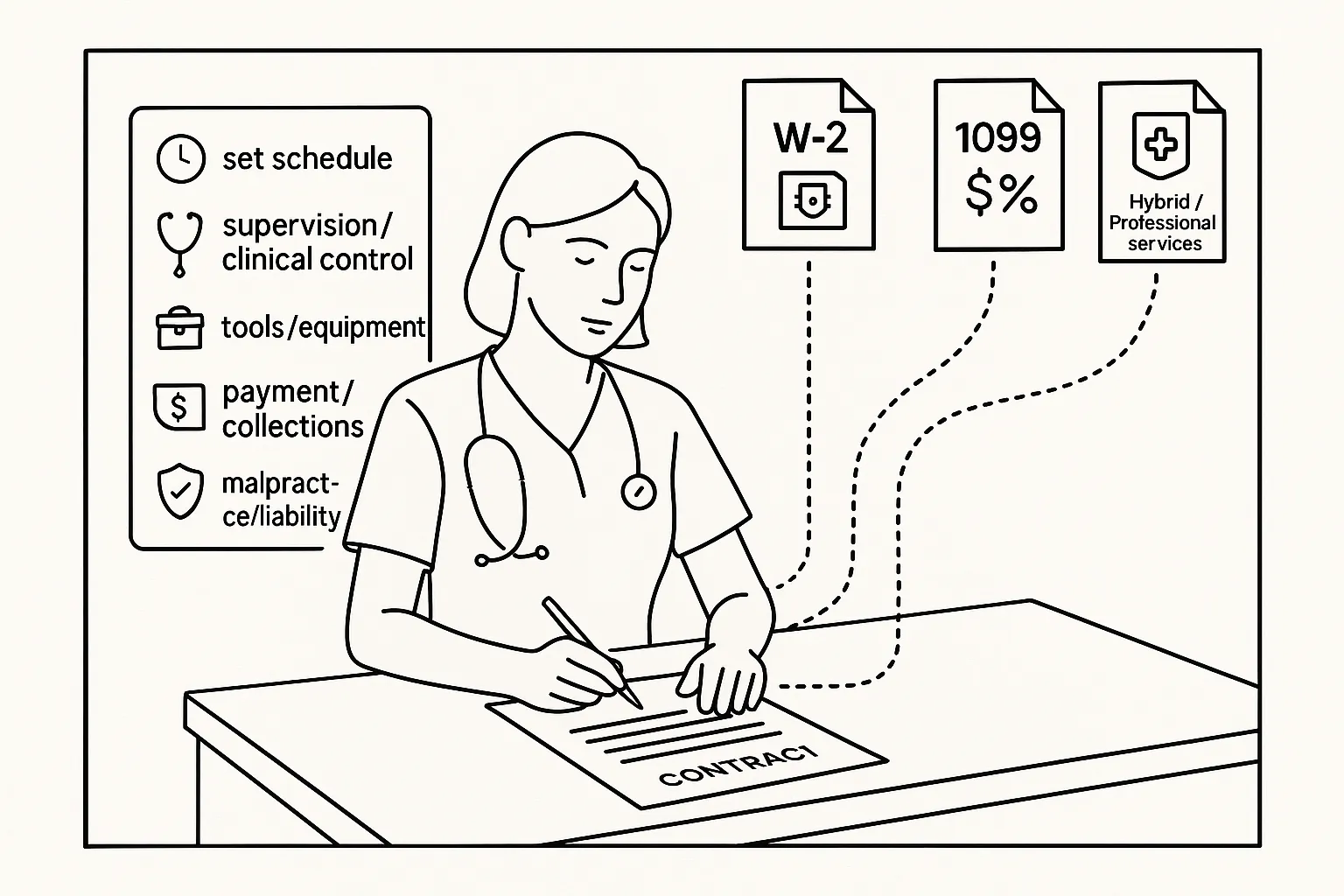
Arkansas nurse practitioners may receive W-2 employment agreements, 1099 independent contractor agreements, or hybrid professional services arrangements used by staffing and telehealth organizations. A W-2 agreement commonly addresses tax withholding, employee benefits, paid leave, employer policies, and defined termination procedures. A 1099 agreement may shift responsibility for taxes, benefits, insurance, equipment, and business expenses to the NP while using collections-based or productivity compensation.
The contract label does not resolve every classification issue. Review can evaluate the agreement’s treatment of schedule control, work locations, equipment, clinical protocols, payment methods, outside work, and the parties’ respective responsibilities. NPs comparing arrangements can review the practical differences between W-2 and 1099 status for nurse practitioners.
Regulatory Terms and Professional Accountability
Arkansas APRNs may assess patients, diagnose conditions, develop and implement treatment plans, and evaluate outcomes within the legal boundaries of their APRN category. They also retain professional accountability for care they delegate. Contract language cannot eliminate those regulatory responsibilities, so provisions concerning clinical protocols, delegation, documentation, quality review, and employer policies require careful comparison with the actual role.
A review can flag provisions that appear to assign duties beyond the stated position, give nonclinical policies excessive control over professional judgment, or make the NP responsible for regulatory matters outside the NP’s control. The analysis can also distinguish legal requirements from additional operational conditions imposed by an employer or facility.
Compensation, Productivity, and Benefits

Salary, Collections, RVUs, and Bonuses
Compensation may consist of a guaranteed salary, net-collections percentage, work relative value unit formula, shift rate, quality incentive, or a combination of methods. A focused compensation and productivity review can test whether the written formula clearly defines when pay is earned and how it will be calculated.
- Base salary: Review pay frequency, partial-period calculations, salary adjustments, and any offset or clawback rights.
- Collections: Determine whether pay is based on gross charges or net collections and how refunds, denials, contractual adjustments, and delayed receipts are treated.
- RVU productivity: Identify the applicable RVU measure, conversion rate, threshold, reconciliation period, coding responsibility, data access, and treatment of non-billable work.
- Bonuses: Clarify whether an incentive is guaranteed, formula-based, or discretionary and whether its quality, patient-satisfaction, or productivity measures are objectively defined.
Terms such as “subject to reconciliation,” “negative balance,” or “company may offset” can permit future reductions from compensation. Analysis can identify negative accrual, retroactive true-ups, chargebacks, or unilateral formula changes and illustrate how those mechanisms may affect earnings.
Benefits and Recruitment Incentives
Benefits provisions may address health and disability insurance, retirement contributions, continuing education, professional dues, licensing fees, paid leave, and expense reimbursement. Material details include waiting periods, employer contribution levels, retirement vesting, leave accrual and carryover, and the date coverage ends following separation.
Signing bonuses, relocation allowances, student loan benefits, and other recruitment incentives often include service requirements. Review can determine whether forgiveness is prorated, what events trigger repayment, whether the employer may deduct an amount from final compensation, and whether repayment applies when the employer terminates the relationship without cause.
Malpractice Insurance and Liability Allocation
Claims-Made, Occurrence, and Tail Coverage
No material Arkansas nurse-practitioner-specific rule identified in the reviewed authorities mandates malpractice insurance, tail coverage, or a particular allocation of those costs between the parties. The agreement therefore becomes especially important. It may define who obtains coverage, pays premiums and deductibles, selects limits, reports claims, and maintains protection after the relationship ends.
Occurrence coverage generally applies to incidents occurring during the policy period regardless of when a covered claim is later made. Claims-made coverage generally depends on when the claim is made and reported, which may create a need for tail coverage or another form of continuing protection after departure. A malpractice and tail insurance review can clarify policy type, limits, prior-acts protection, tail responsibility, and the events that shift costs to the NP.
Indemnification and Defense Obligations
Indemnification language may require one party to reimburse the other for losses, claims, defense costs, or conduct outside available insurance. Broad wording can create exposure beyond ordinary malpractice coverage, particularly if it applies to billing disputes, regulatory matters, contractual breaches, or another party’s conduct.
Review can compare indemnification duties with insurance coverage and identify whether the provision is unilateral, limited by fault, capped, or supported by a duty to defend. Notice requirements, control of legal defense, settlement authority, and survival after termination also affect the practical allocation of risk.
Arkansas Scope of Practice and Prescriptive Authority
Collaborative Practice and Quality Assurance
Prescriptive authority is distinct from Arkansas APRN licensure. Unless an APRN qualifies for statutory full practice authority, an APRN exercising prescriptive authority generally must maintain a current collaborative practice agreement approved by the Arkansas State Board of Nursing. The agreement must address required subjects such as consultation, practice protocols, coverage, and quality assurance.
An APRN with prescriptive authority must also maintain a written, practice-specific quality-assurance plan signed and reviewed annually by the APRN and collaborating physician, with evidence of compliance available to the Board. A collaboration agreement review can compare these regulatory obligations with the employment contract and identify responsibility for securing a collaborator, maintaining required documentation, arranging coverage, and handling associated costs.
If a collaborative practice agreement terminates, the APRN must notify the Board in writing within seven days. Without a current approved agreement, prescriptive authority is inactivated. Contract review can therefore examine what happens to duties, scheduling, compensation, and termination rights if collaboration unexpectedly ends.
Prescribing, Scheduling, Call, and Work Locations
Prescriptive protocols must identify the applicable legend and controlled substances. Controlled-substance prescribing requires DEA registration, along with compliance with applicable monitoring and documentation requirements. Contract language may allocate responsibility for registration fees, prescribing protocols, recordkeeping, employer systems, and regulatory support.
Operational terms may establish patient volume, visit length, administrative time, call coverage, floating obligations, weekend work, telehealth duties, and assignments at multiple locations. Analysis can determine whether schedules are defined or subject to unilateral change, whether call is separately compensated, and whether productivity standards account for administrative and quality-assurance duties. Telehealth provisions also warrant review of patient location, required licensure, documentation, and responsibility for multi-state compliance.
Non-Competes and Other Post-Employment Restrictions
Arkansas Non-Compete Analysis for Nurse Practitioners
Arkansas has a general statute governing employment non-competes, but that statute excludes people holding professional licenses under Arkansas Code Title 17, Subtitle 3. Nurse practitioners are licensed under that subtitle. As a result, analysis of an Arkansas NP non-compete requires attention to the statutory exclusion, applicable Arkansas common law, the agreement’s wording, and the specific circumstances rather than reliance on the statute’s general employment framework alone.
A nurse practitioner non-compete review can evaluate duration, geographic scope, restricted activities, employer locations, service-area definitions, and triggering events. Even when enforceability is uncertain, broad language can complicate a future job search, telehealth work, or a transition to another nearby organization.
Confidentiality and Non-Solicitation Clauses
Confidentiality, nondisclosure, trade-secret, and non-solicitation provisions require analysis separate from a non-compete. These clauses may restrict the use of proprietary information or contact with patients, employees, referral sources, and business relationships after departure.
Review can identify whether confidential information is clearly defined, whether exclusions protect general professional knowledge, and whether patient-related restrictions account for continuity of care and legal obligations. Non-solicitation language also merits attention to prohibited conduct, covered relationships, duration, and whether passive acceptance of contact is treated differently from active solicitation.
Termination, Repayment, and Dispute Terms
For-Cause and Without-Cause Termination
Termination terms determine how quickly either party can end the relationship and what obligations follow. Without-cause termination provisions commonly require advance written notice. Review can determine whether notice periods apply equally, whether the employer may remove the NP from the schedule during notice, and whether compensation and benefits continue through the termination date.
For-cause provisions may allow immediate termination for specified conduct. Vague standards, broad policy references, discretionary determinations, or missing cure periods can create uncertainty. The agreement may also address termination tied to licensure, credentialing, prescriptive authority, loss of a collaborative arrangement, insurance eligibility, exclusion from government programs, or failure to meet productivity requirements. NPs considering departure can consult the guide to terminating a nurse practitioner contract.
Clawbacks, Final Pay, and Dispute Procedures
Separation may trigger repayment of a signing bonus, relocation allowance, loan benefit, training expense, or other incentive. Material terms include prorated forgiveness, payment deadlines, exceptions based on the reason for termination, and any claimed right to withhold amounts from final compensation. The agreement may also determine when earned productivity compensation is calculated and whether collections received after departure remain payable.
Arbitration, venue, governing-law, attorney-fee, and limitation provisions affect how a future dispute proceeds. Review can identify which claims are subject to arbitration, where proceedings must occur, how costs are divided, and whether contractual deadlines shorten the period for raising a claim. These provisions should be evaluated alongside continuing obligations such as repayment, tail coverage, confidentiality, and restrictive covenants.
Preparing for an Arkansas Nurse Practitioner Contract Review
A productive review begins with the complete proposed agreement and every incorporated document available to the NP, including compensation plans, benefit summaries, job descriptions, policy references, collaboration documents, bonus addenda, and repayment agreements. Preparing questions about clinical duties, prescribing authority, schedules, call, locations, billing expectations, and credentialing can help connect the legal language to the position as presented.
High-priority issues commonly include:
- W-2 or 1099 classification and responsibility for taxes, expenses, and benefits
- Salary, collections, RVU thresholds, reconciliations, offsets, and negative accrual
- Collaborative practice, prescriptive authority, quality assurance, and termination procedures
- Claims-made or occurrence malpractice coverage, policy limits, and tail responsibility
- Schedule control, call coverage, administrative time, telehealth, and work locations
- Non-compete, confidentiality, and non-solicitation restrictions
- For-cause definitions, cure rights, without-cause notice, and post-termination compensation
- Signing bonus, relocation, loan, and other repayment obligations
Chelle Law reviews nurse practitioner agreements remotely and provides attorney-led analysis designed to explain material terms, identify risk, and highlight provisions that may warrant clarification or revision before signing.
Speak With an Arkansas Nurse Practitioner Contract Lawyer Before You Sign
Chelle Law can review compensation, collaboration, malpractice, restrictive covenant, termination, and repayment provisions and identify terms that may warrant clarification or revision.
Request a Contract ReviewExplore Nurse Practitioner Contract Guidance
Find attorney-led review services, practical contract resources, and guidance organized by state.