
A California nurse practitioner contract operates within a detailed professional and employment-law framework. The California Board of Registered Nursing regulates NP licensure, certification, furnishing authority, and discipline, while California law distinguishes traditional practice under standardized procedures from qualifying practice under Business and Professions Code sections 2837.103 and 2837.104. Contract review can determine whether the stated clinical setting, practice authority, prescribing duties, credential requirements, and supervision or collaboration terms match the NP’s actual status. These issues matter across major healthcare markets such as Los Angeles, San Diego, San Francisco, and Sacramento, where an agreement may cover multiple facilities, telehealth services, call obligations, or changing practice locations. A California nurse practitioner contract lawyer can also evaluate whether compensation, professional liability coverage, worker classification, restrictive language, and termination provisions create financial or professional risks that are not apparent from the offer summary.
Small drafting differences can materially affect income and mobility. A salary described as guaranteed may be subject to productivity reconciliation, a signing or relocation benefit may become repayable after termination, and claims-made malpractice coverage may leave the NP responsible for tail insurance. California generally voids post-employment restraints on lawful professional practice, subject to statutory exceptions, but confidentiality, trade-secret, non-solicitation, choice-of-law, and forum provisions still require careful analysis.
Chelle Law provides attorney-led nurse practitioner contract review focused on explaining the written terms, identifying employer-favorable provisions, and clarifying issues that may warrant revision before signing. The review can compare the agreement with recruitment representations and translate compensation, insurance, scope, and exit provisions into practical consequences.
California Practice Authority and Contract Compliance
Licensure, Certification, and Furnishing Authority
California NPs must hold the applicable registered-nurse license and Board certification to use the nurse-practitioner title and practice as an NP. Depending on the position, the agreement may also require a Board-issued furnishing number, DEA registration, controlled-substance education, credentialing, and maintenance of other qualifications. Review can identify whether these conditions are accurately described, who pays related fees, and what happens if credentialing or enrollment is delayed.
Licensure clauses often give an employer immediate termination rights if a credential is restricted, expires, or is investigated. Analysis can distinguish an objective loss of authority from broader language allowing termination based on an allegation, administrative delay, or immaterial lapse.
Standardized Procedures and 103 or 104 NP Status
Traditional California NP practice involving medical functions and furnishing or ordering drugs and devices is conducted under approved standardized procedures or protocols. The contract and related clinical documents may address delegated functions, competency review, physician involvement, prescribing authority, chart review, and responsibility for maintaining compliant procedures. Duties described in an employment agreement should be compared with the protocols that will govern actual practice.
A qualifying 103 NP may practice without standardized procedures only in specified group settings where one or more physicians and surgeons practice with the NP and the applicable certification, disclosure, setting, and scope requirements are satisfied. A qualifying 104 NP may practice without standardized procedures in an independent setting, subject to statutory transition, population-focus, certification, education, knowledge, and experience requirements. Contract review can clarify which framework the employer expects to use and flag language that mischaracterizes the setting or assigns duties outside the NP’s authorized scope.
Agreement Type and California Worker Classification
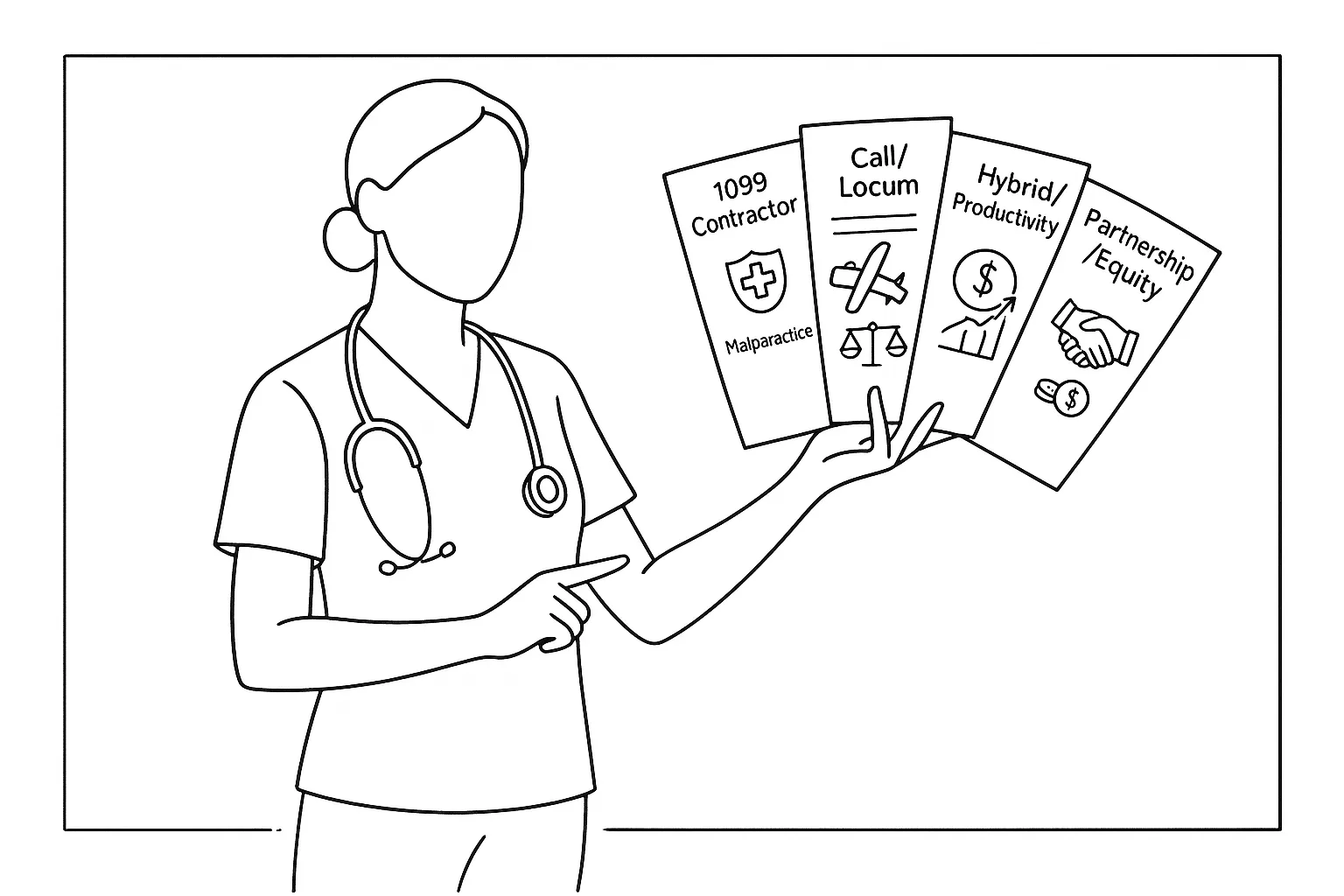
W-2 Employment Agreements
A W-2 employment agreement commonly addresses salary, benefits, scheduling, performance standards, practice locations, malpractice coverage, termination rights, and employer policies. The document may also incorporate a handbook, compensation plan, standardized procedures, or bonus policy that is not attached to the offer. Review can identify missing documents and determine whether the employer retains unilateral authority to change material terms.
1099 Independent Contractor Agreements
A contract label alone does not determine independent-contractor status in California. The state generally applies a statutory ABC framework, subject to exemptions and special rules that may include business-to-business provisions. Analysis may involve control, the hiring entity’s usual course of business, licensing, business organization, scheduling, billing, equipment, outside work, and the parties’ actual relationship.
An independent contractor agreement review can also evaluate tax allocation, invoicing, malpractice costs, indemnification, expense responsibility, payment timing, and termination. Extensive operational control or integration may be inconsistent with the practical expectations created by a contractor form and warrants closer review.
Per-Diem, Locum, Hybrid, and Equity Arrangements
Per-diem, call, and locum agreements frequently emphasize hourly or per-shift pay, minimum availability, documentation deadlines, travel reimbursement, cancellation rights, and malpractice requirements. Hybrid agreements may combine guaranteed compensation with collections or productivity incentives, while proposed partnership or equity arrangements can introduce vesting, valuation, buy-in, and repurchase terms. Review can separate definite contractual rights from nonbinding statements about future ownership or earnings.
Compensation, Productivity, and Repayment Exposure
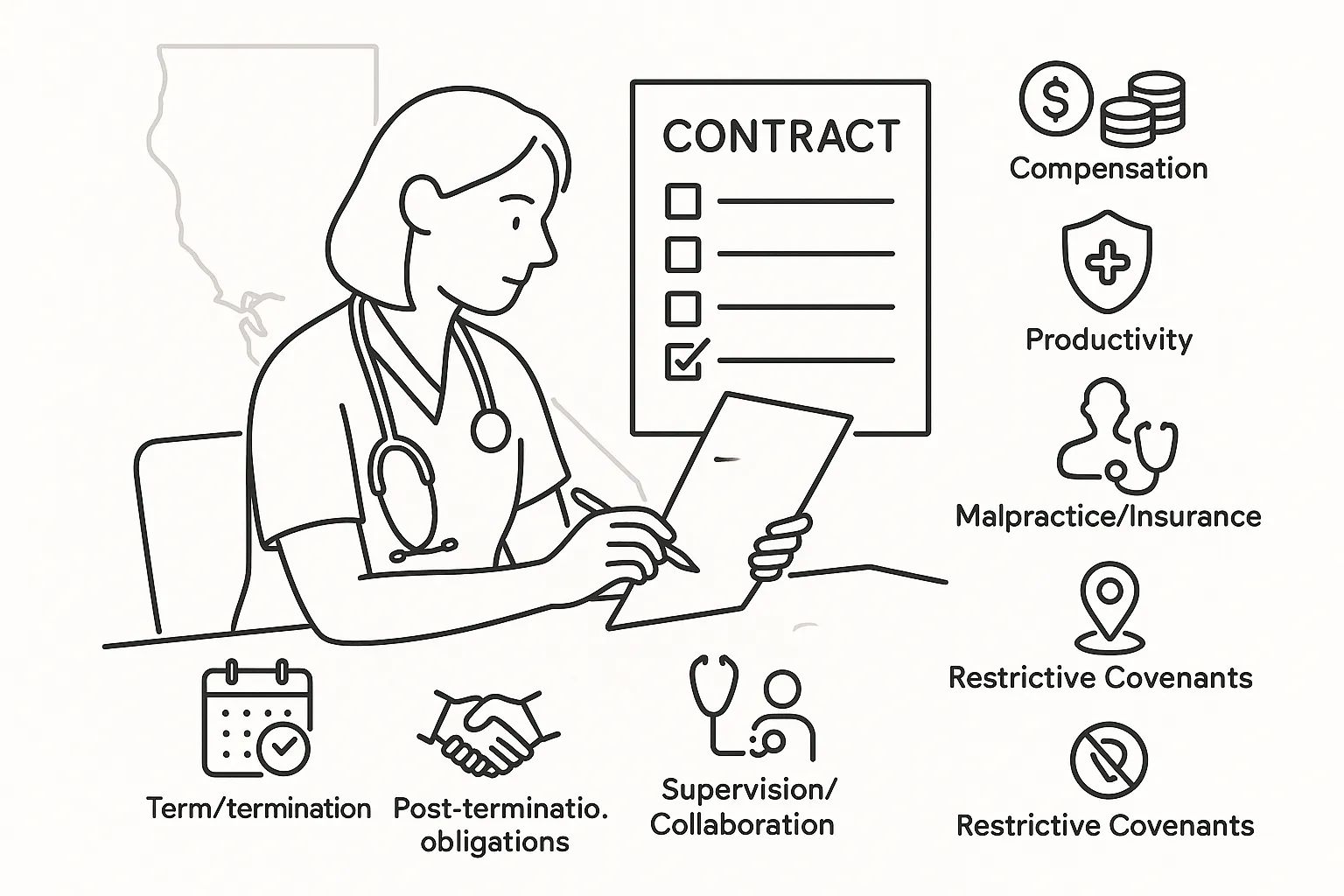
Base Pay, Collections, and RVU Formulas
Compensation review begins by determining whether base pay is fixed, recoverable, or subject to productivity reconciliation. A stated guarantee may operate as an advance if the employer can carry deficits forward, offset future earnings, or demand repayment. A focused compensation and productivity review can test whether the written formula supports the earnings discussed during recruitment.
Collections-based compensation depends on how collections are defined, who controls billing and coding, and how denials, refunds, write-offs, chargebacks, and post-termination receipts are treated. RVU provisions may require analysis of the applicable schedule, conversion factor, threshold, measurement period, reconciliation process, and the employer’s authority to modify the formula. Access to periodic reports is important because the NP may otherwise be unable to verify the calculation.
Bonuses, Benefits, and Clawbacks
Bonus provisions are more meaningful when they contain objective metrics, defined measurement periods, payment deadlines, and clear treatment of compensation after notice or termination. Terms such as “satisfactory performance” or “meeting productivity goals” may preserve substantial employer discretion when the underlying standards are not included.
The financial analysis also includes health and retirement benefits, paid leave, CME funds, licensing and DEA expenses, credentialing costs, relocation assistance, signing bonuses, and student-loan benefits. Repayment language may create significant exposure if it lacks a fixed amount, proration method, triggering event, lookback period, or exception for employer-initiated termination.
Malpractice Coverage and Clinical Obligations
Claims-Made Coverage, Occurrence Coverage, and Tail
Occurrence coverage generally responds based on when the incident occurred, while claims-made coverage generally depends on the claim being made while the policy or applicable reporting coverage is active. No general California NP-specific statutory tail-insurance requirement was identified in the reviewed authorities, making the contract’s allocation especially important. A malpractice and tail insurance review can identify the policy type, coverage limits, covered services, exclusions, consent-to-settle terms, and responsibility for tail or extended reporting coverage.
The agreement may also address cooperation with claims, access to records after departure, reporting duties, and whether coverage extends to telehealth, call, moonlighting, or work at multiple locations. Silence on these subjects can leave unresolved costs or gaps when the relationship ends.
Schedule, Call, Locations, and Outside Work
Clinical-duty provisions can affect workload as much as compensation. Review may address clinic hours, administrative time, patient volume, call frequency, weekend or holiday coverage, cross-coverage, documentation deadlines, travel between facilities, telehealth expectations, and the employer’s ability to change locations or schedules.
Outside-work and moonlighting clauses may require advance approval or prohibit other professional activity. These restrictions warrant comparison with conflict-of-interest, confidentiality, scheduling, malpractice, and scope requirements so the contract does not create an unnecessarily broad limit on lawful work.
California Non-Competes and Related Restrictions
Post-Employment Non-Compete Language
California generally voids contracts restraining a person from engaging in a lawful profession, trade, or business, subject to statutory exceptions. That rule is directly relevant when an NP agreement contains a geographic restriction, a ban on working for competitors, or another post-employment restraint. California law also addresses notice and enforcement involving void non-compete provisions.
A nurse practitioner non-compete review can identify prohibited restraint language, assess the stated exception or justification, and examine whether a choice-of-law or forum provision attempts to avoid California protections where California law applies. Review should not assume that every clause labeled as confidentiality or non-solicitation is valid merely because it is not titled a non-compete.
Confidentiality, Trade Secrets, and Non-Solicitation
Employers may protect legitimate confidential information and trade secrets, but definitions can be drafted so broadly that they appear to cover general professional knowledge, publicly available information, or ordinary patient and colleague relationships. Non-solicitation, patient-notification, record-access, and property-return terms may also affect a transition. Analysis can distinguish legitimate continuing obligations from language that may operate as an unlawful restraint on professional practice.
Termination and Post-Employment Compensation
Without-Cause Notice and For-Cause Triggers
Termination language controls how quickly either party may end the relationship and which obligations survive. A nurse practitioner contract termination review can evaluate the initial term, automatic renewal, without-cause notice, required work during the notice period, paid leave, early-release rights, and the consequences of failing to provide the full notice.
For-cause provisions may address fraud, patient safety, exclusions, loss of licensure, credentialing, documentation, policy violations, or performance. Review can identify subjective triggers, determine whether a cure period applies, and clarify whether an immediate for-cause termination changes bonus eligibility, repayment obligations, insurance responsibility, or other contractual rights.
Final Pay, Collections, and Continuing Duties
The agreement may define whether final compensation includes accrued salary, completed shifts, earned bonuses, generated RVUs, or collections received after departure. It may also permit chargebacks, final reconciliation, offsets, or repayment demands. Clear calculation dates, access to supporting records, and payment deadlines reduce uncertainty over work already performed.
Continuing obligations can include tail coverage, claims cooperation, confidentiality, patient notification, return of property, record access, and repayment of signing or relocation benefits. These terms are best reviewed together because the financial effect of termination often depends on several separate provisions.
California NP Contract Red Flags to Review Before Signing
Attorney review can translate the agreement into practical income, liability, and mobility consequences. Particular attention may be warranted when the contract contains any of the following:
- Unclear practice authority: The agreement does not accurately identify whether the NP will practice under standardized procedures or qualifying 103 or 104 authority.
- Missing clinical documents: Standardized procedures, compensation plans, bonus policies, or incorporated employer policies are unavailable before signing.
- Recoverable base pay: A purported guarantee is subject to negative accrual, reconciliation, offsets, or repayment.
- Unverifiable productivity pay: Collections or RVU compensation lacks a defined formula, reporting rights, or payment schedule.
- Broad clawbacks: Signing, relocation, training, or other benefits are repayable without clear proration or reasonable triggering events.
- Unresolved malpractice obligations: The policy type, limits, covered services, or responsibility for tail coverage is unclear.
- Questionable contractor classification: A 1099 form gives the employer extensive control over scheduling, billing, equipment, documentation, and outside work.
- Restrictive post-employment language: Non-compete, non-solicitation, confidentiality, choice-of-law, or forum provisions may interfere with lawful California practice.
- Subjective termination rights: Vague performance or documentation standards permit immediate termination without a meaningful cure opportunity.
- Uncertain final compensation: The agreement does not explain the treatment of earned bonuses, completed services, accounts receivable, chargebacks, or offsets after departure.
A line-by-line review can identify these provisions, explain how related clauses operate together, and highlight drafting points that may warrant clarification or revision before the NP accepts the position.
Speak With a California Nurse Practitioner Contract Lawyer Before You Sign
Have Chelle Law review the agreement, explain its financial and professional consequences, and identify compensation, scope, insurance, restrictive, and termination terms that may warrant clarification or revision.
Request a Contract Review