
A Connecticut nurse practitioner contract can affect not only compensation and termination rights but also whether the proposed clinical structure fits state APRN requirements. The Connecticut Department of Public Health and the Connecticut Board of Examiners for Nursing oversee nursing licensure, while the Connecticut Department of Consumer Protection Drug Control Division has a role in controlled-substance regulation. Connecticut requires an APRN to hold RN and APRN licenses, maintain qualifying national certification, and satisfy applicable education and examination standards. State law also requires physician collaboration during the first three years after Connecticut APRN licensure. After at least three years and 2,000 hours of qualifying collaborative practice, an APRN may become eligible to practice without physician collaboration, subject to documentation and notice requirements. Contract review can determine whether an offer in Hartford, New Haven, Stamford, or another Connecticut market accurately reflects the practitioner’s current authority, prescribing responsibilities, insurance obligations, and intended clinical duties.
The agreement may also determine how salary, RVUs, collections, bonuses, call, malpractice coverage, restrictive covenants, and repayment obligations operate in practice. Chelle Law provides attorney-led contract review focused on identifying risk, explaining financial and professional consequences, and flagging provisions that may warrant clarification or revision before signing.
Key Connecticut NP Contract Takeaways
- Confirm that the contract’s collaboration, prescribing, reporting, and clinical-duty provisions match the APRN’s current Connecticut practice status.
- Distinguish W-2 employment from a 1099 contractor arrangement because taxes, benefits, insurance, business expenses, and control may be allocated differently.
- Identify the malpractice policy type and expressly allocate any responsibility for claims-made tail coverage.
- Test salary, RVU, collections, bonus, negative-accrual, and repayment language against realistic employment scenarios.
- Evaluate non-compete, non-solicitation, termination, credentialing, call, and location provisions for their practical effect on career mobility.
Types of Connecticut Nurse Practitioner Agreements
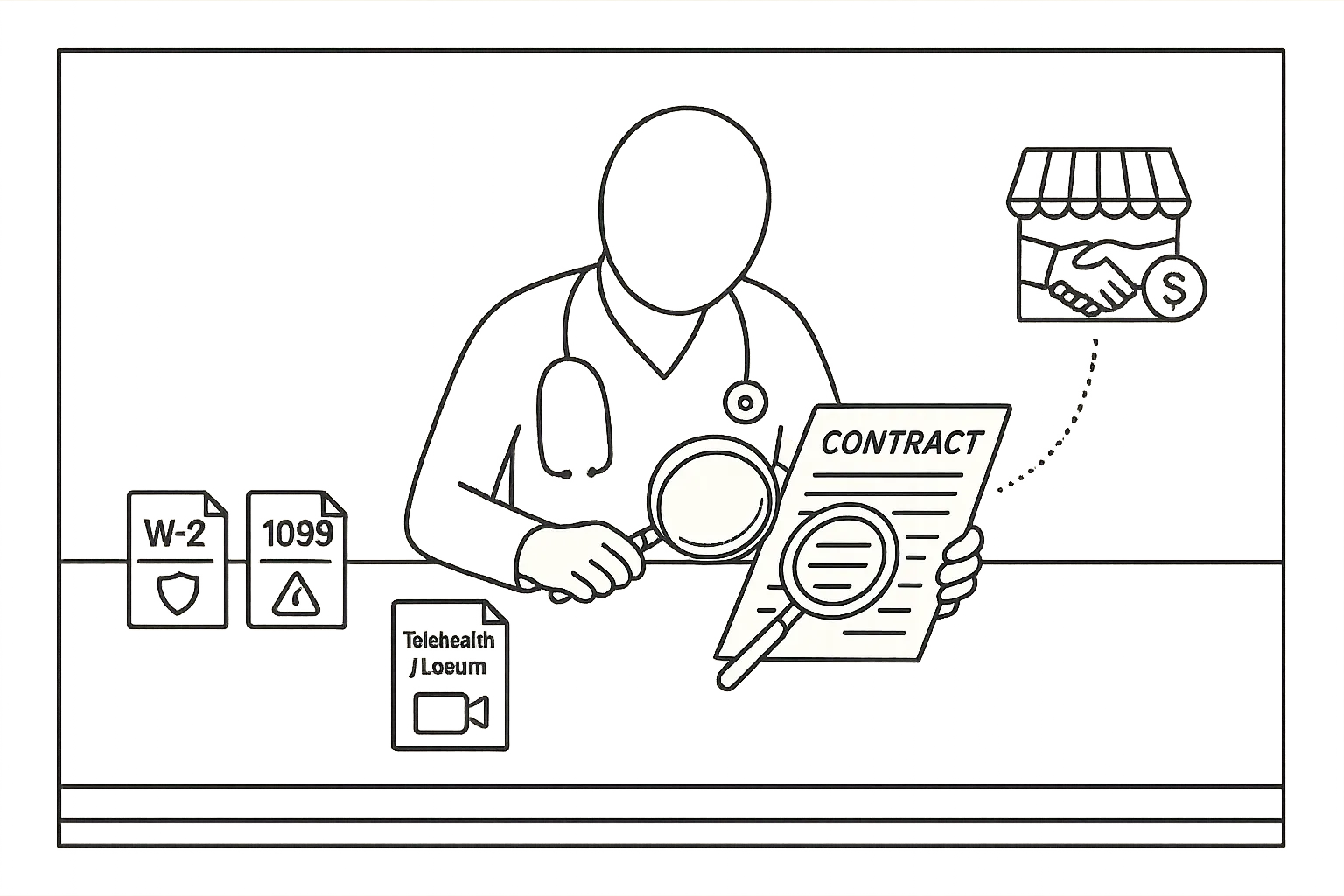
W-2 Employment and 1099 Contractor Agreements
A W-2 employment agreement commonly addresses payroll withholding, benefits, paid leave, malpractice coverage, employer policies, productivity expectations, and post-employment restrictions. A 1099 agreement may offer higher gross compensation while assigning taxes, benefits, licensing costs, insurance, and other business expenses to the nurse practitioner. The contract’s label does not resolve every classification issue; the actual duties, financial structure, and degree of control also matter.
Review can compare the proposed arrangement with the operational terms contained throughout the document, including scheduling control, billing, equipment, staffing, patient assignment, and outside-work restrictions. Chelle Law’s resource on W-2 versus 1099 status for nurse practitioners explains important financial and contractual distinctions.
Telehealth and Locum Tenens Contracts
Telehealth and locum tenens agreements may be shorter than traditional employment contracts, but their risk allocation can be extensive. Relevant terms include multistate licensure, patient location, prescribing protocols, technology requirements, scheduling, professional liability coverage, indemnification, record access, and responsibility for credentialing expenses.
Some agreements permit immediate termination, restrict work with staffing-company clients, or impose non-solicitation obligations that continue after a brief assignment. Analysis can identify whether those restrictions extend beyond the facility, patients, or services involved in the engagement.
Partnership, Profit-Sharing, and Buy-In Offers
An offer that references partnership, equity, profit sharing, or a future buy-in requires more detail than a general promise of ownership. Review can determine whether the documents define the eligibility date, valuation method, capital contribution, vesting schedule, distribution rights, voting authority, access to financial information, and process for selling or forfeiting an interest.
Departure terms are equally important. The agreement may address repurchase pricing, offsets, responsibility for practice debts, restrictive covenants, and whether termination before a stated date eliminates earned or anticipated ownership rights.
Connecticut APRN Licensure and Collaboration Terms

Licensure, Certification, and Early-Practice Collaboration
Connecticut requires nurse practitioners to maintain the licenses and qualifying national certification associated with APRN practice. During the first three years after Connecticut APRN licensure, the practitioner must collaborate with a Connecticut physician. The required relationship addresses consultation and referral, coverage, review of patient outcomes, and patient disclosure.
During this period, written prescriptive collaboration also addresses permitted Schedule II and III controlled substances and outcome review. A contract may allocate administrative responsibility for establishing or maintaining that relationship, but its terms cannot replace the governing licensing and prescribing requirements. A nurse practitioner collaboration agreement review can identify inconsistencies between the employment documents and the intended clinical structure.
Independent Practice Status and Practitioner Profiles
After at least three years and 2,000 hours of qualifying collaborative practice, a Connecticut APRN may become eligible to practice, diagnose, treat, prescribe, dispense, and administer medical therapeutics without physician collaboration. That authority remains subject to applicable documentation and notice requirements; the passage of time alone does not establish that every requirement has been completed.
Connecticut’s APRN practitioner profile identifies whether an APRN practices independently or in collaboration with a physician and identifies the professional liability carrier. Contract language concerning practice status, collaboration, insurance, or reporting can be reviewed for consistency with the information the practitioner must maintain or disclose.
Professional Liability and Tail Coverage
An APRN providing direct patient care in Connecticut generally must maintain professional liability insurance or other qualifying indemnity of at least $500,000 per person, per occurrence, and $1.5 million in the aggregate, subject to statutory exceptions. The contract can specify whether the employer obtains coverage, reimburses the practitioner, or requires the practitioner to maintain a separate policy.
Policy type also matters. Occurrence coverage generally applies to incidents occurring during the policy period, even if a claim is filed later. Claims-made coverage generally responds when the claim is made while the policy is active, potentially creating a need for tail coverage after departure. The reviewed Connecticut authorities do not impose a nurse-practitioner-specific requirement to purchase claims-made tail coverage upon termination, so the contract’s allocation of that expense is especially important. A malpractice and tail insurance review can clarify policy type, limits, premium responsibility, tail obligations, and consent-to-settle language.
Compensation, Bonuses, and Repayment Risk
Salary, RVUs, Collections, and Quality Incentives
Connecticut NP compensation may consist of salary alone or combine a base amount with RVUs, collections, patient encounters, quality measures, or other incentives. A formula can appear precise while leaving important variables undefined. Review can identify the applicable threshold, conversion factor, measurement period, payment date, coding rules, excluded services, and employer authority to change the methodology.
Collections-based compensation requires clear distinctions among billed charges, adjusted production, net collections, and money actually received. The documents may also address refunds, denial appeals, late collections, departures before reconciliation, and negative accrual. A nurse practitioner compensation and productivity review can help explain how these provisions may affect expected earnings.
Signing Bonuses, Relocation Benefits, and Promissory Notes
Signing bonuses, relocation assistance, educational benefits, and loan-repayment support may be conditioned on remaining employed for a stated period. Relevant terms include whether repayment is prorated, which termination events trigger it, when payment becomes due, whether the employer can deduct amounts from final compensation, and whether interest or collection costs apply.
Connecticut law generally prohibits an employer with 26 or more employees from requiring an employment promissory note as a condition of employment when the note requires payment if the employee leaves before a stated period. The law contains exceptions for certain advances, property, sabbatical arrangements, and collective-bargaining terms. Because the rule does not automatically resolve every bonus or repayment clause, review should distinguish a prohibited note from other contractual repayment obligations and consider the employer’s size and the transaction’s structure.
Restrictive Covenants and Career Mobility
Connecticut Non-Compete and Non-Solicitation Provisions
No enacted profession-specific non-compete rule applicable to Connecticut nurse practitioners was identified in the verified research. Connecticut generally evaluates employment restrictive covenants for reasonableness, including duration, geographic scope, the employer’s protectable interests, the effect on the worker’s opportunity, and interference with the public interest. The outcome depends on the actual language and circumstances rather than the clause’s heading alone.
Contract analysis can map a restriction against the practitioner’s work sites, specialty, patient base, referral relationships, and realistic future opportunities. A nurse practitioner non-compete review can identify broad definitions, lengthy periods, excessive geographic reach, and restrictions tied to locations where the practitioner never worked.
Work Locations, Outside Activities, and Confidentiality
A contract may allow assignment to multiple offices, hospitals, clinics, or service areas. If a non-compete is measured from every employer location, a broad assignment clause can expand the restriction’s practical reach. Review can determine whether the geographic trigger is limited to the practitioner’s primary site or actual places of service.
Moonlighting and outside-activity clauses may also affect teaching, telehealth, volunteer work, consulting, or another clinical position. Confidentiality provisions deserve separate attention because they can cover legitimate proprietary information while also using definitions broad enough to complicate future work, professional recordkeeping, or required reporting.
Termination, Scheduling, and Operational Risks
Without-Cause Notice, For-Cause Events, and Final Pay
Termination language establishes whether either party can end the relationship without cause, how much notice is required, and whether the employer can remove the NP from the schedule during the notice period. For-cause provisions may address licensure, certification, controlled-substance authority, credentialing, policy violations, patient safety, or failure to satisfy performance standards. Analysis can identify whether the practitioner receives notice and an opportunity to cure when remediation is possible.
The agreement may also govern final salary, earned incentives, unresolved collections, unused leave, benefit continuation, tail coverage, and repayment claims. Arbitration, forum-selection, indemnification, and attorney-fee clauses can affect the cost and location of a dispute. A nurse practitioner contract termination review can clarify obligations that survive departure.
Duties, Call, Credentialing, and Billing Control
Ambiguous scheduling language can permit material changes to clinic hours, call, weekends, patient volume, floating obligations, or work locations. Clinical duties may also expand through job descriptions and employer policies incorporated by reference. Review can compare those provisions with the practitioner’s specialty, collaboration status, prescribing authority, and expected administrative responsibilities.
Credentialing clauses deserve attention when delayed privileges can postpone a start date, interrupt pay, or create grounds for termination. Compensation risk may also arise when the employer controls coding, billing, denial appeals, and collections but provides limited access to reports. Defined calculation periods, reporting rights, and correction procedures make productivity expectations easier to evaluate.
Preparing for a Connecticut NP Contract Review
A complete review begins with the offer letter, proposed agreement, amendments, compensation exhibits, job description, benefit summary, malpractice information, and relevant written representations about the position. If the offer includes productivity compensation, available sample reports or calculation examples can help reveal how the formula is intended to operate.
- Confirm the employment or contractor classification and expenses assigned to each party.
- Compare collaboration, prescribing, and reporting provisions with the APRN’s current Connecticut practice status.
- Calculate compensation under realistic productivity, collections, and departure scenarios.
- Identify professional liability coverage, policy type, tail responsibility, and indemnification obligations.
- Map non-compete, non-solicitation, location, and outside-activity restrictions.
- Evaluate termination notice, cure rights, repayment provisions, and final compensation.
After signing, retain the executed agreement, amendments, compensation reports, malpractice records, performance reviews, and correspondence about pay or discipline. Early review is also useful when an employer proposes a mid-employment amendment or when a resignation, termination, credentialing problem, or compensation dispute appears possible.
Speak With a Connecticut Nurse Practitioner Contract Lawyer Before You Sign
Chelle Law can review your proposed agreement, explain its practical effect, identify contract risks, and flag provisions that may warrant clarification or revision.
Request a Contract ReviewExplore Nurse Practitioner Contract Guidance
Review Chelle Law’s nurse practitioner services, educational resources, and state-specific contract information.