
An Indiana nurse practitioner contract must account for both the business terms of the position and the profession-specific framework administered by the Indiana State Board of Nursing and the Indiana Professional Licensing Agency. Indiana does not issue a separate license titled “nurse practitioner.” Instead, nurse practitioners practice under an Indiana RN or multistate RN license and, when prescribing, obtain APRN prescriptive authority through the state’s licensing system. Written practice-agreement requirements, qualifying hospital privileges, prescribing authorization, and reporting obligations can therefore affect how an employment or independent contractor agreement is structured. Whether the position is in Indianapolis, Fort Wayne, Evansville, or another Indiana healthcare market, contract review can identify inconsistencies among the proposed duties, practice locations, collaboration terms, compensation model, and regulatory responsibilities.
The financial and post-employment provisions require equal attention. Productivity formulas, negative accrual, malpractice coverage, tail responsibility, termination rights, repayment obligations, and restrictive covenants can materially affect earnings and future practice options. Chelle Law provides attorney-led nurse practitioner contract review to explain how these provisions work together, flag material risks, and identify terms that may warrant clarification or revision before signing.
Key Contract Issues for Indiana Nurse Practitioners
- Confirm that collaboration, prescribing, practice-location, and coverage provisions align with Indiana’s profession-specific requirements.
- Define collections, wRVU credit, incentive calculations, payment timing, deductions, and any negative accrual.
- Identify the malpractice policy type, coverage limits, reporting duties, and responsibility for tail or extended-reporting coverage.
- Evaluate the duration, geography, restricted activities, and triggering events associated with post-employment covenants.
- Map termination provisions to bonus repayment, compensation, benefits, patient-transition duties, and practice-agreement reporting obligations.
Why Attorney Review Matters Before Signing

Employer-Drafted Terms Can Shift Risk
Health systems, hospitals, and private practices often use standardized agreements that preserve operational flexibility and allocate financial or professional obligations to the practitioner. Broad language may allow changes to schedules, locations, productivity expectations, or administrative duties without clearly addressing additional compensation. The significance of these provisions may not become apparent until workload increases, incentive compensation is calculated, or the relationship ends.
Review can identify clauses that give one party extensive discretion, conflict with another document, or leave important subjects unresolved. It can also distinguish between the employment relationship and separate regulatory requirements that continue to apply regardless of how the contract is drafted.
The Entire Contract Must Be Read Together
A favorable salary may be offset by an aggressive productivity threshold, a broad repayment obligation, or responsibility for expensive tail coverage. Likewise, a reasonable termination clause may have limited value if separation automatically activates a non-compete or immediate bonus clawback. Line-by-line analysis can trace those relationships and explain the practical consequences of the complete agreement rather than evaluating each clause in isolation.
Indiana Licensure, Collaboration, and Prescribing Terms
Licensure and Prescriptive Authority
Indiana nurse practitioners practice under an Indiana RN or multistate RN license. A practitioner who prescribes must also hold APRN prescriptive authority administered through the Indiana State Board of Nursing and the Indiana Professional Licensing Agency. Controlled-substance prescribing additionally requires Indiana controlled-substance registration and federal DEA registration.
Contract review can determine whether the agreement accurately allocates responsibility for maintaining required credentials, paying renewal and registration expenses, completing credentialing, and addressing delays. The compensation section also warrants review for unpaid start periods or pay gaps caused by licensing, payer enrollment, or credentialing contingencies.
Written Practice Agreements and Hospital Privileges
An Indiana APRN generally operates in collaboration with a licensed practitioner under a written practice agreement or through qualifying hospital privileges. The written agreement must address matters that include cooperation, coordination, consultation, practice locations, coverage, and review of prescribing practices. These requirements materially qualify ordinary employment language because an employer cannot define the clinical relationship solely through a generic job description.
A focused collaboration and practice-agreement review can compare the employment contract with related clinical documents. Analysis can flag inconsistent locations, unclear coverage arrangements, undefined physician responsibilities, or administrative duties that are not reflected in compensation or scheduling terms.
Agreement Changes, Termination, and Audits
Changes to or termination of a written practice agreement must be reported to the Indiana State Board of Nursing. The agreement also terminates automatically if the APRN or collaborating practitioner no longer holds an active, unrestricted license, and an active qualifying agreement is required to maintain active APRN prescriptive authority. Employment termination language should therefore be examined alongside the process for replacing, amending, or ending the practice agreement.
Indiana may audit practice agreements and request sworn compliance statements and supporting records. Prescriptive-authority renewal also carries continuing-education requirements, including pharmacology, or qualifying national-certification requirements. The contract can clarify record access, cooperation duties, continuing-education support, and responsibility for keeping regulatory documents current.
Compensation, Productivity, and Benefits
Base Salary, Collections, and RVU Formulas
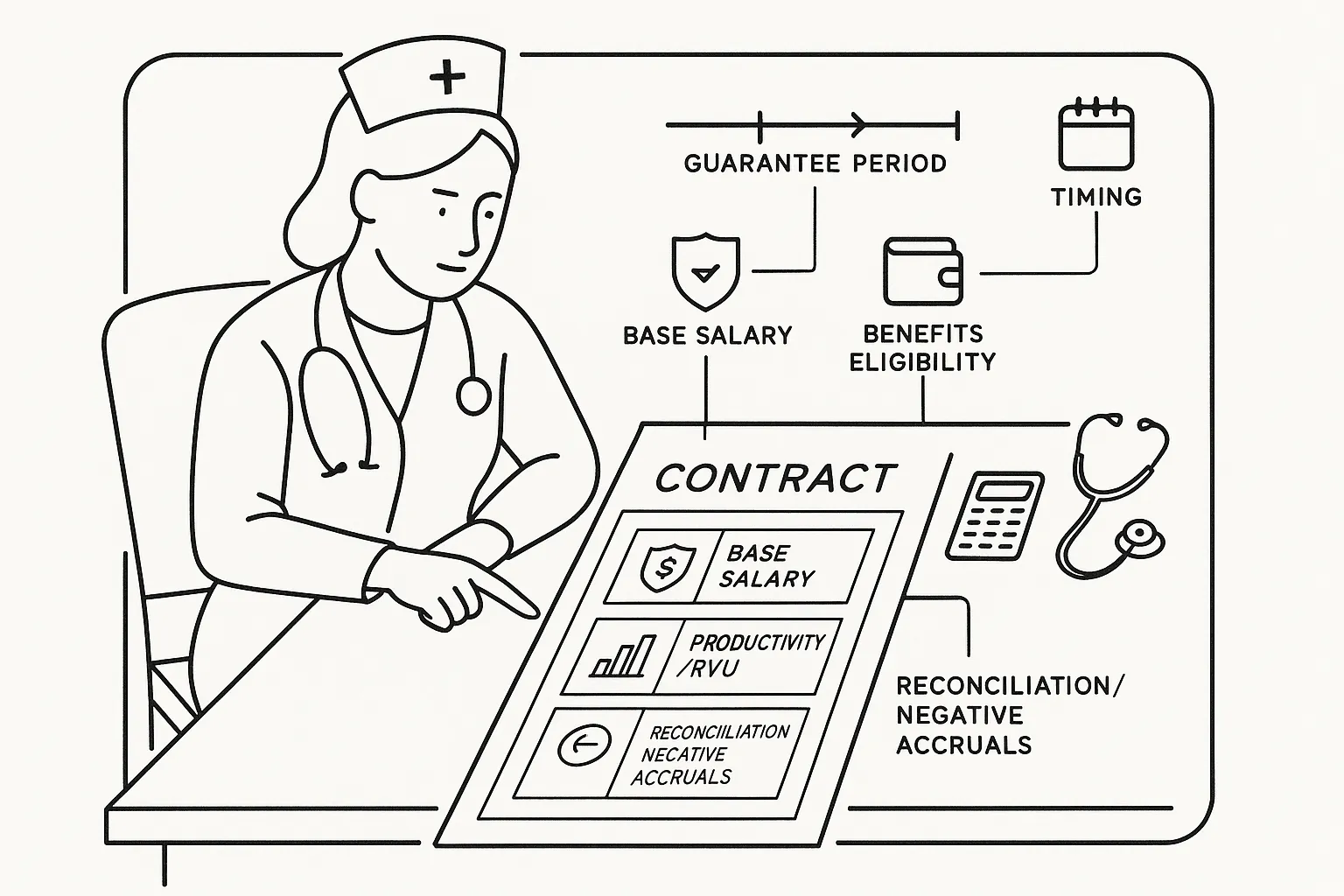
Nurse practitioner compensation may combine guaranteed salary with collections, RVU or wRVU productivity, quality incentives, or discretionary bonuses. A compensation and productivity review can evaluate the duration of a guarantee, the applicable threshold and conversion factor, the timing of calculations, and whether the employer may alter the methodology.
Collections-based formulas require precise definitions. Review can determine whether credit is based on billed charges or money received, which expenses or refunds may be deducted, how shared visits are credited, and when collections are attributed to the practitioner. RVU provisions may also need to address nonclinical duties, onboarding periods, leave, call coverage, quality measures, and payer or coding delays.
Negative Accrual, Bonuses, and Benefits
Reconciliation language can permit productivity shortfalls to carry forward, reduce later incentives, or generate a claimed repayment obligation. The agreement may also leave the employer discretion to determine whether a bonus was earned or to change a target during the term. Sample calculations can expose ambiguity that is difficult to identify from the formula alone.
Health coverage, retirement contributions, paid leave, continuing education, professional dues, licensing expenses, and prescribing-related fees have measurable economic value. Eligibility dates, reimbursement limits, vesting rules, and forfeiture conditions can affect the offer’s total value. Signing bonuses, relocation assistance, and student-loan benefits also require clear repayment triggers and proration terms.
Malpractice Coverage and Contractual Liability
Claims-Made, Occurrence, and Tail Coverage
No nurse-practitioner-specific Indiana rule identified in the verified research requires an employer to provide malpractice insurance or pay for tail coverage. The contract therefore plays a central role in allocating coverage. It can identify whether the policy is claims-made or occurrence-based, state the applicable limits, and clarify whether the practitioner is individually named or covered through an organizational policy.
Claims-made coverage may require tail or extended-reporting protection after the relationship ends, while occurrence coverage generally responds to covered incidents that occurred during the policy period. A malpractice and tail insurance review can identify who must obtain and pay for post-employment coverage and whether responsibility changes based on the reason for separation.
Indemnification and Claim Cooperation
Indemnification, defense-cost reimbursement, and cooperation clauses may create obligations beyond ordinary malpractice premiums. Broad language can attempt to shift losses, legal expenses, billing disputes, regulatory matters, or third-party claims to the practitioner. Review can assess the scope of those obligations and whether they are tied to negligence, misconduct, contractual breaches, or events outside the nurse practitioner’s control.
Claim-reporting deadlines and post-employment cooperation duties also need workable procedures. The practitioner should be able to determine whom to notify, what records must be preserved, whether compensation is available for substantial post-employment assistance, and how access to former employer records will be handled.
Non-Competes, Termination, and Repayment Risk
Indiana Restrictive Covenants
No nurse-practitioner-specific Indiana non-compete statute was identified in the verified research. Indiana generally evaluates employment restraints by considering whether they protect a legitimate interest and impose reasonable limits on time, geography, and prohibited activity. Covenants are strictly construed against the drafter, and courts may sever unreasonable divisible language but generally do not rewrite an overbroad restriction.
A nurse practitioner non-compete review can evaluate the restricted services, duration, geographic area, triggering events, and available exceptions. Non-solicitation, confidentiality, referral-source, employee-hire, and non-disparagement provisions may create separate post-employment obligations even when the non-compete receives most of the attention.
For-Cause and Without-Cause Termination
Termination provisions determine how and when the relationship can end. Without-cause termination usually depends on advance written notice, while for-cause provisions may allow immediate separation or provide a limited opportunity to cure. Broad definitions involving productivity, conduct, credentialing, employer policies, or reputational concerns can give the employer substantial discretion.
Analysis can also determine what happens to earned compensation, pending collections, bonuses, benefits, paid leave, malpractice coverage, patient-transition duties, and access to records after notice is given. Nurse practitioners preparing to leave a position can request a focused contract termination review before providing notice or responding to separation documents.
Clawbacks and Dispute Provisions
Signing bonuses, relocation payments, education benefits, and other advances frequently include repayment clauses. Review can identify whether repayment is full or prorated, when it becomes due, whether it applies after an employer-initiated termination, and whether multiple repayment provisions overlap. These clauses should be compared directly with every termination trigger.
Arbitration, venue, choice-of-law, attorney-fee, and notice provisions affect how a disagreement proceeds. They may establish the forum, filing procedure, available remedies, and potential cost of a dispute. Understanding these terms before signing can prevent procedural surprises later.
Indiana NP Contract Checklist Before Signing
Written terms are more reliable than verbal assurances about compensation, scheduling, location, collaboration, or future partnership opportunities. Before accepting the position, compare the offer letter, employment or contractor agreement, practice agreement, compensation plan, benefits materials, and applicable policies for inconsistencies.
- Test compensation formulas with sample calculations and confirm when each payment becomes earned and payable.
- Verify RN licensure, prescriptive-authority, collaboration, registration, credentialing, and practice-location responsibilities.
- Clarify schedule control, call coverage, administrative time, chart completion standards, and authority to assign additional facilities.
- Identify the malpractice policy type, limits, exclusions, reporting obligations, and tail responsibility.
- Measure each non-compete and non-solicitation restriction against realistic future Indiana practice opportunities.
- Map termination events to compensation, practice-agreement reporting, insurance, restrictive covenants, and repayment duties.
- Flag unilateral amendment clauses, discretionary bonus language, and ambiguous for-cause definitions.
An attorney-led review can explain how the documents interact and identify provisions that may reduce compensation, shift liability, complicate regulatory compliance, or limit future practice. The analysis can then help the nurse practitioner decide which terms require clarification or proposed revision before signing.
Speak With an Indiana Nurse Practitioner Contract Lawyer Before You Sign
Chelle Law provides attorney-led contract review to identify financial, regulatory, malpractice, restrictive-covenant, and termination risks and explain provisions that may warrant clarification or revision.
Request a Contract Review