
When a nurse practitioner accepts a position in Indiana—whether practicing in Indianapolis, Fort Wayne, Evansville, or another healthcare market—the employment or independent contractor agreement becomes the governing document for compensation, scope of practice, malpractice responsibility, and post-employment restrictions. These agreements operate within Indiana law and the regulatory framework administered by the Indiana State Board of Nursing, including applicable provisions of Indiana Code Title 25. An Indiana nurse practitioner contract review helps clarify how employer-drafted language interacts with collaborative practice standards, prescriptive authority rules, and other state-specific practice requirements.
Subtle drafting differences can materially affect productivity calculations, restrictive covenant exposure, and termination rights. A careful review should address collections formulas, negative accrual provisions, tail insurance responsibility, notice requirements, and post-employment limitations. Because the practical effect of these provisions depends on the complete agreement and the circumstances of the position, NPs should understand the financial, regulatory, and career consequences before signing.
Chelle Law provides structured, attorney-led risk assessment tailored to Indiana nurse practitioners. We examine each agreement line by line to identify provisions that may affect earnings stability, regulatory compliance, and long-term career mobility. NPs evaluating an offer can also learn more about our national nurse practitioner contract review service.
Key Takeaways for Indiana Nurse Practitioners
- Clarify definitions for collections, wRVU credit, payment timing, deductions, and negative accrual before signing.
- Confirm the malpractice policy type and who must obtain or pay for tail coverage after employment ends.
- Review non-compete, non-solicitation, and geographic restrictions for their practical effect on future Indiana practice opportunities.
- Require clear written terms for bonuses, repayment triggers, termination notice, and for-cause definitions.
- Verify that duties, collaboration provisions, prescribing responsibilities, and work locations are consistent with the position and applicable Indiana requirements.
Why Indiana Nurse Practitioner Contract Review Matters

Employment agreements for nurse practitioners are rarely neutral documents. Health systems and private practices commonly use standardized forms designed to preserve operational flexibility, allocate liability, and protect business interests. For NPs, particularly those early in their careers, broadly drafted clauses can have an outsized effect on income, licensure responsibilities, scheduling, and future employment options.
A focused review identifies income risks such as ambiguous productivity calculations or negative accrual language, compliance concerns involving collaboration or prescribing responsibilities, and mobility constraints created by restrictive covenants. It also explains how the agreement fits within Indiana’s regulatory environment without assuming that a clause will or will not be enforceable based on a summary review. The goal is to translate contract language into practical exposure so the NP can evaluate the offer with a clearer understanding of its consequences.
Compensation, Productivity, and Benefits Terms
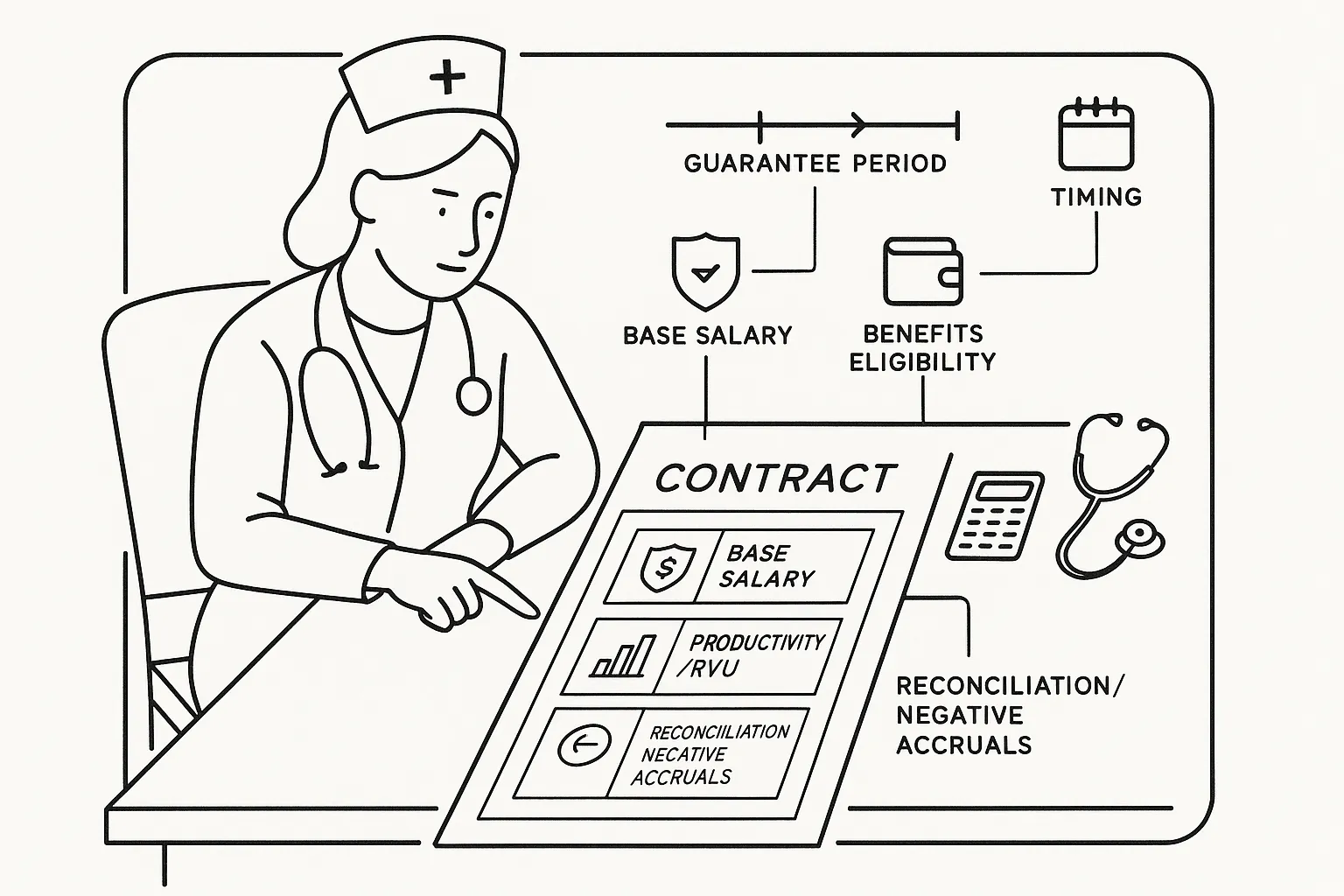
NP compensation arrangements often combine a base salary with collections, RVU productivity, quality incentives, or discretionary bonuses. A guaranteed salary can provide predictability, but the agreement may still permit later reconciliation against performance targets. An effective NP compensation review examines how the guarantee is defined, how long it lasts, when incentive payments are calculated, and whether the employer may change targets or conversion factors.
Collections-based formulas should define whether compensation is based on billed charges or money actually received, which deductions are permitted, and when the NP receives credit. RVU and wRVU models should identify the applicable target, conversion factor, crediting methodology, and treatment of nonclinical duties. Reconciliation provisions deserve particular attention because negative accrual language may allow shortfalls to carry forward, reduce future incentives, or create a repayment dispute.
Benefits also have measurable economic value. Health coverage, retirement contributions, paid time off, continuing education allowances, professional dues, and reimbursement for licensure or prescribing-related expenses should be reviewed for eligibility dates, vesting rules, reimbursement limits, and forfeiture conditions. Signing bonuses, relocation assistance, and loan benefits should state whether repayment is prorated and which types of separation trigger a clawback.
Malpractice Insurance and Liability Allocation
Malpractice coverage and risk-allocation clauses are among the most consequential provisions in a clinical contract. The agreement should identify whether the employer provides claims-made or occurrence coverage, the applicable policy limits, and whether the NP is individually named or covered under an organizational policy. Claims-made coverage may require extended reporting protection after the employment relationship ends, while occurrence coverage generally addresses incidents occurring during the policy period regardless of when a claim is later asserted.
A malpractice and tail insurance review determines who is responsible for securing and paying for tail coverage, whether that responsibility changes based on the reason for termination, and whether repayment provisions apply. Silence or ambiguity can create significant post-employment exposure.
The contract should also be reviewed for indemnification, defense-cost reimbursement, claim-reporting deadlines, and cooperation duties. Broad indemnity language may shift financial obligations to the NP beyond ordinary malpractice premiums. Reporting and cooperation requirements should be clear enough for the practitioner to understand what must be done to preserve available coverage.
Indiana Scope of Practice, Collaboration, and Work Expectations
Clinical practice language should be consistent with Indiana nurse practitioner licensure, prescribing, collaboration, and other applicable requirements overseen by the Indiana State Board of Nursing. Contractual references to physician involvement or collaborative arrangements should identify the responsible parties and avoid creating an ambiguous structure that could impair compliance or shift unfunded administrative duties to the NP. A focused collaboration agreement review can help reconcile the employment contract with related clinical practice documents.
Job duties, schedules, call obligations, charting standards, and work locations should be specific. Vague language may permit an employer to expand responsibilities, add call coverage, or assign the NP among multiple facilities without corresponding compensation. This can be especially important for positions spanning Indianapolis-area facilities or regional systems serving Fort Wayne, Evansville, and surrounding communities.
Performance standards tied to productivity, quality measures, documentation, or patient access should explain how compliance is measured and what corrective process applies. The contract should also accurately describe whether the NP is an employee or an independent contractor. Because classification affects taxes, benefits, control, and liability allocation, a proposed 1099 arrangement warrants a dedicated independent contractor agreement review.
Non-Competes, Termination, and Repayment Obligations
Restrictive covenants can affect where and how an Indiana NP practices after leaving a position. Non-compete clauses may restrict practice within a defined area for a stated period, while non-solicitation provisions may address patients, referral sources, or employees. Confidentiality and non-disparagement obligations may also survive termination. Enforceability depends on Indiana law, the contract language, and the relevant facts, but even a disputed restriction can affect job opportunities or create litigation risk. A non-compete review evaluates the duration, geography, restricted activities, triggering events, and practical effect of the covenant.
Termination provisions should distinguish between for-cause and without-cause separation, identify notice and cure periods, and explain what happens to accrued compensation, bonuses, benefits, and patient-transition duties. Broad for-cause definitions or immediate termination rights can affect income and may activate other provisions, including repayment obligations or restrictive covenants.
Signing bonuses, relocation payments, education benefits, and other advances frequently include clawbacks. The agreement should state whether repayment is full or prorated, when the obligation becomes due, and whether it applies if the employer ends the relationship. Arbitration, venue, and choice-of-law provisions should also be reviewed because they determine where and how a dispute proceeds. NPs anticipating separation can obtain a focused contract termination review before giving notice or responding to an employer.
What to Check Before Signing an Indiana NP Contract
Before executing an agreement, review the terms that affect income, licensure, daily working conditions, and future mobility. Ask for written clarification rather than relying on verbal promises, especially when the contract gives the employer discretion over productivity targets, scheduling, work locations, or bonus eligibility.
- Verify compensation formulas with sample calculations and confirm when payments are earned and paid.
- Confirm the malpractice policy type, coverage limits, tail responsibility, and reporting requirements.
- Identify broad non-compete, non-solicitation, confidentiality, or post-employment provisions.
- Review duties, call coverage, schedules, locations, collaboration terms, and prescribing-related responsibilities.
- Map every bonus, relocation, loan, or benefit repayment trigger to the applicable termination provisions.
- Flag unilateral amendment clauses and ambiguous for-cause definitions that give the employer broad discretion.
If material terms remain unclear, an attorney-led, line-by-line review can explain how the clauses work together and identify provisions that may reduce compensation, shift liability, complicate regulatory compliance, or restrict future practice. Chelle Law provides nationwide contract review services tailored to nurse practitioners, including written analysis designed to help the NP make a well-informed decision about the proposed relationship.
Have an Indiana NP Contract Reviewed Before You Sign
Chelle Law reviews compensation, malpractice, collaboration, restrictive covenant, and termination provisions so you can understand the practical risks in your proposed agreement.
Contact Chelle Law