
An Iowa nurse practitioner contract defines far more than salary. It may allocate clinical duties, prescribing responsibilities, scheduling authority, malpractice costs, termination rights, and post-employment restrictions. The Iowa Board of Nursing regulates nurse practitioners as advanced registered nurse practitioners (ARNPs), who must maintain applicable national certification, practice within their population focus, and comply with Iowa requirements governing scope of practice and prescribing. Iowa rules authorize an ARNP to practice to the full extent of the ARNP’s license, education, and experience within that population focus, making it important to distinguish regulatory requirements from additional employer-imposed oversight or approval terms. Whether a position is based in Des Moines, Cedar Rapids, Davenport, or another Iowa healthcare market, contract review can identify language that changes the expected role, limits professional mobility, or creates financial obligations that are not apparent from the offer summary.
Compensation formulas, malpractice coverage, restrictive covenants, repayment clauses, and termination provisions often interact. For example, a without-cause termination clause may affect an earned bonus, tail insurance responsibility, signing-bonus repayment, and the start of a non-compete period at the same time. Chelle Law provides attorney-led review focused on how the agreement operates as a whole, which provisions create material risk, and which terms may warrant clarification or revision before the nurse practitioner signs.
Iowa ARNP Practice Rules and Contract Terms

ARNP Licensure, Population Focus, and Scope of Practice
Iowa regulates a nurse practitioner as an ARNP. A currently licensed ARNP may use that title or designation and must maintain current national certification while the license remains active. The practitioner’s authorized role is also tied to the applicable population focus, education, experience, and licensure.
An agreement may describe assessment, diagnosis, treatment planning, prescribing, documentation, procedures, and other patient-care responsibilities. Review can determine whether those duties fit the identified specialty and population focus or whether broad language permits the employer to assign materially different work. It can also identify provisions that make continued employment dependent on maintaining licensure, certification, credentialing, prescribing authority, or other professional qualifications.
Collaboration and Employer-Imposed Oversight
Iowa defines collaboration as a process through which an ARNP and physician jointly manage a client, but the state’s advanced-practice rule authorizes an ARNP to practice to the full extent of the ARNP’s license, education, and experience. A contract may nevertheless impose internal consultation, chart review, signature, approval, protocol, or escalation requirements as conditions of employment.
Those contractual requirements are not necessarily identical to the ARNP’s underlying scope of practice. A focused review of nurse practitioner supervision and collaboration terms can distinguish regulatory obligations from additional workplace policies and identify whether the employer may change those policies unilaterally.
Prescribing and Telehealth Responsibilities
An Iowa ARNP may prescribe, administer, or dispense prescription drugs, including controlled substances, within the practitioner’s role and population focus and subject to state and federal law. Contract language may separately address prescribing protocols, controlled-substance responsibilities, medication-management duties, employer formularies, documentation standards, and reimbursement for required professional expenses.
An ARNP providing telehealth to a patient physically located in Iowa must be licensed by the Iowa Board of Nursing and comply with applicable ARNP practice and telehealth requirements. A telehealth agreement may also raise questions about patient location, multistate coverage, scheduling, technology, professional liability insurance, recordkeeping, and responsibility for maintaining additional licenses. Review can identify whether those operational obligations are clearly allocated.
Employment and Independent Contractor Structure
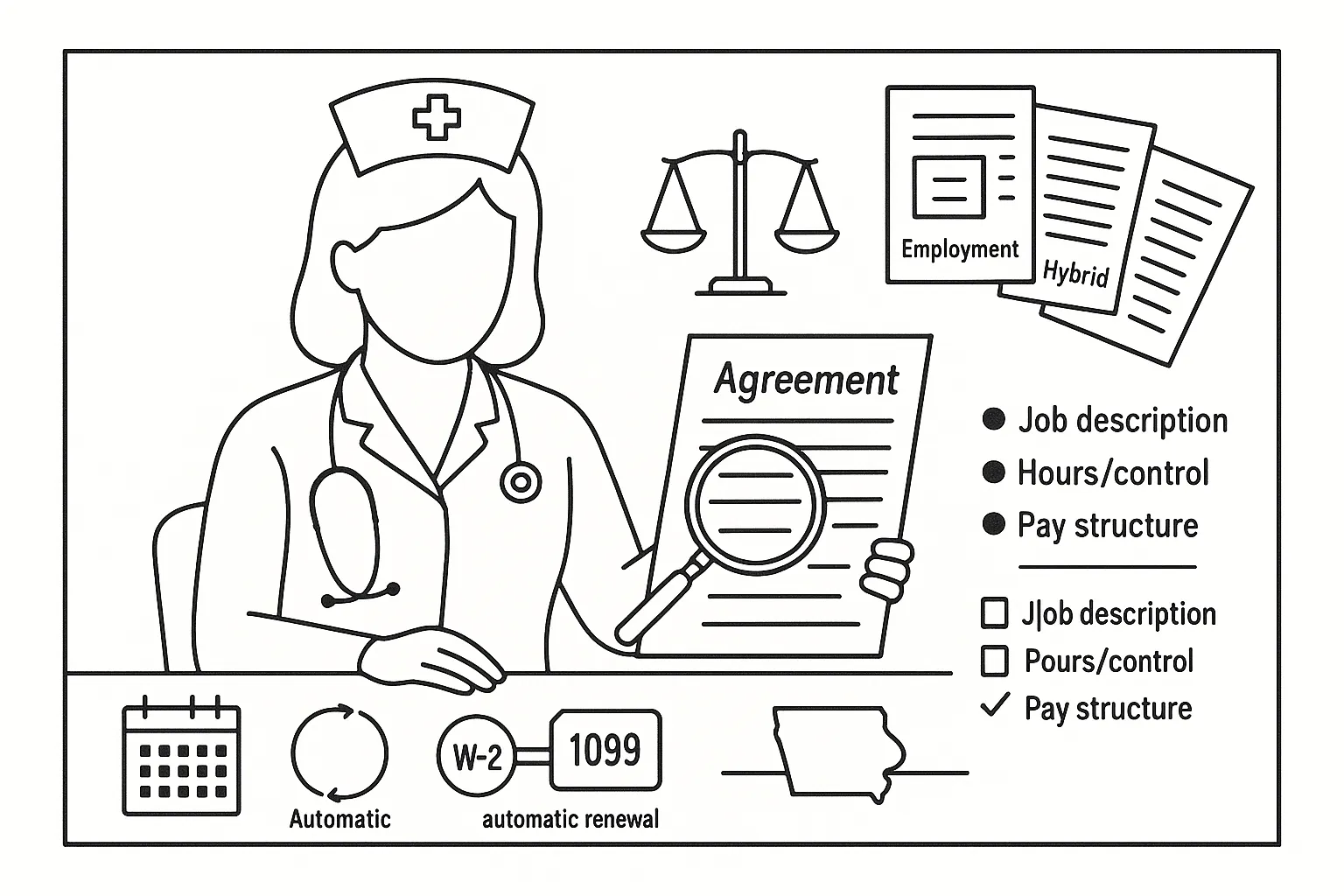
W-2 Employment, 1099 Contracting, and Hybrid Terms
The agreement may establish W-2 employment, a 1099 independent contractor relationship, or an arrangement containing features of both. Classification affects taxes, benefits, insurance, business expenses, equipment, paid leave, and access to employer policies. The contract’s label is relevant, but provisions governing scheduling, billing, clinical operations, performance standards, and control over the work also require careful analysis.
Review can compare the stated classification with the obligations assigned to the practitioner and identify expenses that materially reduce the quoted compensation. Nurse practitioners evaluating an offer can also review the practical distinctions between W-2 and 1099 nurse practitioner arrangements.
Duties, Schedule, Call, and Work Locations
Clinical and operational expectations may be spread across the agreement, job description, handbook, compensation plan, and incorporated policies. Relevant terms include workdays, patient-contact hours, administrative time, call coverage, weekend or holiday rotations, chart-completion requirements, meetings, travel, and the employer’s ability to assign additional locations.
Broad discretion to change schedules, duties, service lines, or worksites can alter the value of an otherwise favorable offer. Review can determine whether call is included in base compensation, whether additional shifts are paid separately, how coverage is assigned, and whether reassignment could place the ARNP outside the anticipated role or population focus.
Professional Corporation and Ownership Provisions
Iowa’s professional-corporation framework includes the practice of nursing. A professional corporation generally practices through appropriately licensed individuals, and ownership or share-transfer provisions are subject to statutory restrictions. These rules may become relevant when an ARNP is offered equity, required to provide services through a professional entity, or asked to sign related ownership documents.
Entity documents do not replace the practitioner’s responsibility to comply with licensing requirements. Contract analysis can identify personal guarantees, capital contributions, mandatory share redemptions, valuation formulas, voting restrictions, and ownership provisions that extend beyond the clinical employment arrangement.
Compensation, Productivity, and Benefits
Salary, RVUs, Collections, and Bonuses
A guaranteed salary provision may address the payment schedule, guarantee period, work expectations, and circumstances under which compensation can be reduced or offset. Productivity models require additional detail. An RVU formula may depend on the threshold, conversion factor, attribution rules, measurement period, quality requirements, reconciliation process, and the practitioner’s access to supporting reports.
Collections-based compensation can turn on definitions of collections, refunds, denials, adjustments, patient payments, and services attributed to the ARNP. The agreement may also determine whether delayed collections remain payable after termination. A detailed nurse practitioner compensation and productivity review can identify missing formula terms, discretionary payment language, negative accrual, and reconciliation provisions that affect actual earnings.
Benefits, Reimbursements, and Repayment Risk
Total compensation may include health coverage, retirement contributions, paid leave, continuing education funds, professional dues, licensing expenses, prescribing-related costs, relocation assistance, signing bonuses, or student loan benefits. Review can determine whether these items are guaranteed by the contract, controlled by a changeable policy, prorated during the first year, or conditioned on remaining employed through a payment date.
Repayment provisions may require the ARNP to return a signing bonus, relocation payment, educational benefit, or other advance after an early departure. Material details include the repayment period, whether the obligation declines over time, which termination events trigger repayment, and whether the employer may deduct the amount from final compensation. Uncapped clawbacks or vague offset rights can create exposure beyond the amount initially received.
Malpractice Insurance and Liability Allocation
Claims-Made, Occurrence, and Tail Coverage
Malpractice provisions may identify the policy type, coverage limits, premium responsibility, covered services, and the protection available after the relationship ends. Claims-made insurance generally requires coverage to remain in effect when a claim is reported, making tail or extended reporting coverage an important contract issue. Occurrence coverage generally addresses covered incidents that occurred during the policy period even when the claim is reported later.
The agreement may assign tail costs based on who ends the relationship or why it ends. Review can clarify whether the employer pays, the practitioner pays, the cost is shared, or prior-acts coverage may satisfy the obligation. A focused malpractice and tail insurance review for nurse practitioners can also evaluate proof-of-coverage requirements and whether stated limits apply separately or across a group policy.
Indemnification, Defense, and Outside Work
Insurance language should be considered together with indemnification and defense provisions. A broad indemnity clause may attempt to shift losses, claims, costs, or attorneys’ fees beyond the protection available under the malpractice policy. Review can identify whether obligations are limited to the practitioner’s conduct or extend to billing, staffing, facilities, employer policies, or acts controlled by other parties.
Moonlighting and outside professional activities may be excluded from the employer’s policy even when the agreement permits them. The contract may also require advance approval, separate insurance, disclosure of outside income, or compliance with exclusivity and conflict-of-interest policies. These terms can affect part-time clinical work, teaching, consulting, and telehealth services.
Iowa Restrictive Covenants and Contract Exit Terms
Non-Compete and Non-Solicitation Restrictions
Iowa generally disfavors non-competes as restraints of trade, but enforceability depends on a reasonableness analysis. Relevant considerations include whether the restriction is reasonably necessary to protect the employer’s business, whether it is unreasonably restrictive of the worker, and whether it is prejudicial to the public interest. The employer bears the burden of establishing reasonableness, and healthcare access or other public-interest concerns may be material.
Contract review can assess the stated duration, geographic area, prohibited services, triggering events, and practical effect in Des Moines, Cedar Rapids, Davenport, and surrounding communities. Related non-solicitation, confidentiality, patient-list, exclusivity, and referral restrictions may limit future opportunities even when they are not labeled as a non-compete. An Iowa-focused nurse practitioner non-compete review can flag language that warrants closer evaluation without assuming how a court would resolve a particular dispute.
For-Cause and Without-Cause Termination
Without-cause termination language determines whether either party can end the agreement before the stated term expires and how much advance notice is required. The notice period affects how quickly an ARNP can leave, how long the employer must continue compensation, and whether the practitioner can be removed from the schedule or patient care during notice.
For-cause provisions may address licensure, certification, credentialing, exclusion from government programs, policy violations, professional conduct, performance, or breach of contract. Analysis can identify subjective standards, immediate-termination rights, and whether the practitioner receives notice and a reasonable opportunity to cure a remediable breach.
Final Pay, Repayment, and Dispute Resolution
Termination can affect final salary, accrued leave, earned bonuses, pending collections, expense reimbursements, tail coverage, and restrictive covenants. The agreement may also accelerate repayment obligations or permit offsets against final compensation. A nurse practitioner contract termination review can trace these cross-references and explain the financial consequences associated with different exit scenarios.
Dispute provisions may select governing law, venue, arbitration procedures, available remedies, or responsibility for attorneys’ fees. Liquidated-damages language may set a predetermined amount for an alleged breach, including violation of a restrictive covenant. Review can evaluate how these provisions interact without predicting the result of a future dispute.
What an Iowa Nurse Practitioner Contract Review Covers
Common Contract Red Flags
A line-by-line legal review prioritizes provisions that may affect earnings, professional obligations, liability exposure, and career mobility. Common issues include:
- Clinical duties or prescribing responsibilities that do not clearly align with the anticipated ARNP role and population focus.
- Collaboration, signature, approval, or oversight terms that impose unclear workplace obligations.
- Undefined RVU conversion factors, collections terminology, bonus criteria, quality measures, or reconciliation procedures.
- Discretionary compensation, indefinite negative accrual, uncapped clawbacks, or broad deduction rights.
- Employer control over billing and coding without meaningful access to supporting productivity reports.
- Claims-made malpractice coverage with unclear tail responsibility or indemnity obligations broader than the insurance coverage.
- Non-compete, non-solicitation, confidentiality, or exclusivity terms that materially limit future Iowa opportunities.
- Broad for-cause termination standards, limited cure rights, or an impractical without-cause notice period.
- Signing-bonus, relocation, student-loan, or other repayment obligations that do not decline proportionally over time.
- Telehealth, call, travel, or additional-location duties without clear compensation and insurance terms.
Review is generally most useful before the agreement or an amendment is signed. Chelle Law can analyze the document, identify employer-favorable or ambiguous language, explain how related provisions operate together, and highlight terms that may warrant clarification or revision. The purpose is to help the nurse practitioner understand the offer’s financial, regulatory, and professional consequences rather than provide a prediction about a specific dispute.
Request an Iowa Nurse Practitioner Contract Review Before You Sign
Chelle Law reviews NP employment and independent contractor agreements to identify compensation risks, malpractice obligations, restrictive covenants, termination terms, and provisions that may warrant clarification or revision.
Contact Chelle LawExplore Nurse Practitioner Contract Guidance
Review attorney-led services, practical contract resources, and state-specific guidance for nurse practitioners.