
A Kansas nurse practitioner contract can affect far more than salary. It may allocate responsibility for malpractice coverage, define productivity expectations, restrict future practice, and assign licensing or credentialing tasks. The Kansas State Board of Nursing regulates advanced practice registered nurses in the state. Kansas generally does not require nurse practitioners to practice under physician supervision or a collaborative agreement, but clinical duties and prescribing authority must remain consistent with the NP’s education, role, population focus, and demonstrated competency. NPs initially licensed on or after July 1, 2023, must also maintain qualifying national certification for their specific role and population focus. Whether an opportunity is in Wichita, Overland Park, Topeka, or another Kansas market, contract review can determine whether the written duties, prescribing provisions, insurance terms, and operational expectations align with the position and Kansas practice requirements.
Compensation formulas, termination rights, repayment obligations, and post-employment restrictions can create substantial exposure even when the headline salary appears favorable. Chelle Law provides attorney-led review that evaluates how these provisions interact, explains their practical effect, and identifies language that may warrant clarification or revision before the agreement is signed.
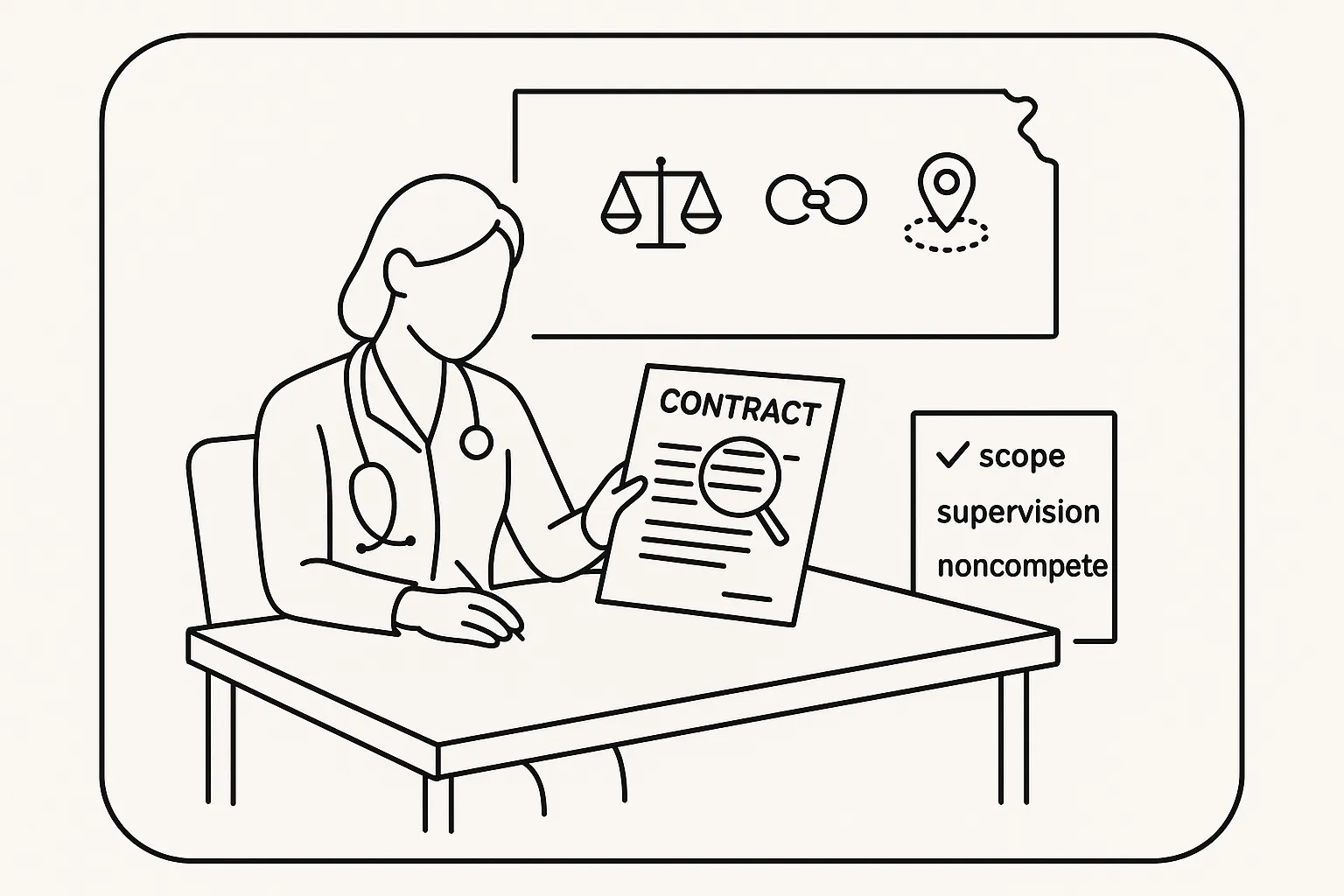
Kansas Practice Rules and Contract Responsibilities
Licensure, Scope of Practice, and Prescribing
A Kansas nurse practitioner must hold a valid APRN license and practice within the boundaries of the NP’s education, role, population focus, and demonstrated competency. Although Kansas eliminated the prior general requirement for collaborative practice authorization, an employment agreement may still contain references to supervision, collaboration, internal clinical oversight, or facility protocols. Review can distinguish an employer’s operational policies from obligations imposed by Kansas law and identify outdated or unnecessarily restrictive language.
Kansas APRNs may prescribe durable medical equipment and prescribe, procure, and administer drugs within their role and population focus, subject to applicable state and federal limitations. Controlled-substance provisions also need to account for federal DEA requirements, while prescription documentation must contain required identifying and practice-location information. Contract terms involving prescribing, formularies, clinical protocols, or controlled substances can be compared with the position’s actual responsibilities and relevant nurse practitioner scope-of-practice issues.
Credentialing and Employer Support
Licensure, payer enrollment, facility credentialing, medical staff privileges, and controlled-substance registrations can affect when an NP may begin providing services or generating productivity credit. The agreement may allocate responsibility for applications, fees, supporting documents, renewal deadlines, and compliance tasks. It can also address what happens if credentialing is delayed or denied.
These provisions are particularly important when compensation begins only after credentialing or when a delayed start date permits termination of the offer. Analysis can identify whether the contract addresses pay gaps, rescheduled start dates, reimbursement of pre-employment expenses, and the consequences of a delay outside the NP’s control.
Compensation, Productivity, and Workload
Base Salary, Collections, and Productivity Formulas
NP compensation may consist of a guaranteed base salary, collections-based pay, RVU or wRVU incentives, quality bonuses, or a combination of these models. A meaningful review examines how the agreement defines collections, personally performed services, productivity credit, thresholds, conversion factors, write-offs, payer adjustments, refunds, overhead deductions, and payment dates. It can also identify whether the employer may revise the compensation plan during the contract term.
The formula must be considered alongside billing practices, patient volume, payer mix, scheduling, staffing support, and attribution rules. A focused compensation and productivity review can clarify how the written model may affect earnings rather than relying only on projected compensation.
Negative Accrual, Call, and Additional Locations
Negative accrual or reconciliation language may allow an employer to offset future earnings when production falls below a draw, guarantee, or threshold. Important details include whether a deficit carries forward, when reconciliation occurs, whether the balance resets, and whether the NP could owe money when employment ends. These terms may materially change the value of an otherwise attractive guarantee.
Workload provisions also merit close review. The agreement may address clinic hours, administrative time, call coverage, weekends, patient-message responsibilities, floating, travel, moonlighting, and services at additional locations. Open-ended language can expand duties without establishing corresponding compensation, reasonable notice, or geographic limits.
Malpractice Coverage and Professional Liability
Kansas Insurance Requirements
Maintaining professional malpractice insurance is generally a condition of rendering clinical services as an APRN in Kansas, with proof required for licensure and renewal. Limited exceptions apply in circumstances involving specified governmental coverage, qualifying charitable practice, or active-duty military service. The contract can identify who obtains the policy, who pays the premium, the coverage limits, and whether the policy covers every location and service included in the position.
Insurance language also needs to match the employer’s actual policy. Review can flag provisions that allow coverage to change without notice, fail to identify limits, exclude certain services, or create uncertainty about protection for activities performed outside the employer’s facilities.
Claims-Made Coverage, Tail Insurance, and Indemnification
A claims-made policy generally requires continuing protection for a claim reported after the underlying policy ends. Kansas APRN law does not assign tail-insurance responsibility to the employer or the nurse practitioner, making the contract language especially important. A malpractice and tail insurance review can determine whether the agreement clearly allocates the cost under resignation, termination without cause, termination for cause, nonrenewal, disability, or another separation event.
Indemnification provisions may create obligations separate from malpractice coverage. Analysis can identify language requiring the NP to reimburse the employer for broad categories of claims, losses, billing disputes, or conduct outside the NP’s control. The scope of indemnification, available insurance, notice rights, and control of the defense need to be considered together.
Termination, Repayment, and Restrictive Covenants
Notice Periods and Financial Consequences
Termination provisions establish whether either party may end the agreement without cause, the required notice period, and the circumstances permitting immediate termination. Review can evaluate whether for-cause events are clearly defined, whether there is an opportunity to cure certain breaches, and whether the employer may remove the NP from the schedule or stop variable compensation during the notice period.
The same termination event may affect unpaid production, accrued leave, bonuses, relocation assistance, training expenses, student-loan benefits, tail insurance, and restrictive covenants. Signing-bonus and relocation provisions may require full or prorated repayment, sometimes even when the employer initiates the separation. A termination-focused contract review can identify these combined consequences.
Kansas Non-Competes and Non-Solicitation Clauses
No Kansas rule identified in the reviewed authorities creates a nurse-practitioner-specific prohibition on non-competes or non-solicitation clauses. Kansas general law treats reasonable restraints as potentially enforceable and permits a court to modify an overbroad covenant. Certain written employee and customer non-solicitation provisions may receive statutory presumptions when specified conditions are satisfied, but those presumptions do not automatically validate every employee non-compete.
Review therefore focuses on the actual language and circumstances, including duration, geographic reach, restricted activities, covered locations, customer or patient definitions, and the events that trigger the restriction. It can also evaluate whether the provision protects identified business interests without unnecessarily limiting future work. Chelle Law’s nurse practitioner non-compete review examines these practical limits before or after signing.
Common Kansas NP Contract Red Flags
Employer-drafted agreements can shift financial, regulatory, or operational risk without clearly describing the consequences. Potential concerns include:
- Collections-based compensation without definitions for billable services, write-offs, payer adjustments, refunds, or deductions.
- Negative accrual without a cap, reset mechanism, or defined reconciliation period.
- Productivity targets that do not account for credentialing delays, scheduling limits, administrative work, or inadequate support.
- Outdated supervision or collaboration language that does not reflect current Kansas NP practice authority.
- Claims-made malpractice coverage without a clear allocation of tail-insurance responsibility.
- Broad indemnification, audit, recoupment, or repayment rights that permit retrospective financial liability.
- Open-ended call, scheduling, floating, travel, or multi-location requirements without defined limits or compensation.
- A non-compete that broadly restricts locations or services unrelated to the NP’s actual work.
These provisions are best evaluated collectively. A single separation could trigger bonus repayment, tail costs, forfeiture of unpaid productivity compensation, and a post-employment restriction. Reviewing the complete agreement can reveal exposure that is not apparent when each clause is read in isolation.
Telehealth, 1099, and Ownership Arrangements
Telehealth and Cross-State Practice
Telehealth contracts may involve patients located in Kansas and other states. The agreement can address where patients may be located, which licenses or registrations the NP must maintain, prescribing expectations, technology and privacy responsibilities, malpractice coverage, and how remote encounters count toward compensation. It should not assume that Kansas requirements govern every patient encounter.
Review can also clarify responsibility for cross-state licensing expenses, credentialing, equipment, internet or workspace costs, after-hours messages, and platform downtime. Any productivity formula needs to explain how canceled visits, asynchronous services, care coordination, and services rejected by a payer are treated.
Independent Contractor and Equity Terms
A 1099 label does not resolve the legal and practical issues associated with independent contractor status. The parties’ actual arrangement may involve scheduling control, methods of work, exclusivity, benefits, expenses, billing, malpractice insurance, taxes, and termination rights. An independent contractor agreement review can evaluate the complete structure rather than relying on the agreement’s title.
Practice ownership, partnership, or future equity opportunities require separate documentation of valuation, capital contributions, voting rights, distributions, management authority, transfer restrictions, and exit procedures. No material Kansas NP-specific ownership restriction was identified in the reviewed authorities, but facility, entity, payer, and other healthcare rules may still affect a particular structure. A vague promise of a future buy-in is not equivalent to documented ownership rights.
When to Request a Kansas NP Contract Review
Attorney review is particularly useful for a first position after graduation, a new compensation model, a 1099 arrangement, a telehealth role, or an offer containing repayment obligations or restrictive covenants. Review before signing provides the best opportunity to understand the agreement as a whole, compare the written terms with the offer, and identify provisions that may warrant clarification or revision.
Chelle Law’s nurse practitioner contract review service focuses on practical risk identification and plain-language explanation. The process may include secure document submission, attorney analysis, written comments or proposed revisions, and consultation concerning compensation, malpractice coverage, termination, repayment, professional obligations, and post-employment restrictions.
Speak With a Kansas Nurse Practitioner Contract Lawyer Before You Sign
Chelle Law can review your proposed agreement, explain its practical effect, and identify compensation, malpractice, termination, practice, repayment, or restrictive covenant terms that may warrant clarification or revision.
Contact Chelle LawExplore Nurse Practitioner Contract Guidance
Review related services, educational resources, and state-specific contract information for nurse practitioners.