
A Louisiana nurse practitioner contract must address more than compensation and scheduling. Nurse practitioners are advanced practice registered nurses regulated by the Louisiana State Board of Nursing, while the Louisiana State Board of Medical Examiners regulates physicians who may participate in required collaborative practice arrangements. Except where a statutory exception applies, medical diagnosis and prescribing by a nurse practitioner require a written collaborative practice agreement addressing consultation and referral availability, clinical-practice management guidelines, and coverage during absences. These requirements can affect contracts in New Orleans, Baton Rouge, Shreveport, and other Louisiana healthcare markets, particularly when an employer expects work at multiple sites or changes the collaborating physician. Contract review can determine whether the proposed duties, prescribing authority, practice locations, and collaboration terms align with the position and Louisiana’s regulatory framework.
The agreement also controls salary or productivity compensation, malpractice coverage, termination rights, repayment obligations, and post-employment restrictions. Louisiana’s rules governing restrictive covenants make the wording, duration, restricted activities, and identified geographic territory especially important. Attorney-led review can explain how these provisions work together, identify financial or professional risks, and flag terms that may warrant clarification or revision before the nurse practitioner signs.
Key Contract Priorities for Louisiana Nurse Practitioners
- Verify how salary, RVUs, collections, bonuses, holdbacks, chargebacks, and negative accrual are calculated and reconciled.
- Determine who pays for malpractice insurance and any required tail or prior-acts coverage.
- Review non-compete and non-solicitation language for its duration, restricted activities, and specified parishes or municipalities.
- Understand without-cause notice, termination-for-cause standards, severance conditions, and obligations that survive termination.
- Compare the contract’s collaboration, prescribing, coverage, and practice-site terms with the proposed Louisiana practice structure.
Louisiana APRN Regulation and Collaborative Practice
APRN Licensure and Nurse Practitioner Status
Louisiana treats a nurse practitioner as an advanced practice registered nurse subject to statutory education, certification, and licensure criteria. The employment agreement cannot expand clinical authority beyond the NP’s licensure, certification, or legally permitted scope. Review can compare the job description with the contract’s provisions on patient populations, procedures, prescribing, supervision, quality review, and administrative responsibilities.
Broad language allowing an employer to assign any additional duties may create uncertainty if the new responsibilities fall outside the anticipated specialty, location, or workload. The agreement can also address responsibility for maintaining licensure, national certification, credentialing, continuing education, and required approvals.
Written Collaborative Practice Agreements and Exceptions
Except where Louisiana law provides an exception, nurse-practitioner medical diagnosis and prescribing must occur under a written collaborative practice agreement with one or more licensed physicians or dentists. The arrangement addresses consultation and referral availability, clinical-practice management guidelines, and coverage during absences. The contract should be evaluated together with the collaborative practice agreement because inconsistent documents can create uncertainty about duties, authority, and responsibility.
Louisiana recognizes an exception for APRNs working under a contract or arrangement with qualifying hospital systems or nursing facilities. Whether that exception applies depends on the actual practice structure rather than the employer’s name or the contract label. A nurse practitioner collaboration agreement review can identify which documents control and whether the proposed terms account for physician availability, absences, and changes in the practice arrangement.
Prescribing, Controlled Substances, and Practice Sites
Prescriptive authority is subject to Louisiana State Board of Nursing rules and the collaborative practice agreement. Controlled-substance authority must be specifically addressed in the agreement and remain consistent with applicable prescribing requirements. Louisiana materials also indicate that an APRN may not prescribe when required collaborating coverage is unavailable, making coverage language important when physicians take leave or leave the organization.
The signed collaborative practice agreement must be retained at the practice site and made available to the Louisiana State Board of Nursing. Collaborating physicians must be actively engaged in Louisiana clinical practice and have a comparable scope, specialty, or area of expertise, and required changes involving physicians or practice sites must be reported. A contract involving multiple clinics, floating assignments, or telehealth should therefore identify where services will be performed and who is responsible for maintaining and updating required documentation.
Employment and Independent Contractor Agreements
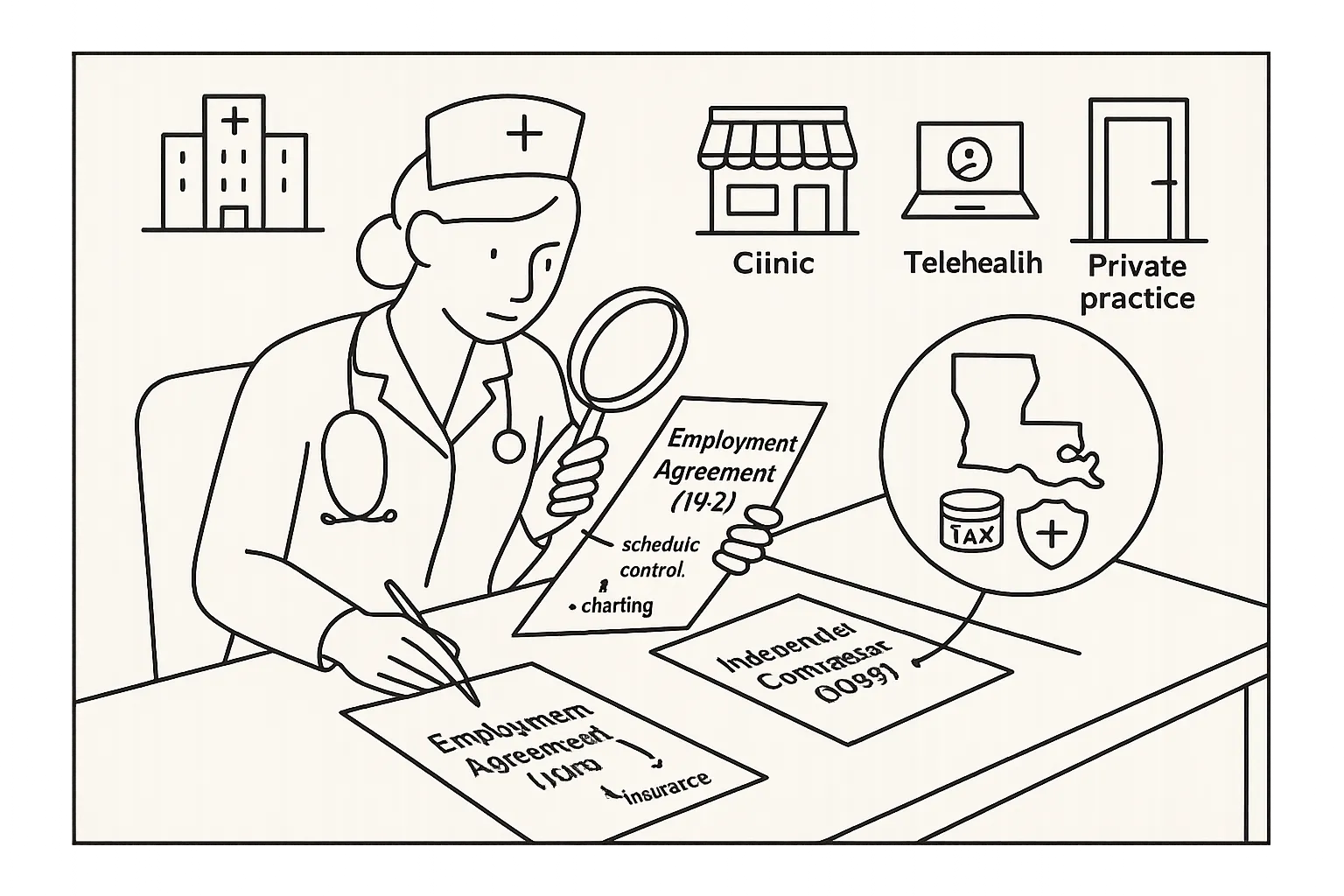
W-2 Employment Compared With 1099 Contracting
W-2 employment and 1099 independent contracting can produce substantially different financial and operational obligations. Employment agreements commonly address payroll taxes, benefits, paid leave, employer policies, and formal termination procedures. Contractor agreements may shift taxes, malpractice premiums, business expenses, insurance, credentialing costs, indemnification exposure, and administrative responsibilities to the NP.
Classification depends on the actual relationship and applicable general law, not only the title placed on the agreement. Schedule control, required systems, work locations, billing arrangements, equipment, exclusivity, and the parties’ day-to-day responsibilities may all be relevant. NPs comparing offers can review the practical differences between W-2 and 1099 nurse practitioner arrangements.
Practice Setting, Work Locations, and Assigned Duties
Hospitals, health systems, clinics, private practices, staffing companies, and telehealth organizations may use different contract structures. The agreement may assign work across multiple facilities, require floating, incorporate departmental productivity standards, or reserve authority to change schedules and locations. Review can identify whether those rights are limited and whether travel, call, administrative work, and additional sites affect compensation.
Telehealth positions may add multistate licensing, technology, prescribing, patient-location, and data-security obligations. Regardless of setting, the written terms should clearly describe clinical duties, administrative responsibilities, expected patient volume, work locations, schedule requirements, and the regulatory arrangements supporting the role.
Compensation, Productivity, and Repayment Obligations
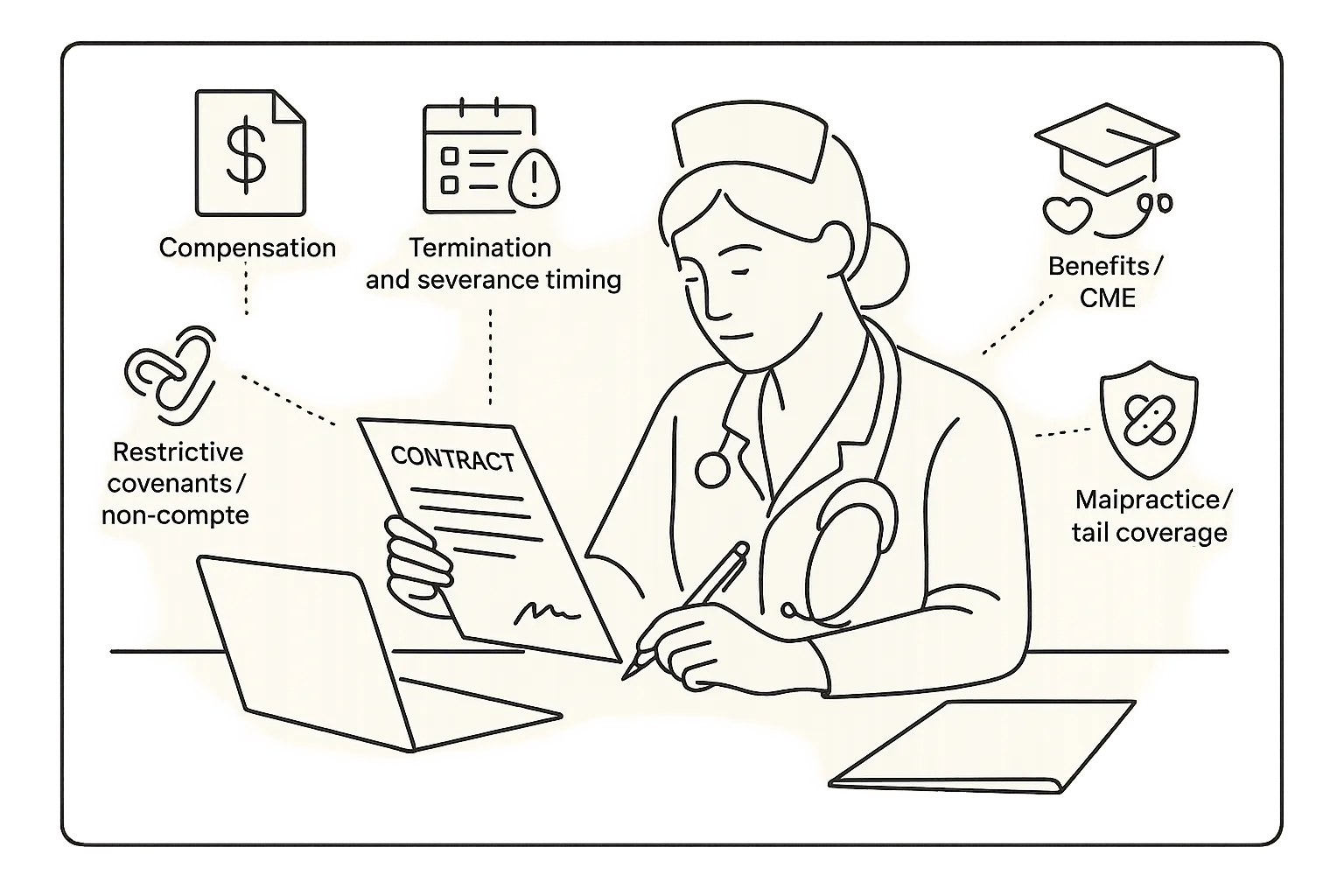
Salary, RVUs, Collections, and Quality Incentives
Compensation language determines when earnings become payable and whether the organization can later adjust the calculation. A guaranteed salary may be relatively direct, while an RVU, collections, or hybrid model requires definitions, thresholds, conversion factors, reporting periods, reconciliation procedures, and payment dates. Chargebacks, payer denials, holdbacks, negative accrual, quality measures, and discretionary adjustments can materially affect actual earnings.
RVU-based compensation reduces some collection variability but still depends on the organization’s methodology and the NP’s access to accurate reports. Collections-based pay can expose compensation to billing delays, payer mix, denials, refunds, and collection practices outside the NP’s control. A focused compensation and productivity review can evaluate whether the formula is measurable, verifiable, and internally consistent.
Signing Bonuses, Relocation Benefits, and Clawbacks
Signing bonuses, relocation assistance, student-loan benefits, training payments, and credentialing advances may become repayable when employment ends. Review can determine whether repayment is prorated, whether interest or collection costs apply, and whether the entire balance accelerates immediately. The triggering event also matters: some provisions apply after resignation, while others extend to termination for cause, termination without cause, or failure to begin work.
Repayment language can create substantial debt even when the original benefit appeared modest. The agreement may warrant clarification concerning forgiveness dates, prorating methods, exceptions for employer breach, and treatment of delayed credentialing or a rescinded start date.
Termination Rights and Louisiana Restrictive Covenants
Without-Cause Termination, Cause, and Post-Termination Pay
Termination provisions determine how quickly either party can end the relationship and which obligations survive. Analysis can distinguish termination without cause from termination for cause, identify applicable notice periods, and assess whether the NP has an opportunity to cure an alleged breach. Broad cause definitions may allow immediate termination for conduct that would otherwise justify notice or a corrective period.
The agreement may also control payment of earned bonuses, outstanding collections, accrued leave, benefits, severance, and malpractice obligations after departure. Notice requirements should be coordinated with start dates for a new position, credentialing timelines, restrictive covenants, and repayment provisions. A nurse practitioner termination review can clarify the financial and professional consequences before signing or providing notice.
Non-Competes and Non-Solicitation Restrictions
Louisiana generally treats restraints on employment as null unless they fit a statutory exception. A potentially enforceable restriction must satisfy statutory requirements concerning the protected relationship, geographic scope, and duration. Louisiana law also places limits on contract choice-of-law and forum provisions, subject to statutory exceptions and possible ratification after the underlying incident.
Review should focus on the parishes or municipalities identified in the clause, the restricted professional activities, the duration, the covered facilities, and the events that activate the restriction. Language covering multiple locations, broad categories of healthcare work, referral relationships, or telehealth may affect opportunities beyond the NP’s primary practice site. A Louisiana nurse practitioner non-compete review can evaluate the actual wording and flag restrictions that may warrant narrowing or clarification.
Malpractice Coverage, Benefits, and Scheduling
Claims-Made Coverage and Tail Responsibility
The contract can identify the malpractice policy type, coverage limits, named insured, premium responsibility, and exclusions relevant to the NP’s services. Claims-made coverage generally requires protection for qualifying claims reported after the policy ends, often through tail coverage or replacement coverage that includes prior acts. Occurrence coverage generally responds based on when the incident occurred, subject to the policy’s terms and limits.
Louisiana law generally imposes a one-year deadline for medical-malpractice claims covered by the statute, measured from the act or discovery, with an outside three-year period from the act. No profession-specific Louisiana statutory requirement making an employer or NP responsible for tail insurance was identified, so the policy and contract language are important. A malpractice and tail insurance review can assess when tail responsibility applies and whether the cost is capped, shared, or waived in specified circumstances.
Benefits, Call, Administrative Time, and Schedule Changes
Total compensation may include health insurance, retirement contributions, paid leave, continuing education funds, protected CME time, licensing and certification fees, and professional memberships. Review can distinguish contractual benefits from benefits governed by employer policies that may change. Eligibility dates, waiting periods, forfeiture rules, and treatment of benefits at termination can materially affect an offer’s value.
Schedule provisions may address clinical hours, administrative time, call, weekends, holidays, floating, travel, remote work, and the employer’s authority to modify assignments. If call, extra shifts, chart completion, or travel affect productivity, the contract can specify how that work is credited and compensated. Material assurances about schedule, location, patient volume, or remote work are more reliable when incorporated into the agreement or a signed addendum.
What a Louisiana Nurse Practitioner Contract Review Covers
An attorney-led review translates contract language into practical financial and professional consequences. The analysis can evaluate compensation mechanics, collaboration requirements, prescribing provisions, termination exposure, malpractice obligations, restrictive covenants, and repayment terms as parts of one agreement. It can also identify inconsistencies between the contract, offer letter, compensation exhibits, employer policies, job description, and collaborative practice documents.
Common warning signs include undefined productivity formulas, employer-only discretion over bonuses, unilateral compensation changes, open-ended repayment obligations, uncapped tail costs, broad indemnification, restrictive covenants extending beyond the actual practice area, and duties that do not match the proposed Louisiana practice structure. These provisions do not necessarily require rejecting an offer, but their effect should be understood before the NP signs, begins work, incurs expenses, or relies on verbal assurances. Additional examples are available in Chelle Law’s guide to nurse practitioner contract red flags.
- Gather the complete agreement, offer letter, exhibits, incorporated policies, job description, and collaboration documents.
- Confirm the employing or contracting entity and every expected practice location.
- Request written examples of RVU, collections, bonus, or quality-incentive calculations.
- Obtain malpractice policy declarations and identify responsibility for tail or prior-acts coverage.
- Document material promises concerning duties, schedule, start date, relocation assistance, and benefits.
Speak With a Louisiana Nurse Practitioner Contract Lawyer Before You Sign
Chelle Law provides attorney-led contract review to help nurse practitioners understand compensation, collaboration, restrictive covenants, malpractice obligations, termination rights, and provisions that may warrant clarification or revision.
Request a Contract ReviewExplore Nurse Practitioner Contract Guidance
Review attorney services, practical contract resources, and state-specific guidance for nurse practitioners.