
A Maryland nurse practitioner contract sits at the intersection of employment terms and professional regulation. The Maryland Board of Nursing oversees nurse practitioner licensure, certification, and scope-of-practice requirements, while the Maryland Department of Health, Office of Controlled Substances Administration regulates controlled-substance matters. Maryland requires an eligible registered nurse license or multistate privilege and Board certification before NP practice, and state law defines nurse practitioner practice without imposing general physician supervision for ordinary care. Prescribing provisions may also implicate electronic prescribing requirements for controlled substances and limits on personal dispensing. In Baltimore, Rockville, Annapolis, and other Maryland healthcare markets, these rules matter when agreements define clinical authority, credentialing, multiple locations, telehealth, or collaboration. Contract review can compare employer-drafted duties with the regulatory framework and identify language that could create operational conflicts, delayed compensation, or accountability beyond the proposed role.
The financial and exit terms deserve equal attention. Compensation formulas may shift collection risk to the clinician, malpractice clauses may leave tail responsibility unclear, and repayment or restrictive-covenant provisions may continue after employment ends. Maryland also limits certain employee non-competes based on compensation and other statutory criteria. A Maryland nurse practitioner contract lawyer can review the complete agreement, explain how its provisions work together, flag material risks, and help the NP identify terms that may warrant clarification or revision before signing.
Maryland Licensure, Scope, and Prescribing Terms

Licensure, Certification, and Independent NP Practice
Maryland practice requires registered-nurse licensure or a qualifying multistate RN privilege together with Maryland Board of Nursing certification as an advanced practice registered nurse and nurse practitioner. Certification depends on Board-approved education and recognized national certification. Contract language concerning start dates, credentialing, and continued employment can be reviewed to determine what happens if licensing, certification, payer enrollment, or facility approval is delayed.
Maryland defines nurse practitioner practice to include independent performance of comprehensive assessments, diagnosis of specified health problems, ordering and interpreting tests, prescribing, therapeutic measures, emergency care, and consultation, collaboration, or referral as needed. The statute does not impose a general physician-supervision requirement for ordinary NP practice. An agreement may nevertheless establish operational reporting or consultation procedures, so review can distinguish employment requirements from legal scope-of-practice requirements.
Prescribing, Dispensing, and Office Compliance
A certified Maryland nurse practitioner may prescribe drugs within the authority provided by state law and Board regulations. Controlled-substance prescriptions generally must be issued electronically unless a statutory exception applies. Contract terms can be evaluated for consistency with the proposed specialty, prescribing responsibilities, available systems, registration expenses, and any employer policies incorporated by reference.
Personal dispensing is more limited and generally involves starter dosages or dispensing at specified qualifying facilities, together with labeling, recordkeeping, inspection, and prescription-file requirements. The Maryland Board of Nursing may also inspect an independent practice office for compliance with universal-precautions requirements, subject to statutory limitations. Agreements involving independent practice, dispensing, or office operations should accurately allocate administrative responsibilities without mischaracterizing the NP’s regulatory obligations.
Classification, Compensation, and Benefits
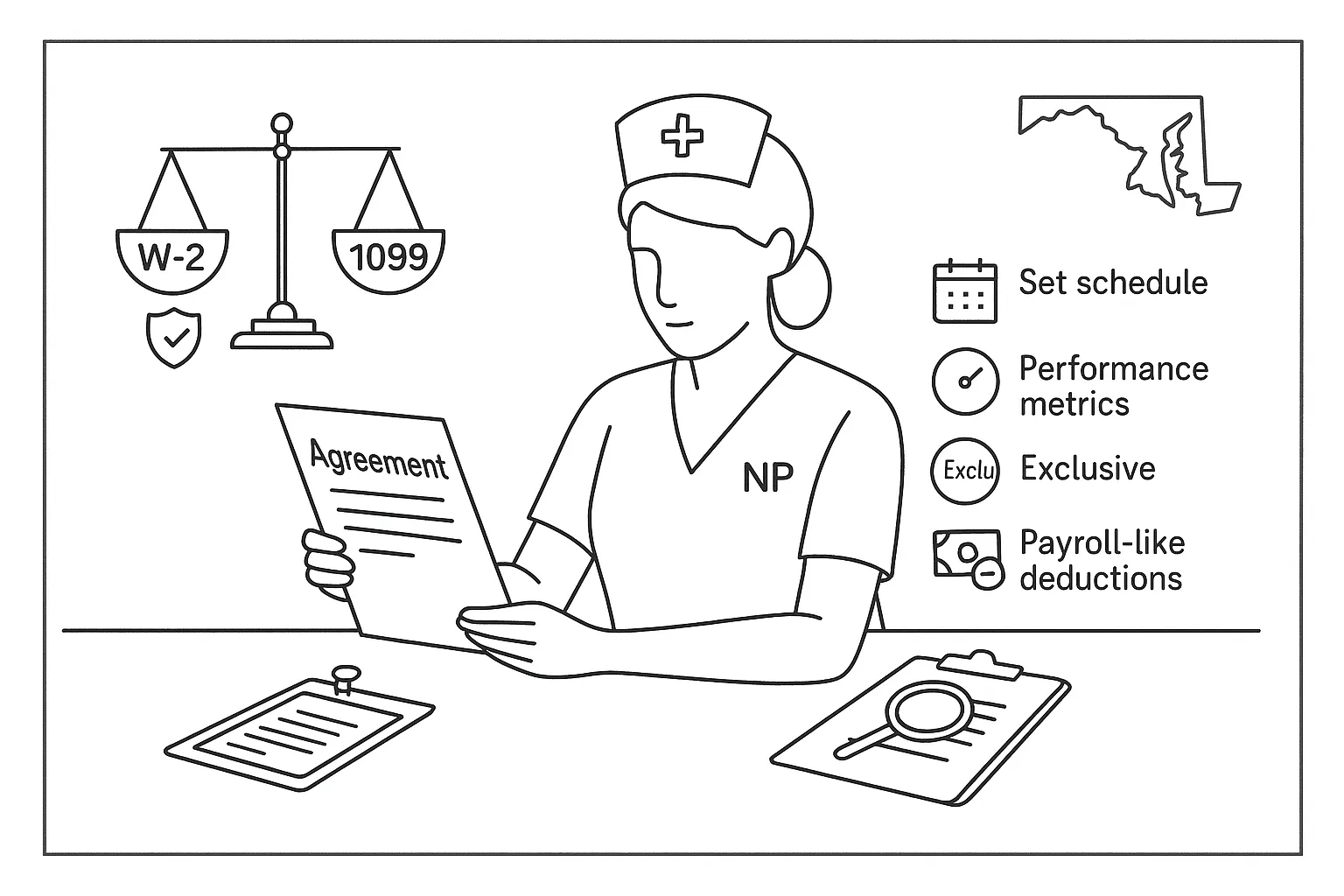
W-2 Employment and Independent Contractor Terms
Classification affects payroll withholding, benefits, expenses, worker protections, and the allocation of business risk. A W-2 employee may receive employer-sponsored benefits and payroll withholding, while a 1099 contractor generally assumes greater responsibility for taxes, insurance, and operating costs. The contract label alone does not reveal how the working relationship will function.
Review can examine scheduling control, exclusivity, performance standards, billing arrangements, equipment, support staff, reimbursement, and the ability to work elsewhere. For contractor offers, an independent contractor agreement review can identify unexpected expenses, unclear payment obligations, and provisions that materially limit professional independence. Contract analysis addresses the agreement’s legal and practical terms but does not replace tax advice.
Salary, Collections, RVUs, and Bonuses
Common compensation models include fixed salary, salary plus productivity, collections-based pay, and relative value unit formulas. Review can determine whether the agreement clearly defines the guarantee period, productivity threshold, conversion factor, payment timing, reconciliation method, and treatment of shortfalls. For collections-based compensation, the relevant language may distinguish billed charges, allowed amounts, and money actually received while accounting for refunds, denials, or chargebacks.
A percentage or productivity rate may appear favorable until deductions, collection delays, negative accrual, or post-termination payment rules are applied. A focused compensation and productivity review can test the formula against sample calculations and identify information the employer controls. The analysis may also flag whether leave, onboarding, credentialing delays, call coverage, or administrative work affects productivity credit.
Benefits and Service-Linked Incentives
Benefits can materially change the value of an offer. Relevant terms may include health and retirement eligibility, paid time off, continuing education, professional dues, licensing expenses, relocation assistance, student loan benefits, and signing bonuses. Review can compare the offer letter, benefits summary, and contract to identify inconsistencies or benefits left entirely subject to change.
Any incentive tied to continued service requires careful attention to repayment language. The documents may define a forgiveness schedule, prorated balance, repayment deadline, and triggering events differently. Analysis can determine whether repayment applies after resignation, termination without cause, disability, failure to obtain credentials, or another event outside the NP’s control.
Clinical Duties, Scheduling, and Practice Locations
Patient Care, Call, and Administrative Work
The agreement may define patient populations, clinical services, scheduling, call coverage, chart completion, administrative work, quality measures, and performance standards. Broad phrases such as “other duties as assigned” can make workload difficult to predict when they are not tied to specialty, licensure, reasonable scheduling, or location limits. Review can identify whether evening, weekend, holiday, call, or inbox responsibilities are included in base compensation or paid separately.
Multi-site provisions deserve particular attention in Maryland’s interconnected healthcare markets. The contract can be evaluated for named locations, travel expectations, mileage or expense reimbursement, remote-work rules, and the employer’s ability to add facilities. Telehealth terms may also affect scheduling, professional licensing, malpractice coverage, and the states in which patients are located.
Collaboration Language and Credentialing
Because Maryland does not impose general physician supervision for ordinary nurse practitioner practice, contract references to “supervision” or mandatory collaboration require context. They may describe internal reporting, specialty consultation, payer conditions, or facility procedures rather than a general state-law prerequisite to practice. A supervision and collaboration agreement review can clarify the stated relationship and flag provisions that conflict with the proposed role.
Credentialing language can also affect the start date and pay. Review can identify who submits applications, what cooperation is required, whether compensation begins before final approval, and what happens if enrollment takes longer than expected. The agreement may need to distinguish a regulatory inability to practice from an administrative delay controlled by the employer or facility.
Malpractice Coverage and Liability Allocation
Claims-Made, Occurrence, and Tail Coverage
No material Maryland nurse-practitioner-specific statute or regulation was identified that mandates malpractice insurance, a particular policy form, or tail coverage in an employment or contractor agreement. Coverage allocation therefore depends substantially on the contract, policy, and any applicable facility requirements. The agreement can be reviewed to identify the insurer, policy type, limits, named insureds, covered services, and responsibility for premiums.
Claims-made insurance generally must be active when a claim is reported, which may create a need for extended reporting coverage after departure. Occurrence coverage generally responds based on when the incident occurred, subject to the policy’s terms and limits. A malpractice and tail insurance review can clarify who pays for tail coverage and whether that obligation changes based on the reason employment ends.
Indemnification and Uninsured Exposure
Indemnification is separate from malpractice insurance. An indemnity clause may require the NP to reimburse the employer for specified losses, claims, penalties, or legal expenses, including matters the insurance policy does not cover. Broad language can transfer billing, documentation, employment, or business risks that extend beyond professional negligence.
Review can compare indemnification obligations with policy exclusions, defense costs, settlement authority, and notice requirements. It can also determine whether coverage extends to telehealth, approved outside work, services at multiple facilities, and duties performed before credentialing is complete. Any personal-liability language should be considered together with the contracting entity and insurance provisions.
Maryland Non-Competes and Post-Employment Restrictions
Compensation-Based Limits on Healthcare Non-Competes
Maryland law places specific limits on certain non-compete or conflict-of-interest restrictions for employees licensed under the Health Occupations Article. For a direct-patient-care employee earning more than $350,000 in total annual compensation, a covered restriction may last no more than one year after employment and extend no more than 10 miles from the primary place of employment. The statute also requires an employer to provide a former patient with the clinician’s new practice location upon request.
A non-compete or conflict-of-interest provision is generally void for an employee earning no more than 150% of the Maryland minimum wage, subject to statutory exceptions and protections for patient or client lists and other proprietary patient-related information. The statute’s application depends on the individual’s compensation, employee status, duties, and contract language. A nurse practitioner non-compete review can evaluate those details without assuming every restriction is treated identically.
Non-Solicitation, Confidentiality, and Outside Work
Post-employment restrictions may also include patient and employee non-solicitation, confidentiality, non-interference, and limits on using business information. These provisions require separate analysis even when a traditional non-compete is limited or unavailable. Review can identify the protected relationships, prohibited conduct, duration, remedies, and treatment of general professional knowledge or relationships developed before employment.
Moonlighting and conflict-of-interest clauses may operate during employment rather than after it. The agreement may restrict outside clinical work, telehealth, teaching, consulting, or ownership interests, sometimes without defining a competing activity. Analysis can determine whether prior approval is required, whether approval may be withdrawn, and whether the restriction affects professional activities unrelated to the employer’s business.
Termination, Repayment, and Dispute Provisions
For-Cause and Without-Cause Termination
Termination provisions determine how the relationship can end and which obligations survive. Review can distinguish termination for cause from termination without cause, assess the required notice period, and identify whether the NP has an opportunity to cure an alleged breach. Immediate termination events may address loss or restriction of a license, credentialing issues, exclusion from government programs, failure to maintain required insurance, or serious policy violations.
A nurse practitioner contract termination review can also evaluate final compensation, earned bonuses, unused leave, patient-transition duties, return of property, records access, and continuing restrictions. The notice period should be considered alongside scheduling obligations and any employer right to remove the NP from duties or compensation before the notice period expires.
Repayment, Arbitration, and Governing Law
Repayment clauses may apply to signing bonuses, relocation allowances, educational benefits, productivity advances, or other incentives. Analysis can calculate the potential balance, determine whether forgiveness is prorated, and identify which termination events trigger payment. The review may also flag provisions requiring immediate repayment or allowing deductions from final compensation.
Governing-law, forum-selection, and arbitration clauses establish where and how disputes are addressed. These terms may select a particular venue, allocate arbitration costs, restrict available procedures, or require advance notice before a claim may proceed. They are best understood before signing rather than after a compensation or termination dispute develops.
Preparing for a Maryland NP Contract Review
A complete review requires more than the signature page. Relevant materials include the proposed agreement, offer letter, compensation exhibits, amendments, referenced policies, benefits summaries, restrictive-covenant documents, malpractice information, and material written communications. Historical productivity information or sample calculations can be useful when the offer includes collections, RVUs, bonuses, or periodic reconciliation.
- Confirm the base salary, guarantee period, productivity formula, payment schedule, deductions, and treatment of negative accrual.
- Identify each practice location, scheduling requirement, call obligation, telehealth expectation, and credentialing responsibility.
- Compare the stated clinical role with Maryland licensure, certification, scope-of-practice, prescribing, and dispensing requirements.
- Verify the malpractice policy type, coverage limits, tail responsibility, defense terms, exclusions, and indemnification obligations.
- Measure post-employment restrictions and calculate repayment exposure under each possible termination scenario.
- Review notice, final-pay, dispute-resolution, governing-law, and surviving-obligation provisions together.
Chelle Law’s review process can include document intake, line-by-line analysis, identification of financial and professional risks, and an attorney-led discussion of practical tradeoffs. The purpose is to explain the proposed terms, highlight provisions that may warrant clarification or revision, and help the nurse practitioner make a more informed decision.
Speak With a Maryland Nurse Practitioner Contract Lawyer Before You Sign
Chelle Law can review your proposed agreement, identify compensation and liability risks, explain Maryland-specific provisions, and flag terms that may warrant clarification or revision.
Request a Contract Review