
A Montana nurse practitioner agreement can shape compensation, clinical responsibilities, liability exposure, and future employment long after the start date. The Montana Board of Nursing and Montana Department of Labor and Industry are central to the state’s professional licensing framework, and Montana classifies nurse practitioners as advanced practice registered nurses. Contract review can compare the position’s duties and prescribing expectations with the NP’s Montana RN and APRN licensure, certification scope, and prescriptive-authority authorization. That analysis is important whether the position is in Billings, Missoula, Bozeman, Helena, or a rural community where reassignment language and travel obligations may cover substantial distances. It can also identify whether employer policies, productivity expectations, telehealth duties, or internal supervision provisions create obligations beyond what was described during recruitment. The goal is to understand how the complete agreement operates before accepting the financial and professional risks attached to the position.
Compensation formulas, malpractice coverage, termination rights, repayment clauses, and post-employment restrictions often interact. For example, an NP may provide notice correctly but still face a signing-bonus repayment, responsibility for tail insurance, an unfinished productivity reconciliation, or restrictions affecting the next position. Chelle Law provides attorney-led, line-by-line nurse practitioner contract review to identify those connections, explain practical consequences, and flag provisions that may warrant clarification or revision.
Why Montana NP Contracts Require a Complete Review

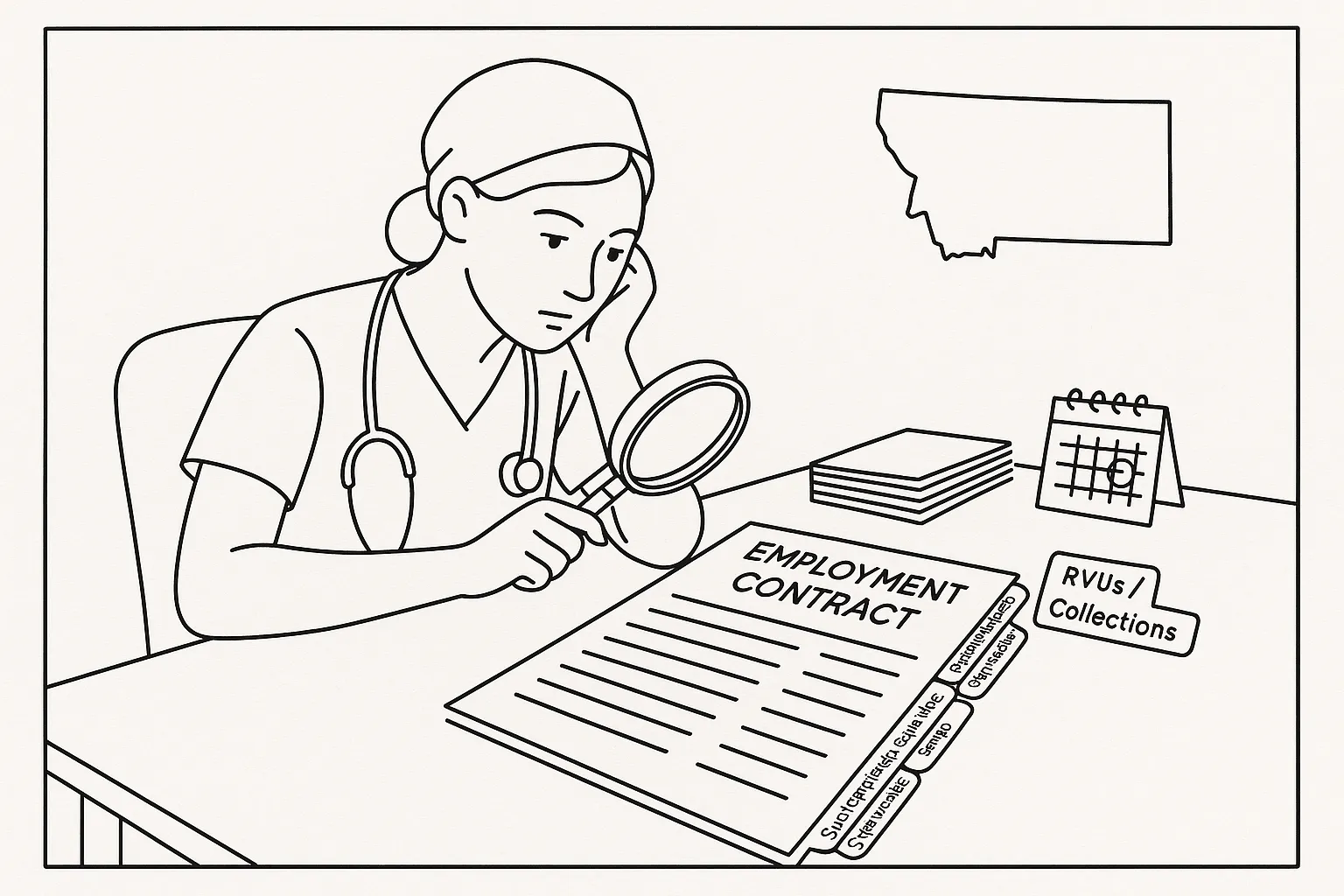
Review the Entire Contract Package
The primary agreement rarely contains every material term. Compensation plans, benefit summaries, restrictive-covenant exhibits, malpractice policies, handbooks, offer letters, and location schedules may contain obligations incorporated into the contract. Review can determine whether those documents are complete, internally consistent, and aligned with promises made during recruitment.
Undefined policies create additional uncertainty when the employer retains broad authority to change productivity standards, schedules, work locations, or professional duties. Important promises concerning call, remote work, bonuses, start dates, or clinic assignments are easier to evaluate when they appear in the signed agreement or an incorporated addendum.
Translate Contract Language Into Practical Risk
Contract terms matter because they allocate income, professional control, and financial responsibility. Broad for-cause definitions, delayed collections accounting, repayment provisions, or unclear clinical-control language can create consequences that are not apparent from the stated salary.
A developed review evaluates how provisions work together rather than labeling individual clauses as favorable or unfavorable. That analysis may reveal unpaid post-termination collections, a negative accrual balance, tail-insurance responsibility, uncompensated call, or reassignment authority that affects the feasibility of the position.
Compensation, Bonuses, and Employment Classification
Base Salary and Productivity Formulas
Montana NP compensation may include a guaranteed salary, collections percentage, RVU formula, encounter-based payment, or a combination of base pay and incentives. Analysis can identify the payment schedule, productivity threshold, conversion factor, reconciliation period, and treatment of refunds, denials, chargebacks, and services performed shortly before termination. A focused compensation and productivity review can determine whether the headline amount depends on assumptions controlled by the employer.
- Guaranteed compensation: Review payment frequency, prorated calculations, start-date conditions, and any authority to reduce the stated amount.
- Collections: Identify when receipts are credited, how refunds and payer denials are handled, and whether accounting reports are available.
- RVUs: Confirm the credited RVU measure, threshold, conversion factor, exclusions, reporting schedule, and effect of leave or credentialing delays.
- Final reconciliation: Determine whether the NP remains eligible for productivity compensation generated before departure but calculated or collected later.
Bonuses, Negative Accrual, and Accounting Rights
Bonus language may depend on productivity, quality measures, patient satisfaction, continued employment, or an employer’s discretionary determination. Review can clarify when a bonus becomes earned, whether the formula can change during the measurement period, and whether termination before the payment date results in forfeiture.
Negative accrual requires particular attention. A shortfall may carry forward, reduce future bonuses, offset final compensation, or become a repayment claim at termination. The agreement may also need clarification concerning access to reports and the process for questioning calculations.
W-2 Employment and 1099 Contractor Terms
The economic effect of a position depends partly on whether it is structured as employment or independent contractor work. A 1099 agreement may allocate taxes, benefits, professional expenses, insurance, scheduling, equipment, billing, and administrative support differently from a W-2 arrangement. The written allocation of control and expenses also needs to match the position described during recruitment.
Chelle Law’s NP independent contractor agreement review examines payment timing, termination, insurance, expenses, control provisions, and obligations that continue after the engagement ends.
Malpractice Coverage and Clinical Responsibilities
Professional Liability and Tail Insurance
The contract may identify the professional liability policy type, limits, premium responsibility, exclusions, and coverage period. Claims-made coverage can create a separate tail-coverage issue after the relationship ends, while occurrence coverage operates differently. Review can determine whether the agreement clearly allocates that responsibility or leaves a potentially significant cost unresolved.
A malpractice and tail insurance review can also evaluate reimbursement language, conditions tied to the reason for termination, and inconsistencies between the employment agreement and insurance provisions. Separate indemnification language deserves attention because it may address risks beyond the malpractice policy itself.
Montana Scope and Prescriptive Authority
Montana treats nurse practitioners as APRNs, and the Montana Board of Nursing establishes APRN licensure qualifications and rules governing prescriptive authority. Contract review can compare the listed services, patient population, prescribing expectations, and administrative responsibilities with the NP’s certification scope and Board authorization. An agreement cannot itself expand the NP’s legal qualifications or authorize practice beyond the applicable professional scope.
Montana law permits an APRN, when acting within the APRN’s certification scope, to satisfy certain signature, certification, verification, affidavit, or endorsement requirements imposed on physicians. That authority does not expand the APRN’s scope of practice. Contract language assigning forms, certifications, or prescribing responsibilities therefore requires evaluation in the context of the particular role and the NP’s authorization.
Scheduling, Call, Locations, and Credentialing
Clinical expectations extend beyond the general job description. The agreement may address patient volume, chart completion, call frequency, weekend coverage, administrative time, telehealth, schedule changes, and assignments at additional locations. If pay depends on productivity, review can determine whether call, telehealth encounters, administrative work, and services at satellite clinics receive credit.
Location clauses are especially important when Montana facilities are separated by substantial distances. Analysis can identify reassignment authority, travel reimbursement, remote-work conditions, and whether rural service commitments interact with bonuses or repayment provisions. Licensing, credentialing, required training, DEA registration, and related fees may also need a clear allocation, along with the effect of credentialing delays on the start date and initial compensation.
Termination, Final Compensation, and Repayment
Without-Cause Notice and For-Cause Events
Termination provisions may address without-cause notice, immediate termination events, cure opportunities, paid or unpaid status during the notice period, and employer authority to remove the NP from the schedule. Broad for-cause language can affect compensation, repayment, insurance, and eligibility for other post-employment rights.
A nurse practitioner termination review can clarify the required notice method, effective date, final scheduling obligations, and provisions that survive departure. It can also identify whether pending bonuses, accrued leave, collections, or productivity payments are addressed expressly.
Signing Bonuses, Relocation, and Other Repayment Clauses
Signing bonuses, relocation allowances, training expenses, student-loan benefits, compensation guarantees, and advances may be subject to repayment. The financial effect depends on the forgiveness schedule, triggering events, prorated treatment, payment deadline, and whether the employer can deduct the amount from final compensation.
Repayment terms are most useful when evaluated alongside termination and malpractice provisions. An NP who follows the required notice process could still face repayment or tail-insurance costs if those obligations are triggered by any departure before a specified date. Review can calculate the potential exposure under different exit scenarios without assuming that every obligation applies automatically.
Montana Non-Competes and Post-Employment Restrictions
Montana’s Restraint-of-Trade Framework
Montana generally treats contracts restraining a person from exercising a lawful profession, trade, or business as void except where a statutory exception applies. One exception addresses specified restrictions associated with partnership dissolution, which is distinct from an ordinary employee’s departure. The contract’s structure and the nature of the restriction therefore matter to the analysis.
Montana also has a statutory prohibition covering post-employment restrictions for certain listed behavioral-health providers. Nurse practitioners are not included in that list, so that profession-specific prohibition should not be assumed to resolve an NP covenant. Analysis instead remains principally tied to Montana’s general restraint-of-trade statutes and applicable case law.
Geographic Reach, Restricted Activities, and Related Clauses
A restrictive covenant may limit work for another organization, particular services, contact with patients or staff, or activity within a defined geographic area. Its practical effect depends on the duration, locations included, triggering events, restricted conduct, and stated remedies. Language covering multiple facilities or a broad radius can be consequential in a state where alternative positions may be separated by long travel distances.
A focused nurse practitioner non-compete review can evaluate the restriction with confidentiality, non-solicitation, patient-transition, liquidated-damages, and repayment provisions. Even when enforceability is uncertain, broad language may affect future employment decisions and create potential dispute costs.
Montana Nurse Practitioner Pre-Signing Checklist
- Obtain the agreement and every referenced exhibit, policy, compensation plan, offer letter, and addendum.
- Confirm the base compensation, productivity metric, threshold, conversion factor, reconciliation schedule, bonus rules, and negative accrual terms.
- Identify whether the relationship is W-2 employment or 1099 contractor work and evaluate the allocation of control, expenses, taxes, and benefits.
- Compare clinical and prescribing duties with Montana APRN licensure, certification scope, and prescriptive-authority authorization.
- Review the malpractice policy type, limits, premium responsibility, tail obligation, indemnification language, and reimbursement terms.
- Clarify patient volume, schedule changes, call, telehealth, administrative time, work locations, and travel reimbursement.
- Evaluate without-cause notice, for-cause definitions, cure rights, final compensation, post-termination collections, and surviving duties.
- Calculate potential repayment for bonuses, relocation assistance, training, advances, or other benefits under different departure scenarios.
- Measure the practical effect of non-compete, non-solicitation, confidentiality, patient-transition, and liquidated-damages provisions.
- Document material promises about schedule, location, bonuses, call, start dates, and remote work in the signed contract package.
Speak With a Montana Nurse Practitioner Contract Lawyer Before You Sign
Chelle Law provides remote, attorney-led review of nurse practitioner employment and independent contractor agreements. The review explains compensation, malpractice, scope, termination, repayment, and restrictive-covenant terms while identifying provisions that may warrant clarification or revision.
Request a Contract ReviewExplore Nurse Practitioner Contract Guidance
Review related services, educational resources, and state-specific nurse practitioner contract information from Chelle Law.