
A Nebraska nurse practitioner employment or independent contractor agreement must account for both the business terms of the position and the professional rules administered by the Nebraska Board of Nursing and the Nebraska Board of Advanced Practice Registered Nursing. Nebraska regulates nurse practitioners as advanced practice registered nurses, defines their clinical and prescribing authority, requires professional liability insurance, and imposes a formal transition-to-practice framework on NPs who are not exempt. In healthcare markets such as Omaha, Lincoln, and Grand Island, an agreement may also determine practice locations, call coverage, productivity expectations, credentialing deadlines, and whether compensation begins before payer enrollment is complete. Contract review can compare those provisions with the NP’s credentialed specialty and intended role while identifying terms that may create regulatory uncertainty, unexpected liability, or restrictions on future employment.
Chelle Law provides attorney-led nurse practitioner contract review focused on compensation, scope of practice, malpractice coverage, termination, repayment obligations, restrictive covenants, and other material risks. The goal is to explain how the written terms operate, identify provisions that warrant clarification or revision, and help the NP make an informed decision before signing.
Nebraska Practice Authority, Transition Requirements, and Credentialing

Scope of Practice, Prescribing, and Clinical Duties
Nebraska nurse practitioners may provide healthcare within their specialty area, including assessing and diagnosing patients, ordering diagnostic and therapeutic measures, treating and managing common acute and chronic conditions, and prescribing therapeutic measures and medications within their scope. A patient who requires care beyond that scope must be referred. Contract analysis can determine whether the assigned patient population, procedures, prescribing duties, telehealth services, call obligations, and work locations are consistent with the NP’s credentials and the position described during recruitment.
Broad provisions allowing an employer to add duties, locations, or schedules unilaterally may create responsibilities that were not reflected in the compensation package. Review can also distinguish legal practice requirements from internal policies concerning chart review, quality oversight, referrals, scheduling, and physician availability.
Nebraska Transition-to-Practice Agreements
For an NP subject to Nebraska’s transition-to-practice requirement, the arrangement must be formal and written. It must provide for collaborative practice within each practitioner’s scope, identify supervisory responsibility and ready availability for consultation, and address joint responsibility for patient care. Certain NPs who were licensed in good standing by August 30, 2015, and satisfied the required prior supervised-practice conditions are exempt, so the agreement must be evaluated against the individual NP’s status rather than a generic assumption.
An employment agreement may refer to a separate transition, supervision, or collaboration document without explaining which document controls if the terms conflict. A focused review of supervision and collaboration terms can identify unclear responsibilities, unavailable supervision, inconsistent termination provisions, or requirements that unnecessarily exceed the applicable Nebraska framework.
Licensure, Credentialing, and Start-Date Conditions
Agreements often allocate responsibility for Nebraska licensure, APRN credentials, board certification, prescribing credentials, DEA registration, hospital privileges, payer enrollment, and renewals. Review can clarify who completes each step, who pays the associated fees, and what happens when approval is delayed for reasons outside the NP’s control.
- Determine whether salary begins on a fixed date, the first day of orientation, or only after credentialing is complete.
- Identify conditions that allow the employer to postpone the start date or terminate the agreement.
- Clarify responsibility for licensing, registration, credentialing, and renewal expenses.
- Evaluate whether credentialing delays affect bonuses, benefits, repayment periods, or guaranteed compensation.
Compensation, Productivity, Benefits, and Classification
Salary, RVUs, Collections, and Bonus Formulas
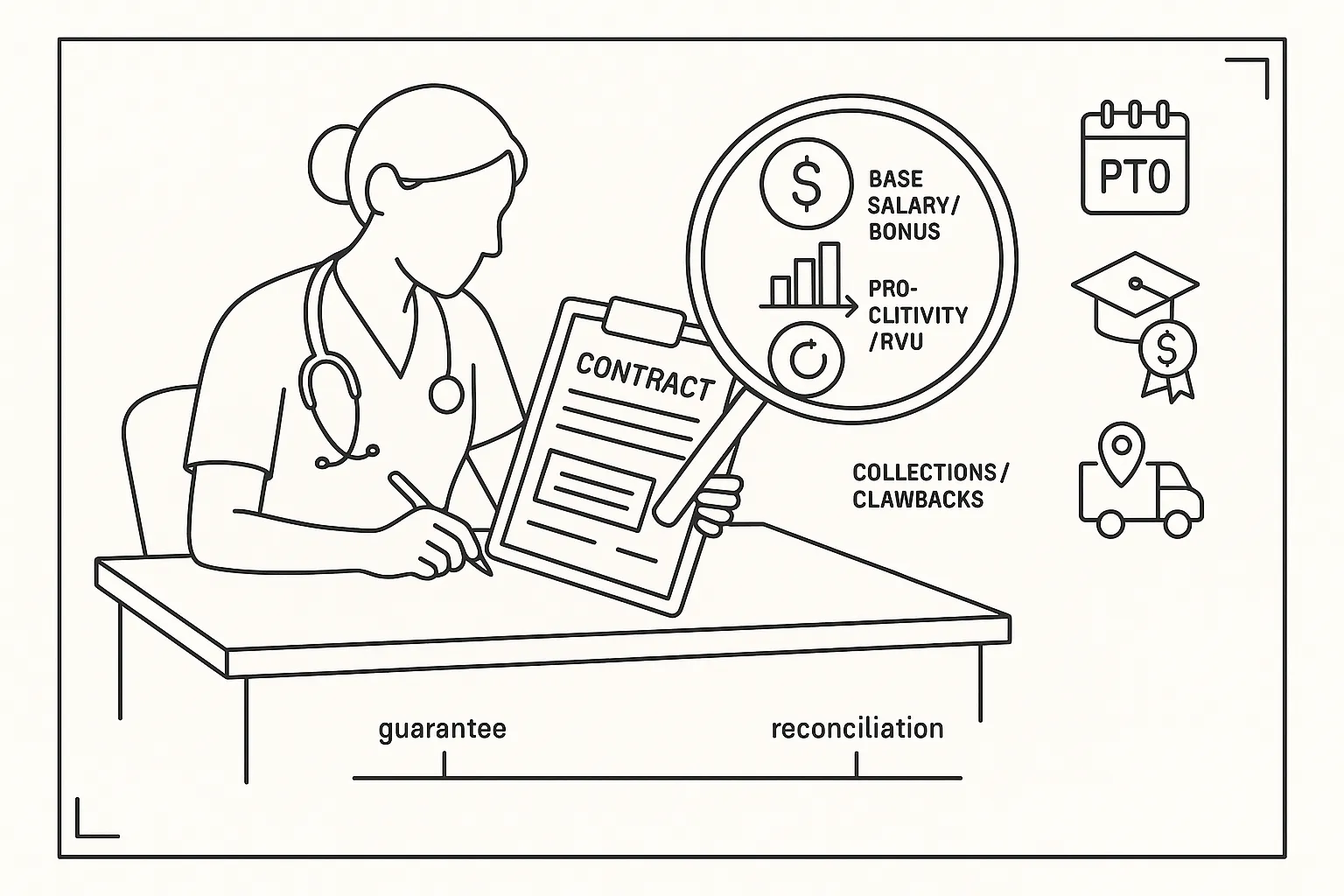
Nebraska NP agreements may combine guaranteed salary with incentives based on work relative value units, collections, encounters, quality measures, or a hybrid formula. Analysis can identify the guarantee period, productivity threshold, conversion factor, measurement period, payment schedule, and conditions that permit the employer to reduce or withhold compensation. Objective formulas generally provide more clarity than bonus language controlled entirely by employer discretion.
RVU provisions may need to address the applicable schedule, credit for shared visits, procedure allocation, data access, and reconciliation. Collections-based formulas raise separate questions concerning payer delays, denials, refunds, write-offs, chargebacks, and collections received after termination. An NP compensation and productivity review can test whether the formula is understandable, independently verifiable, and consistent with the proposed clinical setting.
Negative accrual also warrants close review. The written terms may determine whether a production shortfall is forgiven, carried forward, deducted from later incentives, or converted into a repayment obligation when employment ends.
Benefits, Repayment Terms, and Worker Classification
Health coverage, retirement contributions, paid leave, continuing education funds, signing bonuses, relocation assistance, and student-loan benefits can materially affect total compensation. Contract review can compare eligibility dates, vesting schedules, leave accrual, carryover rules, final payouts, and service periods attached to each benefit. Repayment language may also distinguish resignation from termination without cause and may prorate the obligation as the NP completes the required service period.
A 1099 label does not alone establish independent contractor status. Under a Nebraska statutory employment test, relevant considerations include whether the worker is free from control, performs services outside the hiring party’s usual course or places of business, and is customarily engaged in an independently established profession or business. For a contractor arrangement, the agreement also may allocate taxes, benefits, insurance, equipment, billing expenses, scheduling control, and professional compliance costs differently from a W-2 employment agreement.
Professional Liability Insurance and Contractual Exposure
Required Coverage and Tail Responsibility
Nebraska nurse practitioners must maintain professional liability insurance with coverage and limits established by the Board, and a facility may impose additional reasonable insurance requirements. The contract can identify the policy type, limits, covered services, named insureds, premium responsibility, and whether coverage extends to telehealth, call duties, multiple facilities, or outside activities performed for the employer.
Occurrence coverage generally responds to an incident that occurred while the policy was active, regardless of when the claim is later asserted. Claims-made coverage generally requires active coverage when the claim is made, creating a potential need for extended reporting or tail coverage after the relationship ends. Nebraska does not assign tail responsibility to an NP employer through a profession-specific rule identified for this review, making the written allocation especially important. A malpractice and tail insurance review can explain the cost allocation and separation events that trigger it.
Indemnification, Cooperation, and Post-Employment Planning
Indemnification clauses may impose obligations beyond the malpractice policy, including reimbursement of defense costs, losses, or liabilities attributed to an alleged contract breach. Review can determine whether the provision distinguishes insured professional negligence from uninsured contractual indemnity and whether obligations are mutual or one-sided.
Nebraska’s framework for qualifying malpractice claims generally uses a two-year limitations period, subject to a discovery exception and an outside ten-year repose period. Those timeframes may affect decisions concerning tail coverage, access to records, claim reporting, and post-employment cooperation. The contract may also address who controls the defense and whether the former NP must assist without compensation or reimbursement for expenses.
Nebraska Non-Competes and Related Restrictions
Non-Compete Enforceability and Practical Scope
Nebraska employee noncompetition covenants are evaluated for reasonableness, public impact, the employer’s legitimate business interest, and whether the restriction is unduly harsh or oppressive. Protection generally must be directed toward unfair competition, such as misuse of customer goodwill or confidential information, rather than ordinary competition. Nebraska courts do not simply rewrite an unreasonable employee covenant to make it enforceable, so the original language deserves careful analysis before signing.
- Map every facility, mileage radius, county, and other geographic measurement used in the restriction.
- Determine whether the clause restricts all NP work or only services that compete with the employer.
- Identify the patients, referral relationships, confidential information, or goodwill the employer seeks to protect.
- Review which separation events trigger the covenant, including termination without cause.
- Evaluate any waiver, buyout, liquidated-damages, or garden-leave provision.
A nurse practitioner non-compete review can translate the clause into its practical effect on future opportunities in Omaha, Lincoln, Grand Island, and surrounding communities. Nebraska also has a rule scheduled to become operative July 1, 2027, that bars healthcare staffing agencies from placing specified noncompete clauses in contracts with workers or healthcare entities. Its application depends on timing and whether the arrangement falls within the statute’s staffing-agency framework; it does not replace the broader analysis of ordinary employment covenants.
Non-Solicitation, Confidentiality, and Outside Work
Non-solicitation provisions may address patients, employees, referral sources, vendors, or other business relationships. Analysis can clarify whether “solicit” means active targeted outreach or is drafted broadly enough to reach passive responses, general advertising, or patient-initiated contact. Confidentiality language can likewise be assessed to distinguish proprietary information from general professional knowledge and information the NP may lawfully use or disclose.
Moonlighting, telehealth, and conflict-of-interest restrictions may operate like additional non-competes during employment. The agreement may require advance approval, restrict work across an employer’s affiliates, or claim ownership of outside revenue. These provisions are best read together with schedule expectations, exclusivity requirements, intellectual-property terms, and the post-employment covenants.
Termination, Repayment, and Dispute Terms
For-Cause and Without-Cause Termination
Termination provisions determine how quickly either party can end the relationship and what occurs during the notice period. For-cause language may define events involving licensure, credentials, patient safety, policy violations, exclusion from federal programs, or alleged misconduct. Review can identify whether a remediable issue carries written notice and a cure opportunity or permits immediate termination based solely on the employer’s determination.
Without-cause terms may establish a notice period while allowing the employer to remove the NP from the schedule, discontinue bonus accrual, or pay salary in lieu of continued work. Final-compensation language can address earned incentives, productivity through the last day, accrued leave, expense reimbursement, collections received later, and access to supporting data. A contract termination review can clarify continuing duties and financial consequences before notice is given or a separation document is signed.
Clawbacks, Governing Law, and Arbitration
Clawbacks may apply to signing bonuses, relocation assistance, student-loan benefits, training expenses, or compensation guarantees. The financial effect often depends on why employment ends, whether repayment is prorated, when the debt becomes due, and whether the employer claims authority to deduct it from final compensation. These provisions should be compared directly with the termination section and any separate bonus or relocation agreement.
Governing-law, venue, and arbitration clauses determine how and where disputes are resolved. Mandatory arbitration may affect procedures, discovery, costs, appeal rights, and available remedies, while an out-of-state forum may add expense and inconvenience. Review can also identify fee-shifting, shortened claim periods, jury waivers, and provisions allowing one party to obtain emergency court relief despite a general arbitration requirement.
Nebraska Nurse Practitioner Contract Review Checklist
Before signing, confirm that the complete agreement—including exhibits, policies, offer letters, bonus documents, and any transition-to-practice arrangement—answers the following questions in clear and consistent language:
- Are the specialty, clinical duties, patient population, locations, schedule, call coverage, and administrative work defined?
- Do prescribing, referral, supervision, collaboration, and transition-to-practice terms match the NP’s Nebraska status?
- Can salary, bonuses, RVUs, collections, quality incentives, and negative accrual be calculated and audited?
- Who pays for licensure, credentialing, DEA registration, malpractice premiums, and any required tail coverage?
- How do credentialing delays affect the start date, compensation, benefits, and termination rights?
- What happens to earned compensation, benefits, insurance, and repayment obligations when the relationship ends?
- How would each non-compete, non-solicitation, confidentiality, or outside-work restriction affect realistic career options?
- Does the employer retain unilateral authority to change compensation, duties, policies, schedules, or work locations?
Potential warning signs include discretionary bonus language without objective metrics, unexplained collections deductions, claims-made insurance without a clear tail allocation, broad indemnification, immediate repayment triggers, undefined geographic restrictions, and termination provisions that provide little notice or no opportunity to cure. Reviewing these terms before signing creates time to request clarification, compare the offer with alternatives, and understand the consequences of accepting the position.
Speak With a Nebraska Nurse Practitioner Contract Lawyer Before You Sign
Chelle Law can review the proposed agreement, identify compensation and liability risks, explain restrictive covenants and termination terms, and flag provisions that may warrant clarification or revision.
Request a Contract Review