
When a nurse practitioner accepts a position in Nebraska—whether practicing in Omaha, Lincoln, Grand Island, or another Nebraska healthcare market—the employment or independent contractor agreement governs far more than salary. It may define productivity expectations, scope of duties, malpractice coverage, termination rights, repayment obligations, and post-employment restrictions. Those terms must also operate within Nebraska’s professional and licensing framework, including oversight by the Nebraska Board of Nursing and the Nebraska Uniform Credentialing Act, Neb. Rev. Stat. § 38-101 et seq.
A Nebraska nurse practitioner contract review identifies how employer-drafted provisions may affect earnings, regulatory responsibilities, liability exposure, and future career mobility. Chelle Law reviews agreements line by line, explains their practical consequences, and highlights provisions that warrant clarification before signing. NPs offered contractor-based arrangements should also examine how classification, expenses, benefits, and professional obligations are allocated through an independent contractor agreement review.
Key Contract Review Priorities for Nebraska Nurse Practitioners
- Confirm that the agreement’s scope-of-practice, prescribing, supervision, collaboration, and delegation terms align with Nebraska requirements and the actual clinical role.
- Require precise compensation language defining base salary, bonus formulas, RVU or collections calculations, reconciliation, negative accrual, and audit rights.
- Identify whether malpractice coverage is occurrence-based or claims-made and determine who must pay for tail coverage after termination.
- Evaluate non-compete, non-solicitation, confidentiality, and repayment provisions for their practical effect on professional mobility.
- Review termination notice, cure rights, final compensation, and dispute-resolution terms before committing to the position.
Nebraska Scope of Practice, Licensing, and Credentialing Terms

Clinical Duties, Prescribing, and Employer Policies
A Nebraska NP agreement should describe clinical duties clearly enough to compare them with applicable licensing rules and the position presented during recruitment. Provisions involving prescribing, controlled substances, telehealth, off-site procedures, call coverage, chart review, or delegated tasks deserve particular attention. Broad language allowing the employer to add duties unilaterally may create unpaid work expectations or assign responsibilities that were not contemplated when the NP accepted the role.
Contracts may also use terms such as “supervision,” “collaboration,” and “delegation” without defining what they require. The agreement should distinguish legal or licensing obligations from internal employer policies and explain the frequency, format, and documentation expected for physician involvement. A focused review of supervision and collaboration terms can identify provisions that unnecessarily limit autonomy or create unclear compliance responsibilities.
Licensure, Credentialing, and DEA Responsibilities
Employment agreements routinely allocate responsibility for professional licensure, renewals, board certification, hospital privileges, payer enrollment, credentialing, and DEA registration. The contract should state who completes each step, who pays the related fees, and whether employment or compensation depends on approval by a particular date.
- Determine whether the employer reimburses licensing, credentialing, and registration expenses.
- Review the consequences of delayed privileges, enrollment, or credentials, especially when the delay is outside the NP’s control.
- Clarify whether salary begins on a fixed date or only after credentialing is complete.
- Identify any termination right tied to licensure, prescribing authority, credentialing, or hospital privileges.
Compensation, Productivity, and Benefits
Base Salary, Bonuses, and Productivity Formulas
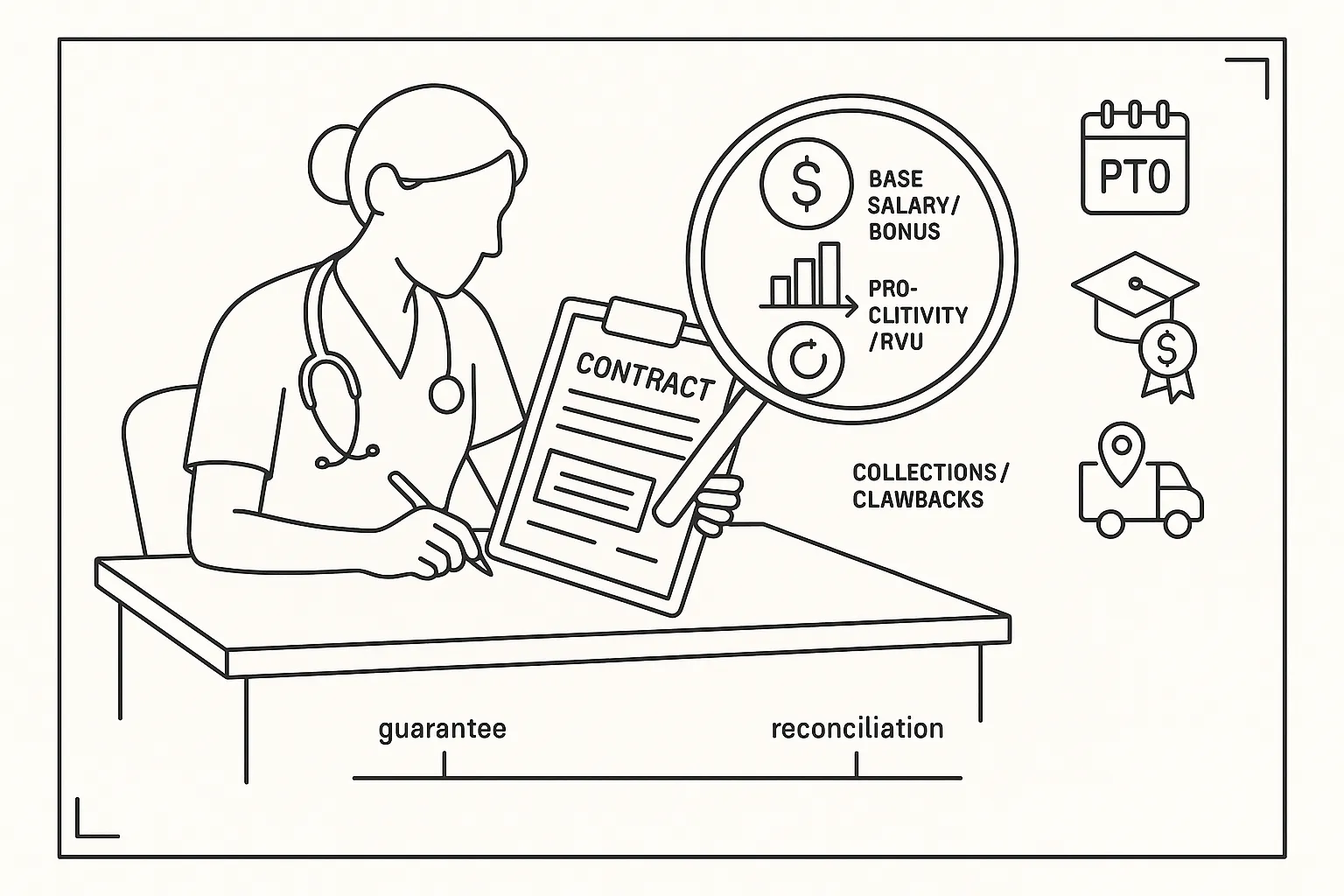
Many Nebraska NP agreements combine guaranteed base compensation with productivity or quality incentives. The contract should define the guarantee period, measurement period, payout schedule, eligibility requirements, and circumstances under which compensation may be reduced or suspended. Bonus language should be measurable rather than dependent entirely on employer discretion.
Productivity may be measured through work relative value units, collections, encounters, or a hybrid formula. RVU provisions should identify the applicable schedule, conversion factor, credit for shared visits, and reconciliation process. Collections-based arrangements should explain how denials, refunds, payer delays, write-offs, and chargebacks affect compensation. A detailed NP compensation and productivity review can test whether the formula is understandable, auditable, and consistent with the actual practice setting.
Negative accrual deserves particular attention. If production falls below a guarantee, the agreement should state whether the shortfall is forgiven, carried forward, deducted from future compensation, or treated as a repayment obligation when employment ends. Audit rights and access to the employer’s underlying productivity data are also important when compensation depends on calculations controlled by the employer.
Benefits, Paid Leave, and Repayment Conditions
Health insurance, retirement contributions, continuing education allowances, paid time off, loan assistance, signing bonuses, and relocation payments can materially increase total compensation, but they often come with eligibility or repayment conditions. Review vesting schedules, PTO accrual and carryover rules, final payout provisions, and any service period required to retain a benefit.
Repayment language should distinguish resignation from termination without cause and should state whether an obligation is prorated over time. An NP should also understand whether the employer may deduct an alleged debt from final wages or other compensation and how the amount will be calculated.
Malpractice Insurance, Tail Coverage, and Indemnification
Malpractice provisions should identify the coverage type, policy limits, covered activities, and the party responsible for premiums. An occurrence policy generally covers incidents occurring during the policy period regardless of when a claim is later asserted. Claims-made coverage generally requires the policy to remain active when the claim is made, which creates a potential need for tail coverage after employment ends.
The contract should state who purchases tail coverage and whether responsibility changes depending on the reason for separation. It should also address coverage for telehealth, call duties, work at multiple locations, and other services performed for the employer. Chelle Law’s malpractice and tail insurance review examines these allocations before they become an unexpected post-employment expense.
Indemnification and cooperation clauses require separate review because they may create obligations beyond the insurance policy. Broad language requiring the NP to reimburse the employer for losses, defense costs, or alleged contract breaches can create personal exposure. The agreement should clearly distinguish insured professional liability from contractual indemnity obligations.
Nebraska Non-Competes and Other Post-Employment Restrictions
Non-Compete Scope and Career Mobility
A non-compete may restrict the type of work an NP can perform, the geographic area in which the NP can practice, and the period during which the restriction applies. In Nebraska, the language should be evaluated in light of applicable state law, the employer’s asserted business interest, and the practical effect on the NP’s ability to continue working in the relevant market.
- Identify the locations, facilities, and geographic measurements used to define the restricted area.
- Determine whether the restriction applies to all NP work or only services that compete with the employer.
- Review which separation events trigger the restriction, including termination without cause.
- Examine any buyout, waiver, garden-leave, or liquidated-damages provision.
A nurse practitioner non-compete review translates the restriction into its likely effect on future opportunities in Omaha, Lincoln, Grand Island, and other locations where the NP may wish to practice.
Non-Solicitation and Confidentiality Terms
Non-solicitation provisions may restrict contact with patients, employees, referral sources, or business relationships after the contract ends. The agreement should define “solicit” and clarify whether it prohibits only active outreach or also attempts to restrict passive responses to patients or colleagues. Confidentiality provisions should protect legitimate proprietary information without being drafted so broadly that routine professional knowledge or lawful career activity becomes restricted.
Termination, Repayment, and Dispute Resolution
For-Cause and Without-Cause Termination
Termination clauses determine how quickly an NP can leave and how quickly the employer can end the relationship. For-cause provisions should define the triggering conduct and identify whether the NP receives notice and an opportunity to cure a remediable issue. Without-cause termination language should specify the required notice period and whether the employer may remove the NP from the schedule, stop incentive accrual, or pay compensation in lieu of notice.
Final compensation provisions should address unpaid bonuses, completed productivity, accrued leave, expense reimbursement, and compensation earned during a notice period. Before giving notice or responding to an employer’s termination decision, an NP may benefit from a contract termination review focused on continuing duties and financial consequences.
Clawbacks, Governing Law, and Arbitration
Clawbacks may require repayment of signing bonuses, relocation assistance, loan benefits, training costs, or compensation guarantees. The agreement should identify each trigger, establish whether repayment is prorated, and explain whether termination without cause activates the obligation. These terms should be reviewed together with the termination section because their financial impact often depends on how and why employment ends.
Governing-law, venue, and arbitration provisions determine where and how disputes will be resolved. Mandatory arbitration may affect available procedures, discovery, costs, and remedies, while an out-of-state venue can create practical disadvantages. These procedural terms may be consequential even though they do not affect daily clinical work.
Nebraska NP Contract Review Checklist
Before signing, confirm that the agreement answers the following questions in clear language:
- Are clinical duties, locations, schedules, call coverage, and productivity expectations defined?
- Do prescribing, collaboration, supervision, and delegation provisions align with the intended Nebraska practice?
- Can base salary, bonuses, RVUs, collections, and negative accrual be independently calculated and audited?
- Who pays for licensure, credentialing, DEA registration, malpractice insurance, and tail coverage?
- What happens to compensation, benefits, and repayment obligations when the agreement terminates?
- How would a non-compete or non-solicitation clause affect realistic future employment options?
- Does the employer retain unilateral authority to change compensation, duties, policies, or work locations?
Common warning signs include discretionary bonus language without objective metrics, unexplained collections deductions, claims-made coverage without clear tail allocation, broad repayment triggers, undefined geographic restrictions, and termination provisions that allow immediate employer action without comparable protection for the NP. Reviewing these issues before signing provides more opportunity to seek clarification and make an informed decision.
Get Your Nebraska NP Contract Reviewed
Chelle Law reviews Nebraska nurse practitioner employment and independent contractor agreements for compensation, liability, termination, repayment, and professional mobility risks.
Contact Chelle Law