
A New Jersey nurse practitioner contract can affect clinical authority, prescribing responsibilities, compensation, malpractice exposure, and the ability to change jobs. The New Jersey Board of Nursing and the New Jersey Division of Consumer Affairs, Department of Law and Public Safety oversee the professional framework for advanced practice nurses, the statutory term that includes nurse practitioners in New Jersey. Agreements for positions in Newark, Jersey City, and other healthcare markets across North Jersey and the Philadelphia corridor may need to address Board certification, population focus, prescribing requirements, and whether a joint protocol applies. New Jersey law also permits certain experienced advanced practice nurses to practice independently in qualifying primary or behavioral healthcare settings after more than 5,000 hours of licensed, active advanced nursing practice, but only when the statutory conditions are satisfied. Contract review can determine whether the proposed duties, practice structure, insurance terms, and employer expectations align with the arrangement described in the agreement.
Compensation formulas, call coverage, malpractice insurance, termination rights, repayment obligations, and restrictive covenants can carry consequences that are not apparent from the offered salary alone. Chelle Law provides attorney-led nurse practitioner contract review to identify unclear provisions, explain financial and professional risks, and flag language that may warrant clarification or revision before an agreement is signed.
New Jersey Practice Rules and Contract Responsibilities
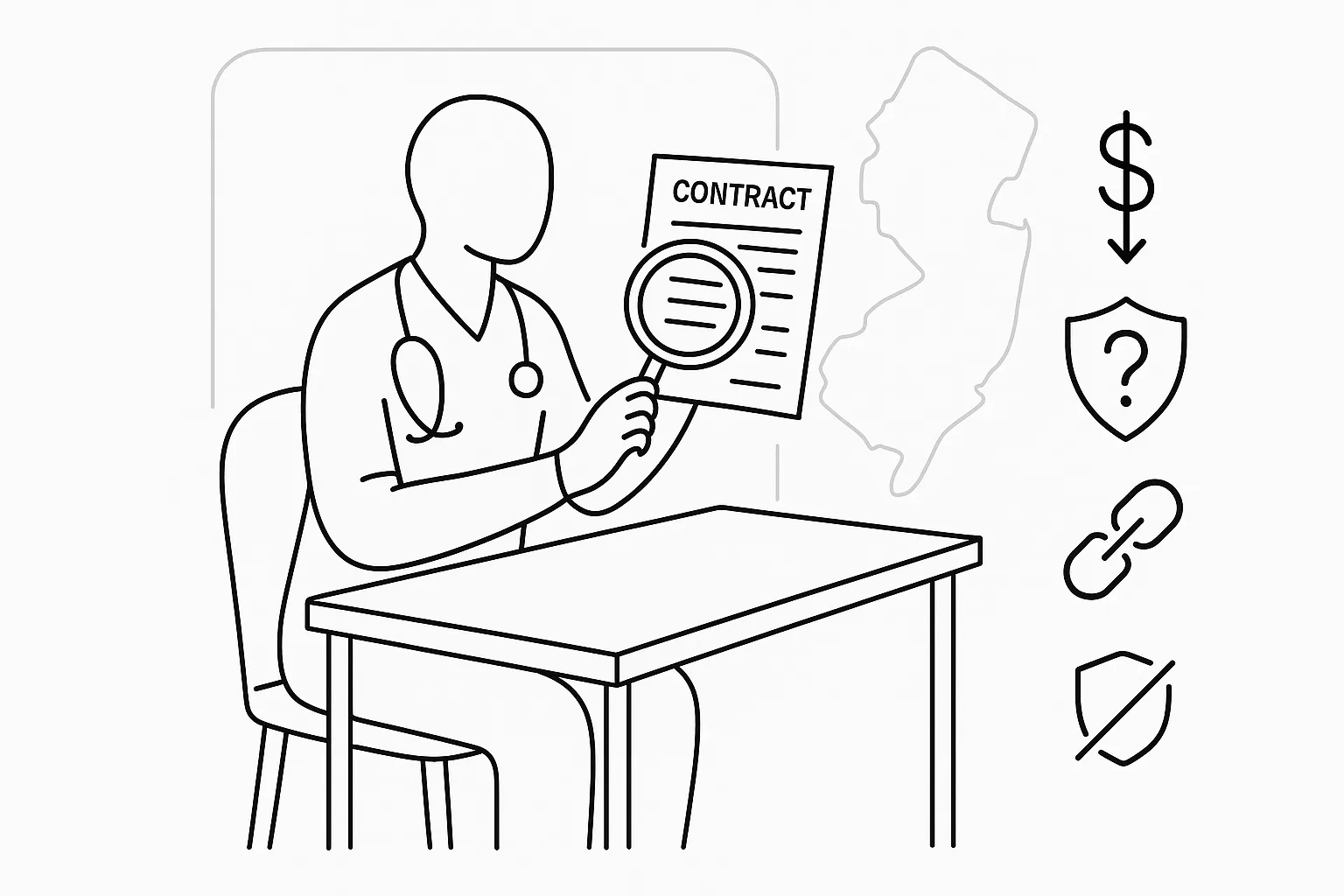
Board Certification and Scope of Practice
A person may not practice or represent themselves as a New Jersey advanced practice nurse without certification from the New Jersey Board of Nursing. New Jersey contract references to a nurse practitioner are treated as references to an advanced practice nurse, so the agreement’s terminology should be read in that professional context.
An advanced practice nurse may provide preventive care and diagnose, monitor, and manage health conditions within the clinician’s certification and population focus, subject to applicable legal and regulatory limits. Review can compare the job description, patient population, procedures, prescribing duties, and assigned locations with the role contemplated by the contract.
Joint Protocol and Independent Practice
New Jersey distinguishes between APNs who remain subject to joint-protocol requirements for covered prescribing and practice functions and experienced APNs who qualify for independent practice. An APN with more than 5,000 hours of licensed, active advanced nursing practice may practice without a joint protocol when providing qualifying primary or behavioral healthcare, but population-focus, service, education, insurance, and other statutory conditions still apply.
The agreement may need to identify whether the position is structured around a joint protocol or qualifying independent practice. A focused supervision and collaboration agreement review can evaluate how responsibilities are allocated and whether the written documents are consistent with the intended clinical arrangement.
Prescribing and Controlled-Substance Duties
APN prescribing authority must remain within the clinician’s certification and population focus and comply with New Jersey requirements involving prescription blanks, pharmacology education, controlled dangerous substances, and any applicable joint protocol or independent-practice conditions. Independent APNs also have specified initial and biennial pharmacology education requirements.
Controlled-substance prescribing can involve additional assessment, documentation, pain-management, continuing-education, and telehealth requirements. Contract analysis can identify whether prescribing expectations, administrative support, chart-review processes, and telehealth duties are described clearly rather than left to broad employer discretion.
Employment and Independent Contractor Agreements
Employee Terms and Wage Provisions
An employment agreement commonly addresses salary, productivity compensation, benefits, paid leave, scheduling, professional expenses, malpractice coverage, and termination. Compensation and payment provisions must be read together with applicable New Jersey wage-payment protections, which cannot be waived merely because an employer includes conflicting language in a contract.
Review can identify when payment timing, deductions, chargebacks, bonus eligibility, or final-compensation provisions are incomplete or difficult to reconcile. Salary-transparency requirements that may apply to certain job postings or transfer opportunities do not replace the need for definite compensation terms in the signed agreement.
Contractor Labels and Classification Risk
A 1099 label does not necessarily determine whether a New Jersey clinician is properly classified as an independent contractor. Classification depends on the applicable statutory and regulatory tests, including the degree of control and other facts surrounding the working relationship. New Jersey rules effective October 1, 2026 clarify application of the ABC test under covered wage, payment, and unemployment laws.
An independent contractor agreement review can evaluate payment mechanics, tax allocation, insurance, expenses, scheduling control, termination, and indemnification. It can also flag provisions that conflict with the practical structure described elsewhere in the agreement without assuming the contract’s label controls classification.
Compensation, Schedule, and Benefits
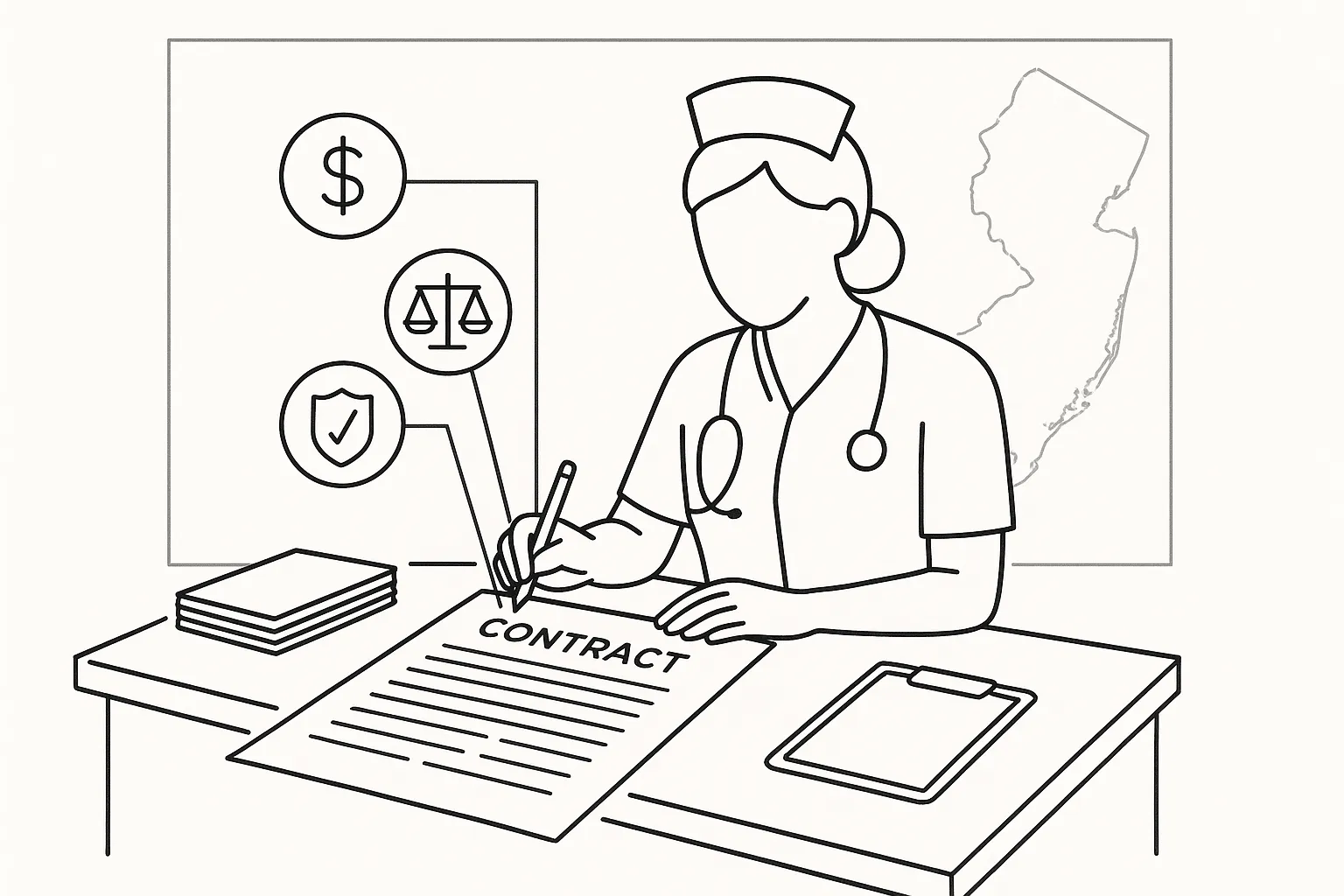
Salary, Collections, and RVU Formulas
NP compensation may consist of guaranteed salary, base pay plus productivity, collections-based compensation, RVUs, or a combination of models. Each approach requires different definitions, reporting rights, measurement periods, and reconciliation rules. A compensation and productivity review can identify undefined metrics, unilateral adjustment rights, and formulas that make earnings difficult to verify.
A collections formula may depend on gross charges, net collections, contractual adjustments, denials, refunds, or other deductions. RVU language may need to identify the applicable conversion factor, included services, reporting source, threshold, and treatment of work performed before termination but credited afterward. Negative-accrual terms can also allow a deficit or alleged overpayment to reduce future or final compensation.
Schedule, Call, and Work Locations
Schedule provisions may cover clinic hours, administrative time, weekends, holidays, call frequency, telehealth, and the right to assign the NP to additional sites. Analysis can determine whether the employer may change these duties unilaterally and whether travel between facilities affects productivity or reimbursable expenses.
When call is required, the agreement may distinguish on-site coverage from remote availability and identify any separate compensation. The relationship between call duties and productivity expectations also matters because uncompensated coverage can reduce the time available to meet collections or RVU thresholds.
Bonuses, Benefits, and Professional Expenses
Bonus provisions may depend on productivity, quality measures, continued employment, or employer-defined eligibility criteria. Review can clarify the measurement period, payment date, access to supporting data, treatment of earned but unpaid compensation, and whether the employer may alter the program during the contract term.
Benefits language may address health insurance, paid leave, retirement contributions, licensing costs, continuing education, professional dues, and reimbursement for business expenses. Signing bonuses, relocation allowances, and student-loan benefits require separate attention because repayment obligations may survive termination.
Malpractice Insurance and Tail Exposure
Occurrence and Claims-Made Coverage
Occurrence insurance generally covers incidents that occur during the policy period regardless of when a claim is filed. Claims-made insurance generally requires coverage to remain active when the claim is made, which can create a need for tail coverage or another extended reporting arrangement after the relationship ends.
No generally applicable New Jersey nurse-practitioner-specific rule was identified that requires an employer to provide tail coverage or dictates who must purchase it. The contract therefore plays a central role in allocating policy type, coverage limits, reporting duties, tail responsibility, and any exceptions based on the reason for termination. A malpractice and tail insurance review can flag ambiguous or potentially expensive allocations.
Insurance Requirements for Independent APNs
A New Jersey APN practicing independently must maintain malpractice liability insurance in at least the minimum amount applicable to a licensed physician or, if insurance is unavailable, an allowed letter of credit. The independent APN must also notify the New Jersey Board of Nursing of the carrier or issuing institution.
A contract involving independent practice may address whether coverage is individual or group-based, who pays the premium, how proof of coverage is maintained, and what happens when the agreement ends. Those terms should be distinguished from tail coverage, which concerns protection for claims reported after claims-made coverage terminates.
Termination, Repayment, and Final Pay
Without-Cause and For-Cause Termination
Termination provisions establish notice periods, grounds for immediate termination, cure rights, and any compensation due at the end of the relationship. Without-cause termination may allow either party to end the agreement on notice, but its practical effect depends on whether the NP must continue working and whether the employer can waive the notice period without pay.
For-cause provisions may include loss of certification, exclusion from payer programs, failure to satisfy credentialing requirements, policy violations, or alleged professional misconduct. A nurse practitioner termination review can assess notice mechanics, cure opportunities, cross-defaults, post-employment obligations, and the treatment of pending compensation.
Repayment Triggers and Compensation Reconciliation
Repayment provisions often apply to signing bonuses, relocation assistance, training expenses, student-loan benefits, or other incentives. Important variables include whether repayment is prorated, which termination events trigger it, whether it applies after employer-initiated termination without cause, and whether the employer may deduct an amount from final pay.
Final-compensation language may also govern productivity reconciliation, accounts receivable, delayed collections, earned bonuses, unused leave, and alleged overpayments. Clear deadlines and calculation methods can reduce uncertainty when compensation continues to depend on revenue received after the NP’s last day of work.
Non-Competes and Other Contract Restrictions
New Jersey Non-Compete Analysis
New Jersey generally evaluates employment non-competes case by case. A restraint may be enforced only to the extent it protects a legitimate employer interest, does not impose undue hardship, and does not injure the public. Courts may partially enforce an overbroad restriction, while healthcare access and other public considerations may weigh against enforcement in a particular situation.
A nurse practitioner non-compete review can examine the restricted territory, duration, prohibited activities, triggering events, and practical effect on future opportunities. Review may also identify whether the restriction follows the NP across multiple facilities or applies even when the employer ends the relationship without cause.
Non-Solicitation, Confidentiality, and Recurring Red Flags
Non-solicitation clauses may restrict communications with former patients, employees, colleagues, referral sources, or business contacts. Confidentiality and intellectual-property provisions can also reach beyond legitimate proprietary information if they are drafted to encompass general knowledge, professional relationships, or materials created outside the job.
Other recurring contract red flags include:
- Undefined collections, RVU, quality, or productivity measurements.
- Negative accrual, chargebacks, or deduction rights without a clear reconciliation process.
- Claims-made malpractice coverage with unclear or NP-funded tail obligations.
- Repayment provisions that continue after termination without cause.
- Clinical, prescribing, or joint-protocol language that does not match the intended practice structure.
- Broad discretion to change compensation, schedules, locations, duties, or policies.
- Restrictions that apply across an employer’s entire service area rather than the NP’s actual practice location.
Preparing for a New Jersey NP Contract Review
A complete review generally requires the proposed agreement, offer letter, compensation exhibits, benefit summaries, policies incorporated by reference, and written communications that explain or modify the offer. Useful background includes the intended patient population, certification, practice setting, work locations, schedule, call duties, prescribing expectations, compensation model, and whether the position involves a joint protocol or qualifying independent practice.
Before signing, compare the written terms with any promises concerning salary, productivity, bonuses, administrative time, staffing, malpractice coverage, tail insurance, benefits, or professional expenses. Historical collections or productivity information may help evaluate variable-pay projections, although projections are not a substitute for a definite contractual formula.
An attorney review can translate the agreement into practical financial and professional consequences, identify provisions that conflict or remain incomplete, and explain language that may warrant clarification or revision. That process is especially valuable when the offer contains negative accrual, broad restrictive covenants, substantial repayment exposure, uncertain insurance obligations, or employer discretion to change material terms.
Request a New Jersey NP Contract Review Before You Sign
Chelle Law can review your agreement, identify compensation and professional risks, explain restrictive provisions, and flag terms that may warrant clarification or revision.
Contact Chelle LawExplore Nurse Practitioner Contract Guidance
Review attorney-led services, practical contract resources, and state-specific guidance for nurse practitioners.