
When a nurse practitioner accepts a position in New Jersey—whether practicing in Newark, Jersey City, Trenton, or elsewhere in the North Jersey and Philadelphia healthcare corridor—the employment or independent contractor agreement governs compensation, scope of practice, malpractice obligations, and post-employment restrictions. These agreements operate within New Jersey law and the professional framework overseen by the New Jersey Board of Nursing, including statutory authority under N.J.S.A. 45:11 governing advanced practice nurses.
Subtle drafting differences can materially affect productivity pay, collaboration requirements, restrictive covenants, and termination rights. A New Jersey nurse practitioner contract review helps clarify how employer-drafted terms interact with state practice requirements and where financial or professional risk may be embedded in the agreement. Review is especially important when an offer includes collections formulas, negative accrual, bonus repayment, claims-made malpractice coverage, or restrictions on future practice.
Chelle Law provides structured, attorney-led risk assessment tailored to New Jersey’s healthcare market. We examine agreements line by line to identify provisions that may affect earnings stability, regulatory compliance, and career mobility. Our broader nurse practitioner contract review service addresses both employment agreements and independent contractor arrangements before an NP signs.
Key Takeaways for New Jersey Nurse Practitioners
- Review the complete agreement before signing to identify income erosion caused by unclear compensation formulas, negative accrual, chargebacks, or repayment obligations.
- Clarify whether productivity is based on gross charges, net collections, RVUs, or another metric, and require written reconciliation rules.
- Confirm the malpractice policy type and identify who must pay for tail insurance if the employer provides claims-made coverage.
- Evaluate non-compete, non-solicitation, and patient-related restrictions for their practical effect on future employment in New Jersey.
- Ensure collaboration, prescribing, location, and workload provisions align with the intended position and applicable professional requirements.
Why New Jersey Contract Terms Require Careful Review
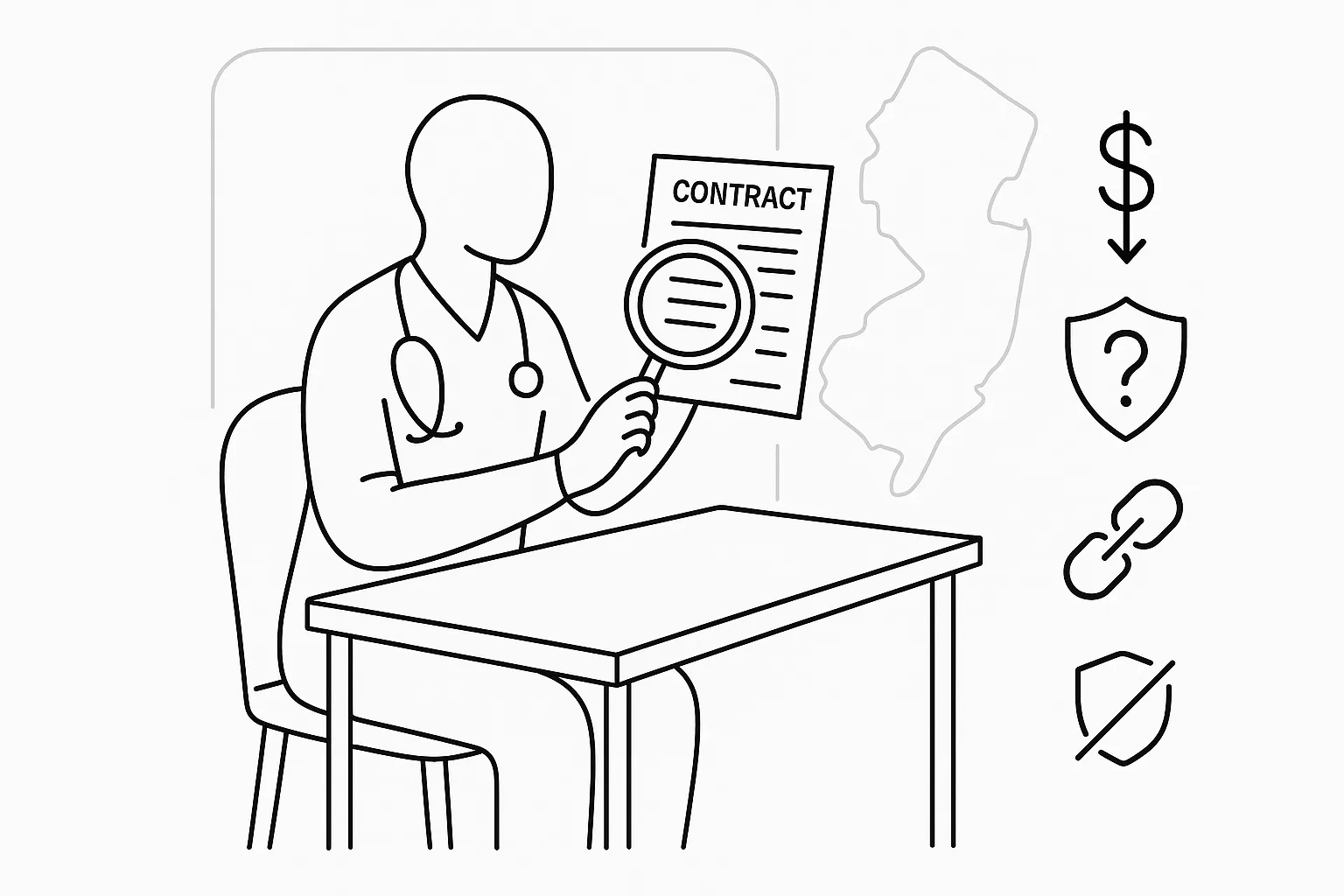
New Jersey’s regulatory framework for nurse practitioner licensure, prescribing, collaboration, and scope of practice can make contract wording consequential. Employers frequently use standardized templates containing provisions that shift financial risk to the clinician, including negative accrual, chargebacks, signing-bonus repayment, and broad discretionary authority. An NP may accept a salary that appears adequate but later discover that reconciliations, clawbacks, or productivity thresholds substantially reduce actual compensation.
A review should focus on three connected risks: income erosion through opaque compensation mechanics, liability or licensing exposure created by ambiguous malpractice and collaboration provisions, and reduced career mobility caused by broad restrictive covenants. Contractual responsibilities should also be compared with the position’s actual clinical setting and the requirements administered by the New Jersey Board of Nursing. Our supervision and collaboration agreement review focuses on whether those responsibilities are clearly and appropriately allocated.
Compensation, Schedule, and Employee Benefits
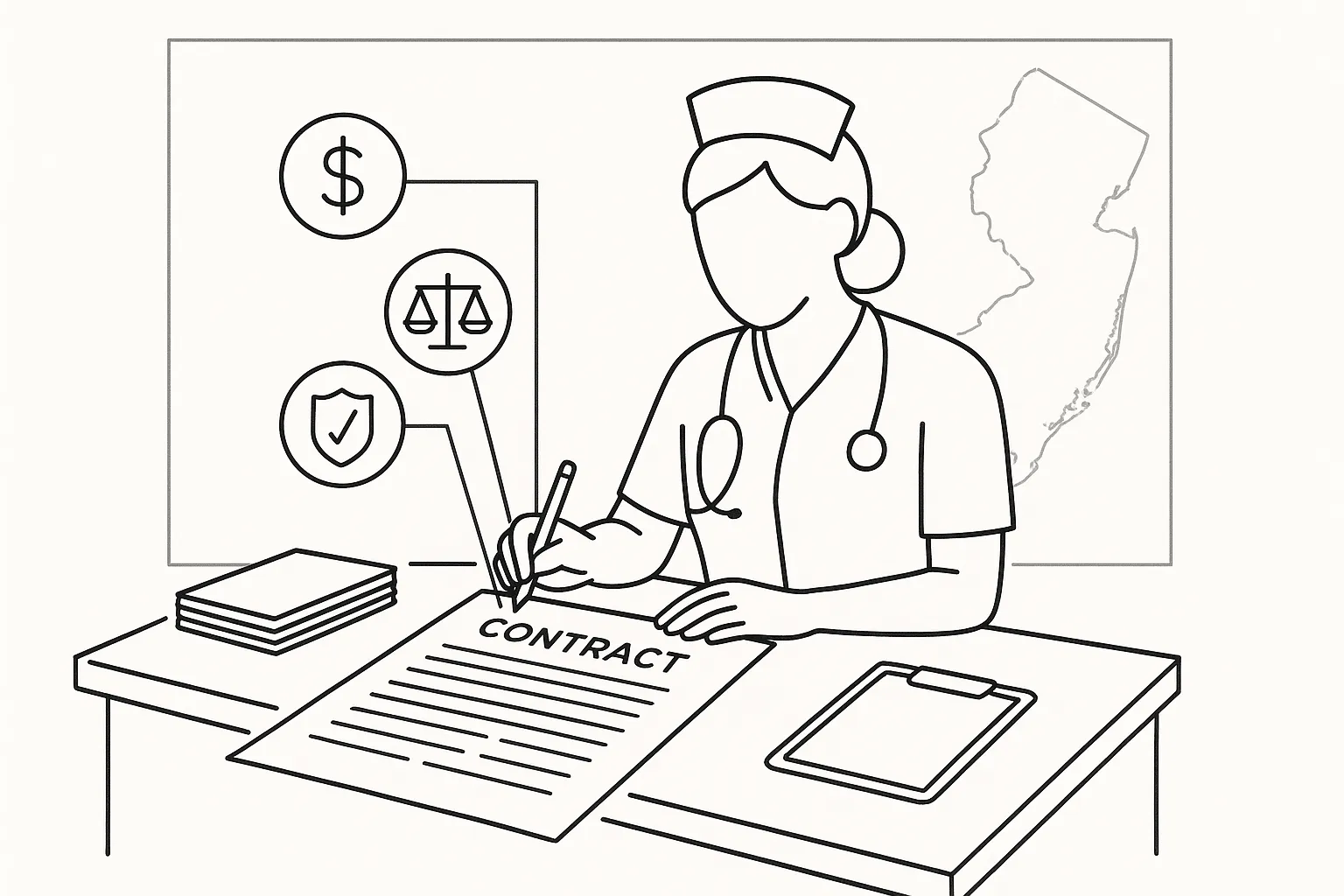
NP compensation may consist of a guaranteed salary, base pay plus productivity, collections-based compensation, or an RVU formula. Each model requires different reporting, monitoring, and reconciliation terms. For example, a contract that pays a percentage of collections should define whether the calculation uses gross charges or net collections after contractual adjustments, denials, refunds, and other deductions. A focused NP compensation review can identify undefined metrics, unilateral adjustment rights, and payment provisions that make earnings difficult to verify.
Negative accrual language can allow an employer to offset future productivity against a prior guarantee or draw. The agreement should explain how the balance is calculated, the applicable look-back period, whether interest applies, and whether the employer may deduct an alleged overpayment from final compensation. Bonus provisions should similarly identify the measurement period, payment date, eligibility conditions, and treatment of earned but unpaid compensation after termination.
Schedule provisions should define clinic hours, administrative responsibilities, call frequency, work locations, and any right to assign the NP to additional sites. If call coverage is required, the agreement should address compensation, on-site versus remote duties, and how call affects productivity calculations; the related guide to NP call requirements explains terms that deserve attention. Benefits language should also identify health insurance eligibility, paid leave, retirement contributions, licensing and CME reimbursement, and the repayment conditions attached to relocation or signing incentives.
Malpractice Coverage and Tail Insurance Obligations
Malpractice provisions determine both current coverage and potential post-termination exposure. Occurrence policies generally cover incidents that occur during the policy period regardless of when the claim is filed. Claims-made policies generally require the policy to remain active when the claim is made, so ending coverage may create a need for tail coverage or another extended reporting arrangement.
An employer may require an NP to obtain individual coverage or may provide claims-made insurance while shifting the cost of tail coverage to the clinician. The contract should identify the policy type, coverage limits, carrier requirements, and the party responsible for tail coverage under each termination scenario. A malpractice and tail insurance review can flag clauses that leave responsibility ambiguous or impose substantial costs after employment ends.
Termination, Repayment, and Final Compensation
Termination provisions establish notice periods, grounds for immediate termination, cure rights, and any severance or compensation due at the end of the relationship. Without-cause termination language may permit either party to end the agreement on notice, but the practical effect depends on whether the NP must continue working, whether the employer may waive the notice period without pay, and whether termination causes bonuses or productivity compensation to be forfeited.
Repayment obligations often apply to signing bonuses, relocation assistance, training expenses, or other incentives. The agreement should identify the events that trigger repayment, whether the amount is prorated over time, and whether repayment still applies when the employer terminates the NP without cause. Our contract termination review also examines final productivity reconciliation, accounts receivable, delayed bonuses, and other compensation that may remain outstanding after departure.
Non-Competes and Other Contract Red Flags
Restrictive covenants can create long-term mobility risk by limiting where, when, or for whom an NP may work after leaving a position. New Jersey courts generally examine non-compete restrictions for reasonableness in duration, geographic scope, and protection of legitimate business interests. Non-solicitation and patient-related provisions may also restrict communication with former patients, colleagues, employees, or referral sources. A dedicated NP non-compete review evaluates the practical effect of these restrictions on future opportunities.
Other recurring red flags include:
- Repayment provisions that remain effective after termination without cause.
- Undefined collections, RVU, quality, or productivity measurements.
- Claims-made malpractice coverage with unclear or NP-funded tail obligations.
- Broad geographic restrictions, sweeping patient provisions, or vague non-solicitation language.
- Ambiguous collaboration, prescribing, or clinical-duty provisions that do not match the intended practice arrangement.
- Employer discretion to change schedules, locations, compensation formulas, or policies without the NP’s written agreement.
Each issue can affect immediate earnings, professional liability, or future employment. Identifying the practical consequences before signing gives the NP an opportunity to seek clarification or revised language while the offer remains open.
Preparing for a New Jersey NP Contract Review
Provide counsel with the complete proposed agreement, offer letter, benefit summaries, compensation exhibits, and any written communication that modifies or explains the offer. Relevant background includes the anticipated practice setting, work locations, schedule, call responsibilities, compensation model, and any promised incentives that do not appear in the written contract. Historical productivity or collections information can also be useful when the employer makes projections about variable pay.
Negotiation priorities should focus on reducing financial uncertainty and clarifying professional responsibilities. High-impact requests often include defining productivity calculations, limiting repayment triggers, assigning tail insurance responsibility, clarifying final compensation, and narrowing restrictive covenants. These requests can be framed as risk-allocation and operational clarifications rather than demands unrelated to the position.
Before signing, confirm the compensation formula, reconciliation process, malpractice policy type, tail obligation, schedule, call expectations, work locations, termination notice, repayment conditions, post-employment restrictions, benefits, and collaboration responsibilities. If any material term remains vague or gives the employer broad unilateral discretion, attorney review can translate the language into its likely financial and professional consequences.
Review Your New Jersey NP Contract Before You Sign
Chelle Law can identify compensation, malpractice, termination, collaboration, and restrictive covenant provisions that may affect your New Jersey practice.
Contact Chelle LawExplore Nurse Practitioner Contract Guidance
Review attorney-led services, practical contract resources, and state-specific guidance for nurse practitioners.