
A nurse practitioner considering a position in New Mexico must evaluate the proposed employment or independent contractor agreement within the state’s advanced-practice framework. The New Mexico Board of Nursing regulates certified nurse practitioners, while the New Mexico Board of Pharmacy has a role when controlled-substance authority requires state pharmacy registration. New Mexico authorizes CNPs to practice independently, so a contract generally need not impose physician supervision or a collaborative practice agreement solely because the clinician is a CNP. Agreements may nevertheless contain outdated supervision language, prescribing conditions, credentialing requirements, or employer-specific approval procedures that affect the actual role. In healthcare markets such as Albuquerque, Santa Fe, and Las Cruces, contract review can clarify whether the written duties, practice locations, compensation structure, and post-employment terms align with the contemplated position and applicable New Mexico requirements.
The financial and professional consequences often extend beyond base salary. Productivity formulas, bonus eligibility, malpractice coverage, repayment obligations, termination rights, non-solicitation clauses, and ownership-related restrictions can determine what the nurse practitioner earns and what happens after the relationship ends. Chelle Law provides attorney-led contract review focused on identifying risk, explaining how provisions interact, and highlighting terms that may warrant clarification or revision before signing.
New Mexico Rules Affecting Nurse Practitioner Contracts
Contract language cannot be evaluated in isolation from the professional rules governing the role. Important New Mexico considerations include independent CNP practice, prescriptive-authority requirements, facility privileges, and statutory restrictions on certain post-employment provisions.
- New Mexico authorizes certified nurse practitioners to perform advanced practice beyond the registered-nursing scope and to practice independently.
- Prescriptive authority depends on the applicable education, experience, registration, and scope requirements.
- New Mexico restricts enforcement of employment non-competes covering clinical healthcare services, but other post-employment obligations may remain enforceable.
- Compensation, malpractice, repayment, and termination provisions require separate review even when a clinical non-compete is unenforceable.
Independent Practice and Supervision Language
A New Mexico CNP must satisfy the state’s registered-nurse licensure, graduate education, national certification, and advanced-practice licensure requirements. Once properly authorized, a CNP may practice independently. An employment agreement therefore generally does not need to require physician supervision or a collaborative practice agreement merely because the clinician is a CNP.
An employer may still establish operational policies, credentialing procedures, clinical reporting structures, or quality-review processes. Review can distinguish those workplace requirements from language that inaccurately describes a legal supervision mandate. It can also identify provisions that make employment, compensation, or termination dependent on an unnecessary collaborative arrangement.
Prescriptive Authority and Pharmacy Registration
New Mexico permits CNPs to prescribe and distribute dangerous drugs and controlled substances within their authorized scope and formulary. Dangerous-drug authority requires the applicable education or prescribing experience and preceptorship. Controlled-substance authority also requires registration with the New Mexico Board of Pharmacy and the federal Drug Enforcement Administration.
The contract may allocate responsibility for registration costs, renewals, credentialing support, prescribing protocols, or delays in obtaining required approvals. Those terms can affect the start date and compensation, particularly if pay does not begin until the practitioner is fully credentialed or able to exercise the prescribing authority expected for the position.
Facility Privileges and the Contracted Role
New Mexico health facilities generally must apply the same criteria and procedures to CNP admitting, discharge, continuing-care privileges, and medical-staff eligibility that they apply to physicians, subject to federal requirements. This does not guarantee privileges, but it provides relevant context when an offer depends on hospital credentialing or medical-staff approval.
Review can determine whether the agreement clearly addresses credentialing deadlines, temporary duties, delayed start dates, compensation gaps, and termination if privileges are not obtained or maintained. The written role can also be compared with the locations, clinical services, and responsibilities described during recruitment.
Employment and Independent Contractor Agreements
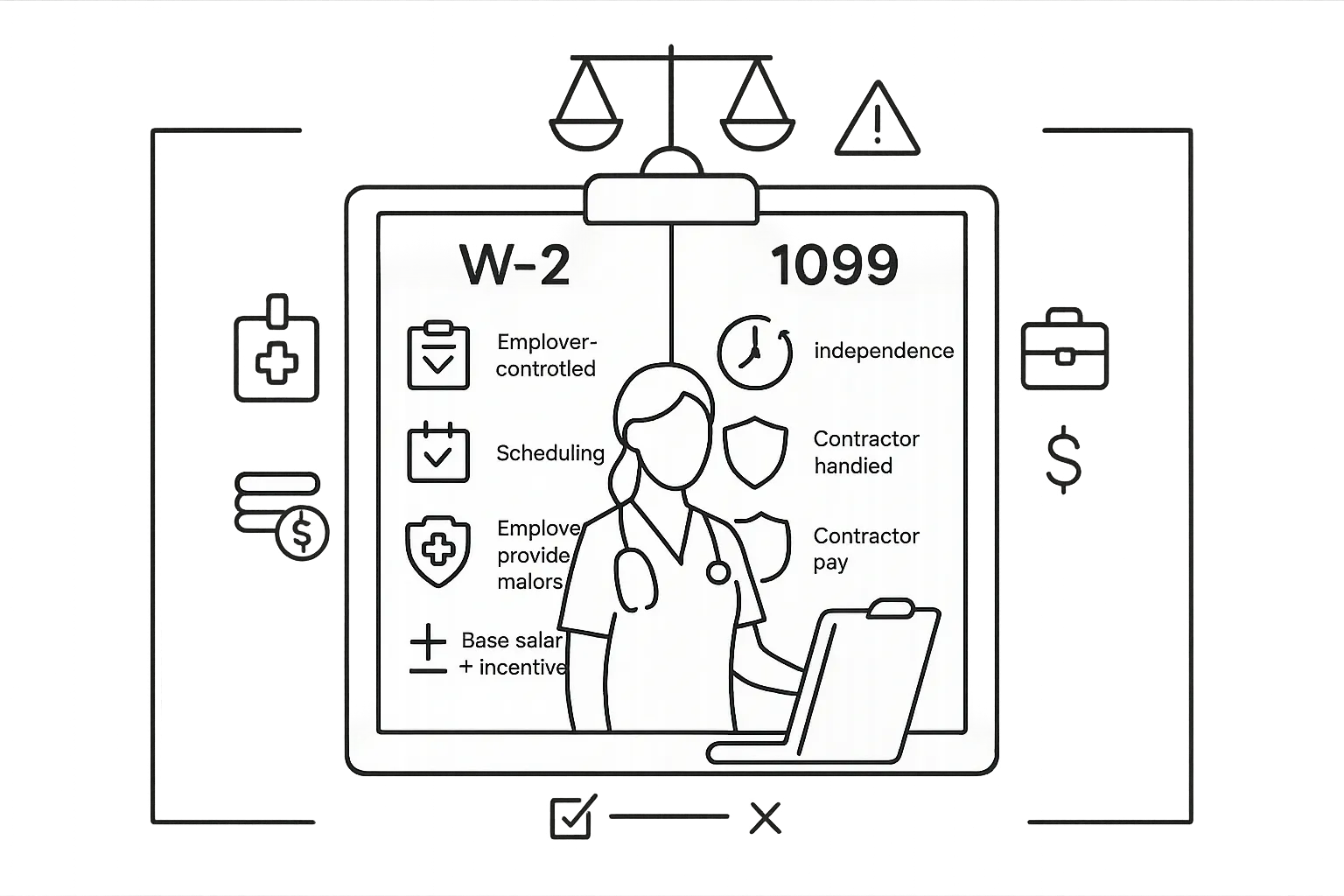
W-2 Employment Compared With 1099 Contracting
A W-2 employment agreement commonly gives the employer greater control over scheduling, workplace policies, billing systems, credentialing, and assigned locations. Compensation may combine salary with productivity or quality incentives, while the benefits package may include health insurance, retirement contributions, paid leave, continuing education support, and employer-provided malpractice coverage.
A 1099 arrangement may shift taxes, benefits, insurance, licensing expenses, and administrative responsibilities to the nurse practitioner. The practical relationship matters as well as the label used in the document. A focused nurse practitioner independent contractor agreement review can evaluate control, costs, insurance, payment mechanics, and exit obligations together.
Clinical Duties, Schedule, Call, and Locations
The agreement may address patient volume, administrative time, documentation, call coverage, weekends, holidays, telehealth, travel, and additional practice sites. Broad clauses allowing unilateral changes to schedule or location can materially change the position without changing compensation. Undefined call duties can likewise create uncompensated work or conflict with outside obligations.
Analysis can compare the written duties with the proposed specialty, authorized scope, prescribing role, and representations made during recruitment. Important details include who controls the schedule, whether call is included in base pay, how added shifts are compensated, and whether the employer may assign locations throughout New Mexico without geographic limits.
Compensation, Productivity, and Repayment Risk
Salary, Collections, RVUs, and Quality Incentives
Base compensation terms may identify a guarantee period, pay frequency, adjustment rights, and circumstances allowing salary to be reduced or recovered. Productivity formulas require additional analysis. The agreement may use collections, work RVUs, encounters, quality measures, or a combination of metrics, but the formula is difficult to evaluate unless each component and calculation period is defined.
- Collections: Review how refunds, contractual adjustments, chargebacks, delayed billing, and uncollected accounts affect credit.
- RVUs: Identify the applicable RVU measure, conversion factor, threshold, reconciliation schedule, and treatment of coding changes.
- Quality incentives: Determine whether the metrics are objective, available to the practitioner, and within the practitioner’s control.
- Reporting: Confirm whether regular statements, supporting data, and a process for questioning calculations are available.
A dedicated compensation and productivity review can test the formula under realistic assumptions and identify provisions that permit discretionary changes. It can also reveal conflicts between the compensation section and termination language that may eliminate an otherwise earned incentive.
Bonuses, Negative Accrual, and Repayment Obligations
Signing bonuses, relocation allowances, training expenses, student-loan benefits, and other advances may be subject to repayment if the relationship ends early. Review can identify the triggering events, repayment period, forgiveness schedule, exceptions, and any right to deduct the balance from final compensation. A prorated obligation generally creates a different risk than language requiring repayment of the full amount until the last day of a commitment period.
Negative accrual provisions can carry productivity deficits into later months or quarters, reducing future bonuses and potentially creating an asserted debt. The calculation warrants particular attention when the employer controls coding, billing, scheduling, payer enrollment, or patient volume. New Mexico law preserves certain repayment provisions involving practitioners employed for fewer than three years, so limits on clinical non-competes do not make every repayment obligation unenforceable.
Malpractice Coverage and Contract Termination
Claims-Made, Occurrence, and Tail Coverage
The agreement may provide claims-made or occurrence-based malpractice insurance. Claims-made coverage generally requires continuing protection for claims reported after the policy ends, while occurrence coverage generally responds based on when the incident occurred. The policy language ultimately controls, making it important to identify the coverage form, limits, carrier requirements, exclusions, and any separate tail obligation.
Tail coverage can become a significant post-employment expense when responsibility is assigned to the nurse practitioner. Contract review can determine who purchases it, whether responsibility changes based on the reason for termination, whether prior-acts coverage is permitted, and when proof must be supplied. Chelle Law offers a focused malpractice and tail insurance review for these provisions.
Without-Cause Termination, Cure Rights, and Final Pay
Without-cause termination allows one or both parties to end the relationship after providing the required notice. The practical value of that right depends on whether the notice period is workable, whether the employer may remove the practitioner from the schedule without pay, and whether repayment or tail obligations are triggered. For-cause provisions also require attention to the definition of cause and whether curable breaches include a reasonable opportunity to cure.
Exit language may determine the treatment of accrued salary, unpaid collections, productivity bonuses, benefits, records, credentialing, malpractice coverage, and repayment balances. A nurse practitioner contract termination review can identify obligations that survive termination and explain how multiple exit provisions operate together.
New Mexico Non-Compete and Post-Employment Terms

Limits on Clinical Non-Compete Restrictions
New Mexico law makes a non-compete restricting a healthcare practitioner from providing clinical healthcare services in the state unenforceable when the agreement, renewal, or employment terminates. This protection is important, but it does not justify ignoring restrictive-covenant language. Review can determine whether the clause covers clinical practice, reaches activities beyond clinical services, or is paired with separate financial and solicitation restrictions.
The statutory rule excludes agreements between practitioners who are shareholders, owners, partners, or directors of a practice. Ownership arrangements therefore require separate analysis rather than an assumption that the employment rule applies. A New Mexico nurse practitioner non-compete review can clarify the provision’s practical scope and identify related terms that may still affect future opportunities.
Non-Solicitation, Confidentiality, Repayment, and Forum Clauses
New Mexico’s healthcare-practitioner agreement statute preserves other lawful provisions, including confidentiality and trade-secret protections, certain repayment obligations, liquidated-damages terms, and patient or employee non-solicitation restrictions lasting no more than one year. Each clause requires its own review. A clinical non-compete may be unenforceable while a narrower non-solicitation, confidentiality, or repayment provision continues to create meaningful exposure.
For agreements covering clinical healthcare services rendered in New Mexico, provisions selecting another state’s law or requiring litigation in another state are void and unenforceable. Contract analysis can flag conflicting choice-of-law or forum language, especially in agreements drafted by multistate employers. It can also distinguish a prohibited out-of-state forum requirement from other dispute-resolution provisions that require separate evaluation.
Contract Red Flags and the Attorney Review Process
A useful first review focuses on provisions that could reduce earnings, create unexpected debt, interfere with professional practice, or make departure unusually expensive. Common nurse practitioner contract red flags include ambiguous productivity formulas, discretionary bonuses, indefinite negative accrual, broad repayment triggers, unclear tail obligations, and duties that do not match the position described during recruitment.
- Confirm whether the relationship is structured as W-2 employment or 1099 independent contracting.
- Calculate sample compensation using conservative patient-volume, collections, or RVU assumptions.
- Locate every repayment, clawback, deduction, negative-accrual, and liquidated-damages provision.
- Identify the malpractice policy type and responsibility for tail or prior-acts coverage.
- Compare duties, locations, call, prescribing expectations, and credentialing conditions with the actual role.
- Review notice periods, cause definitions, cure rights, final compensation, and surviving obligations.
- Separate unenforceable clinical non-compete language from non-solicitation, confidentiality, repayment, and ownership provisions requiring independent analysis.
Chelle Law’s attorney-led review process can include secure document submission, written analysis, identification of contract risks, and a consultation addressing the agreement’s practical effect. The objective is to help the nurse practitioner understand the offer, identify provisions that may warrant clarification or revision, and make an informed decision without promising a particular employer response or outcome.
Speak With a New Mexico Nurse Practitioner Contract Lawyer Before You Sign
Chelle Law reviews nurse practitioner employment and independent contractor agreements to identify compensation risk, malpractice obligations, restrictive terms, repayment exposure, and provisions that may warrant clarification or revision.
Request a Contract ReviewExplore Nurse Practitioner Contract Guidance
Review Chelle Law’s nurse practitioner contract services, educational resources, and state-specific guidance.