
When a nurse practitioner accepts a position in North Carolina—whether practicing in Charlotte, Raleigh, Durham, or another healthcare market—the employment or independent contractor agreement governs compensation, professional duties, malpractice coverage, termination rights, and post-employment restrictions. These provisions must also operate within North Carolina’s regulatory framework, including oversight by the North Carolina Board of Nursing and applicable authority under Chapter 90 of the North Carolina General Statutes.
Subtle drafting differences can materially affect productivity pay, repayment obligations, clinical responsibilities, and future career mobility. A North Carolina nurse practitioner contract review evaluates the agreement line by line, explains how employer-drafted terms may affect the NP, and identifies provisions that warrant clarification or revision before signing. The review should address compensation formulas, supervision and collaboration requirements, malpractice allocation, restrictive covenants, and the financial consequences of termination.
Key Contract Review Takeaways for North Carolina NPs
- Review the agreement before signing so compensation, liability, and career-mobility risks can be evaluated while changes may still be discussed.
- Define collections, RVU conversion factors, productivity thresholds, reconciliation periods, and audit rights to reduce the risk of unexpected pay adjustments.
- Confirm whether malpractice coverage is occurrence or claims-made and identify who must purchase tail or run-off coverage after termination.
- Evaluate non-compete and non-solicitation restrictions for their duration, geographic reach, restricted activities, and practical effect on future employment.
- Ensure duties, supervision, collaboration, prescribing, credentialing, and telehealth provisions align with the role and applicable North Carolina requirements.
North Carolina Contract Types and Regulatory Considerations
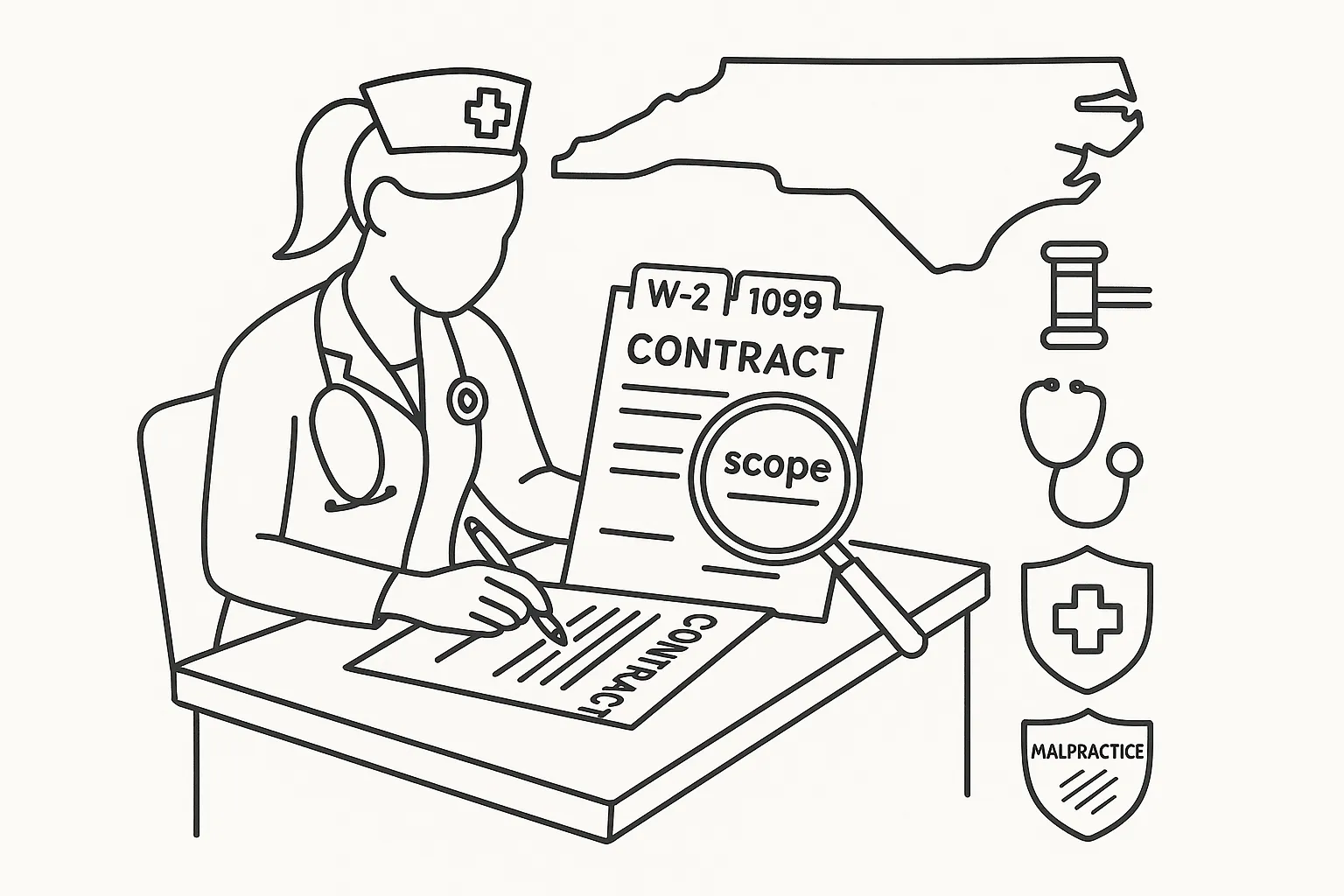
Employment agreements and independent contractor agreements create different legal and practical consequences. A W-2 employment agreement commonly includes tax withholding, employer-sponsored benefits, and greater employer control over scheduling and workplace policies. A 1099 agreement may offer greater operational flexibility but can shift responsibility for taxes, benefits, insurance, and business expenses to the NP. Nurses considering either structure should examine the practical distinctions discussed in this guide to W-2 versus 1099 status for nurse practitioners.
North Carolina practice requirements affect how contractual duties should be written. Provisions addressing scope of practice, prescribing, physician involvement, and written practice arrangements should be consistent with the requirements administered by the North Carolina Board of Nursing and other applicable authorities. The agreement should not promise authority the NP does not have or impose a structure that makes regulatory compliance impractical.
- Scope of practice and collaboration: The contract should accurately allocate responsibility for maintaining required practice arrangements and complying with professional standards.
- Restrictive covenants: North Carolina contract language involving non-compete and non-solicitation restrictions should be reviewed for its duration, territory, restricted activity, and effect on access to future opportunities.
- Credentialing and malpractice coverage: Hospitals, health systems, and private groups may use different credentialing timelines and insurance structures, which can affect the start date, pay, and post-termination obligations.
Compensation, Bonuses, and Benefits
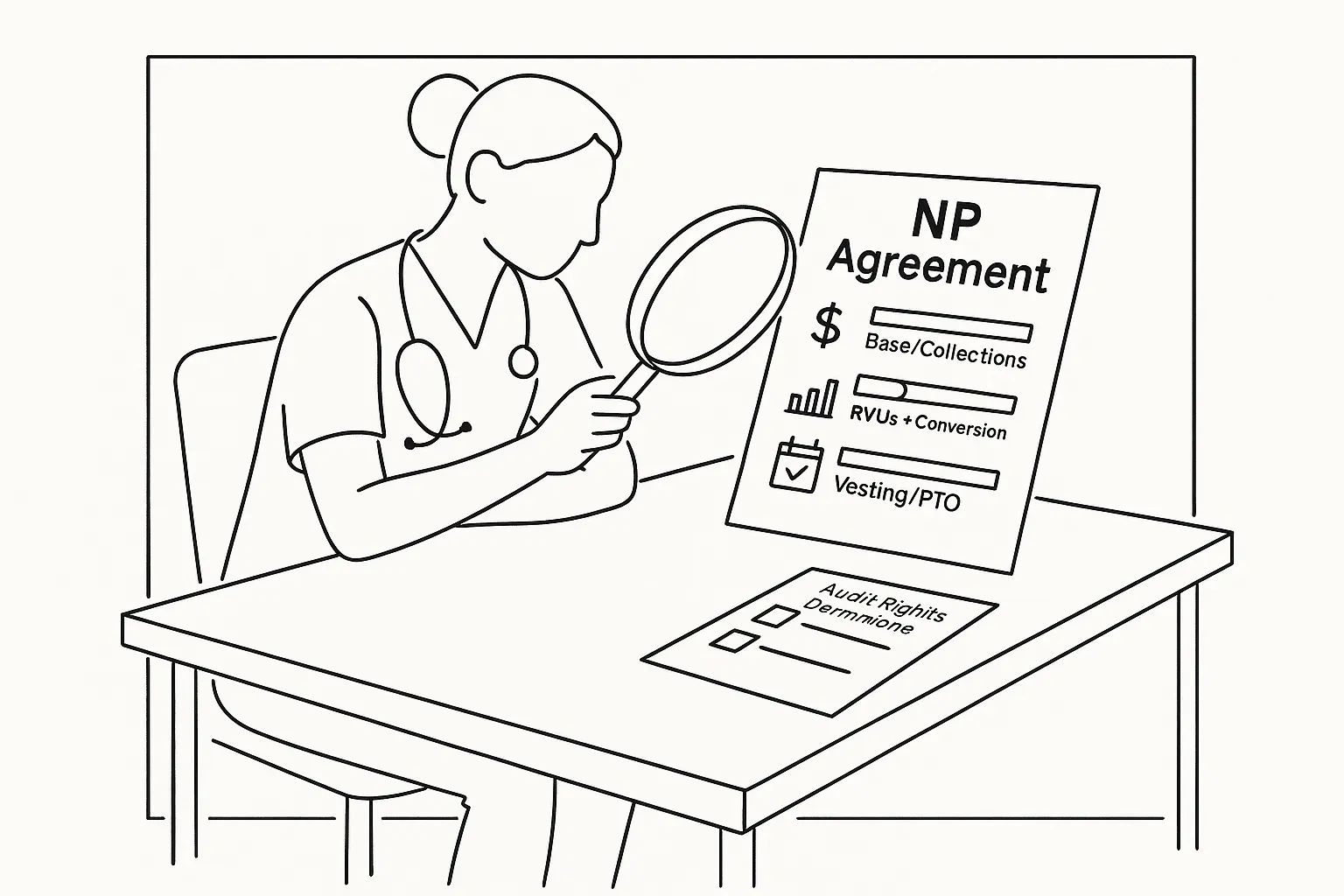
Compensation language is a frequent source of uncertainty because the stated salary or percentage does not necessarily reveal how pay will be calculated in practice. A thorough NP compensation and productivity review examines the formula, the employer’s discretion, the information available to the NP, and what happens when productivity falls below a threshold.
Salary, RVU, and Collections-Based Pay
A base salary provides income stability but may be paired with productivity adjustments. RVU-based arrangements depend on the assigned RVU values, conversion factor, threshold, and measurement period. Collections-based pay requires clear definitions of collections, adjustments, refunds, write-offs, and the date on which revenue is credited to the NP.
- Identify whether compensation is guaranteed or recoverable if productivity falls below expectations.
- Review negative accrual and clawback provisions that may carry a deficit into a later period or convert compensation into a repayment obligation.
- Confirm the frequency of reconciliation and whether the NP receives reports or audit rights sufficient to verify the calculation.
- Determine whether the employer may unilaterally change thresholds, conversion factors, fee schedules, or attribution rules.
Bonuses, Repayment Terms, and Employee Benefits
Quality incentives, retention bonuses, signing bonuses, loan assistance, and relocation benefits may be conditioned on continued employment or compliance with performance standards. The agreement should identify vesting dates, repayment triggers, prorated repayment terms, and whether an obligation is accelerated after resignation or termination. Benefits provisions should also clarify health insurance eligibility, retirement contributions, disability coverage, CME support, paid time off, carryover rules, and whether unused leave is paid at separation.
Malpractice Coverage and Tail Insurance
Professional liability provisions affect both financial exposure and continuity of coverage. An agreement should identify the policy type, coverage limits, covered services, insurer, reporting obligations, and responsibility for post-employment protection. A focused malpractice and tail insurance review can clarify whether the employer’s coverage creates an expense or coverage gap when the relationship ends.
Claims-Made and Occurrence Policies
Occurrence coverage generally responds to covered professional acts that occurred during the policy period, even if the claim is filed later. Claims-made coverage generally depends on when the claim is made and reported, which can create a need for tail or extended reporting coverage after termination. The contract should state who obtains and pays for that protection, how long it must remain in place, and whether responsibility changes based on the reason for termination.
Indemnification language also deserves careful attention. A broadly drafted clause may attempt to shift liability for billing, staffing, system failures, or other matters beyond the NP’s control. Reporting duties should be clear, workable, and connected to actual incidents, claims, or regulatory obligations.
Scope of Practice, Supervision, and Clinical Duties
Clinical responsibilities should be specific enough to define the position without allowing the employer to change the role materially through a general “other duties” clause. The agreement should address patient population, work locations, schedule, call coverage, administrative duties, performance standards, and the conditions under which assignments may change.
Collaboration, Prescribing, and Regulatory Compliance
North Carolina provisions involving physician involvement, written practice arrangements, chart review, prescribing, and professional oversight should reflect the role and applicable regulatory requirements. A supervision and collaboration agreement review can identify conflicts between the employment contract, a separate practice agreement, and the duties the NP will actually perform.
- Identify who is responsible for arranging and maintaining any required physician relationship.
- Clarify responsibility for state licensure, prescribing credentials, DEA registration, hospital privileges, and associated fees.
- Define what happens if credentialing or privileging delays the start date or prevents the NP from performing scheduled services.
- For telehealth or multi-state work, specify the jurisdictions involved and who is responsible for obtaining and maintaining required approvals.
Non-Competes, Termination, and Post-Employment Duties
Restrictive covenants and termination provisions can determine whether an NP can leave a position without substantial financial or professional disruption. North Carolina non-compete language should be examined in the context of the specific agreement, role, territory, duration, and restricted activities. An attorney can assess how the wording may affect employment opportunities rather than relying only on the employer’s description of the clause. Chelle Law provides a dedicated nurse practitioner non-compete review for agreements containing geographic or post-employment restrictions.
Termination Notice and Financial Consequences
The contract should distinguish termination without cause from immediate termination for cause and define any opportunity to cure an alleged breach. Notice periods must be evaluated alongside scheduling obligations, bonus repayment, malpractice tail responsibility, accrued compensation, and the employer’s ability to remove the NP from duty before the notice period expires. A separate contract termination review may be useful when an NP is planning to resign or has received notice from an employer.
Post-employment provisions may also address patient notifications, completion of records, return of property, confidentiality, non-solicitation, and cooperation with claims or audits. These duties should have reasonable limits and should not deny access to records needed for legitimate professional, regulatory, or insurance purposes.
Contract Red Flags and Review Priorities
Contract review should focus on provisions that create measurable income, liability, compliance, or mobility risks. The significance of each term depends on the NP’s experience, specialty, compensation model, and career plans, but several provisions commonly warrant additional scrutiny.
- Undefined collections, productivity, or quality measures that permit unilateral employer interpretation.
- Negative accrual, clawback, or repayment language that can convert compensation or benefits into debt.
- Claims-made malpractice coverage without a clear allocation of tail insurance responsibility.
- Broad non-compete or non-solicitation restrictions with vague geographic, patient, referral-source, or activity definitions.
- Indemnification provisions that shift responsibility for institutional or administrative failures to the NP.
- Credentialing, supervision, or practice-location language that allows pay or duties to change without clear limits.
Early-career NPs may place particular emphasis on compensation clarity, mentorship expectations, and signing-bonus repayment. Experienced NPs may prioritize productivity formulas, restrictive covenants, leadership duties, and predictable scheduling. In either situation, an attorney-led review before signing can translate the contract into practical financial and professional consequences and identify language that should be clarified.
Review Your North Carolina NP Contract Before Signing
Chelle Law reviews nurse practitioner agreements for compensation, malpractice, supervision, restrictive covenant, and termination risks that may affect your North Carolina practice.
Contact Chelle LawExplore Nurse Practitioner Contract Guidance
Learn more about contract review services, practical resources, and state-specific guidance for nurse practitioners.