
An Ohio nurse practitioner contract can shape far more than salary. It may allocate responsibility for licensing, credentialing, prescribing, collaboration, malpractice coverage, call, termination, and post-employment restrictions. The Ohio Board of Nursing regulates advanced practice registered nurses, and Ohio requires a certified nurse practitioner to maintain the required RN and APRN licenses, practice within the CNP’s education and certification, and work under a standard care arrangement with each collaborating physician or podiatrist. Those requirements make it important to compare the employment or independent contractor agreement with the proposed clinical role and related standard care arrangement. In major healthcare markets such as Columbus, Cleveland, and Cincinnati, multi-site assignments, productivity formulas, and geographic restrictions may also materially affect compensation and future mobility. Contract review can identify unclear or one-sided provisions before the NP accepts the position or begins providing services.
Chelle Law reviews Ohio nurse practitioner agreements and related exhibits for financial, professional, and operational risk. Analysis may cover compensation calculations, worker classification, malpractice and tail obligations, termination rights, repayment clauses, scheduling, prescribing terms, and restrictive covenants. The objective is to explain how the provisions operate together and identify language that may warrant clarification or revision before signing.
Understanding the Proposed NP Agreement
W-2 Employment and 1099 Contractor Terms
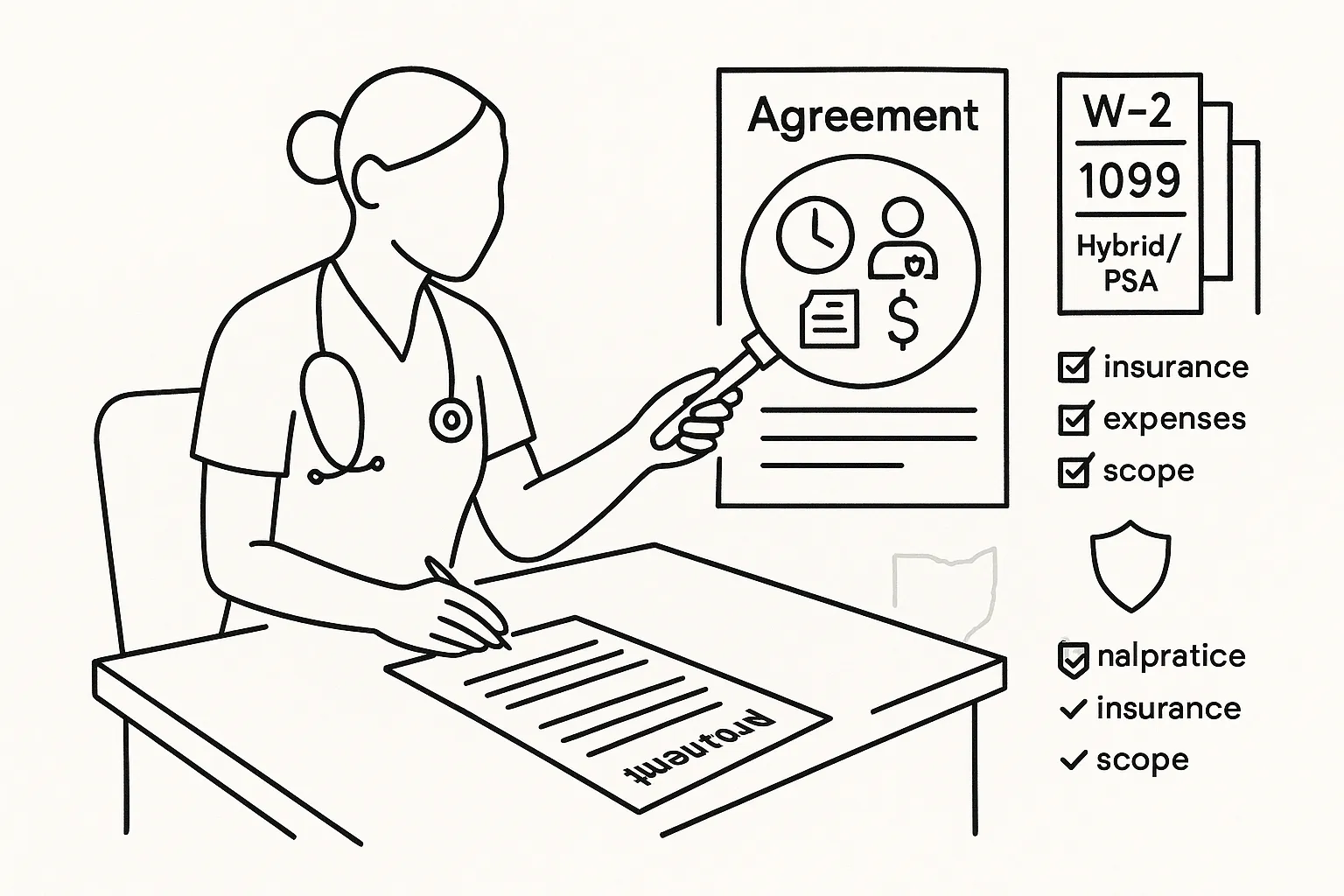
Nurse practitioner relationships may be structured as W-2 employment, 1099 independent contracting, or a hybrid personal-services arrangement. A W-2 agreement commonly addresses payroll withholding, benefits, workplace policies, scheduling authority, and performance expectations. A contractor agreement may instead assign taxes, insurance, licensing costs, administrative expenses, and other business obligations to the NP.
The title placed on the agreement does not resolve every classification issue. Review can compare the written terms with scheduling control, required locations, billing practices, performance standards, expense allocation, and the parties’ anticipated working relationship. The practical distinctions are discussed further in Chelle Law’s guide to W-2 versus 1099 status for nurse practitioners.
Offer Letters, Exhibits, and Incorporated Policies
An offer letter may summarize salary and benefits without containing the complete terms of the relationship. The controlling documents may also include a compensation plan, benefits schedule, restrictive covenant, standard care arrangement, malpractice policy, employee handbook, or separate bonus and repayment agreement. Review is more useful when it covers every document incorporated by reference rather than the main agreement in isolation.
Conflicts among those documents can create uncertainty over payment calculations, termination notice, work locations, or professional responsibilities. The agreement may also allow policies to change unilaterally, making it important to distinguish fixed contractual rights from benefits or procedures the employer reserves the right to modify.
Ohio Scope of Practice and Standard Care Arrangements
Licensure, CNP Designation, and Clinical Scope
Ohio requires a nurse practitioner to hold an Ohio RN license and a separate APRN license designated as a certified nurse practitioner, supported by the required graduate education and approved national certification. A CNP may provide preventive, primary, acute-illness, wellness, and other nursing-specialty services consistent with the practitioner’s education, certification, and Ohio Board of Nursing rules. Contract language describing duties, patient populations, or specialty coverage can therefore be evaluated against the NP’s credentials and proposed role.
Clauses permitting unilateral changes to duties, service lines, or locations deserve particular attention. Broad wording may create practical concerns if the revised assignment exceeds the contemplated specialty, available support, or credentialed privileges. Review can also clarify who is responsible for maintaining licenses, certifications, registrations, and facility credentials and who bears the related costs.
Collaboration and the Standard Care Arrangement
An Ohio CNP may practice only under a standard care arrangement with each collaborating physician or podiatrist. The employer must retain a copy, and the arrangement must address required practice and prescribing matters. Ohio defines collaboration to include a physician entering into the standard care arrangement and remaining continuously available to communicate in person or electronically.
The employment contract and standard care arrangement serve different functions but need to work together. Analysis can identify inconsistencies concerning clinical authority, consultation, referral, communication, chart review, quality assurance, prescribing, or coverage when a collaborator is unavailable. It can also clarify responsibility for obtaining and maintaining a compliant arrangement if a collaborator leaves or the NP transfers locations. Additional background is available in the guide to supervision and collaboration agreements for nurse practitioners.
Prescribing and Credentialing Conditions
Only a properly licensed and designated Ohio CNP may prescribe drugs and therapeutic devices. Prescribing must remain consistent with the standard care arrangement, the NP’s scope, applicable formulary limitations, prescriber-patient relationship requirements, controlled-substance rules, and other state and federal requirements. Contract review can determine whether the proposed duties and productivity expectations account for those limitations.
Credentialing provisions may condition the start date, compensation, or continued employment on hospital privileges, payer enrollment, prescribing credentials, or other approvals. The agreement may need clarification about what happens if processing is delayed for reasons outside the NP’s control, including whether the start date moves, salary begins, benefits remain available, or either party may terminate.
Compensation, Productivity, and Repayment Risk
Salary, Collections, and RVU Formulas
Common NP compensation models include guaranteed salary, base salary plus productivity, collections-based compensation, and RVU-based formulas. Analysis can determine when compensation is earned, how productivity is measured, when payments are made, and whether the NP receives reports sufficient to verify the calculation. Employer-controlled billing, coding, payer enrollment, staffing, and scheduling may materially affect results under a productivity model.
Important details include thresholds, conversion factors, excluded services, shared-visit treatment, reconciliation periods, and credit for administrative work or uncompensated care. Negative accrual deserves close review because a deficit may reduce future bonuses or, depending on the wording, become a repayment demand. Chelle Law’s nurse practitioner compensation and productivity review examines the formula and the reporting terms that support it.
Benefits, Bonuses, and Repayment Clauses
Benefits may include health coverage, retirement contributions, paid leave, parental leave, CME time and reimbursement, licensing fees, credentialing support, professional memberships, relocation assistance, or educational benefits. Review can distinguish guaranteed benefits from policies the employer may change and identify eligibility waiting periods or forfeiture provisions.
Signing bonuses, relocation payments, student loan benefits, and other incentives may be repayable if the NP leaves before completing a specified service period. The triggering event, repayment amount, proration method, payment deadline, and treatment of employer-initiated termination all matter. A provision requiring full repayment near the end of the commitment can create substantially different risk from one that forgives the obligation incrementally.
Malpractice Insurance and Post-Termination Exposure

Claims-Made and Occurrence Coverage
The agreement may identify whether professional liability coverage is occurrence-based or claims-made, the policy limits, the named insureds, and any exclusions. Occurrence coverage generally addresses covered acts that take place during the policy period even if the claim is reported later. Claims-made coverage generally depends on when the claim is made and may require tail coverage after the policy or employment ends.
Ohio’s reviewed APRN-specific statutes and rules do not impose a profession-specific employer obligation to provide malpractice insurance or tail coverage. Allocation of those costs therefore remains an important contract issue. A malpractice and tail insurance review can clarify policy type, coverage limits, and responsibility under different termination scenarios.
Tail, Indemnification, and Claim Cooperation
Tail responsibility may vary depending on whether the NP resigns, is terminated without cause, or is terminated for cause. The agreement may also address prior-acts coverage, defense costs, consent to settlement, notice of claims, and cooperation after departure. These provisions are especially important when the NP works at multiple locations, provides telehealth services, or has approved outside clinical work.
Indemnification language can shift losses or defense obligations beyond the protection supplied by a malpractice policy. Review can identify whether an indemnity is limited to the NP’s conduct, extends to the employer’s acts, or applies to regulatory, billing, and contractual disputes. Ohio law generally applies a one-year limitations period to medical claims, including claims against APRNs, subject to statutory extensions and exceptions, so cooperation and insurance obligations may continue after employment ends.
Termination and Ohio Restrictive Covenants
For-Cause and Without-Cause Termination
Termination provisions determine how the relationship ends and which obligations survive. The agreement may distinguish immediate termination for cause from termination without cause upon advance notice. Review can evaluate the definition of cause, available cure periods, notice procedures, credentialing-related triggers, and whether the parties have comparable rights.
Final compensation also requires attention. The contract may address salary through the last day worked, earned productivity pay, collections received after departure, unused paid leave, benefit continuation, patient-transition duties, and repayment obligations. NPs evaluating an existing agreement can learn more about nurse practitioner contract termination review.
Non-Competes and Non-Solicitation Restrictions
Ohio generally evaluates employee non-competes under common-law standards. A restriction is enforceable only to the extent reasonably necessary to protect a legitimate employer interest, not unduly burdensome to the employee, and not injurious to the public. Ohio courts may modify an overbroad restriction rather than treating every defect as invalid, so an NP should not assume that excessive language will simply be disregarded.
Review can assess duration, geography, restricted services, triggering events, and the facilities used to measure the prohibited territory. Multi-site language may expand a restriction if each clinic or hospital becomes a separate geographic reference point. Non-solicitation, confidentiality, patient-contact, and employee-recruitment clauses may create additional limits even when the agreement contains no traditional non-compete. Chelle Law offers a focused nurse practitioner non-compete review to identify how those provisions may affect future practice options.
Scheduling, Call, Telehealth, and Work Locations
Scheduling language may define regular clinic hours, administrative time, call coverage, weekends, holidays, telehealth responsibilities, and additional shifts. Review can determine whether the employer may change the schedule unilaterally, how much notice applies, and whether call or work beyond the regular schedule receives separate compensation or productivity credit. Vague requirements such as working the hours “reasonably necessary” to complete duties may create substantially different expectations from a defined schedule.
Location provisions matter when an Ohio practice operates multiple clinics or facilities. The agreement may permit floating within a region, temporary reassignment, or permanent transfer without additional consent. Those clauses can affect commuting, credentialing, collaborator availability, productivity, malpractice coverage, and the reach of a post-employment restriction. Telehealth terms may also address authorized states, platform requirements, scheduling control, record access, and whether remote services count toward compensation targets.
Pre-Signing Review and Contract Red Flags
Ohio NP Contract Checklist
Before signing, the NP can gather the complete agreement, all incorporated exhibits, the compensation plan, benefits information, applicable policies, and the proposed standard care arrangement. A complete review may address:
- Effective and anticipated start dates, credentialing conditions, and any probationary period.
- W-2 or 1099 status and responsibility for taxes, insurance, licenses, and business expenses.
- Salary, payment frequency, productivity thresholds, conversion factors, reconciliation rules, and reporting rights.
- Scope of practice, collaboration, standard care arrangement, prescribing, and quality-assurance responsibilities.
- Malpractice policy type, limits, exclusions, prior-acts coverage, and tail responsibility.
- For-cause and without-cause termination, required notice, cure rights, and final compensation.
- Signing bonus, relocation, educational support, or other repayment obligations.
- Non-compete territory, restricted services, duration, and non-solicitation obligations.
- Regular schedule, call, weekends, telehealth, floating, and multi-location assignments.
How Contract Review Can Help
Common warning signs include undefined compensation metrics, unilateral formula changes, limited access to supporting reports, negative accrual that survives termination, unclear tail responsibility, broad indemnification, and repayment clauses without prorated forgiveness. Other concerns include unrestricted changes to schedules or locations, duties that do not align with the proposed clinical role, and restrictive covenants measured from every facility where the NP provides services.
An attorney-led nurse practitioner contract review can explain how compensation, regulatory obligations, insurance, termination, and post-employment restrictions interact. Review before signing provides an opportunity to identify ambiguous terms, compare the written agreement with the promised position, and prepare focused questions or proposed revisions. Chelle Law evaluates the complete arrangement so the NP can make an informed decision about the contractual risks and obligations.
Speak With an Ohio Nurse Practitioner Contract Lawyer Before You Sign
Chelle Law reviews Ohio NP employment and independent contractor agreements to identify compensation, standard care arrangement, malpractice, termination, repayment, and restrictive covenant concerns. Learn which provisions may warrant clarification or revision.
Contact Chelle LawExplore Nurse Practitioner Contract Guidance
Review Chelle Law’s nurse practitioner services, educational resources, and state-specific contract guidance.