
An Oklahoma nurse practitioner contract can affect clinical authority, compensation, liability exposure, and career mobility long after the offer is accepted. The Oklahoma Board of Nursing regulates nurse practitioners as advanced practice registered nurses, including applicable APRN-CNP licensure, certification, scope, and prescribing requirements. When a physician relationship remains relevant to prescriptive authority, the Oklahoma State Board of Medical Licensure and Supervision or the Oklahoma State Board of Osteopathic Examiners may also be relevant to the physician’s licensure and participation. Oklahoma’s recent independent prescriptive-authority changes make careful drafting especially important because an agreement should not assume every NP is subject to the same supervision arrangement. In healthcare markets such as Oklahoma City and Tulsa, review can determine whether employer policies, credentialing conditions, prescribing provisions, and assigned duties accurately reflect the NP’s authority, specialty, population focus, and intended practice setting.
Financial and post-employment terms deserve the same attention. Compensation formulas may depend on collections, RVUs, quality measures, or discretionary policies, while malpractice language can shift responsibility for tail coverage or indemnity. Termination provisions may trigger repayment of a signing bonus, relocation assistance, or compensation guarantee. Oklahoma also limits noncompetition agreements under 15 O.S. § 219A while allowing a narrower restriction on directly soliciting an employer’s established customers, making it important to distinguish a non-compete from non-solicitation, confidentiality, and interference provisions.
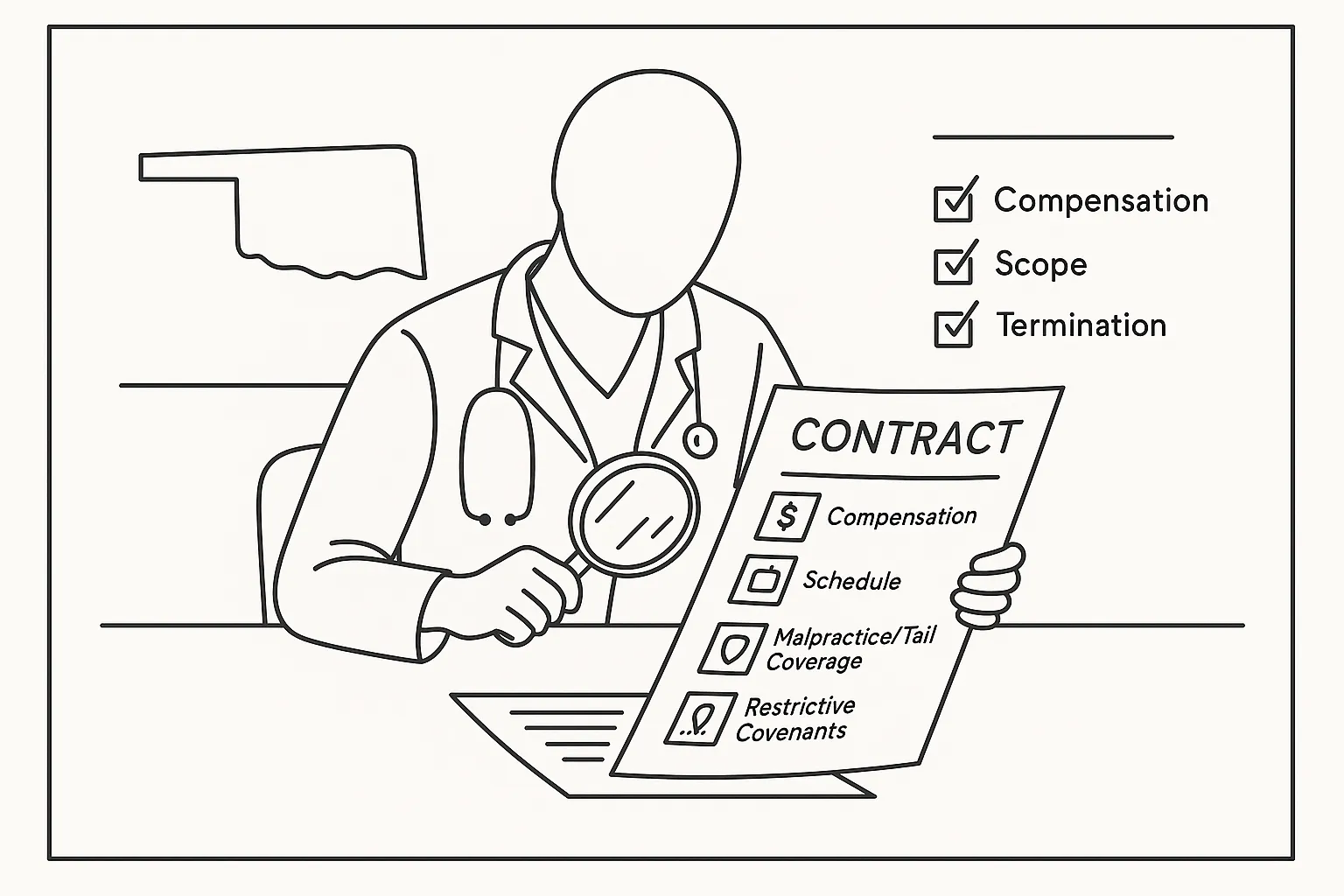
Key Issues in an Oklahoma NP Contract
Attorney-led review can identify how the agreement allocates financial, regulatory, and professional risk. It can also flag terms that are vague, internally inconsistent, incorporated through outside policies, or materially different from the offer presented to the nurse practitioner.
- Confirm that salary, collections, RVUs, bonuses, payment timing, chargebacks, and reconciliation procedures use objective definitions.
- Identify whether malpractice coverage is occurrence-based or claims-made and who bears any tail insurance obligation.
- Compare a W-2, 1099, or hybrid classification with the duties, control, benefits, expenses, and insurance obligations in the agreement.
- Evaluate scope, prescribing, credentialing, physician-relationship, and site-policy provisions under current Oklahoma requirements.
- Examine termination, repayment, non-solicitation, and non-compete language for triggers that could affect income or future practice options.
Oklahoma Scope of Practice and Prescriptive Authority
APRN-CNP Licensure and Clinical Scope
Oklahoma regulates nurse practitioners as APRN-CNPs. Practice must remain consistent with the NP’s education, national certification, population focus, competence, and applicable Oklahoma law and Oklahoma Board of Nursing rules. Contract review can determine whether the described specialty, patient population, procedures, documentation responsibilities, and clinical expectations fit those limits.
Broad clauses allowing an employer to assign any duty or location can create uncertainty if they are not limited by licensure, certification, competence, privileges, and applicable law. The agreement may also incorporate facility bylaws, clinical protocols, payer standards, and employer policies that materially affect daily practice even though those documents are not attached. Reviewing these terms alongside guidance about scope-of-practice issues in NP contracts can reveal obligations requiring clarification.
Prescribing and Physician-Relationship Provisions
Prescriptive authority requires Oklahoma Board of Nursing recognition and compliance with applicable education, renewal, formulary, and prescribing standards. Where supervision requirements remain applicable, Oklahoma rules address referral, consultation, collaboration, communication, emergency assistance, and patient referral with the supervising physician. The contract and any separate practice document should clearly allocate responsibility for maintaining that relationship, obtaining signatures, handling coverage, and responding when the physician becomes unavailable.
Oklahoma’s independent prescriptive-authority changes took effect under legislation effective November 1, 2025. Because eligibility and related requirements matter, a contract should not automatically impose an outdated physician-supervision model on every nurse practitioner or assume that every NP qualifies for the same authority. A focused supervision and collaboration agreement review can compare the documents with the NP’s actual status and intended role.
Credentialing, Reporting, and Compliance Duties
Credentialing provisions may determine when compensation begins, who pays application fees, and what happens if payer enrollment, facility privileges, prescribing recognition, or site access is delayed or denied. Review can also identify whether the employer may postpone the start date indefinitely, terminate immediately, or withhold compensation for delays outside the NP’s control.
Where a supervising-physician requirement remains applicable, changes in supervising physicians must be reported to the Oklahoma Board of Nursing within 30 days. The agreement should not prevent the NP from satisfying licensing, scope, prescribing, controlled-substance, and patient-safety obligations. Language requiring compliance with employer instructions is best understood as subject to the NP’s independent professional and regulatory duties.
Employment and Independent Contractor Agreements

W-2 Employment Terms
A W-2 agreement may include salary, benefits, employer-provided malpractice insurance, paid leave, and established termination procedures. The label alone does not answer whether particular benefits are guaranteed, when coverage begins, or whether compensation can be changed through a policy outside the signed agreement. Review can identify which terms are contractual and which remain subject to the employer’s discretion.
The document may also allocate licensing fees, continuing education expenses, professional dues, travel, equipment, and credentialing costs. Those allocations are particularly important when the offer summary refers generally to “full benefits” but the agreement incorporates a separate handbook that the NP has not received.
1099 and Hybrid Arrangements
An independent contractor agreement for telehealth, urgent care, locum, or other professional services may shift responsibility for taxes, insurance, business expenses, and benefits to the NP. Indemnity provisions, billing responsibility, audit rights, equipment costs, record access, and professional liability obligations can be as important as the stated hourly or per-visit rate.
Hybrid arrangements warrant close attention when the agreement labels the NP an independent contractor but imposes detailed control over scheduling, locations, documentation, equipment, billing, and clinical operations. An NP independent contractor agreement review can compare the written classification with the actual duties and financial obligations. The broader differences are also explained in Chelle Law’s guide to W-2 versus 1099 arrangements for nurse practitioners.
Compensation, Benefits, and Malpractice Coverage
Salary, Collections, and RVU Formulas
NP compensation may include guaranteed salary, collections-based pay, RVU production, quality incentives, or a combination of models. Analysis can determine how compensation is calculated, when it is paid, which services receive credit, and whether a conversion factor, benchmark, threshold, or bonus plan can change during the contract term. A compensation and productivity review is particularly useful when the offer includes tiered bonuses or year-end reconciliation.
- Base salary: Determine whether the amount is guaranteed, when it may be reduced, and whether any guarantee is treated as an advance subject to repayment.
- Collections: Identify whether the formula uses billed charges, allowed amounts, or net cash received and how refunds, denials, delayed payments, and chargebacks are handled.
- RVUs: Clarify the RVU measure, credited codes, conversion factor, threshold, reporting process, and treatment of services performed at different sites.
- Quality bonuses: Examine the metrics, measurement period, data source, payment date, and treatment of an earned bonus after termination.
Benefits, Expenses, and Repayment Exposure
Benefits may include health coverage, retirement contributions, paid leave, continuing education, licensing costs, professional dues, relocation assistance, or a signing bonus. The agreement may specify eligibility dates, vesting conditions, documentation requirements, or circumstances in which a benefit can be discontinued. It is also important to determine whether the contract or a separate plan document controls when the two conflict.
Signing bonuses, relocation allowances, educational benefits, and compensation guarantees may become repayable after certain separation events. Review can determine whether the amount declines over time and whether repayment applies after resignation, termination for cause, termination without cause, disability, or another event. Negative accrual and reconciliation provisions may create additional exposure if productivity falls below a threshold or collections are adjusted after departure.
Malpractice Insurance, Tail Coverage, and Indemnity
An occurrence policy generally covers professional services performed during the policy period even if a claim is reported later. A claims-made policy generally requires coverage to be active when the claim is reported, potentially creating a need for tail coverage after the relationship ends. The contract can be evaluated for the policy type, limits, named insureds, covered activities, consent-to-settle terms, and responsibility for tail insurance.
Tail responsibility may depend on whether the NP resigns, is terminated for cause, is terminated without cause, retires, or completes the term. A dedicated malpractice and tail insurance review can also identify broad indemnification, hold-harmless, reimbursement, and defense provisions that extend beyond ordinary professional liability coverage.
Schedule, Duties, Call, and Work Locations
Clinical Hours and Call Coverage
The agreement may address clinical hours, administrative time, chart completion, meetings, call, weekends, holidays, and after-hours patient communication. Phrases such as “full time,” “as needed,” or “reasonable flexibility” may permit substantial schedule changes without identifying limits or additional compensation. Review can clarify whether duties performed outside scheduled clinic hours count toward salary, productivity, or call pay.
Call provisions are easier to evaluate when they identify frequency, response expectations, backup support, patient volume, coverage locations, and compensation. The contract may also need to distinguish telephone call from required on-site coverage and address whether the employer can add call obligations unilaterally.
Multi-Site Assignments and Reassignment Rights
Multi-site provisions can affect commute time, patient mix, productivity, credentialing, and professional liability. The agreement may identify permitted locations, notice before reassignment, mileage reimbursement, travel-time expectations, and the treatment of work performed at another facility. These terms matter when a practice covers geographically separated sites in Oklahoma City, Tulsa, Norman, or rural communities.
A broad assignment clause may also allow work for affiliates that are not parties to the contract. Analysis can determine whether those assignments remain within the NP’s specialty and privileges, whether malpractice coverage follows the NP to every site, and which entity is responsible for compensation and employment obligations.
Termination, Repayment, and Oklahoma Restrictive Covenants
Without-Cause and For-Cause Termination
Termination language may define without-cause notice, for-cause events, opportunities to cure a breach, and grounds for immediate termination. Review can identify one-sided notice periods, broad cause definitions, continued work obligations during the notice period, and provisions allowing compensation to stop before the NP’s duties end. A nurse practitioner termination review can also evaluate final pay, earned bonuses, outstanding collections, unused leave, records access, and transition responsibilities.
Termination language should be read together with repayment, tail insurance, and restrictive covenant provisions because the same separation event may trigger several obligations at once. A short notice right may provide flexibility but offer limited practical value if departure produces substantial repayment or insurance costs.
Non-Compete and Non-Solicitation Terms
Under Oklahoma’s general restraint-of-trade rule, an employee may engage in the same or a similar business after employment ends. Oklahoma law nevertheless permits a narrower restriction preventing direct solicitation of the former employer’s established customers for sales of goods or services, and conflicting contractual provisions are void and unenforceable. Contract review should distinguish that statutory framework from broad geographic non-competes, patient non-solicitation clauses, employee non-solicitation terms, confidentiality duties, and interference provisions.
The wording still matters because restrictions may address telehealth, moonlighting, affiliated facilities, patient communications, referral sources, or liquidated damages. Relevant details include duration, geographic reach, restricted activities, covered facilities, customer or patient definitions, triggering events, and remedies. Chelle Law’s nurse practitioner non-compete review evaluates the language and its potential practical effect without assuming that every provision is treated the same way.
Attorney Review Before Signing an Oklahoma NP Contract
Contract review is most useful before signing, while unclear or unfavorable language can still be identified for discussion. An attorney can analyze the complete agreement, explain practical consequences, compare related provisions, and flag language that may warrant clarification or revision. Review may include incorporated policies, exhibits, compensation plans, restrictive covenants, practice agreements, and amendments rather than focusing only on salary.
Before accepting an Oklahoma position, consider whether the documents clearly address:
- Compensation calculations, productivity credit, bonus criteria, reconciliation, reporting, and payment dates.
- Malpractice policy type, coverage limits, defense obligations, indemnity, and responsibility for tail insurance.
- Without-cause notice, for-cause standards, cure rights, final compensation, and post-termination duties.
- Signing bonus, relocation, education, guarantee, and negative-accrual repayment exposure.
- Non-compete, non-solicitation, confidentiality, and interference language under Oklahoma law.
- Scope, prescribing, physician-relationship, credentialing, and reporting terms applicable to the NP’s status.
- Schedule, call, work locations, travel obligations, reassignment rights, and expense reimbursement.
- Whether the W-2 or 1099 classification aligns with the duties, control, benefits, taxes, and expenses described.
Chelle Law provides attorney-led contract review intended to translate complex provisions into identifiable financial, regulatory, and professional risks. Although review cannot guarantee a particular outcome, it can help an Oklahoma nurse practitioner understand the proposed obligations and make a more informed decision before signing.
Speak With an Oklahoma Nurse Practitioner Contract Lawyer Before You Sign
Chelle Law can review your compensation, malpractice coverage, termination rights, restrictive covenants, and Oklahoma practice terms, identify material risks, and explain provisions that may warrant clarification or revision.
Request an Oklahoma NP Contract ReviewExplore Nurse Practitioner Contract Guidance
Review attorney-led services, practical contract resources, and state-specific information for nurse practitioners.