
A nurse practitioner considering a Pennsylvania position may encounter an employment or independent contractor agreement that affects clinical duties, compensation, prescribing, malpractice coverage, and future mobility. The Pennsylvania State Board of Nursing regulates nurse practitioners as certified registered nurse practitioners (CRNPs), including certification, specialty-based practice, physician collaboration, and prescriptive authority requirements. A CRNP must practice within the specialty for which certified and collaborate with a Pennsylvania-licensed physician under a written collaborative agreement. Prescriptive authority adds detailed agreement, filing, maintenance, and review obligations that may need to align with the employment contract. In major healthcare markets such as Philadelphia and Pittsburgh, provisions addressing multiple facilities, credentialing, call coverage, productivity, and post-employment restrictions can materially affect the practical value of an offer. Pennsylvania nurse practitioner contract review evaluates how these terms work together before the agreement is signed.
Contract language can also determine who pays for tail insurance, when productivity compensation becomes payable, what happens if credentialing delays the start date, and whether a signing bonus or relocation allowance must be repaid. Pennsylvania’s current healthcare noncompete law creates important protections for CRNPs in agreements entered after January 1, 2025, but the execution date, duration, reason for separation, and statutory exceptions remain material. Review therefore requires more than isolating a single clause.
Chelle Law provides attorney-led nurse practitioner contract review focused on financial, professional, and regulatory risk. The review can explain the agreement line by line, compare interconnected provisions, flag unclear or unfavorable language, and identify terms that may warrant clarification or revision before signing.
Pennsylvania NP Agreements and Review Priorities
A complete review considers the entire contractual relationship rather than relying on the offer letter or compensation figure alone. Material terms may appear in exhibits, compensation plans, policies, collaborative agreements, malpractice summaries, or documents incorporated by reference.
- Confirm how salary, RVUs, collections, bonuses, and reconciliation procedures are defined.
- Identify whether malpractice coverage is occurrence-based or claims-made and who bears any tail obligation.
- Compare clinical duties, prescribing provisions, collaboration terms, credentialing responsibilities, locations, and call requirements.
- Evaluate noncompete, nonsolicitation, confidentiality, and patient-notice language under current Pennsylvania law.
- Clarify termination notice, for-cause standards, repayment exposure, final compensation, and surviving obligations.
W-2 Employment and 1099 Contractor Terms
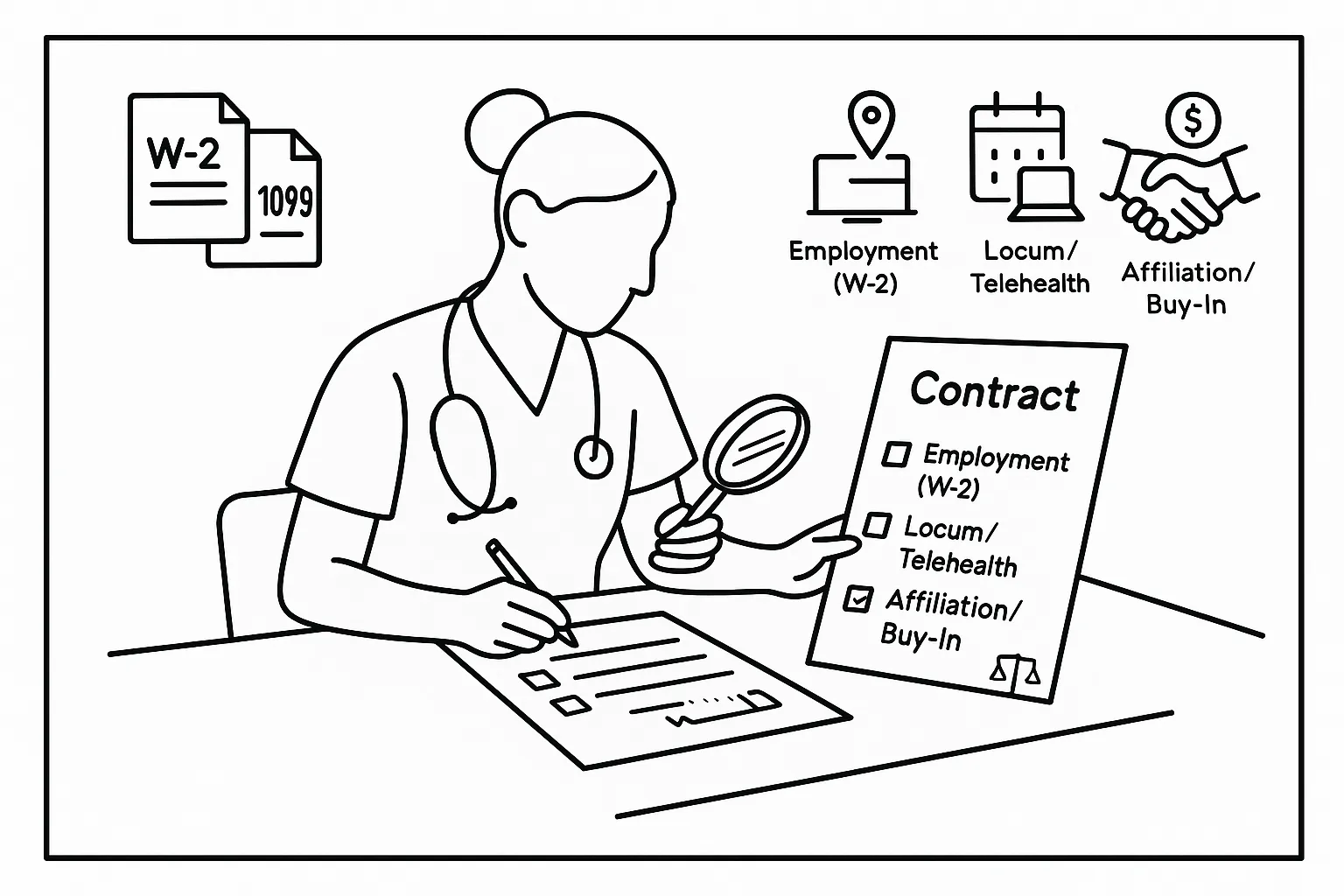
W-2 employment agreements and 1099 contractor agreements can impose similar patient-care obligations while allocating taxes, benefits, insurance costs, scheduling control, and business expenses differently. Employment terms often include tax withholding and employer-managed benefits, while contractor arrangements may shift more financial and administrative responsibility to the CRNP. The contract’s label does not by itself resolve how the relationship will operate.
An independent contractor agreement review can examine compensation, classification-related provisions, indemnification, professional liability coverage, expense allocation, and termination rights. It can also identify control provisions that appear inconsistent with the autonomy described elsewhere in the agreement.
Per-Diem, Telehealth, and Ownership Arrangements
Locum tenens and per-diem contracts may address guaranteed shifts, cancellation rights, travel reimbursement, credentialing, and assignment-specific malpractice coverage. Telehealth agreements can add multijurisdictional licensing, documentation, technology, prescribing, and remote-practice obligations. Review can determine where services may be performed, who supports credentialing, and whether delayed approvals or system access affect compensation.
Proposed affiliation, ownership, or buy-in arrangements require additional analysis of eligibility, valuation, governance, distributions, tax treatment, exit rights, and buyout obligations. A general promise of future ownership may provide little certainty unless the written documents explain timing, valuation methodology, required contributions, and what happens if the relationship ends before the transaction occurs.
Compensation, Benefits, and Repayment Exposure
Salary, RVU, and Collections Formulas

NP compensation may consist of guaranteed salary, base pay plus productivity, collections-based compensation, an RVU formula, or a combination of methods. An RVU provision may define credited services, the conversion factor, the productivity threshold, excluded work, and whether a prior shortfall carries forward. Collections provisions require equal care because gross charges, insurer-allowed amounts, and money actually received after adjustments are not interchangeable measures.
A focused compensation and productivity review can test whether the formula is internally consistent and whether expected earnings can be verified. Material questions include how personally performed services are attributed, whether incident-to billing affects credit, and what happens when scheduling, staffing, payer enrollment, or employer systems limit productivity.
Reporting, Reconciliation, and Formula Changes
Productivity compensation depends on transparent reporting and reconciliation procedures. Negative accrual language may permit a prior shortfall to offset future bonuses, while chargeback provisions may allocate denials, refunds, or billing adjustments to the CRNP. Review can clarify calculation dates, reporting access, dispute procedures, payment timing, and whether compensation earned before termination remains payable.
Unilateral amendment clauses may allow the employer to change benchmarks, conversion factors, bonus metrics, or compensation policies without a signed amendment. The practical effect depends on the scope of the amendment right, required notice, effective date, and whether the CRNP can terminate before the revised formula applies.
Bonuses, Relocation, and Clawbacks
Signing bonuses, relocation allowances, student loan benefits, and training payments often carry repayment conditions if the relationship ends during a stated period. The provision may distinguish resignation from employer-initiated termination, permit or omit proration, and authorize deductions from final compensation. Review can identify the triggering events, repayment amount, due date, exceptions, and relationship between the clawback and other termination terms.
Formula-based incentives also differ from discretionary bonuses. A measurable incentive typically identifies the metric, performance period, eligibility conditions, calculation method, and payment date. Language granting complete discretion or requiring employment on a later payment date may affect whether compensation for completed work is ultimately paid.
Pennsylvania Scope, Collaboration, and Credentialing
CRNP Specialty and Written Collaboration Requirements
Pennsylvania regulates nurse practitioners as CRNPs. Certification requires Pennsylvania RN licensure or qualifying multistate RN licensure together with Board-recognized specialty certification. A CRNP must practice within the specialty for which certified and may diagnose, order and interpret appropriate diagnostic tests, make referrals, and develop treatment plans while collaborating with a physician who holds a current Pennsylvania license under a written collaborative agreement.
The employment agreement, job description, and collaborative documents need to be read together. Broad language permitting any duty, location, schedule, or nonclinical assignment may create uncertainty if it exceeds the role discussed during recruitment. A review of supervision and collaboration terms can identify inconsistent responsibilities, missing operational details, and provisions that shift responsibility for the employer’s clinical structure to the CRNP.
Prescriptive-Authority Agreement Administration
Prescriptive authority in Pennsylvania requires specified advanced-pharmacology education, physician collaboration, and compliance with State Board of Nursing regulations. The written prescriptive-authority collaborative agreement must address matters that include the CRNP and collaborating physician, a substitute physician, specialty, permitted drug categories, circumstances and frequency of physician patient contact, professional liability coverage, filing, and periodic review.
The agreement must be maintained at the CRNP’s primary practice location, filed with the Bureau of Professional and Occupational Affairs, and made available to pharmacists and others upon request. It must also be reviewed at least every two years or when changed, with updates or termination reported to the Board. Contract analysis can clarify who prepares and files the document, maintains required records, coordinates updates, and addresses coverage when a collaborating or substitute physician becomes unavailable.
Credentialing, Privileges, and Delayed Starts
Credentialing clauses may allocate responsibility for applications, supporting documents, fees, renewals, hospital privileges, payer enrollment, prescribing approvals, and electronic medical record access. Delays can affect the start date, patient assignments, billing, and productivity credit even when the CRNP is ready to work.
Review can determine whether compensation begins during credentialing, whether the employer may postpone or withdraw the position, and what happens if an approval is delayed or denied. The agreement may also need to explain how services are attributed after enrollment and whether the CRNP must repay recruitment benefits when a credentialing outcome ends the relationship.
Malpractice Coverage, Tail Insurance, and Indemnification
Occurrence and Claims-Made Coverage
Occurrence malpractice coverage generally applies to covered professional services performed during the policy period even if the claim is reported later. Claims-made coverage generally requires coverage to be active when the claim is made or reported, which can create a need for extended reporting, commonly called tail coverage, when employment ends.
A malpractice and tail insurance review can identify the policy type, limits, covered services, responsible carrier, and party responsible for tail. Tail allocation may vary depending on whether the CRNP resigns, is dismissed, completes a service period, or leaves after employer termination without cause. Any separate collaborative agreement requirement concerning professional liability coverage should also be consistent with the employment contract.
Indemnification and Defense Obligations
Indemnification provisions can extend beyond professional negligence. Broad language may require the CRNP to defend or reimburse the employer for third-party claims, regulatory matters, billing disputes, alleged policy violations, or losses connected to services. The clause may also determine who selects counsel, controls the defense, approves settlement, and pays expenses before fault is established.
Analysis can distinguish responsibility for the CRNP’s conduct from liability arising from facility operations, staff, coding systems, employer policies, or other matters outside the practitioner’s control. It can also compare indemnification duties with available insurance because a contractual obligation is not necessarily covered by a professional liability policy.
Pennsylvania Noncompetes and Related Restrictions
Act 74 Protections for CRNPs
Pennsylvania’s Fair Contracting for Health Care Practitioners Act specifically includes CRNPs as covered healthcare practitioners. For agreements entered after January 1, 2025, a noncompete is generally void and unenforceable. The Act permits an employer to enforce a restriction lasting no more than one year when the CRNP was not dismissed, so the agreement’s execution date, duration, separation circumstances, and statutory conditions matter.
The Act also addresses reasonable recovery of certain relocation, training, and patient-base expenses. A repayment clause therefore requires analysis separate from the noncompete itself. An NP noncompete review can evaluate whether contract language reflects the current healthcare-specific rule rather than relying only on older, general Pennsylvania restrictive-covenant standards.
Nonsolicitation, Patient Notice, and Practical Mobility
Even when a noncompete is limited or unenforceable, nonsolicitation, confidentiality, patient-contact, and employee-recruitment provisions may affect a transition. Restrictions involving patients, referral sources, staff, or business relationships require separate attention because their practical reach may differ from a geographic noncompete.
The Pennsylvania Act also requires specified patient notice within 90 days for qualifying ongoing outpatient relationships. Contract review can compare this statutory framework with provisions governing patient communications, continuity of care, records, and post-employment announcements. In Philadelphia, Pittsburgh, Harrisburg, Allentown, and surrounding communities, facility-based restrictions and broad definitions can affect realistic opportunities even without a traditional mileage radius.
Termination, Final Compensation, and Surviving Duties
For-Cause and Without-Cause Termination
Termination provisions determine how quickly the relationship can end and whether the CRNP has an opportunity to address an alleged breach. A for-cause section may define conduct permitting immediate termination, distinguish curable from noncurable events, and establish notice or cure procedures. Definitions tied broadly to employer policies, reputation, credentialing, or undefined performance standards may give the employer substantial discretion.
Without-cause language ordinarily identifies the notice period and effective termination date. Additional terms may address whether the CRNP must continue working, can be removed from the schedule, remains eligible for benefits, or receives compensation in lieu of work during notice. These details can affect both cash flow and whether a Pennsylvania noncompete exception potentially applies.
Final Pay, Repayment, and Transition Work
Termination provisions must be coordinated with productivity compensation, bonus eligibility, tail insurance, repayment obligations, patient notice, restrictive covenants, and credentialing. Some agreements delay final incentive payments until collections are received or a reconciliation is completed. Others impose continuing chart completion, patient-transition, record, or administrative obligations.
A nurse practitioner contract termination review can identify inconsistent notice periods, open-ended post-employment duties, deduction language, and compensation that may be forfeited after departure. Repayment terms can also be evaluated for the amount due, trigger, proration method, deadline, exceptions, and relationship to employer-initiated termination.
Preparing for a Pennsylvania NP Contract Review
Gather the complete agreement and every incorporated document before review. Relevant materials may include the offer letter, compensation plan, job description, bonus policy, benefits summary, malpractice documentation, handbook, collaborative agreement, prescriptive-authority agreement, restrictive-covenant exhibit, and recruitment correspondence. If the offer includes different terms for multiple locations or assignments, those documents are material as well.
Important verbal representations concerning schedule, call, work location, remote practice, collaboration support, future compensation, ownership, staffing, or protected administrative time may not be enforceable as expected if they never appear in the final written documents. Review can identify discrepancies and help the CRNP determine which points may warrant written clarification or revision.
Common warning signs include undefined productivity terminology, discretionary bonuses, unilateral amendment rights, broad indemnification, CRNP-funded tail coverage, unclear collaboration administration, multiple-location requirements, expansive nonsolicitation language, and repayment clauses without proration. Chelle Law provides flat-fee, attorney-led review that includes written comments and a consultation addressing the agreement’s practical effect. The purpose is to help the nurse practitioner understand financial exposure, professional obligations, liability allocation, and future mobility before making a decision.
Speak With a Pennsylvania Nurse Practitioner Contract Lawyer Before You Sign
Chelle Law can review your proposed agreement, explain its practical effect, identify financial and professional risks, and flag provisions that may warrant clarification or revision.
Contact Chelle Law