
When a nurse practitioner accepts a position in Pennsylvania—whether practicing in Philadelphia, Pittsburgh, Allentown, Harrisburg, or another healthcare market—the employment or independent contractor agreement governs compensation, duties, malpractice allocation, termination rights, and post-employment restrictions. These agreements operate within Pennsylvania law and the regulatory framework administered by the Pennsylvania State Board of Nursing, including applicable collaborative practice requirements under the Professional Nursing Law, 63 P.S. § 211 et seq. A Pennsylvania nurse practitioner contract review helps clarify how employer-drafted terms interact with those professional obligations.
Subtle drafting differences can materially affect productivity compensation, restrictive covenant exposure, credentialing responsibilities, and the ability to leave a position. Pennsylvania courts generally evaluate non-compete agreements based on factors such as legitimate business interests, consideration, duration, geography, and scope. The agreement must also be reviewed as a whole because compensation, malpractice insurance, repayment obligations, and termination provisions often operate together.
Chelle Law provides attorney-led review focused on the financial, professional, and regulatory risks within an NP agreement. We examine the contract line by line, explain how key provisions may work in practice, and identify language that may warrant clarification or negotiation before signing.
Key Pennsylvania NP Contract Review Priorities
- Confirm how base salary, RVUs, collections, bonuses, and reconciliation procedures are defined and calculated.
- Identify whether malpractice coverage is occurrence-based or claims-made and determine who must pay for tail coverage.
- Review duties, prescribing expectations, collaboration provisions, credentialing responsibilities, and other terms connected to Pennsylvania practice requirements.
- Evaluate non-compete and non-solicitation restrictions based on their duration, geographic reach, scope, and termination triggers.
- Clarify without-cause notice, for-cause definitions, repayment obligations, final compensation, and post-employment duties.
Employment, Independent Contractor, and Other NP Agreements
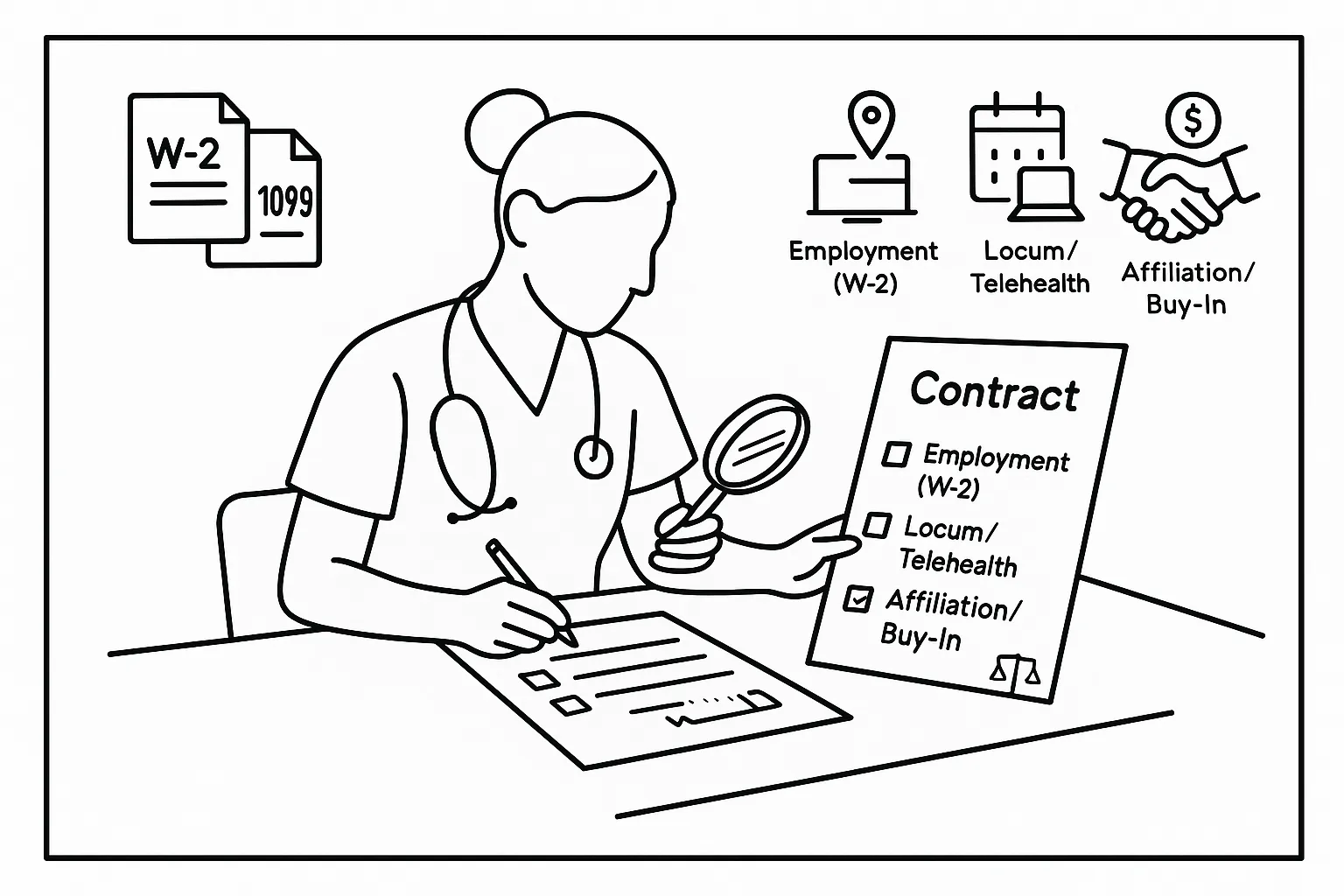
W-2 employment agreements and 1099 independent contractor agreements may contain similar clinical obligations but create different tax, benefit, control, and liability consequences. Employment agreements commonly provide tax withholding and employer-managed benefits while allowing the employer greater control over schedules, policies, locations, and performance expectations. Independent contractor agreements may offer more autonomy but often shift taxes, insurance costs, benefits, and indemnification risk to the NP. The contract label alone does not resolve how the relationship operates, making a careful comparison of W-2 and 1099 contract terms important.
Locum tenens and per-diem contracts may address guaranteed shifts, cancellation rights, travel reimbursement, credentialing, and assignment-specific malpractice coverage. Telehealth agreements can add multijurisdictional licensing, documentation, technology, and remote-practice obligations. Each agreement should identify where services may be performed, who supports credentialing, and how compensation is affected if approvals or system access are delayed.
Affiliation, independent practice, and proposed buy-in arrangements require additional attention to valuation, governance, distributions, tax treatment, exit rights, and buyout obligations. Vague promises of future ownership should be replaced with written terms describing eligibility, timing, valuation methods, and the parties’ rights if the relationship ends before a transaction occurs.
Compensation, Benefits, and Repayment Terms
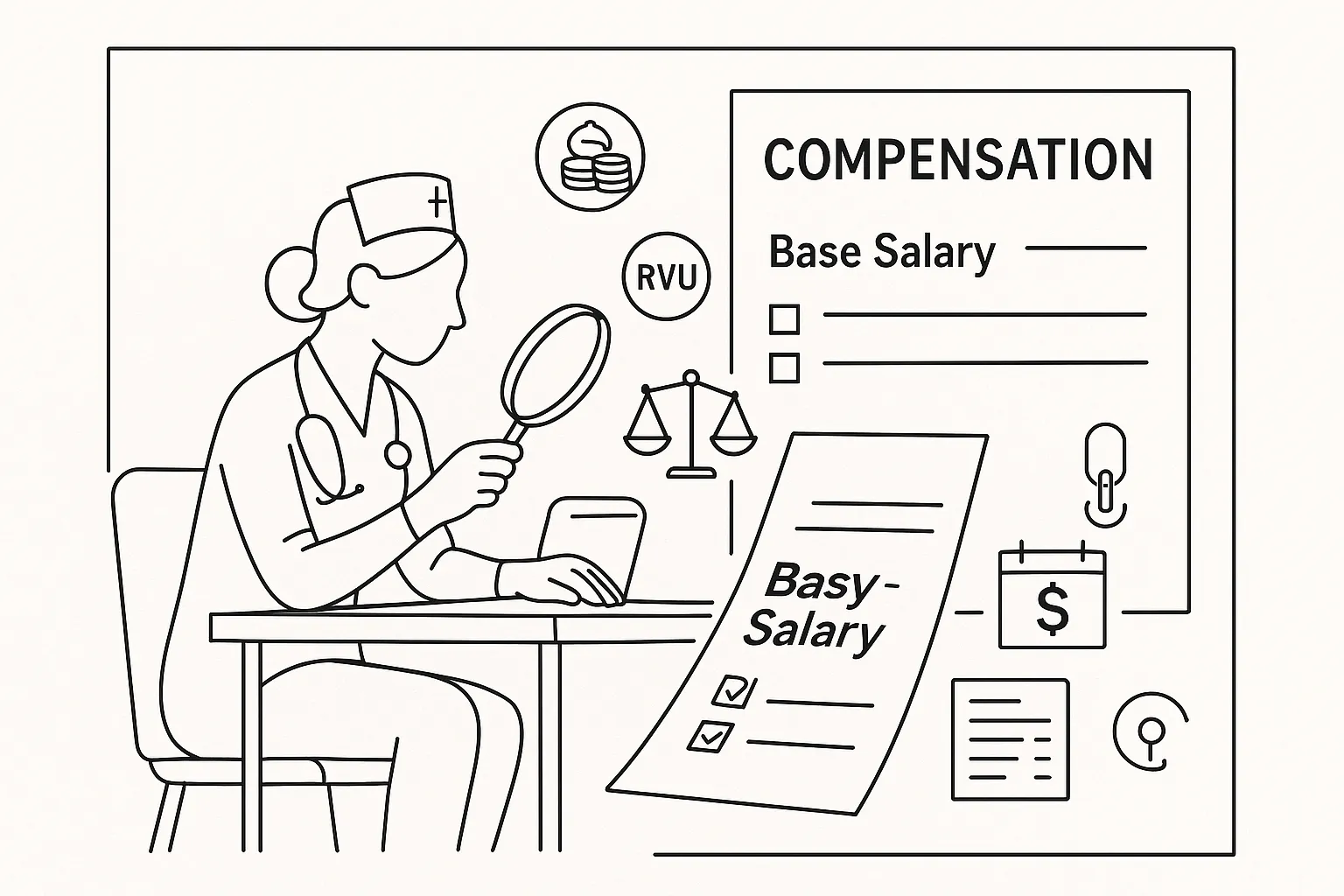
NP compensation may consist of a guaranteed salary, base pay plus productivity, collections-based compensation, an RVU formula, or a combination of these methods. An RVU provision should explain which services receive credit, the conversion factor, the threshold for additional compensation, and whether prior shortfalls carry forward. A collections formula should define whether compensation is based on gross charges, insurer-allowed amounts, or money actually received after adjustments. A focused review of compensation and productivity terms can identify formulas that make expected earnings difficult to verify.
Productivity provisions also require transparent reporting and reconciliation procedures. Negative accrual language may allow an employer to offset a prior shortfall against future bonuses or compensation, while chargeback provisions may shift denials, refunds, or billing adjustments to the NP. The agreement should state when calculations occur, what reports the NP can inspect, how disputes are raised, and whether the employer may change benchmarks or conversion factors unilaterally.
Signing bonuses, loan repayment benefits, relocation allowances, and training payments often include clawback provisions if employment ends within a specified period. Important questions include whether repayment is prorated, which termination events trigger it, whether termination without cause is excluded, and whether the employer can deduct disputed amounts from final compensation. Discretionary bonuses should likewise be distinguished from formula-based incentives with defined metrics, measurement periods, and payment dates.
Malpractice Insurance, Tail Coverage, and Indemnification
Occurrence malpractice policies generally cover claims arising from services performed during the policy period, even if a claim is made later. Claims-made policies generally require the policy to be active when the claim is reported, which can create a need for tail coverage after employment ends. A contract should identify the coverage type, policy limits, responsible carrier, covered services, and whether the employer or NP must obtain and pay for extended reporting coverage.
Tail responsibility may depend on how the relationship ends. Some agreements place the entire cost on the NP after resignation, provide employer-paid tail following termination without cause, or prorate the obligation based on length of service. Because these provisions can create significant post-employment expense, a malpractice and tail insurance review should address both the coverage language and the termination scenarios that trigger payment.
Indemnification provisions deserve separate scrutiny because they may extend beyond professional negligence. Broad language can require the NP to defend or reimburse the employer for regulatory penalties, billing disputes, third-party claims, or losses connected to employer policies. The contract should distinguish responsibility for the NP’s conduct from liability arising from the facility, staff, billing systems, or employer-controlled operations and should clearly state applicable reporting and defense obligations.
Pennsylvania Scope of Practice, Collaboration, and Credentialing
Clinical duties should align with the NP’s education, certification, privileges, and Pennsylvania scope-of-practice requirements. Overly broad language allowing the employer to assign any duties, location, schedule, or nonclinical task can expand the role after signing. The agreement should describe the expected patient population, services, call coverage, administrative responsibilities, work locations, and process for material changes.
Pennsylvania agreements may also address physician collaboration, prescribing, delegation, and related practice procedures. These provisions should reflect the operational arrangement and the requirements applicable to the NP’s role rather than shifting all responsibility for maintaining the employer’s clinical structure to the practitioner. Reviewing supervision and collaboration terms can reveal conflicts between the employment agreement, a separate collaborative document, and actual workplace expectations.
Credentialing and privileging clauses should state who initiates applications, pays required fees, supplies supporting documents, and monitors renewals. Delays in hospital privileges, payer enrollment, prescribing authority, or electronic medical record access can affect start dates and productivity. The agreement should explain whether compensation begins during credentialing, what happens if approvals are delayed or denied, and how services and charges will be attributed once practice begins.
Pennsylvania Non-Compete and Non-Solicitation Restrictions
Pennsylvania non-compete provisions require fact-specific analysis. Courts generally consider whether a restriction protects a legitimate business interest, is supported by adequate consideration, and is reasonable in duration, geography, and scope. Healthcare restrictions may also raise practical concerns involving patient access and continuity of care, but enforceability depends on the contract language and circumstances rather than the provision’s label alone.
A restriction covering a large radius, several facilities, broad categories of services, or an extended period may significantly limit an NP’s options in Philadelphia, Pittsburgh, Harrisburg, Allentown, or surrounding communities. Non-solicitation clauses can have similar effects if they prohibit contact with patients, employees, referral sources, or business relationships. An attorney conducting an NP non-compete review can assess the combined effect of these restrictions on realistic employment opportunities.
Negotiation options may include narrowing the restricted territory or services, shortening the duration, excluding locations where the NP did not practice, or adding exceptions after employer termination without cause. Patient-continuity language, specialty-specific carve-outs, and clear definitions may also reduce uncertainty. Any proposed revision should be evaluated in the context of the complete agreement and the NP’s expected practice area.
Termination, Final Pay, and Post-Employment Obligations
Termination provisions determine how quickly the relationship may end and what financial obligations survive. A for-cause section should define the conduct permitting immediate termination and state whether the NP receives notice and an opportunity to cure. Without-cause termination language should specify the required notice period, whether the employer may remove the NP from the schedule during notice, and whether compensation and benefits continue through the effective termination date.
The agreement should also coordinate termination rights with bonus repayment, tail insurance, non-compete restrictions, credentialing, and final productivity compensation. Some contracts permit the employer to delay final payment until collections are received or reconciliation is complete, while others impose ongoing chart completion, patient transition, or administrative duties. A dedicated contract termination review can identify open-ended obligations, inconsistent notice provisions, and financial consequences that may not be apparent when each clause is read separately.
Repayment provisions should clearly identify the amount, triggering event, proration method, due date, and any exceptions. The NP should also understand whether the employer claims a right to deduct repayment, alleged overpayments, or other disputed amounts from final compensation. Transition duties should be reasonable in duration and should not require uncompensated clinical or administrative work after the relationship ends.
Preparing for a Pennsylvania NP Contract Review
Before review, gather the complete agreement and every document incorporated by reference, including compensation plans, job descriptions, bonus policies, malpractice summaries, handbooks, collaborative practice documents, and recruitment correspondence. Important verbal promises concerning schedule, work location, remote practice, ownership, call coverage, or future compensation should be added to the written agreement rather than left outside the final contract.
Common warning signs include undefined collections or productivity terminology, discretionary bonuses, unilateral amendment rights, broad indemnification, NP-funded tail coverage, expansive restrictive covenants, ambiguous duties, multiple-location requirements, and repayment clauses that are not prorated. Review should occur before signing and with enough time to request written revisions. The goal is not simply to identify unfavorable language but to understand how the contract affects income, licensure responsibilities, liability, and future mobility in Pennsylvania.
Chelle Law provides flat-fee, attorney-led contract review for nurse practitioners, including written comments, proposed revisions, and a consultation addressing the agreement’s practical impact. A line-by-line review can help an NP make an informed decision and document negotiated changes before beginning the position.
Review Your Pennsylvania NP Contract Before You Sign
Chelle Law can identify compensation, malpractice, restrictive covenant, collaboration, and termination provisions that may affect your Pennsylvania practice and long-term career options.
Contact Chelle Law