
A South Carolina nurse practitioner contract can affect far more than salary. The agreement may determine clinical duties, prescribing authority, collaboration responsibilities, malpractice exposure, termination rights, and future practice options in Charleston, Columbia, Greenville, or another healthcare market. Nurse practitioners are regulated by the South Carolina Board of Nursing, while practice-agreement requirements also involve physicians regulated by the South Carolina Board of Medical Examiners. Under South Carolina’s profession-specific framework, an NP must hold the required advanced practice registered nursing authority and practice within the Nurse Practice Act, applicable board standards, and the NP’s specialty. Medical acts generally require a qualifying written practice agreement unless the NP is practicing under applicable full practice authority. Contract review can determine whether the proposed duties, locations, physician arrangements, and prescribing provisions reflect those requirements and clearly allocate responsibility for maintaining the necessary approvals and documentation.
Compensation formulas, malpractice coverage, restrictive covenants, termination notice, and repayment clauses must also be read together. For example, leaving a position may affect earned productivity compensation, trigger tail-insurance or bonus-repayment obligations, and activate a geographic restriction. Chelle Law provides attorney-led contract analysis that identifies these connected risks, explains how the language may operate, and flags provisions that may warrant clarification or revision before the nurse practitioner signs.
Priorities in a South Carolina NP Contract Review
Employment and Independent Contractor Terms
The first step is identifying the nature of the relationship and the documents that govern it. An employment agreement may address wages, benefits, leave, expense reimbursement, professional liability insurance, and employer policies. An independent contractor agreement may instead shift responsibility for taxes, benefits, insurance, business expenses, and other costs to the NP. The contract label does not answer every classification question, but review can reveal the financial and operational obligations the proposed language assigns.
A focused independent contractor agreement review can evaluate payment mechanics, scheduling control, insurance duties, indemnification, termination rights, and expenses that may not be apparent from the stated rate. The complete contract should also be compared with the offer letter, compensation plan, practice agreement, handbook references, and incorporated policies.
How Contract Provisions Interact
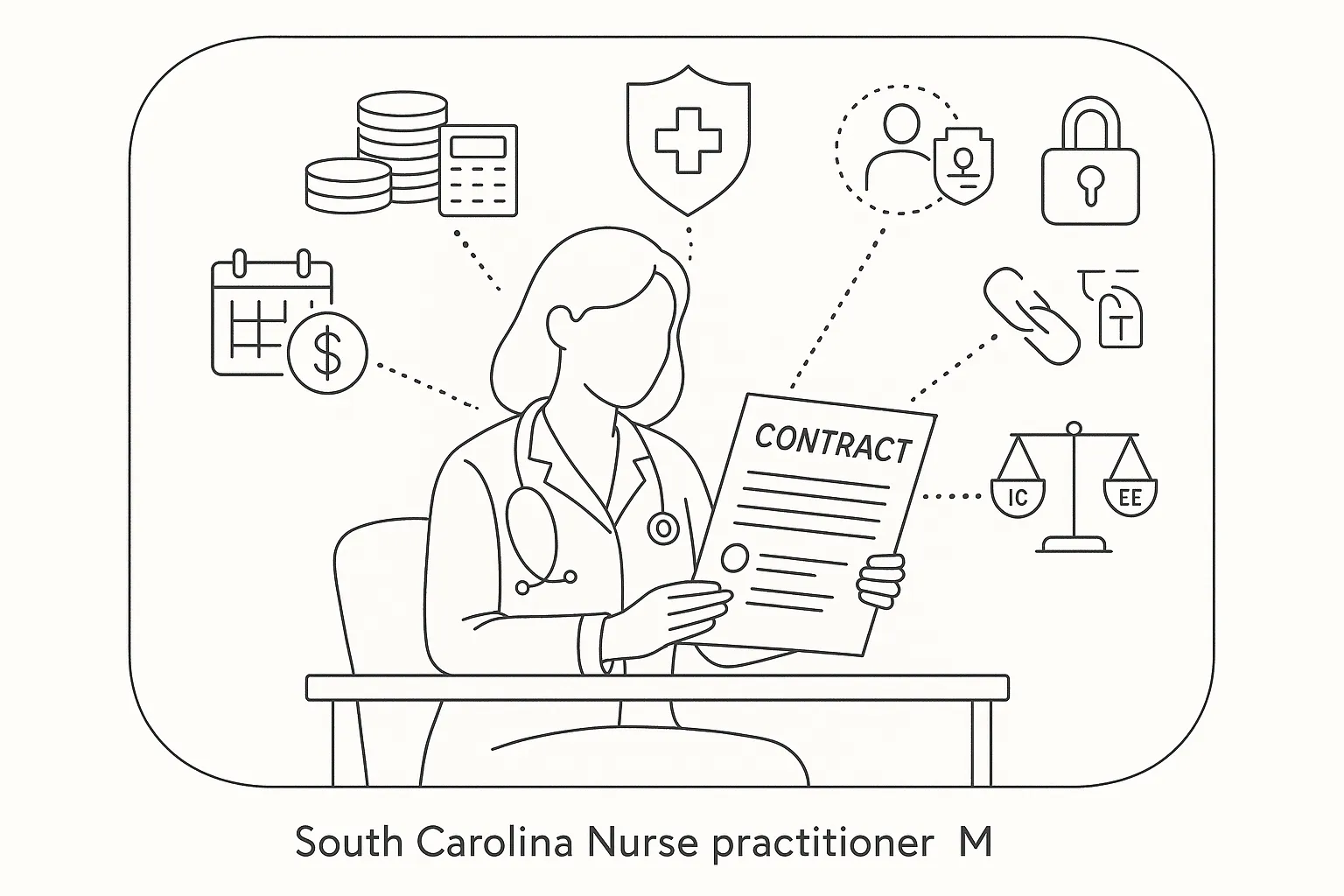
Individual clauses rarely operate in isolation. Assigned locations may expand a non-compete, productivity definitions may affect post-termination collections, and a termination event may determine who pays for tail coverage or repays a signing bonus. A complete nurse practitioner contract review considers those relationships rather than evaluating only salary or one unfavorable clause.
- Compensation formulas, productivity thresholds, reconciliation, and negative accrual.
- Clinical duties, prescribing authority, practice locations, schedules, and call coverage.
- Malpractice policy type, coverage limits, tail responsibility, and indemnification.
- Non-compete, non-solicitation, confidentiality, and outside-activity restrictions.
- Termination notice, final compensation, repayment obligations, and surviving provisions.
South Carolina Scope of Practice and Practice Agreements
Licensure, Specialty Scope, and Clinical Duties
A nurse practitioner must hold a current South Carolina APRN license or other qualifying temporary authority before practicing advanced nursing in the state. The proposed clinical responsibilities must remain within the Nurse Practice Act, applicable board standards, and the NP’s specialty scope. Contract analysis can identify duties that are described too broadly, assign services outside the contemplated role, or allow the employer to change responsibilities without corresponding limits or support.
Operational provisions also deserve attention. The agreement may address patient volume, work locations, administrative responsibilities, chart completion, call, weekend coverage, telehealth, and outside activities. Review can compare those expectations with the compensation model and identify whether the employer retains broad authority to change the schedule, location, specialty coverage, or workload.
Written Practice Agreements and Physician Collaboration
Unless applicable full practice authority governs the arrangement, a South Carolina NP performing medical acts generally must have a written practice agreement with a physician or medical staff. The agreement must identify the parties and practice locations and address consultation, backup coverage, permitted conditions and treatments, drug therapies, and situations requiring referral. It must be reviewed at least annually and made available to the South Carolina Board of Nursing within 72 hours of a request.
The physician-side rules are also relevant to the proposed operating structure. A collaborating physician must maintain the required agreement before the NP begins practice and generally may not enter agreements covering more than the statutory equivalent of six full-time PAs, NPs, CNMs, or CNSs without an approved exception. Review can determine whether the employment contract clearly assigns responsibility for establishing and maintaining the required arrangement rather than leaving the NP exposed to an employer-controlled delay.
An NP who changes practice settings or physicians must notify the South Carolina Board of Nursing within 15 business days and provide verification of the practice agreement; discontinuing practice also carries a 15-business-day notification requirement. These obligations make location changes, physician substitutions, credentialing conditions, and termination procedures important contract issues. Chelle Law’s practice agreement and collaboration review evaluates how the contract allocates these responsibilities.
Prescriptive Authority and Telemedicine
South Carolina prescriptive authority requires the appropriate APRN licensure, application, and pharmacotherapeutics education. Prescribing must remain within the NP’s specialty, applicable state and federal law, and any required practice agreement. When properly authorized, the agreement may include Schedule III–V controlled substances subject to the applicable controlled-substance requirements.
Telemedicine provisions require additional precision. An APRN may not establish a nurse-patient relationship solely through telemedicine for prescribing when an in-person examination is necessary for diagnosis. Contract review can evaluate whether telehealth duties address practice setting, prescribing, recordkeeping, controlled substances, geographic coverage, scheduling, technology support, and professional compliance without assigning unrestricted responsibility to the NP.
Compensation, Productivity, and Benefits
Salary, Collections, and RVU Models
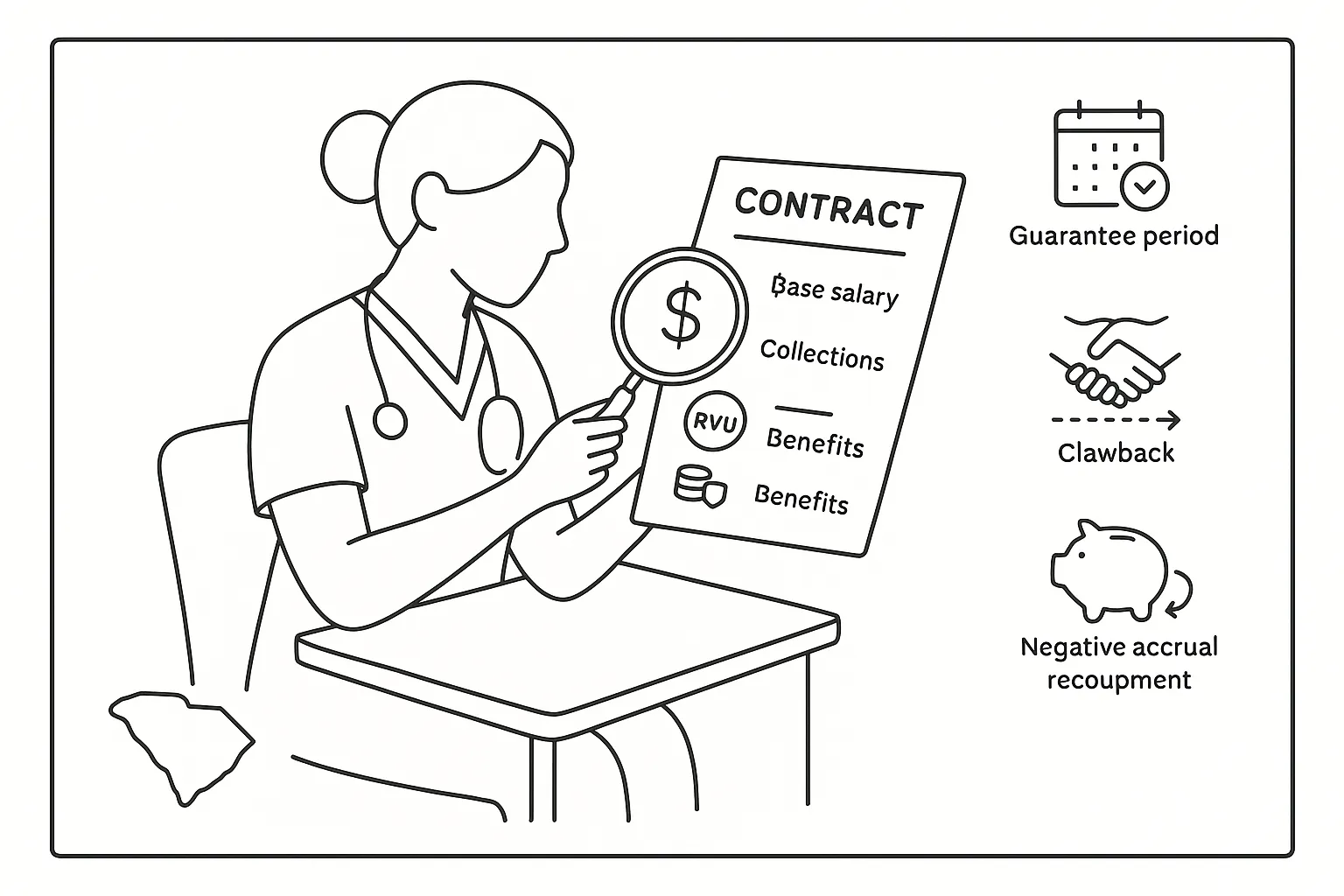
NP compensation may be structured as a salary, hourly rate, shift rate, collections percentage, RVU formula, or combination of guaranteed and variable pay. The stated amount does not establish the agreement’s full economic value. Review can determine how compensation is earned, calculated, reconciled, and paid—and whether employer-controlled deductions or later adjustments can reduce it.
- The duration of guaranteed compensation and the formula that applies afterward.
- The definitions of collections or net collections and any deductions taken before calculating pay.
- The RVU schedule, conversion factor, crediting rules, thresholds, and reconciliation periods.
- Responsibility for billing, coding, payer enrollment, refunds, write-offs, and uncollectible accounts.
- Whether negative accrual, chargebacks, or overpayment language permits deficits to carry forward.
A dedicated compensation and productivity review can help an NP understand variables that affect expected cash flow. This is particularly important when productivity depends on billing or administrative processes the employer controls.
Bonuses, Repayment Clauses, and Benefits
Bonus provisions may depend on collections, RVUs, panel size, quality measures, productivity percentiles, or employer discretion. Analysis can identify when the bonus becomes earned, when it must be paid, whether employment on the payment date is required, and whether the employer can change the formula. Any signing bonus, relocation allowance, student-loan benefit, or advance also requires a clear vesting schedule and defined repayment triggers.
Benefits may contribute substantial value but are sometimes described only by reference to policies that can change. Relevant terms include health-insurance cost sharing, retirement contributions and vesting, paid leave, CME allowances, professional dues, licensing expenses, prescribing-related fees, and continuing education time. Language such as “eligible” or “at the employer’s discretion” may leave the actual benefit uncertain unless the governing plan or policy supplies the missing detail.
Malpractice Insurance, Tail Coverage, and Liability
Claims-Made and Occurrence Coverage
No material South Carolina nurse-practitioner-specific statute or board rule requiring an employer to provide malpractice insurance or tail coverage was identified in the reviewed licensing materials. The contract therefore needs to address the applicable policy and allocation directly. Review can identify whether the employer provides coverage, whether the NP is an insured under the policy, what limits apply, and whether coverage can change during the relationship.
An occurrence policy generally covers an incident occurring during the policy period even if the claim is asserted later. A claims-made policy generally requires active coverage when the claim is made, so extended reporting or tail coverage may be necessary after employment ends. Responsibility for purchasing and paying for tail coverage may depend on resignation, termination for cause, termination without cause, or length of service. A malpractice and tail insurance review can clarify those policy mechanics and separation-related costs.
Indemnification and Post-Claim Duties
Indemnification provisions may require the NP to reimburse an employer for losses, claims, legal expenses, or other costs. Analysis can determine whether those duties are mutual or one-sided, extend beyond the NP’s conduct, or conflict with the malpractice coverage described elsewhere. The contract may also impose continuing duties to cooperate with later claims, preserve records, attend proceedings, or notify the employer of a demand.
South Carolina medical-malpractice claims are generally subject to a three-year limitations period tied to treatment, omission, or discovery, along with a six-year outer limit and statutory exceptions or tolling provisions. State law also limits certain noneconomic damages, subject to aggregate limits, adjustments, and exceptions. Those rules do not replace careful review of insurance, tail, indemnity, and post-termination cooperation provisions because contractual obligations may create separate financial exposure.
Non-Competes and Other Post-Employment Restrictions
South Carolina Non-Compete Terms
A restrictive covenant can affect an NP’s ability to move between employers in Charleston, Columbia, Greenville, or another South Carolina market. Under South Carolina law, a restrictive covenant may be enforceable only when it satisfies requirements involving reasonableness in time, geographic area, and line of business; a written and signed agreement; consideration; and a legitimate business interest. The enforcing party bears the burden of pleading and proving that interest, and courts may consider public health, safety, and welfare.
Enforceability depends on the specific language and circumstances, so a review cannot promise a particular outcome. It can, however, identify the activities, locations, facilities, and termination events covered by the restriction. A focused nurse practitioner non-compete review can also evaluate whether multiple worksites create overlapping restricted areas or whether the clause reaches telehealth, moonlighting, administrative work, or practice outside the NP’s current specialty.
Non-Solicitation, Confidentiality, and Enforcement Provisions
Post-employment restrictions may extend beyond a non-compete. Patient and employee non-solicitation clauses, confidentiality obligations, referral-source restrictions, intellectual-property provisions, and limits on using professional information can affect a future position. Review can identify whether patient or employee groups are defined too broadly and whether ordinary professional communications could arguably fall within the restriction.
Enforcement provisions may increase the practical cost of a dispute. Relevant terms include liquidated damages, injunctive relief, attorney-fee provisions, forum-selection clauses, arbitration requirements, and garden-leave language. If the contract provides compensation during a restricted period, it should clearly explain the payment amount, timing, duration, and conditions for continued eligibility.
Termination, Notice, and Repayment Obligations
For-Cause and Without-Cause Termination
Termination provisions control how the parties may end the relationship and often activate other financial obligations. The contract may distinguish termination for cause, termination without cause, nonrenewal, and resignation. Review can determine whether the notice procedure is workable, whether an alleged breach includes an opportunity to cure, and whether the employer can immediately remove the NP from duties or stop compensation during the notice period.
Cause provisions may address licensure restrictions, credentialing problems, exclusion, criminal conduct, policy violations, failure to meet performance standards, or material breach. Broad or subjective definitions can give the employer significant discretion while affecting repayment, tail coverage, and restrictive covenants. The agreement may also need to account for delays or interruptions involving payer enrollment, hospital privileges, practice agreements, or other conditions outside the NP’s direct control.
Final Compensation and Clawbacks
Separation language should explain payment of accrued salary, earned bonuses, outstanding productivity compensation, unused leave, and any severance. Post-termination accounting is especially important in a collections model because payment may arrive after the NP’s final workday. The contract may need to define the collection period, chargebacks, deductions, access to supporting reports, and the date of final reconciliation.
Repayment clauses may cover signing bonuses, relocation assistance, student-loan benefits, training expenses, advances, or alleged compensation overpayments. Analysis can identify whether repayment is prorated, which termination events trigger it, whether the employer may accelerate the balance, and whether offsets can be taken from final compensation. Chelle Law’s NP contract termination review evaluates these consequences before an NP gives notice or signs a separation-related document.
When to Request a South Carolina NP Contract Review
Contract review is most useful after the NP receives the complete written agreement and before signing, resigning from another position, relocating, or relying on promised compensation. It may also be appropriate when an employer proposes an amendment, changes the compensation model, adds a practice location, alters clinical duties, replaces a collaborating physician, or presents a termination or repayment demand.
Chelle Law’s review process includes secure document submission, line-by-line attorney analysis, written comments, and a consultation explaining the practical implications of significant provisions. The review can flag employer-favorable language, clarify compensation and insurance mechanics, identify provisions that may warrant revision, and help the NP prioritize material concerns. No particular outcome can be guaranteed, but understanding the agreement before acceptance supports a more informed career decision.
Speak With a South Carolina Nurse Practitioner Contract Lawyer Before You Sign
Chelle Law can review compensation, practice-agreement responsibilities, malpractice coverage, restrictive covenants, termination terms, and other provisions that may warrant clarification or revision.
Request a Contract ReviewExplore Nurse Practitioner Contract Guidance
Review related services, practical contract resources, and state-specific guidance for nurse practitioners.