
When a nurse practitioner accepts a position in Tennessee—whether practicing in Nashville, Memphis, Knoxville, or another healthcare market—the employment or independent contractor agreement governs compensation, clinical duties, malpractice coverage, termination rights, and post-employment restrictions. These provisions must also operate within Tennessee’s regulatory framework, including oversight by the Tennessee Board of Nursing and the laws governing advanced practice registered nurses.
Small drafting differences can materially affect productivity pay, credentialing timelines, supervision expectations, tail insurance responsibility, and career mobility. Chelle Law provides attorney-led Tennessee nurse practitioner contract review focused on identifying financial, professional, and regulatory risks before an agreement is signed. The review considers how the contract’s terms work together rather than evaluating salary or any single clause in isolation.
Key Contract Review Priorities for Tennessee Nurse Practitioners
- Confirm whether the agreement creates W-2 employment or a 1099 independent contractor relationship and whether its control provisions are consistent with that classification.
- Examine base salary, RVU thresholds, collections formulas, negative accrual, bonus triggers, and reconciliation procedures to understand how compensation is actually calculated.
- Require clear malpractice language addressing policy type, coverage limits, tail insurance, and responsibility for premiums after termination.
- Compare scope-of-practice, prescribing, supervision, and collaboration provisions with applicable Tennessee requirements and the employer’s operational expectations.
- Review non-compete, repayment, termination, and notice provisions for restrictions or liabilities that could affect future employment.
Employment and Independent Contractor Agreements in Tennessee
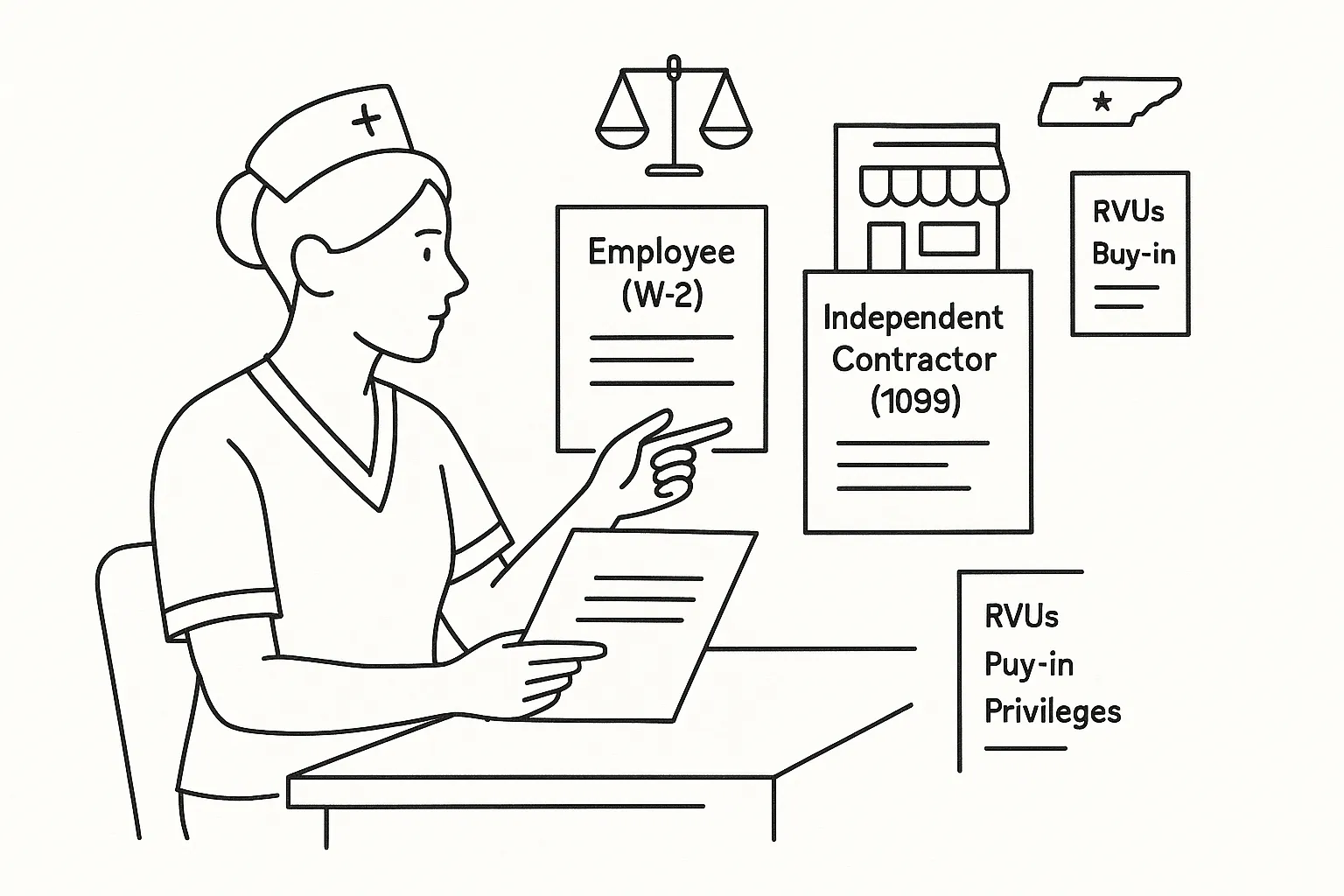
The agreement type is the starting point for assessing legal and practical exposure. An employee agreement generally creates a W-2 relationship involving payroll withholding, employer-provided benefits, and greater employer control over schedules, duties, and performance standards. A 1099 agreement commonly shifts taxes, insurance, and other business expenses to the nurse practitioner, even when the organization retains substantial control over the work. Reviewing the practical differences between W-2 and 1099 arrangements for nurse practitioners can help clarify the consequences of each structure.
Classification, Control, and Agreement Structure
An independent contractor agreement may promise autonomy while also requiring set hours, mandatory electronic health record use, exclusivity, or detailed scheduling compliance. Those provisions deserve careful attention because the contract’s label does not resolve every classification issue. A review should consider control over the work, equipment and support provided, exclusivity, benefits, termination rights, and responsibility for professional expenses.
Hospitals, health systems, urgent care groups, and private practices also use different contract structures. Hospital agreements may emphasize credentialing, privileging, productivity metrics, and broad termination rights, while private practice agreements may address buy-in opportunities, equity, or partnership-related terms. A dedicated independent contractor agreement review can identify obligations that differ from a traditional employment offer.
Compensation, Benefits, and Repayment Obligations
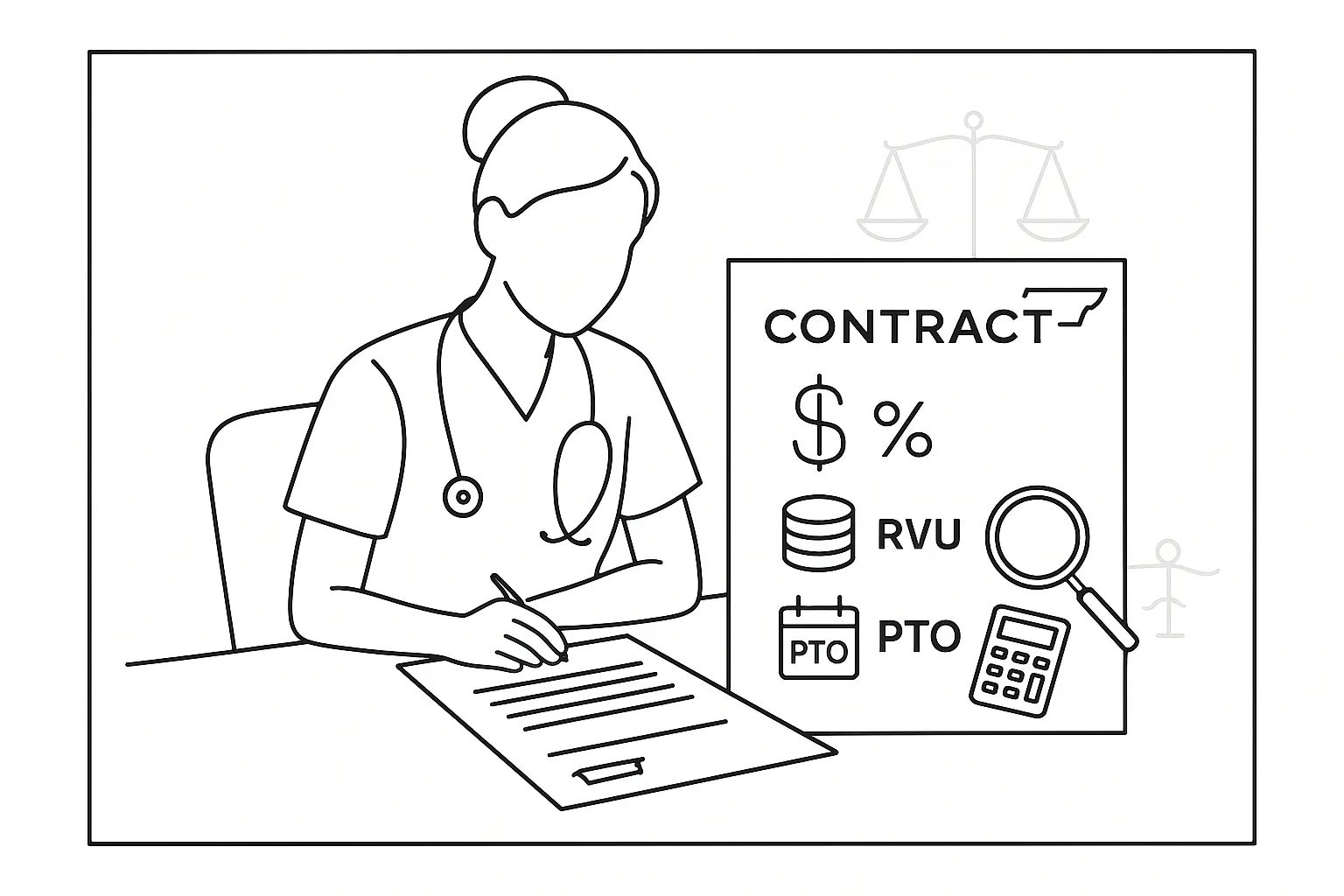
Compensation language is often the most financially consequential part of an NP contract. The headline salary does not show how productivity thresholds, reconciliation periods, collections delays, negative accrual, chargebacks, or employer discretion may affect take-home pay. A thorough NP compensation and productivity review evaluates the formula, the data used to calculate payment, and what happens when employment ends during a measurement period.
Salary, RVUs, Collections, and Bonus Formulas
A base salary may be guaranteed only for an initial period before converting to an RVU, collections-based, or blended model. The agreement should identify the productivity threshold, conversion rate, measurement period, reconciliation schedule, and access to supporting reports. Negative accrual provisions may allow an employer to carry a productivity deficit into a later period, while collections-based formulas may expose compensation to billing delays, payer adjustments, denials, or recoupments outside the NP’s control.
Bonus provisions also require objective and measurable triggers. Quality incentives, discretionary bonuses, signing bonuses, relocation assistance, and loan repayment benefits may be valuable, but repayment obligations can create substantial debt if the NP leaves before a specified date. The agreement should clearly state whether repayment is prorated, which termination events trigger it, and when payment becomes due.
Benefits, Leave, and Professional Expenses
Total compensation also includes health coverage, retirement contributions, paid time off, continuing education allowances, licensing fees, DEA-related expenses, and other professional costs. Eligibility waiting periods, vesting schedules, payroll deductions, and limits on PTO payout can materially change the offer’s value. These terms should be compared with the contract’s work schedule, call requirements, and productivity expectations rather than treated as separate benefits.
Tennessee Scope of Practice, Supervision, and Clinical Duties
Clinical duty provisions should be consistent with the nurse practitioner’s licensure, certification, training, and applicable Tennessee requirements. Contracts may incorporate job descriptions or employer policies by reference, allowing important duties to appear outside the signed agreement. The review should identify who can change those duties, whether additional locations or specialties may be assigned, and how expanded responsibilities affect compensation and liability.
Supervision, Collaboration, and Prescribing Terms
Tennessee agreements may address collaborative practice, physician supervision, prescribing responsibilities, chart review, and related operational requirements. Those provisions should align with applicable Tennessee law, Tennessee Board of Nursing requirements, and the actual resources supplied by the employer. A supervision and collaboration agreement review can assess whether physician availability, documentation duties, and contractual responsibilities are clearly allocated.
Delegation and supervision terms can also affect productivity. If physician involvement, co-signatures, or administrative approvals are required for key services, the agreement should account for how those requirements influence scheduling, billing, and performance metrics. The contract should not impose obligations that depend on support the employer has not committed to provide.
Call Coverage, Telehealth, Credentialing, and Work Locations
On-call, weekend, holiday, floating, and telehealth obligations should be defined with enough detail to evaluate workload and compensation. Relevant questions include how frequently call is assigned, whether additional coverage is paid, whether telehealth encounters count toward productivity, and whether the employer can add work locations without the NP’s consent.
Credentialing and privileging contingencies should explain what happens if approvals delay the start date. The agreement should address whether compensation begins during a delay, whether the employer may terminate the contract, and whether the NP remains responsible for relocation or bonus repayment. Performance standards should rely on measurable information rather than undefined employer discretion.
Malpractice Insurance and Contractual Liability
Malpractice coverage can create significant financial exposure during and after employment. The contract should identify the policy type, coverage limits, named insureds, responsibility for premiums, and any conditions affecting continued coverage. A focused malpractice and tail insurance review can clarify obligations that otherwise become apparent only when the relationship ends.
Claims-Made Coverage, Occurrence Coverage, and Tail Insurance
Occurrence coverage generally responds to covered incidents occurring during the policy period even if the claim is asserted later. Claims-made coverage generally depends on the policy being active when the claim is made, which can make tail or other extended reporting coverage important after termination. If the employer supplies claims-made insurance, the agreement should state who purchases tail coverage, when it must be obtained, and whether responsibility changes based on the reason for separation.
Indemnification provisions require separate review because they may shift third-party claims, defense expenses, or operational liabilities to the clinician. The agreement should distinguish liability arising from the NP’s conduct from liability caused by employer systems, staffing, billing, facilities, or other personnel. Cooperation requirements and control of the defense should also be understandable and reasonably allocated.
Non-Competes, Termination, and Dispute Terms
Post-employment restrictions and termination provisions should be read together because the reason for separation may determine whether a restriction, repayment obligation, or tail insurance clause applies. Tennessee contract language may address non-competes, non-solicitation, confidentiality, patient relationships, referral sources, and future work within a defined area. These provisions can affect opportunities in Nashville, Memphis, Knoxville, and other Tennessee healthcare markets.
Restrictive Covenants and Career Mobility
A restrictive covenant should be evaluated for its stated duration, geographic reach, covered services, triggering events, and practical impact. Undefined geographic terms, restrictions tied to every employer location, or language covering services the NP never performed may create unnecessary uncertainty. Chelle Law’s nurse practitioner non-compete review focuses on how the complete restriction could affect realistic future practice options.
Non-solicitation and confidentiality provisions may separately restrict communication with patients, employees, referral sources, or business contacts. Definitions such as “client,” “prospective patient,” or “confidential information” should be specific enough to understand. Appropriate exclusions may be needed for information already public, independently known, or required to be disclosed by law.
Termination, Notice, Clawbacks, and Dispute Resolution
For-cause termination language should identify the events permitting immediate separation and whether the NP receives an opportunity to cure a correctable breach. Without-cause termination should establish a workable notice period and explain whether the employer can remove the NP from the schedule, stop productivity opportunities, or end benefits during that period. A contract termination review can also identify provisions governing final compensation, patient transition duties, records, and post-employment cooperation.
Repayment clauses may apply to signing bonuses, relocation assistance, training costs, loan benefits, or employer-paid insurance. The calculation method and triggering events should be explicit. Arbitration, governing-law, venue, attorney-fee, and injunctive-relief provisions also matter because they determine where and how a dispute proceeds and may affect the practical cost of enforcing contractual rights.
What a Tennessee NP Contract Review Should Address
A targeted review should explain how the agreement affects income, licensure-related responsibilities, professional liability, and future mobility. Priority issues commonly include compensation calculations, objective bonus standards, malpractice and tail obligations, supervision or collaboration terms, restrictive covenants, termination rights, repayment triggers, and employer authority to change policies or duties. Vague phrases such as “as determined by the employer,” undefined cause standards, broad repayment language, and unilateral amendment clauses deserve particular attention.
Review is most useful before the offer is signed, when proposed revisions can still be raised with the employer. Chelle Law provides attorney-led analysis, written feedback, and a consultation focused on the provisions that matter to the individual agreement. The objective is to help the nurse practitioner understand the offer, prioritize requested changes, and make an informed decision before beginning the position.
Review Your Tennessee NP Contract Before You Sign
Understand the compensation, supervision, malpractice, termination, and restrictive covenant provisions in your proposed Tennessee nurse practitioner agreement.
Contact Chelle LawExplore Nurse Practitioner Contract Guidance
Review attorney-led services, practical contract resources, and state-specific information for nurse practitioners.