
A Utah nurse practitioner contract can shape clinical responsibilities, compensation, professional liability, and career mobility long after the start date. Nurse practitioners are regulated as advanced practice registered nurses under the Utah Nurse Practice Act and related rules administered by the Utah Division of Professional Licensing and the Utah Board of Nursing. Those requirements affect licensure, national certification, scope of practice, and prescriptive authority, while the contract may add separate operational expectations involving schedules, consultation, chart completion, credentialing, or work locations. In healthcare markets such as Salt Lake City and Provo, a broad location clause or restrictive covenant may also affect access to future positions across multiple facilities. Attorney review can compare the proposed duties with Utah’s APRN framework and identify compensation, insurance, repayment, termination, and post-employment provisions that warrant clarification before the agreement is signed.
Small drafting differences can materially change an offer’s value. A productivity formula may exclude certain services, a claims-made policy may leave the NP responsible for tail coverage, or a signing bonus may become immediately repayable after an early departure. Utah’s treatment of healthcare non-competes also depends on when the agreement was entered, making the contract date and the exact type of restriction important. Chelle Law provides attorney-led analysis focused on explaining these practical consequences and identifying language that may warrant revision. Learn more about the firm’s nurse practitioner contract review service.
Key Contract Issues for Utah Nurse Practitioners
- Evaluate the agreement as a whole because compensation, malpractice coverage, repayment obligations, restrictive covenants, and termination rights often interact.
- Confirm how salary, collections, RVUs, bonuses, quality incentives, true-ups, and negative accrual affect actual earnings.
- Compare clinical duties, prescribing responsibilities, credentialing requirements, and employer protocols with Utah’s APRN practice framework.
- Identify the malpractice policy type, applicable limits, defense obligations, and responsibility for tail or prior-acts coverage.
- Review the agreement date and distinguish a healthcare non-compete from separate nonsolicitation, confidentiality, and nondisclosure provisions.
- Examine without-cause notice, for-cause triggers, final compensation, benefit repayment, and post-employment duties before signing.
Utah Employment and Independent Contractor Agreements
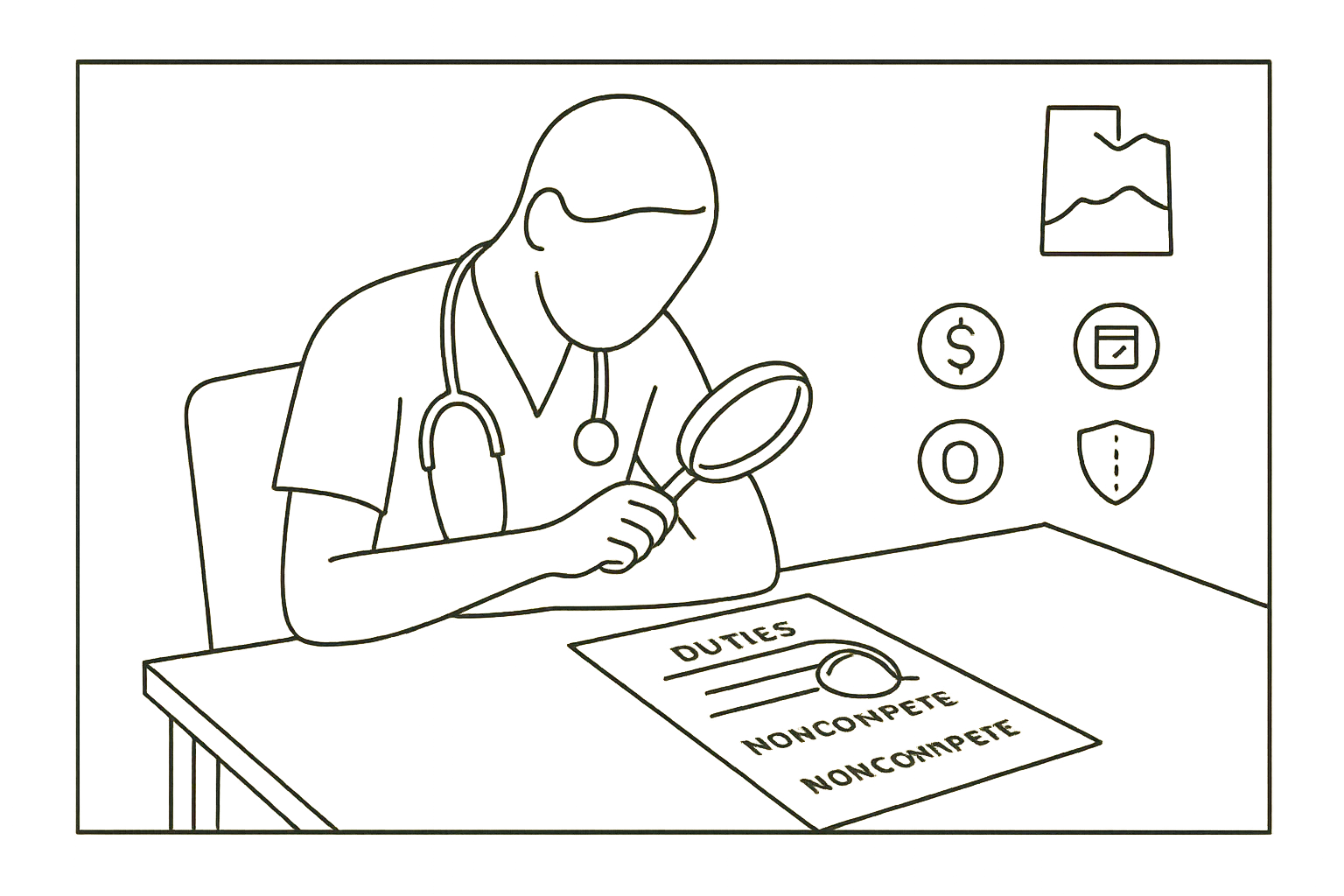
An NP agreement may address clinical duties, work locations, schedules, call, compensation, benefits, expenses, professional liability insurance, credentialing, termination, restrictive covenants, and dispute procedures. The practical allocation of these responsibilities can differ significantly between a W-2 employment contract and a 1099 independent contractor agreement.
W-2 Employment Versus 1099 Contracting
A W-2 agreement may provide employee benefits and employer-funded business expenses, while an independent contractor agreement may allocate taxes, insurance, equipment, licensing costs, and administrative expenses to the NP. The label used in the document does not answer every classification question or eliminate professional licensing obligations. Review should examine both the written terms and the operational relationship, including schedule control, billing, expense responsibility, outside work, and how services are performed.
Compensation comparisons also require more than comparing headline rates. A higher contractor rate may have to cover unpaid leave, payroll taxes, professional expenses, benefits, and insurance that an employer would otherwise fund. Chelle Law’s guide to W-2 and 1099 arrangements for nurse practitioners explains additional terms to evaluate.
Defined Terms, Policies, and Triggering Events
Defined terms and incorporated policies can carry the same practical importance as the main compensation section. An employee handbook, productivity plan, malpractice policy, bonus document, or credentialing policy may establish rules that do not appear in the signed agreement. Review can identify whether the employer may change those materials unilaterally and whether the contract controls if the documents conflict.
Financial obligations often arise only after a specified event, such as resignation, termination for cause, a credentialing delay, disability, failure to meet a productivity threshold, or a sale of the practice. Those triggers may determine whether the NP forfeits an incentive, repays an advance, purchases tail coverage, or becomes subject to post-employment obligations. A line-by-line analysis helps reveal terms that shift risk or leave important operational questions unanswered.
Compensation, Productivity, and Benefits
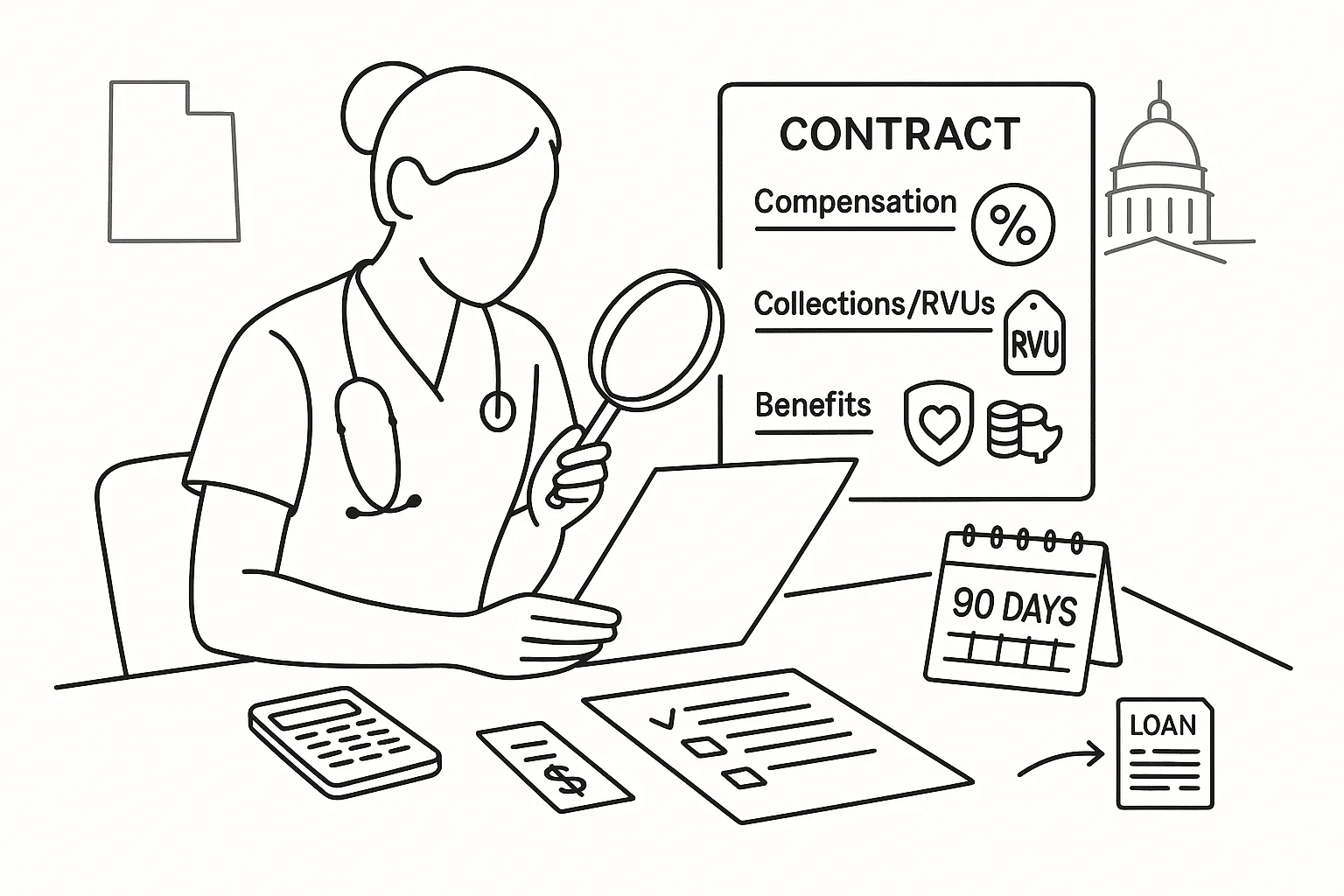
Compensation is often the most economically significant part of an NP contract, but the stated salary or hourly rate provides only part of the picture. Analysis can determine how productivity is measured, when incentives are calculated, what supporting information the NP may review, and whether previously paid amounts can be reconciled or recovered. These provisions should be evaluated alongside scheduling, paid leave, administrative time, call obligations, and termination terms.
Salary, Collections, RVUs, and Bonuses
Base compensation may be expressed as an annual salary, hourly rate, shift rate, or guaranteed draw. Productivity compensation may use collections, relative value units, completed encounters, quality measures, or several combined metrics. Review can identify thresholds, conversion factors, exclusions, payment dates, caps, reporting procedures, and language allowing the employer to modify the formula during the contract term.
A collections formula may turn on whether gross or net collections are used, which expenses or payer adjustments are deducted, and whether revenue is attributed to the individual NP or a practice-wide pool. An RVU model may require analysis of the conversion factor, minimum threshold, attribution rules, and treatment of services that are not separately billable. A discretionary bonus generally offers less predictability than an objective formula with measurable criteria and a defined payment date. A focused compensation and productivity review can assess how these provisions work together.
True-Ups, Benefits, and Repayment Terms
Negative accrual and true-up provisions may allow an employer to offset future earnings or seek repayment when calculated production does not support amounts previously advanced. Important details include the reconciliation period, whether deficits carry forward, access to supporting reports, and how a deficit is handled when employment ends. These mechanics can substantially reduce the value of a seemingly attractive compensation package.
Benefits may include health coverage, retirement contributions, paid leave, continuing education, professional dues, licensing fees, and other reimbursements. Signing bonuses, relocation assistance, and student loan benefits frequently include repayment obligations if the relationship ends within a stated period. Review can determine which events trigger repayment, whether the amount is prorated, when payment becomes due, and whether exceptions apply when the employer ends the relationship without cause.
Utah APRN Scope, Licensing, and Credentialing
Utah regulates nurse practitioners as APRNs. The statutory and administrative framework addresses the applicable RN licensure, APRN education, national certification, examination, and licensing requirements. Contractual duties should remain consistent with the NP’s license, specialty, education, certification, competence, and the standards applicable to the services being performed.
Clinical Scope and Prescriptive Authority
Utah’s APRN scope includes maintaining and promoting health, diagnosing and treating, consulting and referring, prescribing or administering prescription drugs and devices, and other activities within recognized APRN standards and preparation. APRN prescriptive authority may include Schedule II through V controlled substances, subject to statutory limitations that can differ for particular APRN classifications. A contract cannot expand the clinician’s lawful scope merely by assigning a duty or placing it in a job description.
An employer may impose internal protocols, consultation expectations, chart-review procedures, service limitations, or quality controls beyond the regulatory baseline. Review can distinguish employer policy from a legal requirement and determine whether the contract clearly identifies the expected clinical and administrative duties. It can also flag provisions giving the employer broad authority to add services without addressing training, support, scheduling, or compensation.
Work Locations, Credentialing, and Telehealth
The agreement may identify a primary facility while allowing reassignment, floating, remote work, or the addition of future locations. Broad location language can affect commuting, productivity, call coverage, and the practical scope of a post-employment restriction. Nonclinical obligations—such as meetings, chart completion, inbox management, patient callbacks, and administrative work—also matter when evaluating workload and compensation.
Credentialing provisions may allocate responsibility for payer enrollment, privileges, licensing documentation, fees, and required applications. Because delays can postpone the start date or reduce billable productivity, the agreement may need to clarify when compensation begins and whether a delay permits termination or triggers repayment. For telehealth services, review should identify authorized work locations, technology and support obligations, productivity credit, scheduling control, and any required professional approvals.
Malpractice Insurance, Tail Coverage, and Indemnification
Professional liability provisions allocate risk during the working relationship and after it ends. Utah does not impose a profession-specific tail-insurance requirement for nurse practitioners through the malpractice limitations statute, so the policy type and contract language are especially important. Review can identify whether coverage applies to all assigned services and locations and whether contractual indemnity obligations extend beyond available insurance.
Occurrence and Claims-Made Coverage
An occurrence policy generally responds to covered acts that occurred during the policy period, even if a claim is asserted later. Claims-made coverage generally depends on when the claim is made and reported, making continuous coverage and the applicable reporting dates important. The agreement or supporting policy documents may also address limits, deductibles, consent to settle, defense costs, exclusions, and whether the NP has access to proof of coverage.
If claims-made coverage ends with employment, tail coverage or another form of prior-acts protection may be necessary. Contract review can determine who purchases that protection, who pays the premium, how long the coverage lasts, and whether responsibility changes depending on the reason for termination. Chelle Law’s malpractice and tail insurance review focuses on these risk allocations.
Indemnification, Defense, and Agency Language
An indemnification clause may require one party to reimburse the other for specified losses, claims, or defense expenses. Broad language can create obligations beyond ordinary professional negligence, particularly when it covers regulatory matters, billing disputes, contractual breaches, or conduct excluded from the malpractice policy. Any duty to indemnify should be read together with insurance limits and exclusions rather than treated as standard boilerplate.
Defense and agency provisions may address who selects counsel, controls litigation, approves settlement, or bears responsibility for acts performed within the assigned role. Utah’s healthcare liability framework includes rules concerning ostensible agents, making consistency among agency language, actual operations, and insurance arrangements important. Review can flag gaps between the employer’s promised coverage and the liabilities assigned to the NP.
Utah Non-Competes, Termination, and Continuing Duties
Restrictive covenants and termination provisions determine both how the relationship can end and what obligations continue afterward. Utah law materially distinguishes healthcare non-competes entered into on or after May 6, 2026, from earlier agreements and from separate nonsolicitation, nondisclosure, and confidentiality provisions. The agreement date, statutory classification, precise restriction, and departure circumstances therefore require careful review.
Healthcare Non-Competes and Other Restrictions
For agreements entered into on or after May 6, 2026, Utah Code § 34-51-201 prohibits a person and a healthcare worker from entering into a healthcare non-compete agreement, and a violating agreement is void. This healthcare-worker rule is more restrictive than Utah’s general rule for non-healthcare workers. For agreements entered before that date, the applicable statutory and common-law framework must be evaluated based on the agreement and circumstances rather than assuming the later prohibition controls.
The healthcare non-compete prohibition does not generally eliminate separate restrictions concerning patient or employee solicitation, nondisclosure, or confidentiality. Those clauses still require analysis of their wording, duration, protected interests, and practical reach. Utah law also provides potential remedies when an employer unsuccessfully seeks to enforce certain covered restrictions. A dedicated nurse practitioner non-compete review can distinguish the provisions and assess how they may affect future work.
Termination, Notice, Clawbacks, and Disputes
For-cause termination language may permit an immediate end to the relationship after specified conduct or events. Analysis can identify vague triggers, determine whether a curable issue includes a notice-and-cure period, and evaluate how licensing, credentialing, productivity, documentation, or policy violations are treated. Without-cause provisions should be reviewed for the required notice period and whether the employer can remove the NP from duties while discontinuing compensation, benefits, or productivity opportunities.
Departure provisions may address final salary, earned incentives, unused leave, patient transition duties, record access, tail coverage, and repayment of signing bonuses or other benefits. Arbitration, venue, governing-law, and attorney-fee clauses determine how a dispute will proceed and may affect its cost. A contract termination review can clarify these obligations before notice is given or a repayment dispute develops.
Utah Nurse Practitioner Contract Review Checklist
Before signing, compare the agreement with the offer letter, job description, productivity examples, benefit summaries, insurance documents, and policies incorporated by reference. Material terms should not depend solely on verbal assurances. The following issues commonly warrant confirmation or clarification:
- How salary, hourly pay, collections, RVUs, quality measures, and bonuses are calculated and paid.
- Whether negative accrual, reconciliation, offsets, or post-termination collections affect compensation.
- The expected schedule, call obligations, patient volume, administrative time, work locations, and reassignment rights.
- Whether assigned duties are consistent with the NP’s Utah license, certification, specialty, competence, and prescriptive authority.
- Responsibility for licensure, credentialing, payer enrollment, privileges, applications, and related fees.
- The malpractice policy type, limits, tail responsibility, exclusions, indemnification obligations, and defense costs.
- The agreement date and scope of any non-compete, nonsolicitation, confidentiality, or patient-transition restriction.
- For-cause and without-cause termination rights, notice requirements, cure periods, and compensation due at departure.
- Repayment formulas for signing bonuses, relocation assistance, student loan benefits, training costs, or other advances.
- Arbitration, venue, governing-law, attorney-fee, amendment, and incorporated-policy provisions.
Useful supporting documents may include the malpractice declarations page, a sample productivity report, the employee handbook, the formal bonus plan, benefit summaries, and any policies referenced in the agreement. Reviewing those materials can reveal exclusions, discretionary rules, and operational requirements that the primary contract does not fully explain.
How Attorney Contract Review Helps
Attorney review translates contract language into practical consequences for income, professional liability, daily responsibilities, and future employment. It can identify undefined compensation metrics, conflicting provisions, broad employer discretion, one-sided repayment terms, insurance gaps, and termination language that changes the apparent value of an offer. The review may also identify where a clarification, amendment, or proposed revision would make the parties’ responsibilities more predictable.
Review before signing generally provides a clearer opportunity to evaluate alternatives than waiting until a dispute or departure. It is particularly useful when the agreement involves productivity compensation, multiple facilities, telehealth, an independent contractor structure, substantial upfront payments, claims-made insurance, or restrictions that could affect future work in Utah.
Request a Utah NP Contract Review Before You Sign
Chelle Law can review your proposed agreement, explain its practical effect, identify legal and financial risks, and flag provisions that may warrant clarification or revision.
Contact Chelle LawExplore Nurse Practitioner Contract Guidance
Review Chelle Law’s nurse practitioner services, educational resources, and state-specific contract information.