
Accepting a nurse practitioner position in Vermont requires more than comparing salary and benefits. The Vermont State Board of Nursing and Vermont Office of Professional Regulation oversee advanced practice registered nursing, and state law treats nurse practitioner as an APRN role. Vermont also requires certain APRNs who have not completed the applicable transition-to-practice experience to maintain a formal collaborative provider agreement and refrain from solo practice in that role or population focus until the requirements are met. In healthcare markets such as Burlington, Montpelier, and Rutland, an employment or independent contractor agreement may therefore affect not only compensation and scheduling but also collaboration, approved practice guidelines, prescribing responsibilities, and clinical autonomy. A Vermont nurse practitioner contract lawyer can review how employer-drafted duties interact with these requirements and identify terms that may create financial, regulatory, or career risk before the agreement is signed.
Contract analysis also helps clarify productivity formulas, malpractice coverage, repayment obligations, restrictive covenants, and termination rights. Small drafting differences can determine whether an NP receives a bonus, bears the cost of tail coverage, must repay a signing incentive, or faces limits after leaving the position. Chelle Law provides attorney-led review focused on explaining the agreement, identifying contract red flags, and flagging provisions that may warrant clarification or revision.
Key Vermont NP Contract Review Takeaways
- Vermont transition-to-practice requirements may require a formal collaborative provider agreement based on the APRN’s experience in the applicable role and population focus.
- Clinical duties should remain consistent with the NP’s licensure, scope of practice, approved practice guidelines, and any applicable collaboration requirements.
- Compensation analysis can identify unclear RVU calculations, collections adjustments, bonus thresholds, chargebacks, and negative accrual.
- Malpractice terms should expressly allocate premiums, reporting duties, policy type, coverage limits, and any tail insurance expense.
- Termination, repayment, non-solicitation, and non-compete provisions should be evaluated together because their combined effect may influence an NP’s ability to change positions.
Vermont APRN Licensing and Practice Requirements

Transition to Practice and Collaborative Provider Agreements
Vermont requires an APRN with fewer than 24 months and 2,400 hours of active advanced nursing practice in an initial role and population focus to maintain a formal collaborative provider agreement as required by Board rules. For an additional role and population focus, the applicable threshold is fewer than 12 months and 1,600 hours. An APRN subject to these requirements may not practice solo in that role and population focus until the transition requirements have been completed.
A contract involving a transitioning NP should identify the collaborating provider, each party’s responsibilities, and how required access or consultation will be maintained. Review can also determine who bears any related expense and what happens if the collaborating provider leaves or becomes unavailable. These issues are especially important for a new practitioner, who may benefit from a focused new graduate NP contract review.
Scope, Practice Guidelines, and Signature Authority
Contract duties should remain consistent with the NP’s Vermont license, role, population focus, prescribing authority, and approved practice guidelines. Vermont APRNs intending to engage in clinical advanced practice must submit individual practice guidelines for Board approval as required by state law and Board rules. Employer policies may impose additional consultation, documentation, quality-review, or co-signature procedures, but the contract should distinguish those operational policies from legal scope requirements.
A Vermont-licensed APRN certified as a nurse practitioner or nurse midwife may provide certain signatures, certifications, verifications, affidavits, or endorsements otherwise required from a physician. That authority does not expand the practitioner’s scope of practice. Contract review can identify language that overstates the NP’s authority, assigns duties outside the stated role, or makes performance dependent on support the employer has not committed to provide.
Employment and Independent Contractor Structure
W-2 and 1099 Contract Terms
The employee or independent contractor label is only the starting point. Analysis should consider who controls the schedule, supplies the workplace and equipment, manages billing, establishes administrative procedures, and pays employment-related taxes. Classification affects benefits, business expenses, insurance obligations, retirement planning, and the practitioner’s financial exposure.
A 1099 agreement may place responsibility for taxes, professional insurance, licensing costs, technology, and other expenses on the NP. The compensation must be evaluated in light of those obligations rather than compared directly with a W-2 salary. Chelle Law offers an independent contractor agreement review for nurse practitioners to assess these provisions together.
Contract Term, Renewal, and Start Date
The agreement may establish a fixed term, automatic renewal, or an indefinite employment period subject to termination rights. Automatic-renewal language deserves attention because missing a notice deadline may extend the contract or affect the timing of departure. Review can identify whether the renewal terms align with without-cause termination, compensation changes, and continuing restrictions.
The effective date and clinical start date may not be the same. An agreement may tie compensation, bonus periods, or repayment schedules to signing, credentialing, payer enrollment, hospital privileges, orientation, or the first patient encounter. Defining these dates can reduce uncertainty if administrative approval delays the NP’s ability to begin working or generating productivity credit.
Compensation, Bonuses, and Benefits
Salary, Collections, and RVU Formulas
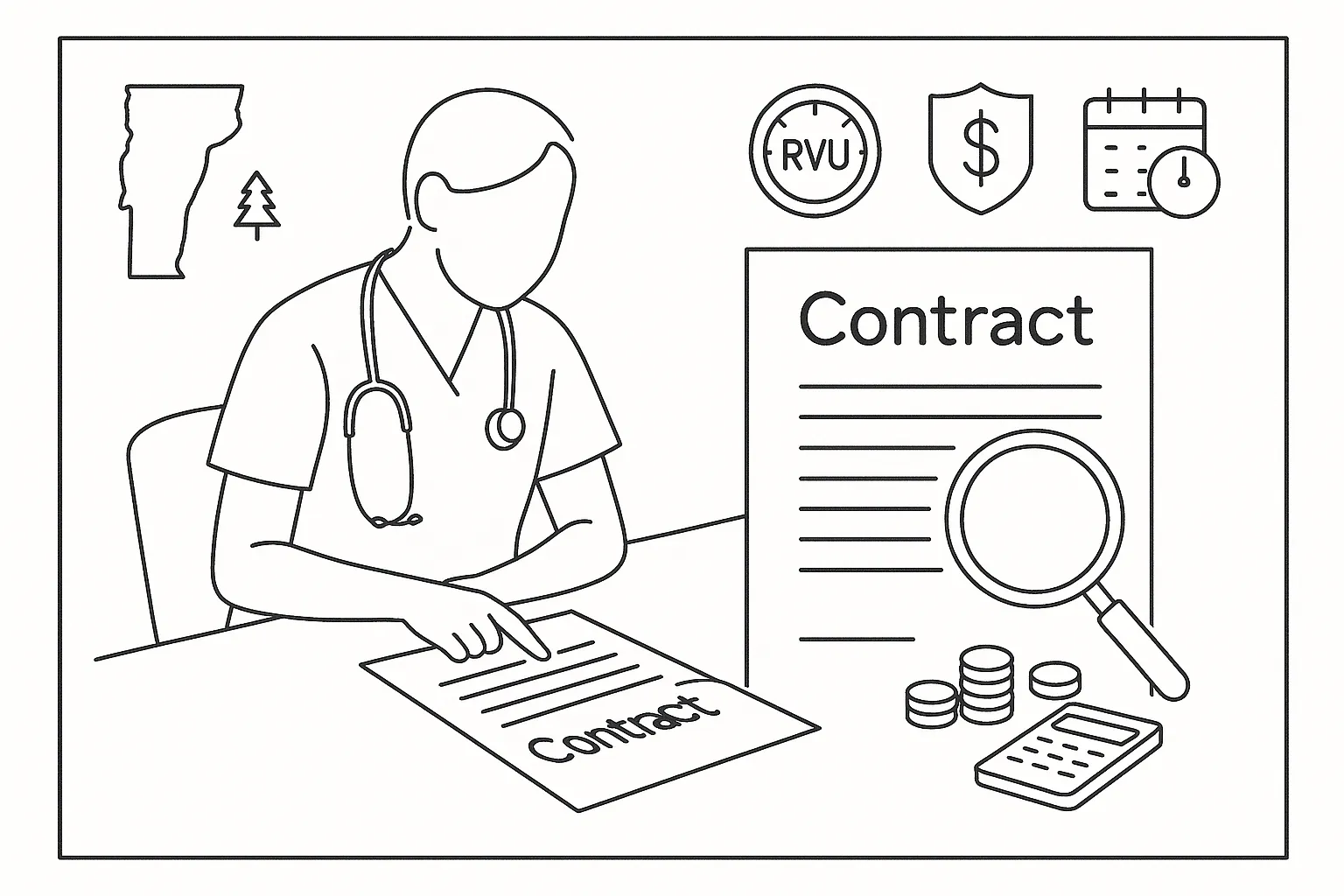
NP compensation may include a guaranteed salary, salary plus productivity, collections-based pay, or an RVU formula. A collections model may depend on payer denials, contractual adjustments, refunds, discounts, chargebacks, and accounts that remain unpaid. An RVU provision should identify which RVUs count, the conversion factor, the threshold, the reporting source, and the applicable reconciliation period.
Sample calculations can reveal whether the formula is understandable and whether the stated compensation is attainable under the assigned schedule and patient volume. Analysis can also flag negative accrual, retroactive changes, employer control over coding, and undefined terms such as “billable encounter” or “adjusted collections.” A focused nurse practitioner compensation and productivity review can help evaluate the complete formula rather than relying on the advertised rate alone.
Bonuses, Repayment Terms, and Benefits
Bonus language should explain how performance is measured, when the bonus is earned, when it is paid, and whether the NP must remain employed through the payment date. If the employer controls the underlying productivity data, the agreement may also address reporting access and the process for raising calculation questions. Quality incentives require similarly clear metrics, measurement periods, and attribution rules.
Signing bonuses, relocation assistance, training expenses, and loan-related benefits may be subject to repayment if the relationship ends early. Review can determine whether repayment is full or prorated and whether the trigger differs for resignation, termination for cause, or termination without cause. Health coverage, retirement benefits, paid time off, continuing education, and licensing reimbursements may be governed by separate plan documents, so the contract and incorporated policies should be compared for consistency.
Clinical Duties, Scheduling, and Practice Logistics
Patient Care, Call, and Administrative Time
The contract may define full-time status through hours, shifts, patient sessions, encounters, or another productivity measure. Review should account for patient-contact time, chart completion, inbox management, meetings, call coverage, cross-coverage, telehealth, and quality activities. These duties may reduce the time available to meet an encounter or RVU threshold even when they are part of the NP’s required workload.
Schedule language can also determine whether the employer may add evenings, weekends, facilities, or service lines without additional compensation. Clear terms regarding administrative time, call frequency, backup coverage, and compensation for added shifts make it easier to evaluate the actual workload. Vague references to duties “as assigned” warrant comparison with the stated role, compensation model, and practice guidelines.
Credentialing, Locations, and Employer Support
Credentialing, payer enrollment, and facility privileges can delay the start of clinical work and productivity credit. The agreement may identify who prepares applications, pays associated fees, monitors deadlines, and addresses a delay or denial. Contract analysis can also clarify whether base pay begins before credentialing is complete and whether a delayed approval permits either party to terminate.
Location provisions should identify the primary worksite and any obligation to travel, float, or cover another facility. Equipment, support staff, telehealth systems, prescribing resources, and access to medical records may directly affect the NP’s ability to satisfy contractual expectations. If multiple locations are permitted, review can determine whether the employer has unilateral authority to make assignments and whether travel time or expenses are addressed.
Malpractice Insurance and Liability Allocation
Claims-Made, Occurrence, and Tail Coverage
No material Vermont profession-specific rule requiring an NP employment or independent contractor agreement to provide malpractice insurance or tail coverage was identified. The written agreement therefore plays an important role in allocating policy type, limits, premiums, reporting duties, and post-termination costs. A claims-made policy generally depends on when a claim is reported and may create a need for tail coverage after the policy ends, while an occurrence policy generally responds based on when the incident occurred.
Tail responsibility may vary according to whether the NP resigns, is terminated for cause, or is terminated without cause. Review can also identify gaps involving suspension, a change in carriers, or the transition to a new employer. Chelle Law’s NP malpractice and tail insurance review evaluates these provisions alongside the termination section.
Indemnification and Uninsured Exposure
Indemnification provisions may require the practitioner to reimburse losses, legal expenses, or claims arising from specified conduct. Broad language can create exposure beyond available malpractice coverage, particularly if it applies to contractual disputes, billing issues, data incidents, or another party’s conduct. Analysis can identify whether the obligation is limited, reciprocal, and connected to risks the NP can reasonably control.
The agreement may also require a separate policy, proof of specified limits, or additional-insured status. Those requirements should be compared with the employer’s policy and any exclusions. Review can flag potential coverage gaps, unclear defense-cost allocation, or provisions allowing insurance expenses to be deducted from compensation.
Restrictive Covenants and Clinical Independence
Vermont Non-Compete and Non-Solicitation Terms
Vermont generally evaluates employment restrictive covenants for reasonableness. The analysis considers whether a covenant protects a legitimate business interest, is narrowly tailored in geographic, temporal, and subject-matter scope, and avoids unnecessary or unduly restrictive limits contrary to public policy. A restriction generally cannot be justified solely as protection from ordinary competition.
A practical review examines the duration, geographic area, covered services, restricted facilities, patient limitations, and effect on realistic employment opportunities. Non-solicitation, confidentiality, and patient-contact terms may create separate obligations even when a non-compete is narrow. A nurse practitioner non-compete review can compare these restrictions with termination rights, repayment exposure, and the locations where the NP actually practices.
Clinical Judgment and Management Control
Vermont’s 2026 Act 133 limits private-equity and hedge-fund interference with clinical decision-making and control over specified patient-care and operational matters. Agreements involving a covered healthcare facility or management services organization should preserve the nurse practitioner’s independent clinical judgment. Contract provisions addressing protocols, utilization, referrals, staffing, scheduling, and productivity warrant careful evaluation when they may affect patient-care decisions.
Operational expectations can be legitimate without authorizing improper interference with clinical judgment. Review can distinguish administrative requirements from provisions that may give a nonclinical party excessive control over care. The contract should also remain consistent with the NP’s scope, approved practice guidelines, professional duties, and any required collaborative provider arrangement.
Termination, Repayment, and Dispute Provisions
For-Cause and Without-Cause Termination
Termination language should distinguish immediate for-cause termination from separation without cause. Cause definitions may address licensure problems, exclusion from healthcare programs, misconduct, failure to perform contractual duties, or other specified events. Review can determine whether the definition is objective, whether certain alleged breaches include notice and an opportunity to cure, and whether the employer retains overly broad discretion.
Without-cause notice affects income continuity, patient transition, malpractice coverage, and the timing of a new position. Its effect should be compared with bonus eligibility, repayment obligations, paid time off, restrictive covenants, and final compensation. NPs evaluating an existing separation right can use a focused nurse practitioner contract termination review to understand how these provisions interact.
Post-Termination Duties and Dispute Terms
Post-termination obligations may include completing records, assisting with patient transitions, returning property, preserving confidentiality, and cooperating with claims. The scope, duration, compensation, and system access associated with those duties should be clear. Open-ended language may otherwise require substantial work after the final employment date without explaining how it will be completed or paid.
Arbitration, governing-law, venue, and attorney-fee provisions affect the cost and process of resolving a dispute. An out-of-state forum may add expense and complexity, while one-sided fee shifting can increase financial exposure. Reviewing these terms before signing allows the NP to understand the agreement’s enforcement structure before a compensation dispute, alleged breach, or separation occurs.
Speak With a Vermont Nurse Practitioner Contract Lawyer Before You Sign
Chelle Law can review your proposed employment or independent contractor agreement, explain its terms, identify material risks, and flag provisions that may warrant clarification or revision.
Contact Chelle LawExplore Nurse Practitioner Contract Help
Review attorney-led services, practical contract resources, and state-specific guidance for nurse practitioners.