
When a nurse practitioner accepts a position in Virginia—whether practicing in Richmond, Virginia Beach, Arlington, or another healthcare market—the employment or independent contractor agreement becomes the governing document for compensation, scope of practice, malpractice responsibility, and post-employment restrictions. These agreements operate within Virginia law, including oversight by the Virginia Board of Nursing and statutory authority under Title 54.1 of the Code of Virginia governing advanced practice registered nurses.
Subtle drafting differences can materially affect productivity compensation, restrictive covenant risk, termination rights, and responsibility for insurance or repayment obligations. A Virginia nurse practitioner contract review examines how employer-drafted language interacts with state practice requirements, including licensure, prescriptive authority, collaboration arrangements, and the NP’s actual clinical duties. Chelle Law reviews each agreement line by line to identify provisions that may affect earnings stability, regulatory compliance, and long-term career mobility.
Key Takeaways
- A Virginia NP contract should clearly define compensation, productivity measurements, audit rights, and any reconciliation or negative accrual process.
- Malpractice provisions should identify the policy type, coverage limits, and who must pay for tail insurance when employment ends.
- Clinical duties, prescriptive authority, collaboration arrangements, and productivity expectations should align with Virginia practice requirements and the actual position.
- Termination, bonus repayment, non-compete, and non-solicitation clauses can create significant financial or career consequences after departure.
- The proposed agreement, exhibits, job description, benefit summaries, and collaboration documents should be reviewed together before signing.
Virginia NP Agreements and State Practice Requirements

Virginia’s regulatory framework affects how an NP’s clinical authority, prescriptive duties, and professional relationships should be described in a contract. The agreement should not assume a supervision or collaboration structure that conflicts with the position’s actual requirements, and the NP should understand who is responsible for maintaining required documents, signatures, privileges, and prescribing arrangements. Exhibits such as a job description or practice agreement are therefore part of the practical contract review, not merely administrative attachments.
Ambiguous language can also create licensing and operational risk. Examples include undefined “other duties,” unilateral changes to clinical responsibilities, physician co-signature requirements that are not fully explained, or productivity targets based on matters outside the NP’s control. A review should compare these provisions with the applicable Virginia Board of Nursing framework and the realities of the practice setting. Additional guidance on scope-of-practice issues in NP contracts can help identify clauses that deserve closer attention.
Compensation, Benefits, and Financial Terms
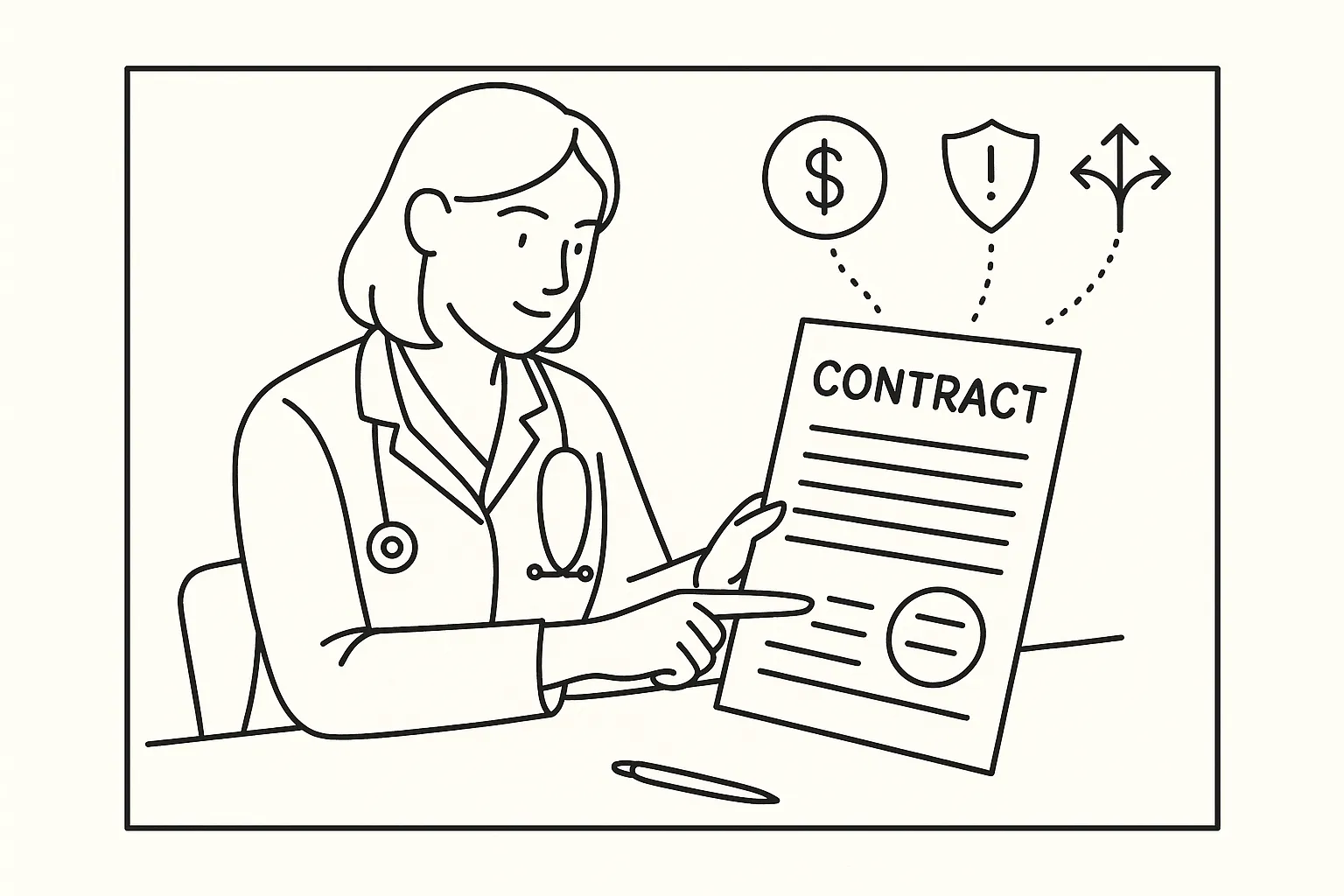
Virginia NP compensation may consist of a guaranteed base salary, base pay plus productivity, collections-based compensation, relative value unit incentives, or other bonus arrangements. The agreement should define how each component is calculated, when it is paid, and whether the employer can change the methodology. A focused NP compensation review also examines whether the clinician can verify the data used to calculate variable pay.
- Base salary: Verify payment frequency, prorated calculations, and whether compensation continues during onboarding, leave, or credentialing delays.
- Productivity or collections: Determine whether compensation is based on billed charges, collected dollars, net receipts, encounters, or another defined measure.
- RVU compensation: Confirm the applicable RVU measure, conversion factor, threshold, exclusions, reporting process, and treatment of services requiring physician involvement.
- Negative accrual and reconciliation: Identify look-back periods, repayment limits, and whether a shortfall can reduce future incentives or guaranteed compensation.
- Audit rights: Require access to sufficient reports to verify collections, RVUs, quality measures, and deductions used in the calculation.
Benefits should be evaluated alongside cash compensation. Review health and disability coverage, paid time off, continuing education allowances, licensing and DEA fee reimbursement, retirement contributions, and any vesting schedule. Signing bonuses and relocation allowances frequently include repayment provisions, so the contract should identify the triggering events, repayment period, amortization method, and whether repayment is still required after an employer-initiated termination.
Malpractice, Scope of Practice, and Collaboration
Malpractice Insurance, Tail Coverage, and Indemnity
Malpractice language should identify whether the employer provides occurrence or claims-made coverage. An occurrence policy generally covers incidents occurring during the policy period regardless of when a claim is made, while claims-made coverage may require tail insurance after the policy or employment ends. The agreement should clearly allocate the cost of tail coverage and address what happens if the employer changes carriers or ends the policy.
Indemnification provisions require equal attention. A one-sided clause may attempt to make the NP responsible for defending the employer or paying liabilities arising from matters outside the clinician’s control. A malpractice and tail insurance review can clarify the policy type, coverage responsibilities, and financial exposure created by the indemnity language.
Clinical Duties, Productivity Expectations, and Collaboration Terms
The contract and job description should accurately describe patient-care duties, administrative work, charting, call coverage, work locations, and scheduling expectations. Productivity targets should account for the practice environment and explain whether charting time, patient education, no-shows, payer denials, or administrative responsibilities affect performance calculations. Broad language allowing unlimited duties or location changes can transfer substantial operational risk to the NP.
Collaboration provisions should identify the relevant documents, responsible parties, and process for replacing a collaborating physician or modifying the arrangement. The NP should also understand whether the employer can change these terms unilaterally and what happens if a physician’s privileges or status changes. Reviewing the supervision and collaboration terms helps connect the employment agreement with Virginia-specific practice obligations.
Termination, Repayment, and Restrictive Covenants
Termination Rights and Post-Employment Payments
The agreement should distinguish termination for cause from termination without cause and state the notice required from each party. The definition of cause matters because it may affect final compensation, bonus eligibility, tail insurance, repayment obligations, and the opportunity to cure an alleged breach. The contract should also explain whether the employer can remove the NP from the schedule during the notice period and whether compensation continues during that time.
Repayment provisions may apply to signing bonuses, relocation expenses, training costs, or guaranteed compensation. Review whether those obligations are prorated and whether they apply after resignation, termination for cause, or termination without cause. A dedicated contract termination review can identify notice, repayment, and post-employment provisions before they become an active dispute.
Non-Compete, Non-Solicitation, and Confidentiality Restrictions
Virginia restrictive covenants should be evaluated for duration, geographic scope, restricted activities, triggering events, and the employer interests they purport to protect. Broad language may restrict work across an entire metropolitan area, apply to services the NP never performed, or remain in effect even after an employer-initiated termination. Although enforceability depends on the wording and circumstances, an expansive restriction can still deter future employers and limit career options.
Non-solicitation clauses may cover patients, employees, referral sources, or business relationships, while confidentiality clauses may extend beyond legitimate proprietary information. These provisions should be read together because overlapping restrictions can function like a broader non-compete. An attorney conducting a Virginia NP non-compete review can assess the practical effect of the restrictions and identify language to clarify or narrow before signing.
Negotiation Priorities and Contract Review Process
Priorities by Career Stage and Practice Setting
New graduates often benefit from clear base-pay guarantees, defined onboarding and collaboration arrangements, realistic productivity expectations, and limits on signing-bonus repayment. Because an initial agreement can establish important career and compensation expectations, a new graduate NP contract review should address both immediate financial terms and the consequences of leaving the position.
Experienced NPs may place greater emphasis on transparent productivity formulas, narrow restrictive covenants, tail insurance allocation, leadership duties, and equity or buyout terms. Telehealth, urgent care, hospital, and specialty positions may also involve per-encounter compensation, floating requirements, call obligations, multiple locations, or specialty-specific malpractice exposure. These operational expectations should be stated in the agreement rather than left entirely to changeable employer policies.
Documents and Clauses to Review Before Signing
A complete review should include the proposed agreement, offer letter, job description, compensation exhibits, collaboration documents, benefit summaries, and any relevant licensing or credentialing correspondence. Verbal promises concerning schedules, bonuses, remote work, partnership, or future compensation should be documented in the agreement or another enforceable written instrument.
- Confirm the legal entity employing or contracting with the NP and identify every incorporated exhibit or policy.
- Verify compensation definitions, payment timing, audit rights, deductions, and reconciliation provisions.
- Review malpractice coverage, tail responsibility, indemnification, and professional expense reimbursement.
- Compare clinical duties, collaboration terms, work locations, schedules, and productivity expectations with the actual role.
- Identify termination rights, repayment triggers, assignment provisions, and change-of-control consequences.
- Evaluate non-compete, non-solicitation, confidentiality, and other post-employment restrictions.
When Legal Review Is Most Valuable
Attorney review is particularly valuable when an agreement includes productivity-based compensation, collections formulas, negative accrual, restrictive covenants, unclear malpractice language, multiple work locations, equity promises, or substantial repayment obligations. Early review gives the NP an opportunity to request definitions, supporting exhibits, and written clarification before the agreement is signed and before work begins.
Chelle Law’s review focuses on how contract mechanics affect income, liability, licensing, and career mobility. The process may include an annotated agreement, written identification of material issues, and a consultation addressing the practical effect of the terms. Standard agreements may be reviewed more quickly than arrangements involving equity, partnership, or multistate practice, so the scope and expected turnaround should be confirmed when the agreement is submitted.
Review Your Virginia NP Contract Before You Sign
Understand how your proposed compensation, malpractice coverage, collaboration terms, termination rights, and post-employment restrictions may affect your career in Virginia.
Contact Chelle LawExplore Nurse Practitioner Contract Guidance
Review legal services, educational resources, and state-specific guidance for nurse practitioner agreements.