
A Wisconsin nurse practitioner contract can determine far more than salary. It may allocate prescribing duties, malpractice obligations, credentialing risk, productivity expectations, termination rights, and post-employment restrictions. Nurse practitioner practice is overseen by the Wisconsin Department of Safety and Professional Services and the Wisconsin Board of Nursing under Wisconsin’s nursing laws and administrative rules. Agreements covering work in Milwaukee, Madison, Green Bay, or another Wisconsin healthcare market must account for the practitioner’s current credentials and the state’s scheduled transition from advanced practice nurse prescriber credentials to Advanced Practice Registered Nurse licensing effective September 1, 2026. Contract review can identify whether the written role aligns with the NP’s authority, whether prescribing and independent-practice expectations are properly conditioned, and whether compensation or continued employment could be affected by credentialing, payer enrollment, or regulatory requirements.
Financial and post-employment terms require the same attention. Productivity formulas can obscure how services are credited, claims-made malpractice coverage can create a tail obligation, and termination may trigger repayment of bonuses or relocation assistance. Wisconsin restrictive covenants are governed by Wis. Stat. § 103.465 and related court decisions, so the wording and practical reach of a non-compete, non-solicitation clause, or similar restraint matter. Chelle Law provides attorney-led contract review focused on explaining these provisions, identifying risk, and helping the NP determine which terms may warrant clarification or revision before signing.
Key Contract Issues for Wisconsin Nurse Practitioners
- Licensure, prescribing, collaboration, and independent-practice terms must correspond to the NP’s actual Wisconsin credentials and authority.
- W-2 or 1099 status affects taxes, benefits, expenses, insurance, and operational control, but the contract label alone does not determine classification.
- Compensation analysis should address productivity credit, payment timing, reconciliation, reporting access, negative accrual, and repayment obligations.
- Malpractice language should identify the policy type, applicable limits, covered services, and responsibility for post-termination coverage.
- Termination, repayment, and restrictive covenant provisions should be evaluated together because the circumstances of departure may activate several obligations at once.
Wisconsin Licensure, Prescribing, and Practice Authority
Contract language cannot expand an NP’s legal authority or eliminate professional obligations imposed by Wisconsin law. Review can determine whether the position description, required credentials, prescribing expectations, and employer policies accurately reflect the practitioner’s role. The agreement also may need to account for regulatory changes that occur during its term.
APNP-to-APRN Credential Transition
Effective September 1, 2026, Wisconsin issues Advanced Practice Registered Nurse licenses that recognize the Nurse Practitioner role, and existing APNP credentials convert to APRN credentials. An agreement that spans this transition may require maintenance of the applicable RN and advanced-practice credentials, national certification when required, and timely completion of renewal or conversion requirements.
Credential-related termination language deserves particular attention. Broad provisions allowing immediate termination for any licensing issue may not distinguish between a temporary administrative delay and a substantive loss of authority. Review can identify whether the agreement provides notice, an opportunity to cure, or a reasonable process for addressing a credentialing issue.
Prescribing and Continuing Education Duties
Wisconsin prescribing authority is credential- and role-dependent and remains subject to statutory and administrative limitations, including controlled-substance requirements. The contract may address prescribing, medication management, delegated tasks, documentation, and compliance with Wisconsin Board of Nursing rules. Those duties should remain conditioned on the NP holding the authority required for the assigned work.
The Wisconsin Department of Safety and Professional Services states that APRNs must complete 16 contact hours per biennium in clinical pharmacology or therapeutics relevant to practice, including at least two hours concerning responsible controlled-substance prescribing. Contract analysis can clarify whether the employer provides time or reimbursement for required education and whether a lapse affects scheduling, compensation, or continued employment.
Independent Practice, Collaboration, and Credentialing
Wisconsin recognizes enhanced or independent APRN practice eligibility based on specified clinical-practice requirements. Current Department of Safety and Professional Services guidance includes a 7,680-clinical-hour requirement for independent practice. The agreement should accurately identify whether the NP will practice under ordinary or enhanced independent-practice authority rather than assuming authority the practitioner has not obtained.
Operational collaboration requirements may include physician availability, consultation procedures, documentation, quality review, or on-site expectations. These employer requirements may be more restrictive than the minimum legal framework, so their practical effect should be understood before work begins. A focused supervision and collaboration agreement review can evaluate how responsibilities and compliance duties are allocated.
Credentialing, payer enrollment, hospital privileges, and onboarding also may affect the start date or compensation. The contract can specify what happens when approval is delayed for reasons outside the NP’s control, whether the start date moves automatically, and whether salary or benefits begin during the delay.
Employment and Independent Contractor Agreements
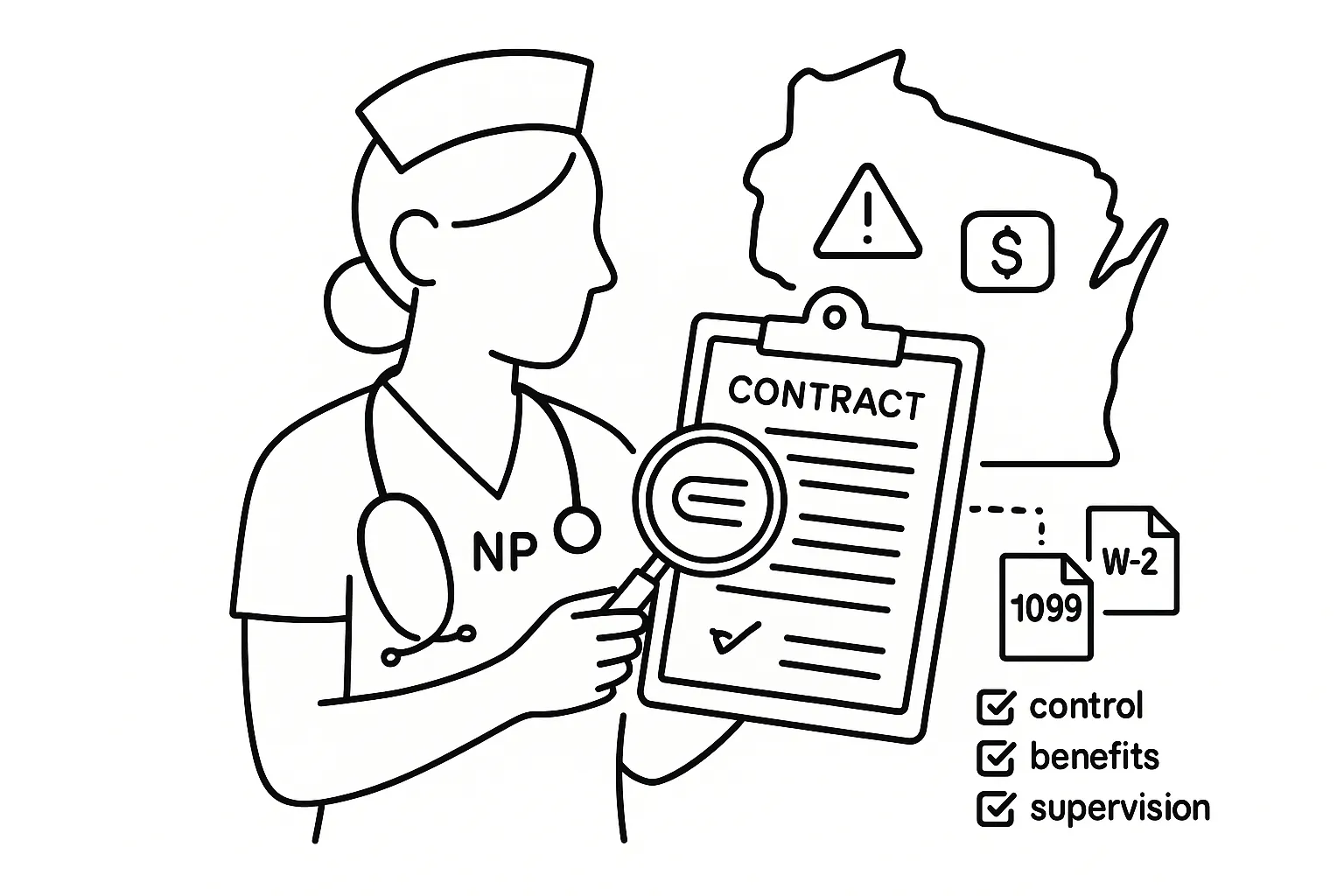
Employment status affects tax treatment, benefits, professional expenses, insurance, and control over the work. A W-2 employee generally has payroll taxes withheld and may receive employer-sponsored benefits. A 1099 contractor often assumes responsibility for estimated taxes, benefits, insurance, continuing education, equipment, and other business expenses.
Classification, Control, and Professional Expenses
Under Wisconsin’s statutory classification standards, the actual relationship matters more than the title placed on the agreement. Schedule control, required workflows, supplies, EHR access, billing procedures, documentation standards, referral expectations, and the practitioner’s business independence can all affect how the arrangement operates. A mismatch between 1099 language and day-to-day control may create tax, benefits, insurance, or compliance concerns.
An independent contractor agreement review can evaluate whether the contract clearly allocates taxes, malpractice coverage, licensing costs, billing responsibilities, equipment, staff support, termination rights, and control over clinical work. The financial comparison also should account for expenses and benefits the practitioner must replace rather than focusing only on the stated hourly or per-visit rate.
Compensation, Benefits, and Repayment Risk

The stated salary or rate is only one part of compensation. The agreement may incorporate productivity thresholds, collections, quality incentives, discretionary bonuses, expense reimbursement, and repayment obligations. A nurse practitioner compensation and productivity review can identify terms that make expected earnings less predictable than the headline number suggests.
Salary, Collections, and RVU Formulas
A compensation plan may use a guaranteed salary, collections-based pay, an RVU formula, or a hybrid model. Salary language may address pay periods, permissible offsets, and the date on which a guarantee converts to production-based compensation. A collections formula may distinguish gross charges from net receipts after denials, refunds, contractual adjustments, and write-offs.
RVU provisions can define the dollar-per-RVU rate, threshold, attribution rules, applicable modifiers, and treatment of non-billable work. Analysis also can determine whether onboarding, credentialing delays, administrative work, call, or employer-controlled scheduling could make the stated target difficult to reach. Access to timely productivity reports is important when the NP’s pay depends on employer-maintained data.
Bonuses, Benefits, and Clawbacks
Bonus provisions may rely on measurable requirements or subjective standards such as satisfactory performance. Signing bonuses, relocation allowances, and employer-funded loan assistance frequently include repayment terms if the relationship ends within a stated period. Review can identify the triggering events, whether repayment is prorated, and whether the obligation applies when the employer initiates termination without cause.
Benefits language may address eligibility dates, paid leave, retirement contributions and vesting, CME allowances, licensing fees, and professional memberships. The employer’s ability to modify benefit plans can affect the package’s total value even when base compensation remains unchanged.
Negative Accrual, Reconciliation, and Audit Rights
Negative accrual and reconciliation provisions may carry a productivity deficit into a later period or permit recovery of amounts previously paid. Adjustments can result from payer denials, refunds, coding changes, audits, or alleged overpayments. The agreement may specify how deficits are calculated, how long an adjustment remains open, and whether a deficit survives termination.
Employer-controlled audit rights can create substantial uncertainty if the NP cannot review source data or challenge an adjustment. Useful terms include advance notice, a defined lookback period, access to supporting records, consistent attribution rules, and a dispute process before deductions occur.
Malpractice Insurance and Tail Coverage
Wisconsin nursing rules require specified malpractice coverage for advanced-practice nurse prescribers and APRNs. Contract review can determine whether the employer-provided or practitioner-purchased policy appears to correspond to the applicable credential and assigned services. The agreement may identify the carrier, coverage limits, exclusions, defense obligations, reporting requirements, and treatment of work performed outside the primary location.
Claims-Made and Occurrence Coverage
Occurrence coverage generally responds to covered incidents that occur during the policy period, even if a claim is reported later. Claims-made coverage generally depends on the applicable policy being active when the claim is made, which can create a need for an extended reporting endorsement, commonly called tail coverage, after the relationship ends.
No separate profession-specific Wisconsin rule identified in the research packet expressly requires an employer to purchase tail coverage after termination. Responsibility therefore should be addressed clearly in the contract. A malpractice and tail insurance review can clarify the policy type, potential post-employment gap, required reporting, and whether the allocation changes based on the reason for departure.
Indemnification and Defense Obligations
An indemnification clause may require the NP to reimburse the employer for losses, claims, or defense costs arising from specified conduct. Broad language can extend beyond uninsured professional negligence and shift organizational liabilities that the practitioner does not control. Review can identify whether the obligation is tied to the NP’s conduct, whether insurance may respond, and whether the practitioner retains appropriate access to records and defense protections.
Schedule, Call, Duties, and Practice Controls
Operational provisions shape day-to-day work and can affect both earnings and professional risk. Relevant terms include work locations, clinic sessions, patient volume, call coverage, chart completion, administrative duties, floating, travel, telehealth, and the employer’s authority to revise assignments. Broad discretion to add duties or locations may increase uncompensated work or make productivity targets harder to achieve.
Work Locations, Moonlighting, and Performance Standards
Multiple-location provisions may address mileage, travel time, expense reimbursement, and whether productivity standards account for time away from the primary facility. Telehealth terms can identify permitted patient locations, required credentials, scheduling, documentation, equipment, and compensation. Moonlighting or exclusivity clauses may define which outside activities require approval and the standard the employer uses when granting or withholding consent.
Performance and quality provisions may affect bonuses, base pay, corrective action, or termination. Review can determine whether standards are objective, whether the measurement period is reasonable, and whether the NP can review the data or correct an alleged deficiency before consequences apply.
Termination and Wisconsin Restrictive Covenants
Termination terms determine how quickly compensation and benefits may end and which obligations survive. They should be read together with malpractice, repayment, records, patient-transition, confidentiality, and restrictive covenant provisions because several financial and professional consequences may arise from the same departure.
Without-Cause and For-Cause Termination
A without-cause provision may permit either party to end the relationship after a specified notice period. The language can address whether the NP must continue working, whether the employer may pay in lieu of notice, and how accrued compensation, leave, expenses, and productivity bonuses are handled. Severance is generally a contractual benefit rather than an automatic payment.
For-cause language may distinguish curable events from conduct permitting immediate termination. Vague standards can give the employer broad discretion and may activate bonus repayment, tail costs, or post-employment restrictions. A contract termination review can assess notice, cure rights, final compensation, insurance, repayment, and obligations that continue after separation.
Non-Competes, Non-Solicitation, and Confidentiality
Wisconsin restrictive covenants are evaluated under Wis. Stat. § 103.465 and related court decisions. Enforceability depends on factors that include whether the restriction is reasonably necessary to protect a legitimate employer interest, reasonable in time and territory, not harsh or oppressive to the employee, and consistent with public policy. Under Wisconsin law, an unreasonable covenant is void and unenforceable, including unreasonable severable portions.
The analysis is not limited to a clause labeled “non-compete.” Customer or patient non-solicitation, employee non-solicitation, confidentiality, and non-interference terms may fall within the statute when they function as restraints on post-employment competition. The wording should be evaluated for restricted activities, covered people or organizations, duration, territory, and whether it extends to locations or relationships with which the NP had no involvement.
Remedy provisions may authorize injunctive relief, liquidated damages, attorney fees, or a contractual buyout. A nurse practitioner non-compete review can evaluate both legal concerns and the restriction’s practical effect on future work in the relevant Wisconsin market.
Additional Contract Risks and Attorney Review
Assignment and change-of-control provisions may allow the agreement to transfer to a purchaser or affiliated entity without the NP’s consent. Review can determine whether compensation guarantees, work locations, benefits, termination rights, and restrictive covenants remain unchanged after a sale. Amendment clauses also matter because they may permit changes through an employer policy or compensation plan that is not signed by both parties.
Dispute resolution provisions can require arbitration, select a governing law or venue, shorten claim periods, or shift attorney fees. Confidentiality and patient-record provisions should be evaluated alongside mandatory reporting, licensing-board cooperation, continuity of care, and access needed to respond to a claim or investigation.
What an Attorney-Led Review Can Identify
Review priorities depend on career stage, practice setting, and compensation structure. A new graduate may focus on onboarding, mentoring, credentialing, guaranteed pay, and reasonable exit terms. An experienced NP may place greater weight on protecting outside work, preserving an established patient base, limiting assignment changes, or understanding the consequences of leaving.
Chelle Law’s attorney-led process examines the agreement as a whole rather than treating each clause in isolation. The review can flag income uncertainty, classification concerns, malpractice exposure, regulatory conflicts, termination consequences, and restrictions on future practice. The NP can then decide which provisions to accept and which may warrant clarification or proposed revision before signing.
Speak With a Wisconsin Nurse Practitioner Contract Lawyer Before You Sign
An attorney-led review can explain compensation, malpractice coverage, termination rights, restrictive covenants, and Wisconsin practice issues while identifying provisions that may warrant clarification or revision.
Request a Contract ReviewExplore Nurse Practitioner Contract Guidance
Review attorney-led services, practical contract resources, and state-specific guidance for nurse practitioners.