
When a nurse practitioner accepts a position in Wisconsin—whether practicing in Milwaukee, Madison, Green Bay, or another healthcare market—the employment or independent contractor agreement governs compensation, scope of practice, malpractice allocation, termination rights, and post-employment restrictions. These agreements operate within Wisconsin law, including oversight by the Wisconsin Board of Nursing and statutory authority under Chapter 441 of the Wisconsin Statutes governing advanced practice registered nurses. A Wisconsin nurse practitioner contract review helps clarify how employer-drafted language interacts with state regulatory requirements and where financial or professional risk may be embedded in the agreement.
Subtle drafting differences can materially affect productivity compensation, restrictive covenant enforceability, and termination rights. Wisconsin courts generally evaluate non-compete agreements under Wis. Stat. § 103.465, making it important to understand the practical effect of the restriction before signing. An attorney can also assess collections formulas, negative accrual provisions, tail insurance responsibility, notice requirements, supervision or collaboration terms, and other provisions that may affect earnings stability, regulatory compliance, and long-term career mobility.
At Chelle Law, the review is structured around the actual risks presented by the proposed Wisconsin agreement. Each provision is examined in context so the NP can identify unclear obligations, compare the written terms with the expected working relationship, and decide which issues should be clarified or negotiated before accepting the position.
Key Takeaways for Wisconsin Nurse Practitioners
- A contract review translates legal language into practical effects on income, licensure risk, liability, and career mobility.
- The agreement should match the operational relationship, including whether the NP will work as a W-2 employee or 1099 independent contractor.
- Compensation formulas should clearly define productivity credit, payment timing, reconciliation, audit rights, and potential negative accrual.
- Malpractice provisions should identify the policy type, coverage limits, carrier obligations, and responsibility for tail coverage.
- Termination and restrictive covenant language should be evaluated together because the circumstances of departure may determine whether repayment duties or post-employment restrictions apply.
Employment Agreements vs. Independent Contractor Agreements
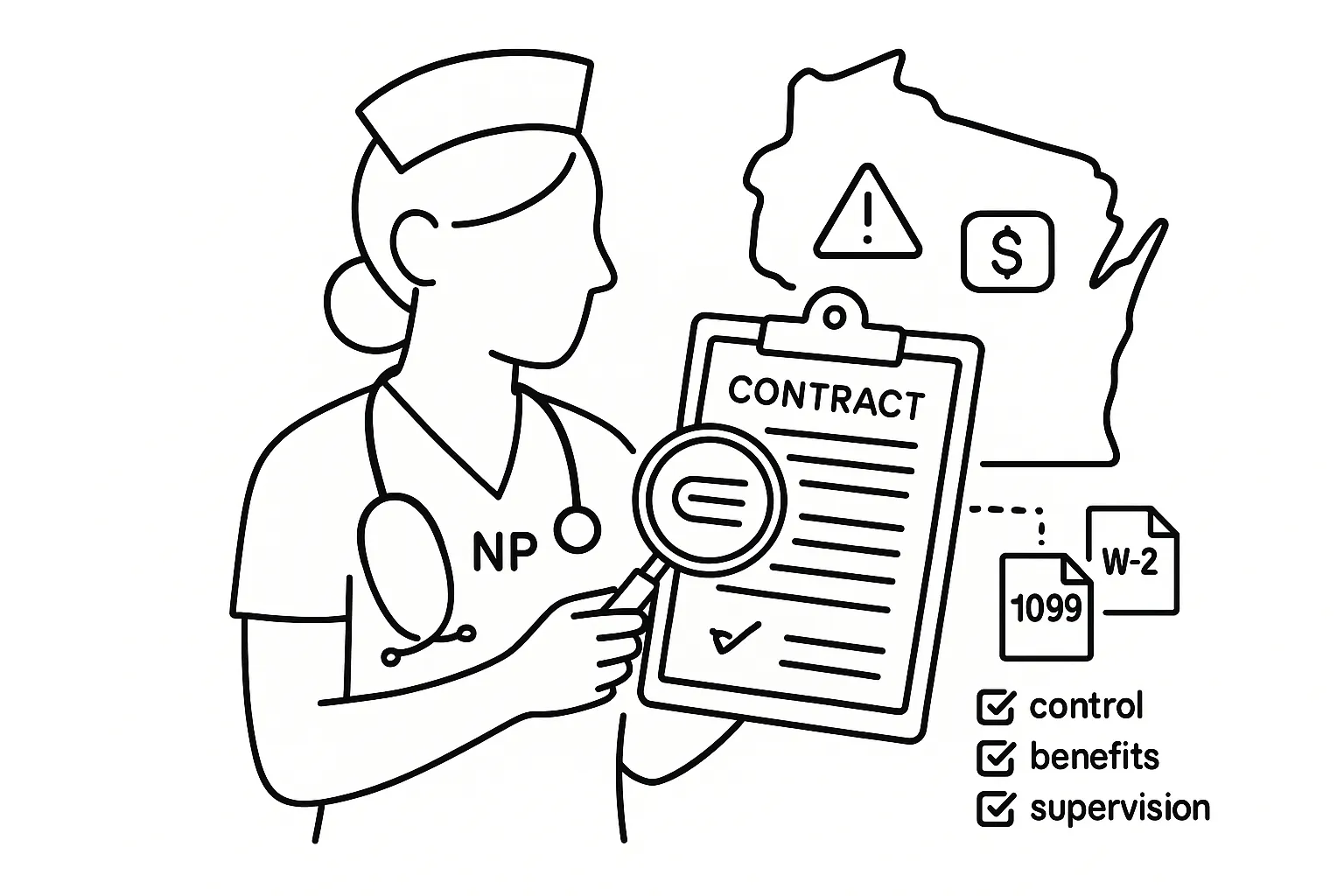
Employment status affects tax treatment, benefits, professional expenses, control over practice, and potential liability. A W-2 employee typically has payroll taxes withheld and may receive employer-provided benefits, while a 1099 contractor is often responsible for taxes, insurance, and other practice expenses. The label in the agreement is not the only consideration; the expected schedule, clinical workflows, documentation standards, supplies, EHR access, referral requirements, and employer oversight may reveal how the relationship will operate in practice.
A mismatch between the written classification and the actual working relationship may create tax, benefits, malpractice, or compliance concerns. Chelle Law’s independent contractor agreement review examines whether a proposed 1099 arrangement clearly allocates expenses, insurance obligations, billing responsibilities, termination rights, and control over the NP’s work.
Compensation, Benefits, and Income Protection

Compensation provisions determine more than the stated salary. The review should account for productivity calculations, bonus conditions, repayment obligations, benefits eligibility, and the employer’s ability to adjust or reconcile compensation. A focused NP compensation and productivity review can identify terms that make projected earnings less predictable than they initially appear.
Base Salary, Collections, and RVU Compensation
A compensation plan may use a guaranteed base salary, collections-based pay, an RVU or productivity formula, or a hybrid model. Salary provisions should identify the pay period, whether offsets or deductions are permitted, and when a guarantee converts to production-based compensation. Collections formulas should define whether compensation is based on gross charges or net receipts after adjustments, denials, refunds, and write-offs.
RVU models should state the dollar-per-RVU rate, threshold, attribution rules, applicable modifiers, and treatment of services that cannot be billed or credited promptly. For example, a plan that combines a guaranteed salary with additional compensation above a stated wRVU threshold may produce an unexpected shortfall if the agreement does not clearly define creditable work, reconciliation timing, or access to productivity reports.
Bonuses, Benefits, and Repayment Obligations
Bonus language should distinguish measurable eligibility requirements from discretionary or subjective standards such as “satisfactory performance.” Signing bonuses, relocation allowances, and employer-funded loan assistance may include repayment duties if employment ends within a specified period. The contract should explain whether repayment is prorated, what events trigger it, and whether the obligation applies when the employer terminates the relationship.
Benefits provisions should identify eligibility dates, paid leave accrual, retirement contributions and vesting, CME allowances, and reimbursement for licensing or prescribing-related expenses. Language allowing unilateral changes to benefit plans can affect the total value of the compensation package even when the stated salary remains unchanged.
Clawbacks, Negative Accrual, and Productivity Audits
Clawback and negative accrual provisions may allow an employer to recover prior payments or carry a deficit into later compensation periods. These adjustments can arise from payer denials, refunds, productivity audits, or alleged overpayments. A fair agreement should explain how deficits are calculated, whether the NP receives supporting records, how long adjustments may remain open, and what process applies when the NP disputes the employer’s accounting.
Audit rights that permit unilateral changes to reported production can create substantial earnings uncertainty. Notice requirements, limits on the audit period, access to source data, and a meaningful dispute process help determine whether the financial risk is reasonably allocated.
Malpractice Insurance and Post-Termination Coverage
Malpractice provisions determine who bears the cost and risk of professional liability during and after the relationship. The agreement should identify the carrier, policy type, per-claim and aggregate limits, covered services, defense obligations, and any requirement that the NP purchase additional insurance. An NP malpractice and tail insurance review can clarify whether the proposed coverage leaves a post-employment gap.
Occurrence policies generally cover incidents occurring during the policy period regardless of when a claim is filed. Claims-made policies generally require the policy to remain active when the claim is made, which can make extended reporting—or tail—coverage necessary after employment ends. When claims-made coverage is used, the contract should expressly state who purchases tail coverage, when it must be obtained, and whether the allocation changes based on the reason for termination.
Indemnification language also requires careful review. A provision may require the NP to reimburse the employer for losses or defense costs arising from specified conduct, sometimes beyond what insurance covers. The contract should avoid shifting unrelated organizational liabilities to the NP and should preserve appropriate access to records and defense protections for services performed within the scope of employment.
Wisconsin Scope of Practice, Collaboration, and Credentialing
Contract terms must be read alongside Wisconsin’s licensure and practice framework. The Wisconsin Board of Nursing regulates nursing practice, while Chapter 441 of the Wisconsin Statutes addresses advanced practice registered nursing authority. The agreement should accurately describe the NP’s role without attempting to redefine professional obligations or require conduct that conflicts with applicable licensing, prescribing, or practice requirements.
Clinical Authority and Collaboration Requirements
The contract should clarify clinical duties, prescribing expectations, delegation, required documentation, physician availability, and any on-site requirements. Employer policies may impose operational restrictions beyond the minimum legal requirements, but those restrictions should be identified before the NP begins work. A supervision and collaboration agreement review can evaluate whether the responsibilities, documentation duties, and practical expectations are clearly allocated.
Credentialing, Privileging, and Quality Metrics
Compensation or continued employment may depend on credentialing, payer enrollment, hospital privileges, or quality metrics. The agreement should address what happens if those processes are delayed for reasons outside the NP’s control. It should also explain how quality standards are measured, who maintains the relevant data, whether the NP has an opportunity to correct deficiencies, and whether a credentialing delay affects the start date or pay.
Schedule, Duties, Productivity, and Practice Controls
Operational provisions shape the NP’s day-to-day practice and may affect both earnings and professional risk. A clear agreement should address primary work locations, scheduling expectations, call coverage, administrative duties, patient volume, documentation responsibilities, and the employer’s ability to assign new duties. Broad language allowing unilateral expansion of responsibilities can result in additional call, floating, or administrative work without corresponding compensation.
Moonlighting and exclusivity clauses should specify which outside activities require approval and the standards for withholding that approval. Telehealth provisions should address the locations from which patients may be treated, applicable licensure expectations, documentation, scheduling, and compensation. When work is performed at multiple facilities, the agreement should also clarify travel expectations, expense reimbursement, and whether productivity targets account for time spent away from the primary location.
Productivity standards and performance improvement plans should use objective criteria, reasonable measurement periods, and defined consequences. The NP should understand whether failure to meet a target affects bonus eligibility, base compensation, continued employment, or the employer’s ability to terminate for cause.
Termination and Wisconsin Restrictive Covenants
Notice, For-Cause Termination, and Severance
Termination language determines how quickly income and benefits may end and which obligations survive separation. The agreement should define for-cause events, distinguish curable from non-curable conduct, and state whether the NP receives notice and an opportunity to correct an alleged breach. Without-cause termination provisions should identify the required notice period, whether the employer may pay in lieu of notice, and what happens to accrued compensation, bonuses, benefits, and outstanding expenses.
Severance is not automatic unless the agreement provides it. A contract termination review can assess the financial effect of leaving, including repayment obligations, tail insurance, final productivity reconciliation, patient transition duties, and continuing restrictions.
Non-Competes, Non-Solicitation, and Available Remedies
Wisconsin restrictive covenants may include non-compete, patient or employee non-solicitation, confidentiality, and non-interference provisions. Their practical effect depends on the wording, facts, and applicable law, including Wis. Stat. § 103.465. The review should examine duration, geographic scope, restricted activities, covered locations, and whether the language reaches facilities the NP never served.
Restrictions tied to every current or future employer location may substantially limit practice in a Wisconsin healthcare market. The agreement may also authorize injunctive relief, liquidated damages, attorney fees, or a contractual buyout. Chelle Law’s nurse practitioner non-compete review evaluates both enforceability concerns and the real-world effect on future employment options.
Other Contract Terms That Can Create Hidden Risk
Assignment and change-of-control provisions may permit the agreement to transfer to a new owner without the NP’s consent. The contract should address whether compensation guarantees, benefits, termination rights, and restrictive covenants remain unchanged after a sale. Any buyout formula should use objective terms rather than a calculation controlled solely by the employer.
Confidentiality and patient-record provisions should preserve compliance with mandatory reporting, licensing-board cooperation, continuity of care, and legitimate access needed to respond to a claim or investigation. Dispute resolution clauses also deserve attention because arbitration requirements, governing-law provisions, venue selection, and fee-shifting terms can make a dispute more expensive or difficult to pursue.
Immediate review is especially important when the agreement contains broad non-compete language, unclear tail responsibility, significant clawbacks, vague for-cause standards, assignment without consent, or a mismatch between contractor classification and operational control. These issues can be difficult to correct after the agreement has been signed or the employment relationship has ended.
What to Expect From an Attorney-Led Contract Review
Review priorities vary by career stage and practice setting. A new graduate may focus on salary guarantees, onboarding, mentoring, credentialing, and reasonable restrictions, while an established NP may place greater emphasis on protecting an existing patient base, preserving outside work, negotiating severance, or limiting post-employment restrictions. The goal is to identify the provisions with the greatest effect on the individual NP rather than treating every clause as equally important.
Chelle Law’s attorney-led process includes document review, analysis of high-risk provisions, and an explanation of the agreement’s practical implications. The review can identify income uncertainty, malpractice exposure, compliance concerns, termination consequences, and restrictions on future practice so the NP can seek clarification or revisions before accepting the proposed terms.
Have a Wisconsin NP Contract Reviewed Before You Sign
An attorney-led review can help you understand compensation, malpractice coverage, termination rights, restrictive covenants, and Wisconsin-specific practice concerns before the agreement takes effect.
Contact Chelle LawExplore Nurse Practitioner Contract Guidance
Review available legal services, practical contract resources, and state-specific guidance for nurse practitioners.