
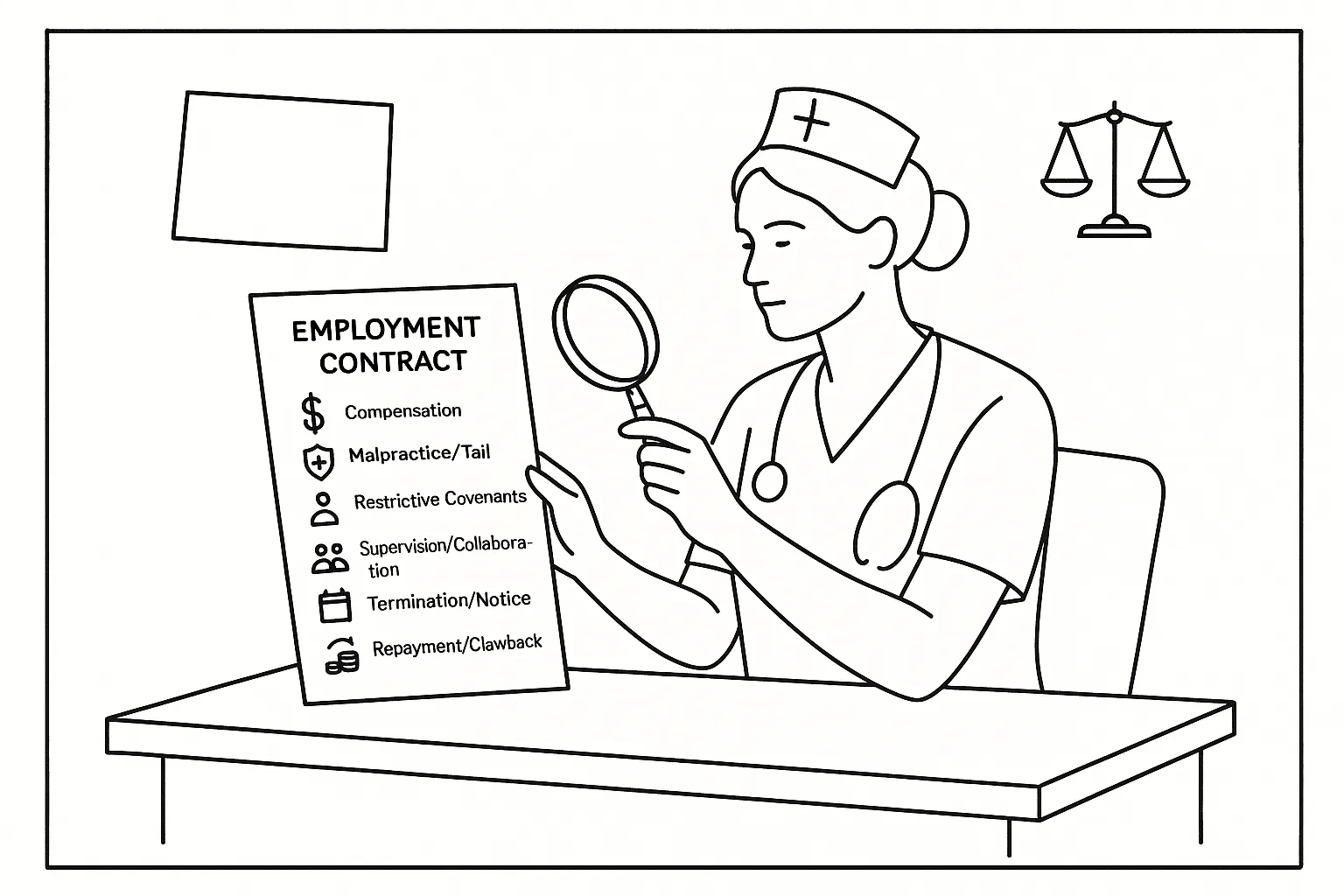
A Wyoming nurse practitioner employment or independent contractor agreement defines far more than salary. It may allocate responsibility for licensure, prescribing authority, credentialing, malpractice coverage, billing, termination, and post-employment restrictions. The Wyoming State Board of Nursing regulates advanced practice registered nurses under the Wyoming Nurse Practice Act, which addresses APRN qualifications, licensed scope, independent practice, and prescriptive authority. Wyoming permits an APRN to establish an independent nursing practice within the nurse’s licensed scope, and the reviewed APRN provisions do not impose a physician-supervision or collaborative-agreement requirement. Contract language should reflect that framework rather than importing generic requirements from another state. Whether the position is in Cheyenne, Casper, Laramie, or another Wyoming healthcare market, review can identify provisions that conflict with the proposed role, shift unexpected costs to the NP, or give the employer broad control over duties, locations, and compensation.
Subtle drafting differences can materially affect productivity pay, bonus repayment, professional liability exposure, and the ability to accept another position. Chelle Law provides attorney-led nurse practitioner contract review focused on identifying risk, explaining the practical effect of the agreement, and flagging terms that may warrant clarification or revision before signing.
Wyoming APRN Practice and Contract Requirements
Licensure, Certification, and Independent Practice
Wyoming APRN status involves qualifying graduate-level education, national specialty certification, and APRN licensure granted by the Wyoming State Board of Nursing. An agreement may require the NP to maintain active RN and APRN licensure, applicable national certification, payer enrollment, and other credentials. Review can determine whether those conditions are clearly defined and whether the employer may terminate or suspend compensation for a credentialing issue.
Wyoming expressly recognizes an APRN’s ability to establish an independent nursing practice within the nurse’s licensed scope. No physician-supervision or collaborative-agreement requirement was identified in the reviewed Wyoming APRN provisions. Accordingly, language requiring physician supervision or a collaboration agreement deserves careful examination to determine whether it reflects an operational choice, facility policy, payer requirement, or generic provision rather than a Wyoming licensure requirement.
Prescriptive Authority and APRN Signatures
Wyoming law permits an authorized APRN to prescribe, administer, dispense, or provide nonprescription and prescription medications other than Schedule I drugs, subject to applicable state and federal requirements. The contract may address controlled-substance registration, pharmacy compliance, prescribing protocols, renewal costs, and the consequences of a restriction or lapse in authority. Those provisions should correspond to the actual specialty and duties rather than impose responsibility for services outside the accepted position.
An APRN acting within the APRN’s scope may also satisfy certain requirements for a physician signature, certification, verification, affidavit, endorsement, or similar acknowledgment unless another law expressly provides otherwise. This rule does not expand the NP’s licensed scope, but it can be relevant when an agreement assigns documentation, certification, or administrative responsibilities.
Independent Contractor and Fee-for-Service Terms
The Wyoming Nurse Practice Act does not prohibit fee-for-service nursing or direct reimbursement to an APRN and recognizes independent nursing practices within licensed scope. That does not resolve every contractual or business issue. A 1099 agreement may still allocate billing, payer enrollment, taxes, records, staffing, expenses, regulatory compliance, insurance, and collection risk to the NP.
A focused independent contractor agreement review can compare those obligations with the proposed compensation and termination rights. The written terms should make clear whether payment depends on hours worked, services performed, claims submitted, or money actually collected.
Compensation, Benefits, and Repayment Risk
Salary, Collections, and RVU Formulas
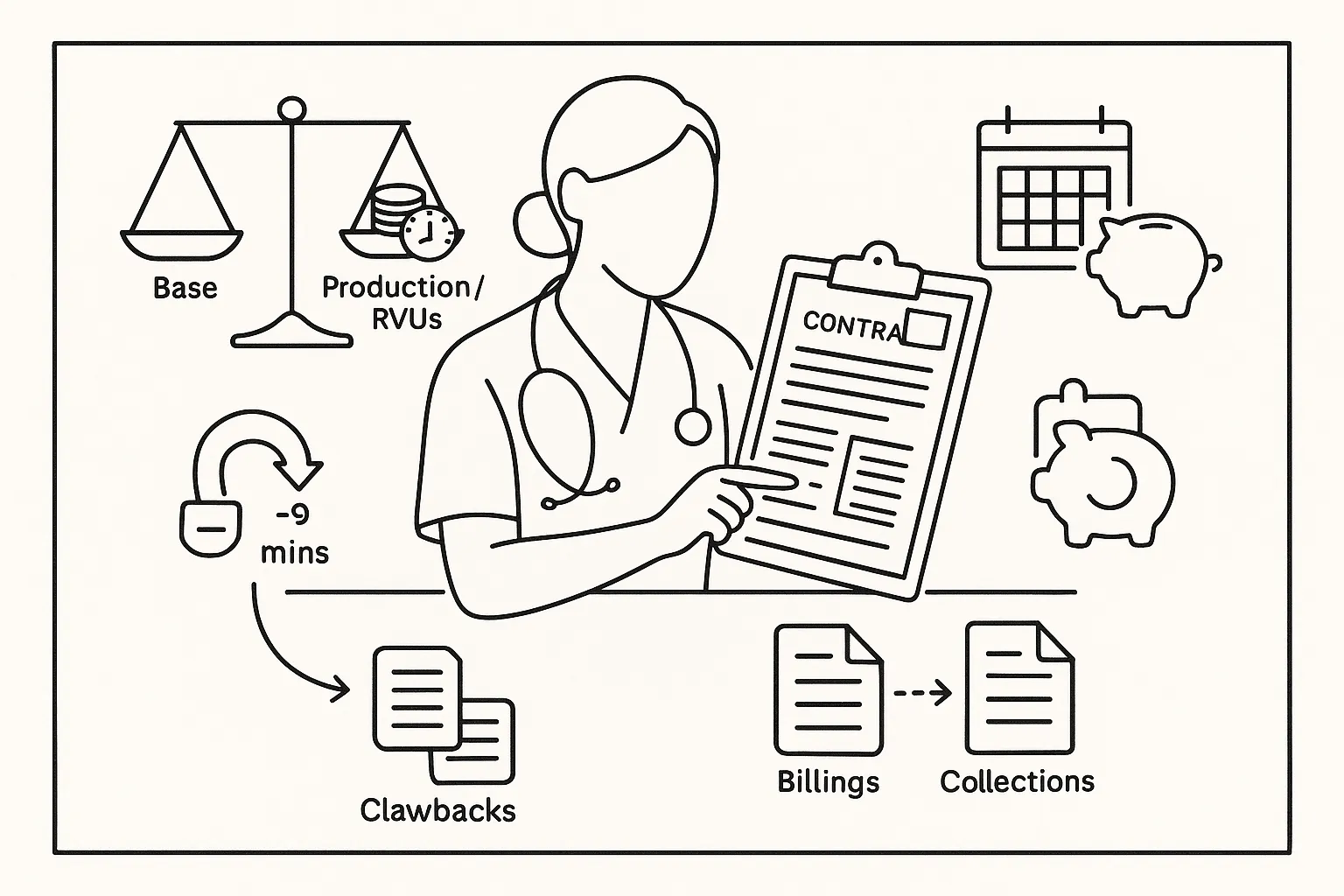
Common compensation structures include guaranteed salary, base salary plus production, collections-based pay, and RVU compensation. Billings and collections are not interchangeable: billed charges may be reduced by contractual adjustments, denials, payer rules, or collection delays. Analysis should identify the formula, production threshold, conversion factor, reporting method, payment schedule, reconciliation process, and employer-controlled inputs.
An RVU formula may appear straightforward but produce a different result after thresholds, caps, expense deductions, or negative accrual are applied. The agreement may also need to explain whether the NP receives production credit for procedures, shared visits, delayed claims, or services affected by coding and credentialing. A compensation and productivity review can evaluate how these provisions operate together rather than relying on the headline salary alone.
Benefits, Bonuses, and Clawbacks
Paid time off, continuing education allowances, retirement contributions, call pay, health benefits, licensing expenses, and professional dues contribute to the offer’s overall value. Review can also determine when benefits begin and whether credentialing or a delayed start date creates an unpaid gap.
Signing bonuses, relocation assistance, educational support, and student-loan benefits often carry repayment obligations. Important details include whether repayment is prorated, which termination events trigger it, how long the obligation continues, and whether interest, collection costs, or legal fees may be added. A repayment clause is particularly significant when the employer has broad immediate-termination rights.
Malpractice Insurance and Tail Exposure
Occurrence and Claims-Made Coverage
Malpractice provisions may identify occurrence or claims-made coverage, policy limits, covered services, reporting requirements, and any exclusions. Occurrence coverage generally responds to a covered incident that took place during the policy period even if the claim is filed later. Claims-made coverage generally requires the claim to be made while the policy or an applicable extended reporting endorsement remains effective.
No Wyoming profession-specific statute requiring an employed or independent contractor NP to purchase malpractice insurance or tail coverage was identified in the reviewed authorities. Private agreements therefore need to state the parties’ obligations clearly. Separate governmental liability rules may apply when an NP works for a governmental entity or under a qualifying governmental contract.
Tail Coverage, Prior Acts, and Indemnity
An employer may provide claims-made insurance during the relationship while assigning tail coverage to the NP at departure. Review can clarify when tail is required, who selects and purchases it, whether prior-acts coverage is an acceptable alternative, and whether responsibility changes based on the reason for termination. The indemnification language should also be compared with the insurance provision so the NP does not unknowingly accept uninsured contractual liability.
A dedicated malpractice and tail insurance review can identify potential post-employment cost and reporting obligations. Policy declarations, endorsements, and an insurance summary are useful when available because the contract alone may not describe all coverage limitations.
Non-Competes, Confidentiality, and Termination
Wyoming Restrictions on Future Practice
A Wyoming statute voids certain non-competes restricting physicians, but that physician-specific prohibition does not expressly extend to APRNs or nurse practitioners. An NP restriction instead remains subject to generally applicable Wyoming contract and reasonableness principles. Review should consider the restricted activities, duration, geographic reach, triggering events, listed facilities, and practical effect on future work without assuming that the physician rule controls an NP agreement.
Non-solicitation, confidentiality, patient-record, and non-interference provisions require separate analysis. Wyoming law protects qualifying trade secrets, but an agreement may define confidential information more broadly than statutory trade-secret protection. A nurse practitioner non-compete review can evaluate how the restrictions interact and whether they could affect employment elsewhere in the community.
Without-Cause Termination and Post-Employment Duties
Termination language defines for-cause events, cure opportunities, without-cause notice, immediate termination rights, and obligations during the notice period. It may also control final salary, earned bonuses, benefit continuation, malpractice reporting, patient transition, records, and return of employer property. If the employer can remove the NP from the schedule during notice, the agreement should clarify whether compensation continues.
Termination provisions should be read with bonus repayment, tail insurance, and restrictive covenants because one event may activate all of them. A focused contract termination review can identify gaps between the notice requirements and the financial obligations that survive departure.
Credentialing, Schedule, and Clinical Expectations
Credentialing, Privileges, and Start-Date Conditions
Licensure, payer enrollment, credentialing, and hospital privileges can affect the start date and the ability to generate revenue. The agreement may specify who submits materials, pays fees, monitors renewals, and bears the risk of administrative delay. Analysis can determine whether compensation begins on a fixed date, after orientation, or only when all credentialing conditions have been satisfied.
Broad conditions allowing the employer to withdraw the offer or terminate immediately for any credentialing delay may create significant uncertainty. The agreement can also be compared with the job description and written offer to identify material promises that were not included in the final contract.
Schedule, Call, Locations, and Telehealth
Schedule provisions may address clinic hours, administrative time, weekends, call, patient volume, floating, travel, and coverage at multiple sites. Vague language can give the employer substantial discretion to alter hours or locations without a corresponding compensation adjustment. Review can clarify whether call is mandatory, how frequently it is assigned, and whether additional coverage generates separate pay.
Telehealth terms may identify approved work locations, patient jurisdictions, technology responsibilities, record access, and malpractice coverage. Because authority to practice depends on the patient’s location and other applicable requirements, the contract should not assume that Wyoming licensure alone authorizes care in every state.
Wyoming Nurse Practitioner Contract Review Process
Documents and Contract Red Flags to Review
Recurring concerns include ambiguous productivity formulas, unexplained negative accrual, broad duty language, one-sided termination rights, expensive tail obligations, repayment clauses, and restrictions that make a local job change difficult. Comparing the agreement with common nurse practitioner contract red flags can help organize questions before attorney review.
- The complete employment or independent contractor agreement, including exhibits and addenda
- The offer letter, job description, proposed schedule, call expectations, and assigned locations
- Compensation examples, productivity reports, or sample reconciliations when available
- Malpractice policy declarations, endorsements, or a coverage summary
- Employer policies incorporated into the agreement and written communications containing material promises
Attorney-Led Analysis Before Signing
An attorney-led review evaluates the agreement as a whole rather than treating compensation, malpractice, termination, and restrictive covenants as isolated clauses. The process can identify income risk, regulatory inconsistencies, post-employment costs, and provisions that may warrant clarification or revision. Completing that analysis before signing gives the NP an opportunity to understand the practical consequences of the offer and make a more informed decision.
Speak With a Wyoming Nurse Practitioner Contract Lawyer Before You Sign
Chelle Law provides attorney-led contract review to identify compensation risks, malpractice obligations, restrictive covenants, termination exposure, and provisions that may warrant clarification or revision.
Request a Contract ReviewExplore Nurse Practitioner Contract Guidance
Review related services, educational resources, and state-specific nurse practitioner contract information.