
An automatic-renewal provision can extend a physician assistant employment or independent contractor agreement without requiring the parties to sign a new contract. Often called an evergreen clause, it typically renews the agreement for another stated period unless the PA or employer gives notice by a specified deadline. The practical effect reaches beyond the contract term: compensation formulas, scheduling obligations, malpractice responsibilities, repayment provisions, and post-employment restrictions may continue with little or no additional discussion.
The renewal clause cannot be evaluated in isolation. Its notice deadline may differ from the period required to terminate without cause, and incorporated policies or compensation schedules may allow important terms to change during the renewed period. A missed deadline can leave the PA working under an agreement that no longer reflects the position, particularly when duties, locations, productivity expectations, or supervision and collaboration arrangements have changed since the original signing date.
A useful contract review traces the renewal language through every provision that may continue or survive termination. Chelle Law examines notice mechanics, compensation and repayment exposure, malpractice coverage, scope-of-practice terms, restrictive covenants, and exit rights so a PA can understand the consequences of renewing or ending the relationship. Because state laws governing PA practice and restrictive covenants continue to evolve, current jurisdiction-specific requirements also matter.
What an Evergreen Clause Actually Renews
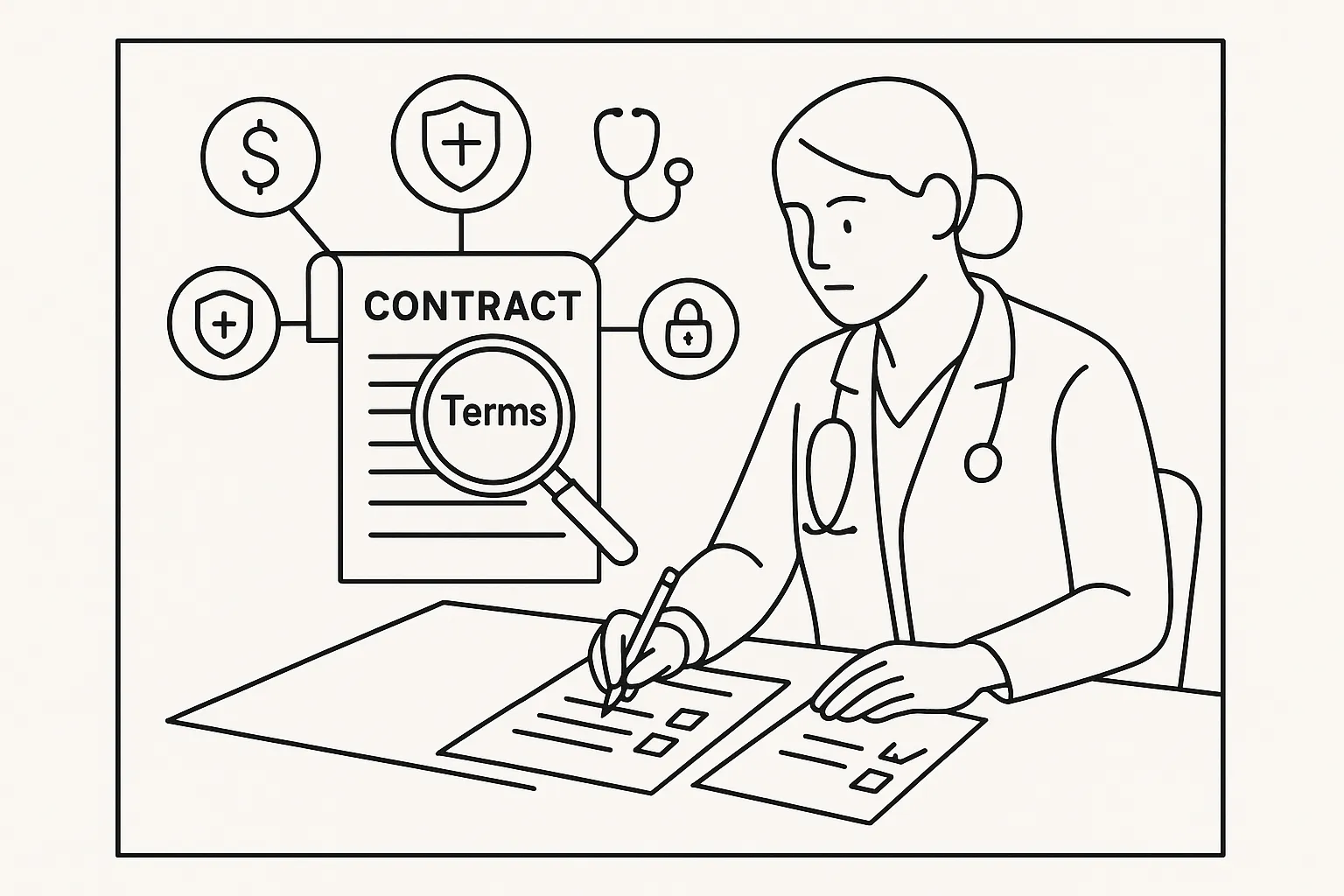
An evergreen clause ordinarily provides that the agreement continues for another term unless one party delivers timely notice of nonrenewal. The provision may create successive one-year terms, shorter renewal periods, or continued employment for an indefinite period. Understanding the result requires reviewing the initial term, renewal period, notice window, delivery instructions, and any language allowing the employer to revise policies or attached schedules.
Renewal and termination are separate contract events
Notice of nonrenewal and termination without cause may lead to the same eventual outcome, but they are not necessarily interchangeable. A contract might require 90 days’ notice to prevent renewal while permitting without-cause termination on 60 days’ notice. Another agreement may prohibit termination during an initial period or impose different financial consequences depending on which provision is used.
The provisions also can affect when employment ends. Nonrenewal may allow the contract to expire at the end of its term, while termination notice may start a separate countdown on the date notice is received. The PA needs to know which mechanism applies, whether the employer can remove clinical duties during the notice period, and whether compensation and benefits continue through the effective departure date.
Notice details can determine whether nonrenewal is effective
A notice provision may specify the recipient, address, delivery method, and date on which notice becomes effective. Sending an email may be insufficient if the agreement requires certified mail or personal delivery. Notice addressed to a supervisor also may not satisfy language requiring delivery to a corporate officer, legal department, or designated administrative address.
The PA can reduce avoidable uncertainty by identifying the deadline well in advance and retaining evidence of compliant delivery. Any amendment, addendum, offer letter, compensation plan, or incorporated policy should also be checked for a different notice rule. When the documents conflict, the agreement’s amendment and order-of-precedence language may determine which provision controls.
Financial Terms That May Carry Into the Renewal Period

Automatic renewal may preserve the existing compensation arrangement, but that result depends on the full contract. Some agreements continue a fixed salary and incentive formula. Others allow benchmarks, conversion factors, benefit contributions, or productivity schedules to change through annual notices, employer policies, or documents incorporated by reference. A focused review of PA compensation terms can identify which financial provisions are fixed and which remain subject to adjustment.
Salary, RVUs, collections, and reconciliation
A productivity formula is only as clear as its underlying definitions. An RVU provision may depend on whether the PA receives credit for work RVUs or total RVUs, which conversion factor applies, when production is measured, and whether the employer can revise the benchmark. Collections-based arrangements raise different questions, including how payments are attributed, how long collections remain payable after departure, and whether billing delays or denials reduce compensation.
Draws, advances, and negative accrual provisions deserve particular attention before renewal. A draw may be reconciled against later production, carried into the next measurement period, deducted from final pay, or treated as a debt when the relationship ends. The agreement should be analyzed for the reconciliation date, access to supporting data, treatment of disputed calculations, and whether the PA receives post-termination collections or bonuses earned before departure.
Bonuses, relocation assistance, and repayment exposure
Signing bonuses, relocation payments, student loan assistance, and retention incentives frequently come with service periods or repayment triggers. Important details include whether repayment is prorated, when the obligation becomes due, and whether termination by the employer produces the same result as a voluntary resignation. A survival clause may keep the repayment duty enforceable after the employment term ends even when the incentive itself does not renew.
Independent contractor agreements may allocate expenses, taxes, benefits, insurance, and business costs differently from employment contracts. The contract’s label does not resolve every classification or licensing issue, and employment protections should not be assumed to apply to a contractor relationship. Renewal analysis therefore includes both the economic terms and the legal framework governing the actual working arrangement.
Malpractice Coverage and Clinical Practice Obligations
Renewal may continue malpractice coverage and clinical duties, but the agreement needs enough detail to show what protection and operational support the PA will receive. A general statement that the employer provides insurance may not identify the policy type, limits, exclusions, reporting requirements, or protection available after employment ends. Those omissions can create substantial financial and professional risk.
Claims-made, occurrence, prior-acts, and tail coverage
Claims-made coverage generally responds when a covered claim is made during the policy period, subject to the policy terms and any applicable retroactive date. Occurrence coverage generally responds based on when the underlying incident occurred, even if the claim is reported later. The agreement should identify the coverage type, policy limits, retroactive or prior-acts protection, reporting duties, and the party responsible for premiums and deductibles.
When claims-made coverage ends, tail or extended-reporting coverage may be needed to address later claims arising from earlier services. The cost and duration can be significant, making it important to determine whether the employer, the PA, or both parties share responsibility. Current professional guidance likewise cautions that a generic insurance promise may not establish complete post-employment protection. Chelle Law’s guide to tail insurance obligations for PAs provides additional context for reviewing this allocation.
State practice rules and changing clinical duties
Supervision, collaboration, delegation, prescribing, chart review, physician availability, and documentation requirements are not uniform nationwide. Contract language must be compared with the law and board rules governing each state in which the PA practices. Employer policies may also impose operational requirements that are more restrictive than the legal baseline.
Recent reforms illustrate why an older contract may not reflect current terminology or practice requirements. For example, Kansas HB 2702 changed key statutory concepts in 2026 by replacing certain supervision terminology with collaboration, removing physician-to-PA ratio restrictions, and shifting aspects of scope determination toward practice and credentialing structures. The relevance of any reform depends on the jurisdiction and the PA’s role, but an evergreen agreement may continue outdated duties unless the documents are revisited.
Changes in facility assignments, call coverage, telehealth duties, and travel expectations also warrant review before renewal. Provisions allowing work at any employer location can materially expand the position over time. PAs facing broader geographic responsibilities may find the discussion of multi-site assignment terms helpful when assessing location and scheduling language.
Restrictive Covenants After Automatic Renewal
Non-compete and non-solicitation provisions can limit a PA’s next position after the renewed agreement ends. The analysis includes the duration, territory, restricted activities, facilities used to calculate the geographic area, and the events that trigger the restriction. Patient, employee, and referral-source restrictions may operate independently of a traditional non-compete, while confidentiality and proprietary-information provisions can survive even when other restrictions do not.
Renewal can change the practical timing of a restriction when its duration begins on the eventual termination date. It may also extend exposure to contractual language covering new sites, affiliated entities, or service areas added during employment. A PA restrictive-covenant review can evaluate those provisions within the complete agreement rather than treating the non-compete as a standalone paragraph.
Federal developments do not eliminate the need for state-specific analysis. The Federal Trade Commission’s nationwide Noncompete Rule is not in effect or enforceable, and in September 2025 the agency withdrew its appeals and acceded to vacatur of the rule. The effect and enforceability of a PA restriction therefore continue to depend primarily on applicable state statutes, case law, the contract language, and the surrounding facts.
Leaving an Agreement That Has Renewed
The termination section controls whether and how the PA can leave during a renewed term. Without-cause termination language typically states the required advance notice, while for-cause provisions identify events that may permit immediate termination or a shorter process. Definitions of cause, any opportunity to cure a breach, and the employer’s right to suspend duties during the notice period can materially affect the exit.
Financial consequences should be mapped before notice is sent. The agreement may address final salary, earned incentives, collections received after departure, unused paid time off, reimbursement expenses, bonus repayment, negative accrual, and tail coverage. A separation agreement or release may impose additional conditions not found in the original contract. A focused review of PA termination terms can clarify the notice process and the obligations that may survive departure.
Operational duties can continue as well. Patient handoffs, record completion, credentialing notifications, return of property, confidentiality, and cooperation with later claims may all remain relevant. The PA should also determine whether the employer can require continued work, place the PA on paid or unpaid leave, or accelerate the departure date after receiving notice.
Questions to Resolve Before the Renewal Deadline
A practical review begins with the renewal date and follows every provision affected by continued employment or eventual termination. Before allowing the agreement to renew, identify:
- The initial term, renewal period, nonrenewal deadline, required delivery method, and correct notice recipient.
- Whether nonrenewal and without-cause termination use different deadlines or produce different financial consequences.
- Which salary, RVU, collections, bonus, benefit, or reconciliation terms remain fixed and which may be revised.
- How draws, negative accrual, repayment obligations, and final compensation are calculated when the relationship ends.
- The malpractice policy type, limits, reporting duties, prior-acts coverage, and responsibility for tail coverage.
- Whether current state requirements align with the contract’s supervision, collaboration, delegation, prescribing, and documentation language.
- The duration, territory, triggering events, and restricted activities covered by non-compete and non-solicitation provisions.
- Whether duties, call, schedule, telehealth work, and practice locations can change during the renewed period.
Unclear notice language, adjustable compensation formulas, undefined malpractice obligations, broad location clauses, and restrictions tied to multiple facilities warrant closer examination. The goal is not simply to confirm that the contract renews, but to understand precisely what continues, what can change, and what it may cost to leave.
Frequently Asked Questions
What does automatic renewal mean in a physician assistant contract?
Automatic renewal means the agreement continues for another stated period unless the PA or employer gives notice as required by the contract. The clause usually identifies the renewal term and deadline, but the separate notice, amendment, and termination provisions may supply additional requirements.
How can a PA stop an agreement from automatically renewing?
The PA generally needs to satisfy the contract’s nonrenewal requirements, including the deadline, delivery method, address, and designated recipient. Because nonrenewal and without-cause termination may operate differently, both provisions need to be reviewed before notice is sent.
Does renewal guarantee that the same compensation formula will continue?
No uniform rule applies. Some contracts continue the existing salary or productivity formula, while others permit changes through amendments, annual schedules, employer policies, or incorporated compensation plans. The renewal and compensation provisions must be read together.
How does nonrenewal differ from termination without cause?
Nonrenewal generally prevents another contract term from beginning, while without-cause termination ends the agreement under a separate notice provision. The deadlines, effective dates, work requirements, and financial consequences may differ even when both options eventually end the relationship.
Can malpractice and tail obligations survive the renewed contract?
Yes. Claims-made coverage may require tail or extended-reporting protection after employment ends, and the agreement may assign the cost to the employer, the PA, or both. Policy type, limits, prior-acts coverage, reporting duties, and survival language all require review.
Does automatic renewal extend a PA non-compete?
Renewal may affect the practical timing of a non-compete when the restricted period begins on the eventual termination date. Its effect and enforceability depend on the wording, applicable state law, restricted activities, duration, territory, and triggering events.
Have Your PA Contract Reviewed Before It Renews
Chelle Law can analyze renewal deadlines, compensation provisions, malpractice obligations, restrictive covenants, repayment exposure, and termination terms before the next contract period begins.
Contact Chelle Law