
An immediate termination clause allows a physician assistant’s employer or contracting entity to end the relationship without the notice period that ordinarily applies to a without-cause departure. Depending on the wording, the clause may be labeled termination for cause, immediate termination, or termination without notice. The practical concern is not limited to losing a position: the termination date may also control final compensation, benefits, malpractice coverage, bonus repayment, restrictive covenants, and access to an internal review process.
The consequences often depend on several documents rather than one paragraph in the employment agreement. A compensation plan may govern an unpaid productivity bonus, an offer letter may contain a sign-on bonus clawback, and an employee handbook may define misconduct more broadly than the signed contract. State wage-payment law, the applicable malpractice policy, credentialing actions, and the reason given for termination can also affect the analysis.
For that reason, a physician assistant contract review must examine how the termination provision interacts with the rest of the agreement. Chelle Law evaluates the stated grounds for immediate termination, any notice or cure rights, compensation reconciliation, repayment obligations, insurance allocation, and post-employment restrictions so the PA can understand the contractual exposure before signing or respond promptly after an adverse action.
How Immediate Termination Changes the Contractual Exit
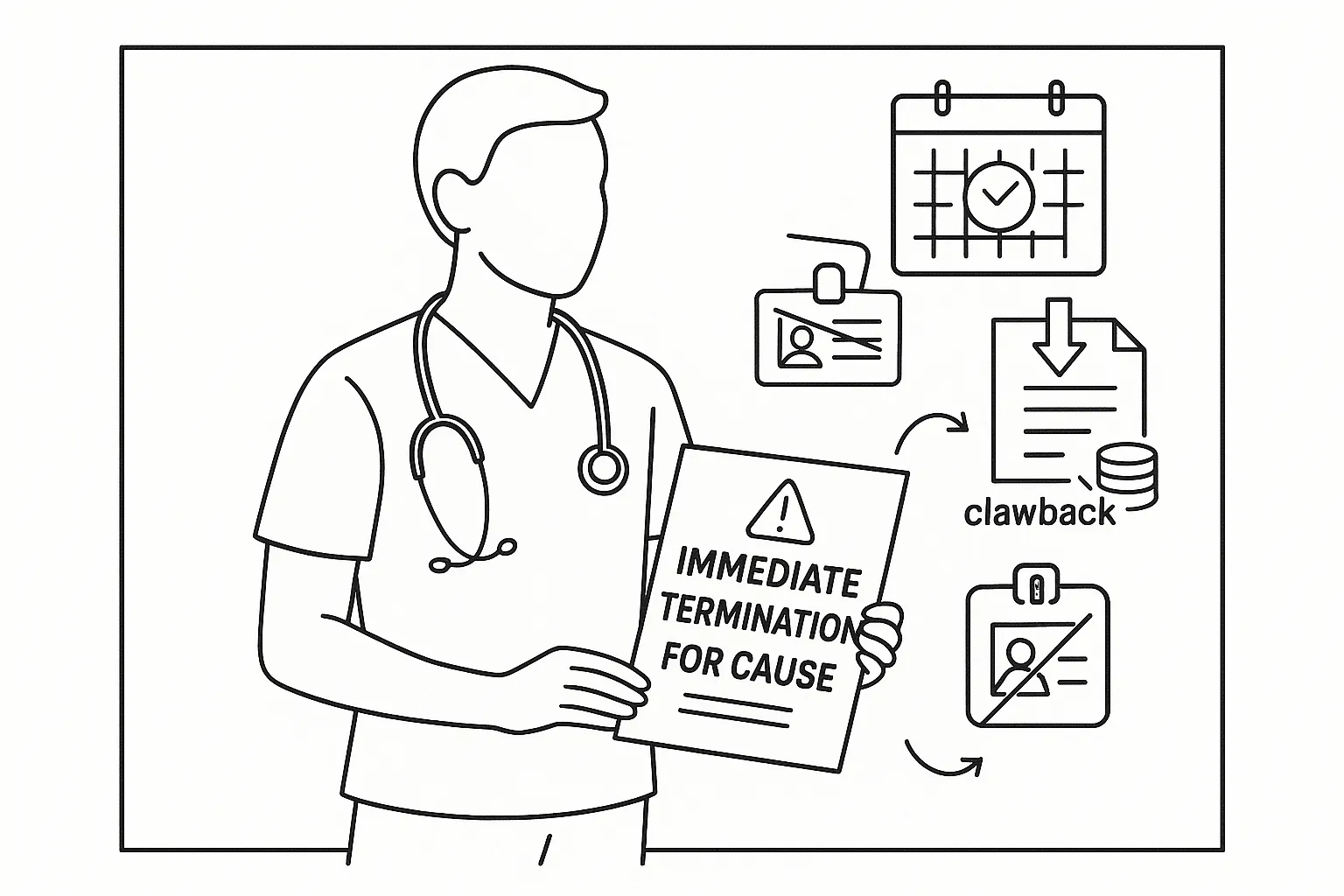
For-Cause Termination Versus a Without-Cause Departure
Without-cause termination generally permits either party to end the relationship for a reason that does not have to fit a defined contractual ground, provided the terminating party follows the required notice procedure. Immediate or for-cause termination is different because the employer may assert that a specified event permits the relationship to end at once. The PA may lose the remaining notice-period income and any severance or transition protection that applies only to a without-cause departure.
The distinction can affect more than the final working day. Agreements sometimes assign different consequences to resignation, without-cause termination, and termination for cause. Those differences may determine whether a bonus must be repaid, whether unvested compensation is forfeited, who pays for malpractice tail coverage, and whether a noncompete exception applies. A related termination-clause analysis can identify those cross-references before a dispute develops.
Commonly listed grounds include loss or suspension of a required license, exclusion from a government healthcare program, loss of required certification, fraud, patient abandonment, controlled-substance diversion, material policy violations, or conduct outside an authorized scope of practice. A contract may also address the loss of hospital privileges, failure to maintain required credentials, criminal conduct, documentation misconduct, or repeated noncompliance with supervision, collaboration, or delegation requirements.
The greatest interpretive risk often comes from subjective language. Phrases such as “conduct detrimental to the employer,” “loss of confidence,” “unprofessional behavior,” or “failure to meet standards” may give the employer considerably more discretion than a clause tied to an objectively verifiable event. The review should also determine whether an allegation is enough to trigger termination or whether the agreement requires a final decision by a licensing board, court, payer, or credentialing body.
Contract Language That Controls the Employer’s Authority

Notice, Cure Rights, and Incorporated Employer Policies
A cure provision can require written notice of a breach and provide a stated period in which to correct it. That protection is most useful for conduct that can realistically be remedied, such as incomplete documentation, failure to satisfy an administrative requirement, or noncompliance with a scheduling procedure. Other events—such as license revocation or intentional fraud—may be expressly excluded from any cure opportunity.
The clause must be read for both the existence and scope of a cure right. Some agreements allow the employer to decide unilaterally whether a breach is curable, while others provide a cure period only for a “material breach” but define professional misconduct separately as grounds for immediate action. Important questions include who decides whether the cure was successful, whether the PA may continue working during the cure period, and whether a repeated event eliminates future cure rights.
References to handbooks, compliance plans, medical staff bylaws, supervision documents, compensation policies, or other employer rules also deserve attention. If those materials can be revised unilaterally, they may effectively expand the conduct supporting termination after the contract has been signed. The review should identify which documents are incorporated, whether the PA has received them, and whether the signed agreement or a later policy controls when the terms conflict.
- Is “for cause” limited to specific, verifiable events, or does it contain broad catch-all language?
- Does the employer have to provide written reasons and cite the provision allegedly violated?
- Is there a cure period, and which grounds are excluded from it?
- Can suspension pending an investigation continue without pay, and is its duration limited?
- Do medical staff bylaws, policies, or compensation plans provide separate appeal procedures?
- Does immediate termination eliminate notice pay, severance, or another contractual benefit?
Final Pay, Bonuses, and Post-Termination Debt
Compensation Reconciliation and Repayment Provisions
Immediate termination can stop base salary at once, but it does not by itself answer when the final paycheck is due or whether other compensation has been earned. The U.S. Department of Labor explains that federal law does not generally require an immediate final paycheck. State wage-payment law and the written compensation documents may impose different deadlines or rules for commissions, paid leave, deductions, and promised compensation.
Productivity-based compensation creates additional timing questions. A wRVU bonus may depend on services performed before termination, while a collections formula may not be calculated until the employer receives payment months later. The agreement needs to clarify whether the PA receives a post-departure reconciliation, how long collections remain attributable to the PA, whether adjustments can reduce earned amounts, and whether the PA may inspect the underlying data. A focused PA compensation and productivity review can test how the formula operates when employment ends mid-period.
Draws and negative accrual provisions may create a different problem. If advance compensation exceeds the amount later supported by productivity, the employer may characterize the deficit as a recoverable debt. The contract should be examined for authorization to deduct that amount from final wages, demand repayment after departure, offset it against a bonus, or carry the deficit between measurement periods. The existence and enforceability of any deduction can depend on the agreement and governing state law.
Sign-on bonuses, relocation assistance, student-loan support, retention payments, and prepaid continuing education funds may also be subject to clawbacks. The decisive language is usually the repayment trigger: some provisions apply whenever employment ends before a stated date, while others distinguish resignation, termination without cause, and termination for cause. The agreement may require full repayment rather than prorating the obligation according to time worked. These details are addressed more fully in Chelle Law’s resource on physician assistant bonus repayment terms.
Malpractice Coverage and Restrictions After Departure
Tail Insurance, Noncompetes, and Career Mobility
Termination does not automatically determine whether the PA or employer must purchase malpractice tail coverage. The first question is the type of insurance. Claims-made coverage generally requires continued protection through tail coverage or replacement coverage with an appropriate prior-acts date after the original policy ends. Occurrence coverage generally protects covered events that occurred during the policy period even if the claim is asserted later. The policy, carrier requirements, and contract allocate the practical and financial responsibility.
The agreement may make the allocation depend on why the relationship ended. An employer might pay for tail after a without-cause termination but assign the cost to the PA following resignation or termination for cause. The review should determine whether the contract refers to tail, prior-acts or “nose” coverage, policy limits, consent-to-settle terms, and the deadline for documenting replacement coverage. Chelle Law’s guide to tail insurance for physician assistants explains these distinctions in greater detail.
Restrictive covenants may become active immediately when employment ends. A noncompete can limit work within a defined area, while a nonsolicitation clause may restrict contact with patients, referral sources, or employees. Confidentiality, property-return, and patient-record provisions may impose separate duties. The effect depends on the contract, applicable state law, the reason for termination, and the particular facts.
There is currently no enforceable nationwide FTC rule that categorically controls noncompetes in PA contracts. The FTC’s Noncompete Rule status page explains that the agency’s 2024 rule is not in effect or enforceable following federal litigation. Enforceability therefore remains primarily a matter of state law, contractual wording, and case-specific judicial analysis, although federal and state regulators may still challenge particular practices. A physician assistant noncompete review can identify the applicable restrictions without assuming that a uniform national rule applies.
Employment Termination Is Not the Same as a Reportable Professional Action
An employer’s decision to terminate employment does not automatically mean that a licensing board, the Drug Enforcement Administration, a payer, a hospital, or the National Practitioner Data Bank will take or receive a reportable action. Each system has its own authority, standards, procedures, and reporting triggers. The analysis must distinguish the employment decision from any separate restriction of clinical privileges, professional-review action, license action, controlled-substance registration action, payer exclusion, or malpractice payment.
This distinction is especially important for PAs. Federal Title IV reporting rules impose mandatory clinical-privilege reporting requirements for certain professional-review actions involving physicians and dentists. The NPDB Guidebook explains that reporting of comparable clinical-privilege actions involving other practitioners, including PAs, may occur under different authority and is not identical to the mandatory physician-and-dentist framework. A PA therefore should not assume either that every firing is reportable or that no related credentialing action can be reported.
Where an action is reportable, the relevant trigger is the qualifying action rather than the employment termination date alone. A restriction or surrender of clinical privileges during an investigation may raise different issues from a simple employment separation, and an internal appeal does not necessarily postpone an otherwise applicable reporting deadline. State-board reporting duties can also differ substantially by jurisdiction and by the nature of the alleged conduct.
A termination involving alleged patient harm, impairment, diversion, fraudulent documentation, scope-of-practice concerns, or a privilege restriction requires prompt attention because statements made in one process can affect another. The PA should identify which entity acted, what action was taken, whether an investigation was pending, and what review deadlines apply instead of treating all professional consequences as part of a single termination event.
What to Do After an Immediate Termination
The first priority is to preserve an accurate record. A PA facing immediate termination should retain the signed agreement, amendments, offer letter, compensation plans, relevant policies, malpractice documents, pay statements, productivity reports, bonus communications, credentialing materials, and the written termination notice. Records must be preserved lawfully; patient information, confidential business data, and employer property should not be copied or removed in violation of privacy obligations or workplace policies.
- Request the stated grounds for termination and the relied-upon contract or policy provisions in writing.
- Create a factual timeline of relevant conversations, complaints, investigations, warnings, and credentialing events.
- Confirm the final dates of wages, health benefits, malpractice coverage, and access to employer systems.
- Obtain the calculations supporting any bonus forfeiture, productivity reconciliation, wage deduction, or repayment demand.
- Identify deadlines for an internal appeal, medical staff review, unemployment application, board response, or other proceeding.
- Avoid speculative written explanations or unnecessary admissions before the allegations and documents have been reviewed.
Unemployment eligibility, final-pay remedies, credentialing procedures, and potential contract claims vary by state and circumstance. An internal appeal may address an employer or facility decision, but it does not necessarily suspend an external reporting obligation or extend another filing deadline. The PA should identify every potentially relevant process and evaluate each timeline separately.
Legal review is particularly time-sensitive when the employer alleges professional misconduct, seeks substantial repayment, withholds earned compensation, invokes a restrictive covenant, ends malpractice coverage, or connects the termination to a licensing or privilege action. Counsel can compare the employer’s stated basis with the contract, determine which documents control, evaluate procedural requirements, and identify issues that require advice from an attorney in the governing jurisdiction.
Frequently Asked Questions
Can a physician assistant be terminated immediately without prior warning?
A contract may permit immediate termination when a defined event occurs, but the result depends on the agreement, incorporated policies, and applicable law. Some grounds require no cure period, while others require written notice or an opportunity to correct the alleged breach.
Does immediate termination eliminate a PA’s right to a final paycheck?
No. Termination does not erase compensation that is legally earned, but the payment deadline and treatment of bonuses, commissions, paid leave, deductions, and productivity compensation depend on state law and the governing contract or compensation plan.
Must a PA repay a sign-on bonus after being terminated for cause?
Not automatically. Repayment depends on the clawback language, the stated reason for termination, any prorating formula, and applicable law. Some clauses require repayment after any early departure, while others distinguish resignation, without-cause termination, and termination for cause.
Who pays for malpractice tail coverage after immediate termination?
The answer depends on the malpractice policy and contract. Claims-made coverage may require tail or qualifying prior-acts coverage, while occurrence coverage generally does not. The agreement may allocate the cost differently based on the reason employment ended.
Is every immediate termination reported to the NPDB or a licensing board?
No. Employment termination alone is not automatically reportable. Reporting depends on the type of action, the entity taking it, the practitioner category, the governing authority, and whether a separate privilege, professional-review, licensing, malpractice, or other qualifying event occurred.
When should a PA seek legal review after termination?
Prompt review is especially important when deadlines are running, professional misconduct is alleged, clinical privileges or licensure may be affected, compensation is withheld, repayment is demanded, malpractice coverage ends, or a restrictive covenant limits the next position.
Have a Physician Assistant Termination Clause Reviewed
Chelle Law can analyze immediate-termination grounds, compensation consequences, repayment provisions, malpractice coverage, and post-employment restrictions so you can understand the risks in the agreement.
Contact Chelle LawExplore Physician Assistant Contract Resources
Review related services, practical contract guides, and state-focused pages for physician assistants.