
A notice provision determines how a physician assistant and an employer or contracting entity may end their working relationship without relying on an immediate-termination right. Although the clause may appear to address only the number of days before departure, it can also control when compensation ends, whether the PA must continue providing clinical services, how patient responsibilities are transferred, and whether repayment or restrictive-covenant provisions are triggered.
The consequences often depend on several documents rather than one sentence. The employment agreement, compensation plan, employee handbook, practice agreement, bonus addendum, malpractice policy, and incorporated employer policies may assign different obligations during the notice period. Ambiguous or conflicting terms can create disputes over productivity credit, collections, benefits, call coverage, the effective termination date, and the PA’s ability to begin another position.
A careful contract review examines the entire departure framework before the PA signs or submits notice. That analysis can identify one-sided deadlines, undefined delivery requirements, post-employment coverage gaps, regulatory notifications, and financial obligations that may not become apparent until the working relationship ends.
Why a PA Notice Clause Controls More Than the Departure Date
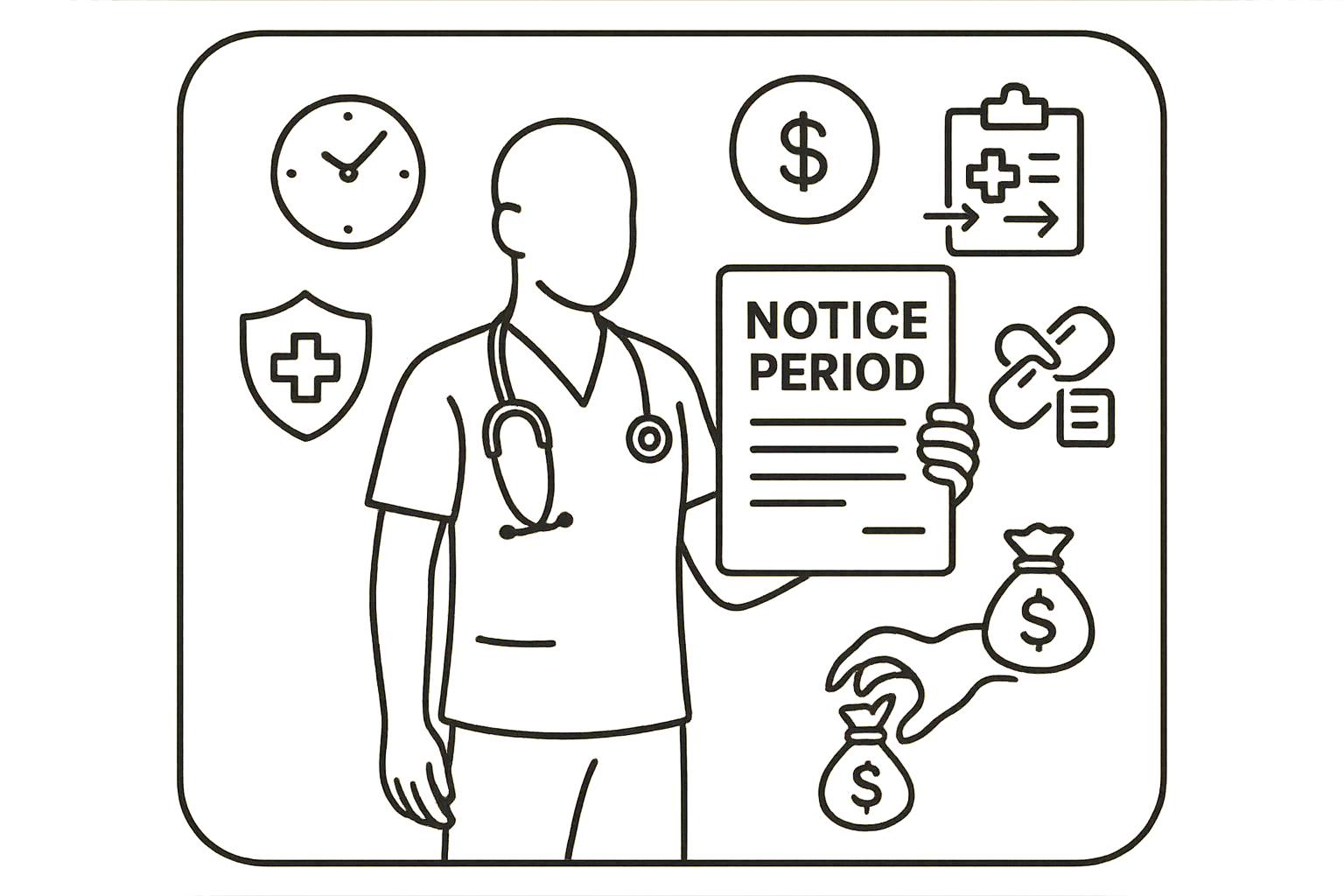
A notice period is the contractual interval between delivery of a termination notice and the effective end of the relationship. PA agreements may use periods ranging from a few weeks to several months, but those ranges are contract-market observations rather than a universal legal standard. The controlling period and its consequences depend on the agreement, worker classification, employer policies, and governing law.
Federal law generally does not require advance notice before an individual employee is discharged, and it does not ordinarily require an immediate final paycheck. As the U.S. Department of Labor explains, state law may impose different final-pay requirements. State wage-payment rules and the contract therefore matter when determining the timing and treatment of salary, commissions, collections, bonuses, deductions, and accrued benefits.
- Income and benefits: Whether salary, productivity compensation, collections, bonuses, insurance benefits, and accrued leave continue during notice.
- Clinical obligations: Whether the PA must continue seeing patients, taking call, completing records, or assisting with handoffs.
- Exit costs: Whether departure triggers bonus repayment, relocation reimbursement, liquidated damages, or malpractice tail obligations.
- Future employment: When non-compete, non-solicitation, confidentiality, and other post-employment restrictions begin.
- Regulatory compliance: Whether the end of employment or a practice relationship requires notice to a licensing board or another regulatory body.
Because these subjects interact, the number of notice days cannot be evaluated in isolation. A seemingly reasonable deadline may become burdensome if the employer can remove the PA from clinical work without clarifying pay, demand full call coverage through the final day, or treat incomplete notice as a trigger for significant repayment.
What Happens After a Physician Assistant Gives Notice
Pay, Productivity Credit, and Benefits During the Transition
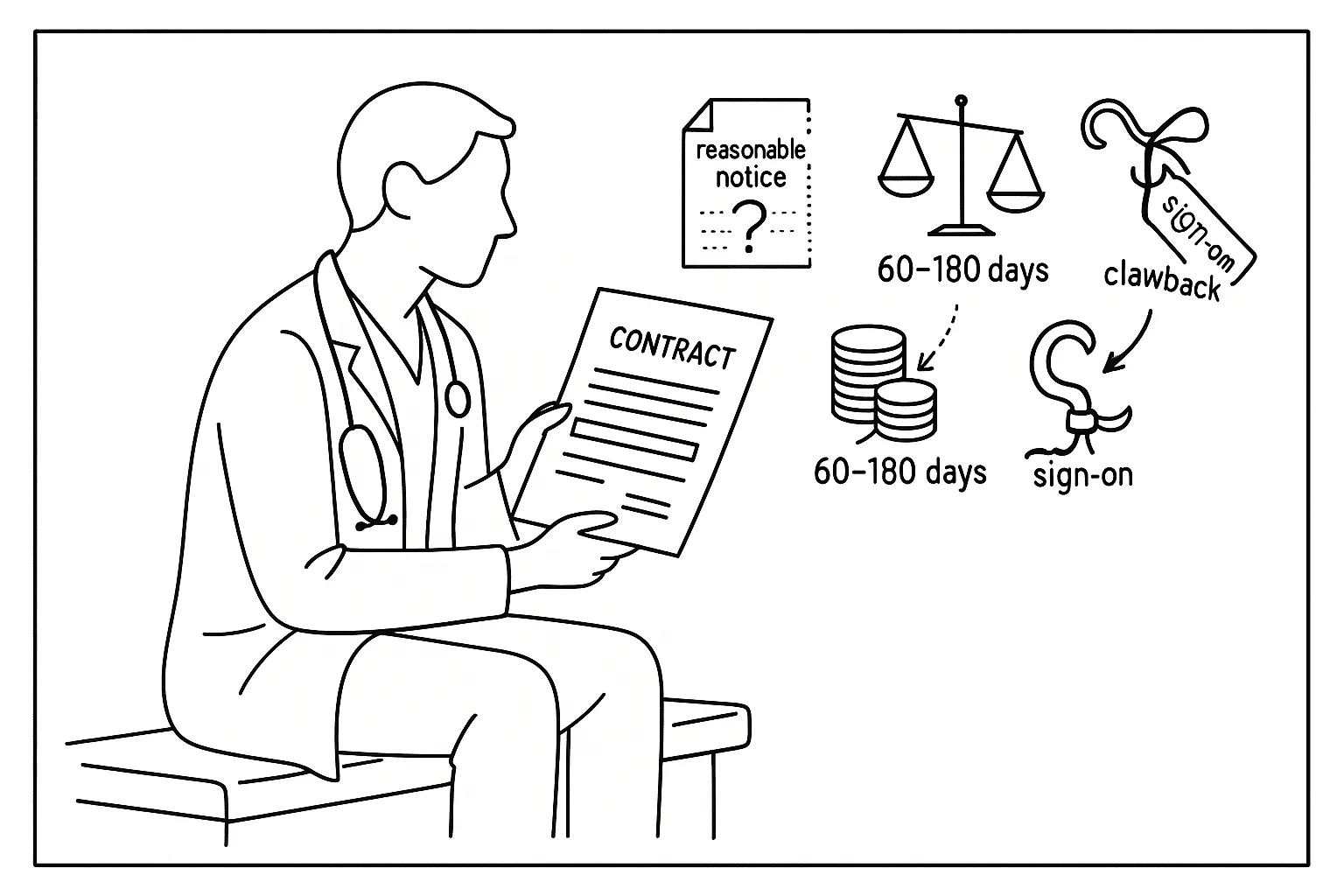
The agreement may state that ordinary salary and benefits continue through the effective termination date, but that language does not necessarily resolve every payment issue. A productivity formula may stop crediting work when notice is submitted, exclude services billed after departure, or require the PA to remain employed on the bonus payment date. Collections-based arrangements can create a similar problem when revenue from services already performed arrives after the final day.
A detailed review of PA compensation terms can determine how base pay, RVUs, collections, quality incentives, discretionary bonuses, continuing medical education allowances, and benefits are treated during notice. The analysis also needs to account for state wage-payment rules, because contractual language does not necessarily resolve whether particular deductions or forfeitures are permitted.
Scheduling, Call, and Clinical Responsibilities
An employer may require the PA to continue performing all ordinary duties, alter the schedule, remove the PA from patient care, or place the PA on paid garden leave. If the PA remains responsible for clinical service, the documents need to clarify scheduling authority, practice locations, patient handoffs, records completion, call obligations, and compensation through the final clinical date. Open-ended cooperation provisions can otherwise create continuing work after employment ends without a defined duration or payment method.
Call coverage deserves particular attention when a departure may leave staffing gaps. The notice clause must be read with any schedule policy, job description, practice agreement, or call addendum. Reviewing the PA’s call and coverage requirements can reveal whether the employer has broad authority to increase nights, weekends, or backup responsibilities during the transition.
Practice Agreements and State Regulatory Notifications
Departure from a practice may trigger regulatory steps that are separate from the employment contract. Requirements vary significantly by state and can depend on the PA’s practice arrangement, supervising or collaborating relationship, prescribing authority, and licensing structure. For example, Pennsylvania regulations include a 15-day written notification requirement for certain changes or terminations of PA employment, while West Virginia regulations contain a 10-day notification provision associated with termination of a practice notification. These are state examples, not nationwide rules.
A PA preparing to leave should verify the current requirements of the governing state board rather than assuming the employer will complete every filing. The contract review should also account for the written position description, practice agreement, delegation documents, and employee handbook. These materials may determine how prescribing authority, patient coverage, unfinished documentation, records access, and the end of a clinical relationship are handled.
Immediate Termination, Cause Definitions, and Notice Waivers
Most notice clauses operate alongside separate termination-for-cause provisions. An agreement may permit immediate termination for loss or restriction of licensure, exclusion from a government program, criminal conduct, patient-safety concerns, failure to maintain required credentials, or a material contract violation. Some immediate-termination rights may address legitimate operational concerns, but vague standards can allow a disagreement to be characterized as cause, eliminating the ordinary notice period and potentially affecting pay or repayment obligations.
The definition of cause needs to be read together with any notice-of-breach and cure procedure. Important distinctions include whether a breach can be corrected, how much time the PA receives to respond, and whether different consequences apply to resignation, termination without cause, and termination for cause. A focused termination provision review can identify where those classifications alter compensation, insurance, repayment, or post-employment restrictions.
Notice-waiver language creates a related risk. An employer may reserve the right to accept a resignation immediately, waive the remaining work period, or remove the PA from the schedule. The agreement may not explain whether salary, benefits, bonus eligibility, or productivity credit continues after that decision. It may also be unclear whether the official termination date changes or whether the employer can waive the PA’s services while still treating the departure as an early resignation.
The practical consequences depend on the wording and applicable law. A waiver provision is more predictable when it expressly addresses pay, benefits, outstanding incentive compensation, accrued leave, clinical access, and the effective date used for malpractice coverage and post-employment obligations.
Financial and Insurance Exposure at the End of Employment
Bonus Repayment and Other Clawback Obligations
Signing bonuses, relocation assistance, loan-repayment contributions, training expenses, and retention incentives often carry service commitments. The repayment clause may be triggered by resignation before a stated anniversary, failure to complete the full notice period, or termination for cause. Some provisions use monthly or annual proration, while others demand the entire amount even when most of the service commitment has been completed.
The PA needs to know which event triggers repayment, whether the amount declines over time, when payment is due, and whether the employer may deduct it from final compensation. The agreement should also be checked for inconsistent language—for example, a notice clause that permits employer waiver paired with a clawback triggered whenever the PA does not work through the entire notice period. A review of sign-on bonus repayment provisions can identify that exposure before resignation or contract execution.
Malpractice Coverage and the Final Clinical Date
Malpractice coverage must remain coordinated with the last date on which the PA provides professional services. Occurrence coverage generally responds to covered incidents occurring during the policy period, even if the claim is made later. Claims-made coverage ordinarily requires the claim to be made while the policy remains active, subject to the actual policy terms, so post-termination protection may require tail coverage or another form of prior-acts protection.
The contract should identify the policy type, coverage dates, limits, reporting requirements, and responsibility for arranging and paying for any necessary extended reporting endorsement. It should also address whether responsibility changes based on resignation, termination without cause, termination for cause, or failure to complete notice. A dedicated review of tail insurance terms for PAs can clarify whether a waiver of clinical duties or an altered termination date creates a coverage gap.
Non-Competes and Other Restrictions After Notice
The termination date may determine when a non-compete, non-solicitation clause, confidentiality obligation, or other post-employment restriction begins. Some agreements treat voluntary resignation differently from termination without cause. Others attempt to extend a restricted period by the length of an alleged notice deficiency or use paid garden leave to delay the PA’s start with another organization.
- Departure classification: The agreement may apply different restrictions depending on whether the PA resigns or the employer ends the relationship.
- Starting date: A restriction may begin on the last clinical day, the payroll termination date, or another contractually defined date.
- Extension language: Alleged failure to provide complete notice may be used to extend the restricted period.
- Garden leave: The PA may remain employed and compensated while being prevented from beginning another position.
The Federal Trade Commission’s 2024 nationwide Noncompete Rule is not currently enforceable, so it does not categorically invalidate PA non-competes across the country. The FTC nevertheless continues to scrutinize potentially unreasonable restrictions in healthcare, including through warning letters and case-specific enforcement activity. State law, the precise wording of the covenant, the circumstances of departure, and the relevant facts remain central to the analysis.
A physician assistant restrictive-covenant review can evaluate the notice clause together with the restriction’s duration, geographic reach, prohibited activities, triggering events, and governing law. Neither automatic enforceability nor automatic invalidity should be assumed without that analysis.
How to Evaluate a PA Notice Provision Before Signing or Resigning
A useful notice review starts with the complete contract package, not only the termination paragraph. The employment or independent contractor agreement may incorporate compensation plans, handbooks, clinical policies, bonus documents, practice agreements, and insurance provisions by reference. Any amendment or addendum can also change the result.
Before relying on the provision, identify the following:
- The exact notice period for each party and whether the deadlines are reciprocal.
- The permitted delivery method, required recipient, and date on which notice becomes effective.
- Whether the PA must continue working and whether the employer may waive duties or remove the PA from the schedule.
- How salary, RVUs, collections, bonuses, benefits, allowances, and accrued leave are treated.
- Whether repayment obligations or liquidated damages are triggered by incomplete notice.
- How cause, resignation, termination without cause, and employer-waived notice are defined.
- Whether call, practice locations, schedules, supervision, delegation, or clinical responsibilities may change during notice.
- The policy type and responsibility for malpractice coverage after the final clinical date.
- When restrictive covenants begin and whether alleged notice deficiencies extend them.
- Whether departure requires notification to a state board, payer, hospital, credentialing body, or other organization.
Red flags include undefined “reasonable notice,” a lengthy PA obligation paired with immediate employer termination rights, compensation forfeiture tied to resignation, unclear waiver consequences, repayment without meaningful proration, and open-ended post-employment cooperation. Reading these provisions together helps distinguish a manageable transition requirement from a clause that shifts substantial financial or professional risk to the PA.
Frequently Asked Questions
Is there a legally required notice period for physician assistants?
There is no universal federal notice period for PA resignations or ordinary individual discharge. The required period usually comes from the contract, although state law, employer policies, and regulatory notification rules may create additional obligations.
Can an employer stop scheduling a PA after notice is given?
The answer depends on the agreement and applicable law. An employer may reserve the right to remove the PA from clinical work or waive the remaining service period, but the documents need to clarify whether salary, benefits, bonuses, and other compensation continue.
Does a PA keep earning productivity compensation during notice?
Not necessarily. The compensation plan may address RVU credit, collections received after departure, bonus measurement dates, and payment eligibility differently. State wage-payment law may also affect whether earned compensation can be withheld or deducted.
What may happen if a PA leaves before completing the notice period?
Depending on the contract and governing law, leaving early may lead to an alleged breach, a repayment demand, disputed incentive compensation, liquidated damages, or an attempt to extend a restrictive covenant. The agreement must be reviewed to determine the actual consequences.
Can a notice period affect malpractice tail coverage?
Yes. The final clinical date, policy type, reporting requirements, and reason for termination can affect whether post-departure protection is needed. Claims-made coverage may require tail or equivalent coverage, while occurrence coverage operates differently under its policy terms.
Should a PA review documents beyond the employment agreement?
Yes. Compensation plans, employee handbooks, practice agreements, bonus addenda, malpractice policies, call schedules, and incorporated clinical policies may contain terms that change the PA’s duties and financial rights during departure.
Review Your PA Notice Obligations Before You Act
Chelle Law reviews physician assistant contracts to identify how notice, compensation, clinical duties, repayment, malpractice coverage, and post-employment restrictions work together.
Contact Chelle LawExplore Physician Assistant Contract Guidance
Find attorney-led services, practical resources, and state-focused contract information for physician assistants.