
A without-cause termination provision allows a physician assistant or an employer to end an employment or independent contractor relationship without proving misconduct, breach, or poor performance. The clause may look like a simple exit right, but its practical effect depends on provisions scattered throughout the agreement. Notice requirements, scheduling authority, final compensation, malpractice coverage, repayment obligations, and restrictive covenants can substantially change the consequences of an otherwise lawful separation.
For a PA, the central question is not merely whether the employer may terminate without cause. The agreement may permit the employer to remove the PA from the schedule during the notice period, eliminate eligibility for an unpaid productivity bonus, demand repayment of a signing incentive, or leave the PA responsible for costly tail coverage. Post-employment restrictions can also affect where the PA may work while credentialing delays postpone the start of a replacement position.
A careful PA contract termination review evaluates how these provisions operate together. Reviewing the entire agreement before signing or responding to a termination notice can reveal financial exposure, ambiguous obligations, and terms that may warrant clarification or revision.
How Without-Cause Termination Works in a PA Agreement

A without-cause clause permits separation without an accusation that either party violated the contract. An employer may use the provision after restructuring, a change in staffing needs, financial pressure, a service-line closure, or an unsuccessful credentialing process. A PA may rely on the same clause to leave for another opportunity, relocate, or change specialties. Whether the right is genuinely mutual depends on the notice periods, repayment obligations, and other consequences imposed on each party.
Without-cause termination is different from termination for cause. Cause provisions commonly identify events such as fraud, loss of required credentials, exclusion from a government program, or a material contractual breach. The distinction matters because a for-cause termination may permit immediate separation or affect notice, severance, repayment, and post-employment obligations. Vague cause definitions and discretionary language can therefore create substantial disagreement about which termination process applies.
A contractual right to terminate without cause also does not necessarily make the relationship at will. An agreement may allow termination for any lawful reason while still requiring 60, 90, or more days of advance notice. Obligations concerning compensation, confidentiality, patient information, insurance, repayment, and restrictive covenants may continue after the effective termination date.
Notice, Scheduling, and the Effective End Date
What Happens During the Notice Period
The notice period determines how far in advance a party must communicate its decision to end the relationship. For a PA, that period may provide time to locate another position, complete credentialing, arrange new benefits, and address malpractice coverage. The protection is limited, however, if the employer may immediately stop assigning shifts, reduce hours, revoke access to facilities, or place the PA on unpaid administrative leave.
The agreement warrants close review for language addressing whether the PA remains employed, scheduled, and eligible for compensation and benefits throughout the notice period. It may also authorize payment in lieu of notice, commonly allowing the employer to end active work immediately while paying some or all of the compensation associated with the remaining period. The clause needs to be read alongside compensation plans, handbook provisions, and incorporated policies rather than in isolation.
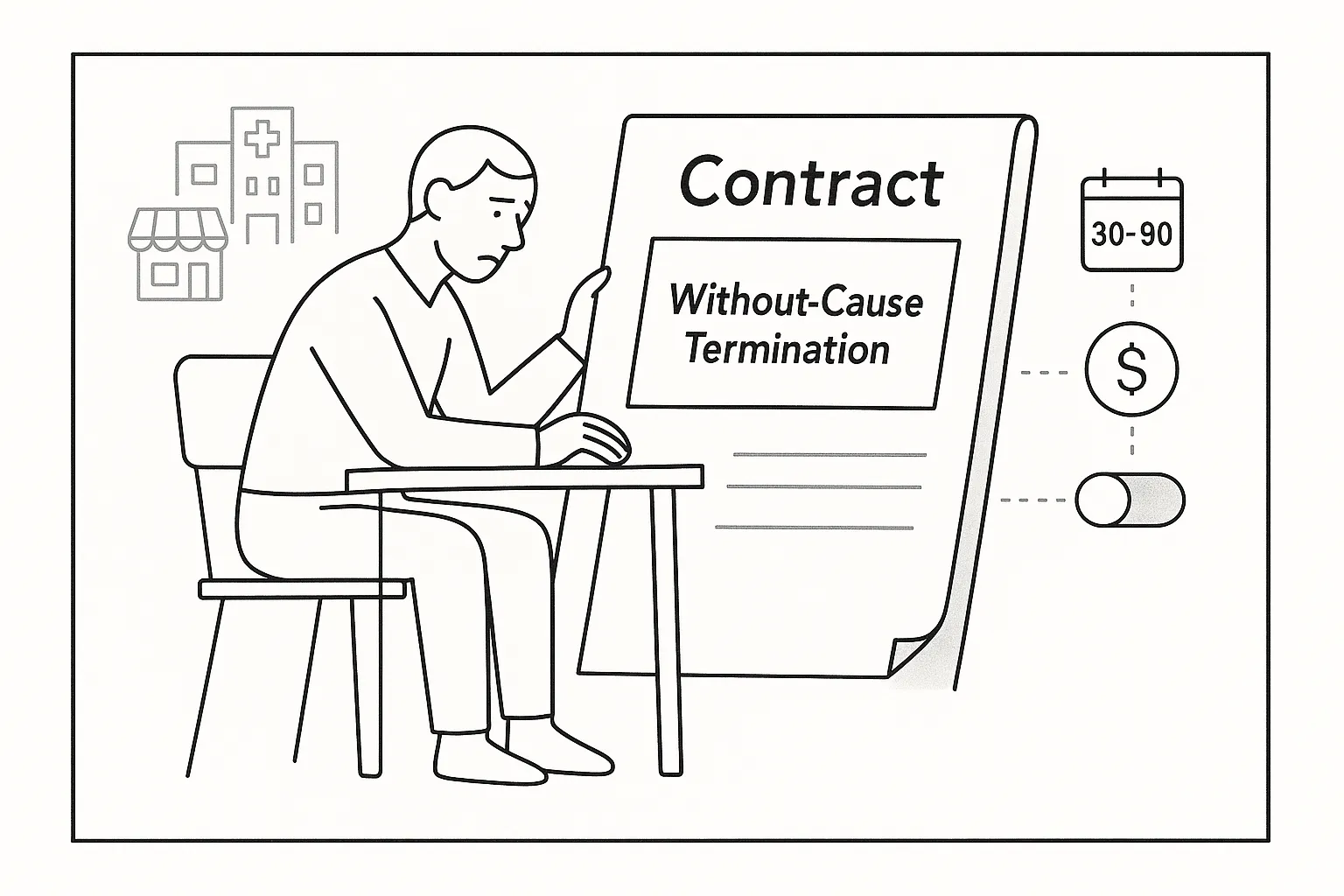
Notice mechanics also matter. The contract may require written notice delivered to a specific person or address by an approved method. An email or verbal conversation may not satisfy the provision. The effective date should be calculated from the contractually recognized delivery date, and any amendment affecting the notice period must be considered.
Final Pay, Bonuses, and Repayment Exposure
Salary, Productivity Pay, and Final Reconciliation
Final compensation may include regular salary, earned incentive pay, expense reimbursements, accrued leave when payable, and compensation generated under an RVU or collections formula. There is no single nationwide final-pay deadline or uniform rule governing accrued paid time off for every private PA employment relationship. Timing, bonus eligibility, deductions, and leave treatment can depend on state wage law, worker classification, the employment agreement, and the governing compensation plan.
Productivity compensation creates additional accounting issues. If the employer controls scheduling, coding, billing, or collections, active production may stop immediately even though money attributable to earlier services remains outstanding. The formula needs to establish the measurement period, the treatment of work performed before separation, the date of final reconciliation, access to supporting data, and the deadline for payment. A focused review of PA compensation terms can identify formulas that cause earned production to disappear at termination.
Federal salary-basis rules may also limit certain deductions from the guaranteed salary of an exempt employee. For example, the federal regulation governing salary-basis compensation generally addresses deductions when an employee is ready, willing, and able to work but work is unavailable. Its application depends on the facts, classification, and reason for the deduction, so the contract and payroll treatment must be evaluated together rather than assuming every post-notice deduction is permitted.
Draws and negative accrual provisions deserve similar attention. If guaranteed payments are characterized as advances against future production, an employer may claim that a deficit remains due after separation. The documents should clarify whether deficits carry forward, whether reconciliation applies after an employer-initiated termination, and how refunds, chargebacks, or later coding adjustments affect the final calculation.
Signing Bonuses, Relocation Funds, and Severance
A signing bonus, relocation payment, training stipend, or educational benefit may become repayable when the relationship ends. Some clauses require full repayment regardless of who initiated termination. Others prorate the balance over a service period or create exceptions when the employer terminates without cause. The repayment trigger, forgiveness schedule, payment deadline, and right to deduct money from final compensation all affect the PA’s exposure. Chelle Law’s guide to PA signing-bonus repayment provisions explains additional terms to examine.
Severance is not automatic merely because the employer terminates without cause. It may be absent, calculated as a defined number of weeks of pay, or conditioned on signing a release of claims. A release may also impose new confidentiality, non-disparagement, cooperation, or restrictive-covenant obligations. The amount and timing of severance should therefore be considered together with the rights the PA is being asked to waive.
Malpractice Coverage and Credentialing After Separation
Claims-Made Policies, Tail Coverage, and Continuing Exposure
Malpractice responsibility can remain important long after the PA stops working. Under a claims-made policy, coverage generally depends on the claim being reported while the policy or an applicable extended-reporting endorsement remains active. As explained in the American Academy of Physician Associates’ malpractice insurance guidance, tail coverage can address claims reported after the underlying claims-made policy ends. It is different from portable individual coverage that may follow the PA between positions.
The agreement needs to identify the policy type, limits, retroactive date, reporting requirements, and party responsible for obtaining and paying for post-termination protection. Employer-provided coverage does not necessarily include tail coverage, and the expense can be significant. A review of the contract’s tail insurance allocation can reveal whether responsibility changes based on who ends the relationship or why it ends.
The employment agreement is not a substitute for confirmation from the insurer or broker. The PA should verify applicable reporting deadlines, the availability of an extended-reporting endorsement, license-defense coverage, and whether substitute coverage preserves the correct retroactive date. Written confirmation is particularly important when the employer promises to maintain or purchase coverage after separation.
Termination may also affect facility privileges, payer enrollment, prescribing-system access, billing platforms, and electronic health record access. A future employer may request information about prior privileges, procedures, coverage, or separation. The PA must observe confidentiality and record-access requirements while retaining employment, compensation, and credentialing documents the PA is lawfully permitted to keep.
Non-Competes and Other Post-Employment Restrictions
A without-cause termination does not automatically cancel a non-compete, non-solicitation clause, confidentiality obligation, or restriction involving patients, employees, or referral sources. Some agreements expressly waive a restriction when the employer initiates termination without cause, but many do not. The geographic area, duration, restricted activities, specialty, employer locations, and contractual exceptions all require analysis under the governing law.
The federal landscape also requires accurate treatment. The Federal Trade Commission’s 2024 nationwide Noncompete Clause Rule is not currently in effect or enforceable. In September 2025, the FTC withdrew its appeal and agreed to vacatur of the rule after a federal district court concluded that the agency lacked authority to issue it. Non-compete analysis for PAs therefore continues to depend primarily on state law, contract language, and state-specific court decisions. The FTC may still pursue particular non-compete or no-hire practices through case-specific enforcement, so the absence of a nationwide rule does not establish that every restriction is valid.
These restrictions can complicate a job transition when credentialing already delays the PA’s next start date. Before accepting a new position or communicating with patients, employees, or referral sources, the PA should understand the contract’s boundaries and any applicable state-law limitations. A physician assistant non-compete review can evaluate the language, identify termination-based exceptions, and explain how multiple post-employment clauses interact.
Reviewing the Contract Before and After Termination
Before signing, the most useful review examines the entire separation framework rather than negotiating one clause at a time. A longer notice period may provide little protection if the employer can stop all scheduling without pay. Severance may be less valuable if it is offset by bonus repayment or conditioned on a broad release. Similarly, a favorable termination clause may not protect the PA from an expensive tail obligation or a restrictive covenant that limits the next job search.
- Determine whether the without-cause termination right and notice period are mutual.
- Identify whether the employer can remove the PA from the schedule or pay in lieu of notice.
- Define how salary, bonuses, RVUs, collections, draws, deductions, and expenses are reconciled.
- Clarify severance eligibility and whether payment requires a release.
- Allocate responsibility for tail coverage and other post-termination insurance obligations.
- Limit repayment exposure when the employer initiates termination without cause.
- Determine whether non-compete and non-solicitation clauses survive the separation.
After receiving notice, the PA should preserve the signed agreement, amendments, compensation plans, termination notice, payroll records, productivity reports, insurance documents, and relevant written communications. A written final accounting can identify earned compensation, deductions, repayment demands, and the timing of later reconciliations. Benefits deadlines, insurer reporting requirements, and credentialing matters also require prompt attention.
- Confirm the effective termination date and whether active work continues during notice.
- Compare the employer’s stated process with the agreement and incorporated policies.
- Request documentation supporting final pay, bonus, draw, and repayment calculations.
- Confirm when benefits and malpractice coverage end and whether tail coverage is necessary.
- Review restrictive covenants before accepting a new role or contacting protected relationships.
- Seek legal review promptly if compensation, severance, repayment, insurance, or post-employment obligations are disputed.
Independent contractors need the same issue-by-issue analysis, but employee protections may not apply in the same way. The label in the agreement does not by itself resolve worker classification, wage treatment, benefits eligibility, tax responsibility, or insurance obligations. Those questions depend on the governing law and the actual working relationship.
Frequently Asked Questions
Can an employer terminate a PA without alleging misconduct?
Yes, when the agreement permits termination without cause. The employer generally must still follow the contract’s notice, compensation, severance, insurance, and other separation requirements.
Does a without-cause provision make a PA contract at will?
Not necessarily. A contract may permit termination for any lawful reason while requiring advance notice and preserving obligations that continue after termination. The complete agreement controls the contractual process.
Must an employer keep scheduling a PA during the notice period?
That depends on the agreement. Some contracts require normal work and compensation, while others permit schedule removal, administrative leave, or payment in lieu of notice. Compensation and benefit consequences should be evaluated with the termination clause.
What happens to an unpaid PA productivity bonus after termination?
The answer depends on the compensation plan, contract language, and applicable state law. Important terms include the measurement period, proration method, collections or RVU reconciliation date, post-separation eligibility, and payment deadline.
Can a PA owe a signing bonus when the employer ends the contract?
Possibly. Some repayment clauses apply regardless of who initiates termination, while others provide an exception or prorated forgiveness after an employer-initiated without-cause termination. The precise trigger and repayment schedule control the contractual obligation.
Does a PA non-compete remain effective after termination without cause?
It may, depending on the contract and governing state law. The FTC’s nationwide non-compete rule is not in effect, so enforceability remains primarily state-specific. The agreement should be examined for termination-based exceptions and limits on duration, geography, and restricted activities.
Have Your PA Termination Terms Reviewed
Chelle Law reviews physician assistant agreements to identify notice requirements, compensation risks, repayment duties, malpractice obligations, and post-employment restrictions before or after a termination notice.
Contact Chelle LawExplore Physician Assistant Contract Guidance
Find contract review services, practical resources, and state-focused information for physician assistants.