
A notice period does more than establish when a physician assistant can leave an employment or independent contractor relationship. Depending on the agreement, giving notice may change the PA’s schedule, compensation calculations, bonus eligibility, malpractice obligations, and access to employer systems. Leaving before the required period ends can create additional consequences if the contract treats incomplete notice as a breach or ties benefits to completion of the entire notice period.
The notice clause also operates alongside provisions governing automatic renewal, termination for cause, productivity reconciliation, restrictive covenants, credentialing, and clinical handoffs. A date that appears clear in one section may have a different practical effect when the agreement distinguishes the notice date, last day worked, and formal termination date. Those distinctions matter when compensation continues after separation or a post-employment restriction begins on a defined contractual event.
Before signing an agreement or announcing a departure, a PA should understand the complete sequence of contractual and operational consequences. Chelle Law reviews notice requirements, cross-referenced termination terms, repayment provisions, insurance language, and restrictions to identify ambiguities and financial or professional exposure before notice triggers them.
Why a PA Notice Clause Controls More Than the Departure Date

A notice period is the time one party must provide before ending the contractual relationship, commonly 30, 60, or 90 days in PA agreements. The contract controls the actual requirement. It may specify when notice becomes effective, how it must be delivered, whether the PA remains obligated to work, and whether the employer can remove the PA from active duties while continuing or modifying compensation and benefits.
The agreement may use several dates for different purposes. Written notice could begin the countdown, while the last clinical shift determines productivity credit and the formal termination date controls benefits or restrictive covenants. A PA evaluating a departure should therefore review the broader rules for ending a physician assistant contract rather than relying on the notice paragraph alone.
- Final compensation: Notice may affect productivity calculations, collections, bonus eligibility, draws, holdbacks, or negative accrual reconciliation.
- Repayment obligations: An early departure or incomplete notice period may activate signing bonus, relocation, training, or other repayment language.
- Insurance allocation: The termination event and policy type may determine whether tail coverage is necessary and who bears its cost.
- Post-employment limits: The contract may use resignation, the last day worked, or formal termination as the starting point for a noncompete or non-solicitation period.
- Clinical operations: Departure can affect scheduling, patient handoffs, supervision or delegation arrangements, payer enrollment, credentialing, and access to records.
Notice Deadlines, Delivery Rules, and Automatic Renewal
How Notice Must Be Delivered and When It Takes Effect
A resignation may be ineffective under the contract if it is sent to the wrong person, delivered through an unauthorized method, or calculated from the wrong date. Notice language may require delivery to a particular executive, legal department, or business address and may distinguish personal delivery, certified mail, overnight service, and email. The agreement may also state that notice is effective when sent, received, signed for, or acknowledged.
Work expectations during the notice period require equal attention. The PA may remain responsible for ordinary shifts, call, documentation, and transition duties unless the employer waives active service. If the employer removes the PA from the schedule, the agreement needs to clarify whether base compensation, productivity credit, benefits, and professional liability coverage continue through the contractual termination date. Otherwise, a paid notice period can function very differently from immediate removal without pay.
Evergreen Terms and Nonrenewal Windows
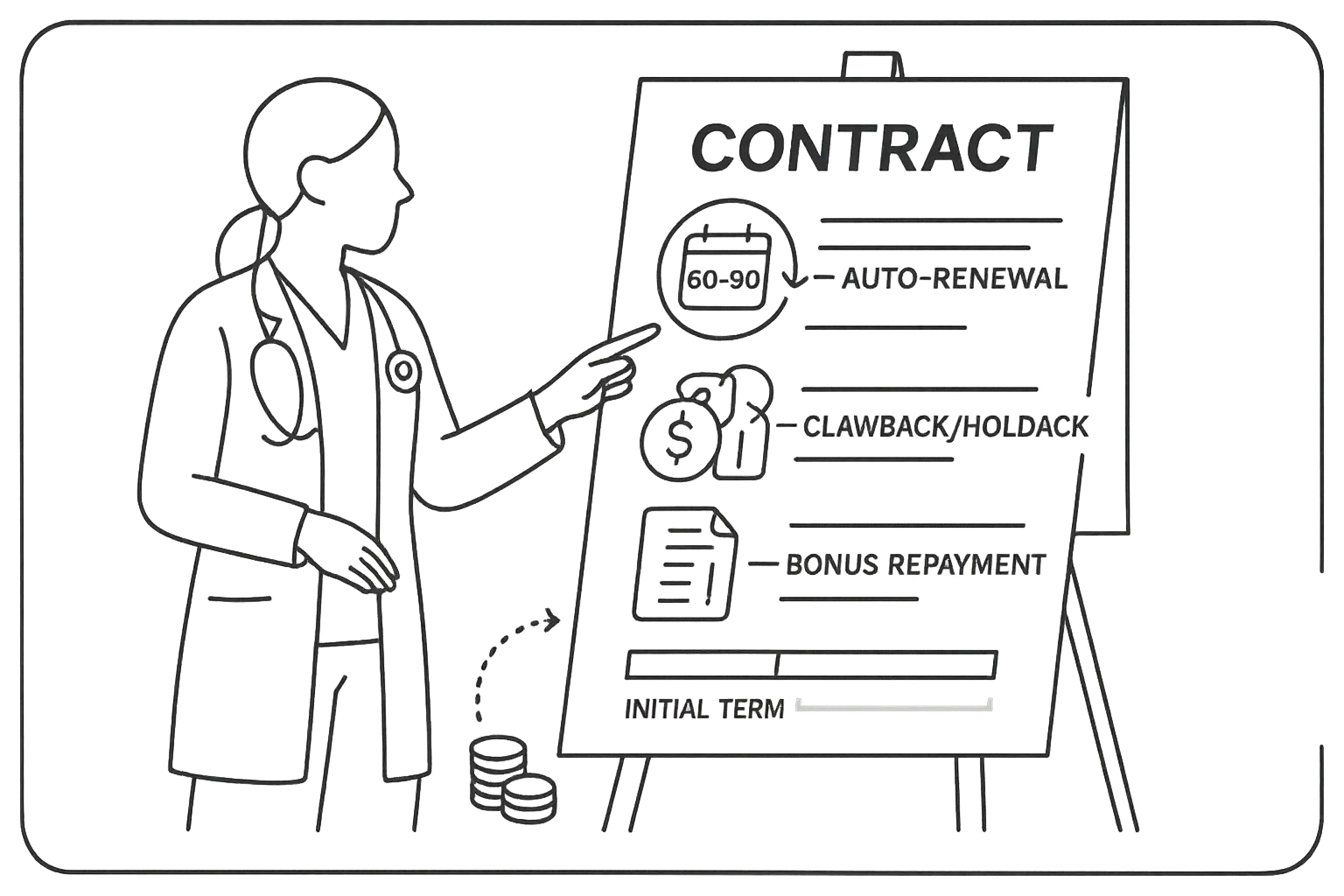
A fixed term does not necessarily mean the agreement ends automatically. An evergreen provision may renew the contract for another year or another defined period unless one party delivers written nonrenewal notice before a stated deadline. A PA who plans to leave at the end of the term could unintentionally renew by missing a 60- or 90-day window.
Renewal can preserve more than the work commitment. It may extend existing compensation terms, repayment duties, termination requirements, malpractice allocations, and post-employment restrictions. The review must distinguish notice of nonrenewal from without-cause termination because the contract may impose different deadlines and consequences for each route.
Final Pay, Productivity Reconciliation, and Repayment Exposure
How Separation Can Change the Compensation Calculation
Production- and collections-based compensation rarely ends as neatly as a salary payment. Services performed before departure may not be coded, billed, or collected until after the PA’s final day. A contract that stops credit at termination, shortens the measurement period, or excludes later collections can create a gap between the work performed and the compensation ultimately credited.
Draw and negative accrual provisions create another layer of risk. A draw is an advance against anticipated productivity, while negative accrual permits the employer to compare amounts already paid with compensation earned under the contractual formula. Giving notice may prompt an immediate reconciliation or cause an incomplete measurement period to be treated differently. The agreement’s treatment of negative accrual and unfinished production periods can determine whether the PA receives additional compensation or faces a repayment demand.
For example, a model paying $60 per RVU would produce $72,000 for 1,200 RVUs. If the employer also pays a $3,000 monthly draw and reconciles the account at separation, the result may be disputed when pending RVUs are excluded, credited late, or measured over a shortened period. A focused review of PA compensation and productivity terms can identify the formula, timing, data source, and post-termination payment rules before notice is submitted.
Holdback language may allow the employer to retain compensation temporarily for refunds, payer recoupments, denials, or chargebacks. Useful drafting identifies the permitted amount, the basis for withholding it, the reconciliation deadline, and when the remaining balance must be paid. Without those details, an open-ended holdback may delay a meaningful portion of the PA’s final compensation.
Signing, relocation, retention, and training incentives may also be connected to notice compliance. Some provisions require full repayment if the PA leaves before a stated date, while others reduce the obligation over time. The trigger may be the date notice is given, the last day worked, failure to complete the notice period, or termination for a specified reason. Reviewing sign-on bonus repayment language requires matching the trigger date with the contract’s termination definitions rather than assuming the obligation is automatically prorated.
Malpractice Coverage, Restrictions, and Professional Mobility
Insurance Responsibility and Post-Employment Restrictions
Malpractice consequences depend first on the type of policy. Occurrence coverage generally responds to covered incidents that occurred while the policy was active, even if a claim is reported later. Claims-made coverage generally requires the policy to be active when the claim is made, which can make tail coverage or prior-acts coverage important after the policy ends. The contract then determines how the parties allocate any tail expense under different termination scenarios.
Incomplete notice does not automatically make the PA responsible for tail insurance. Responsibility depends on the policy, the wording of the agreement, the reason for termination, and any enforceable breach or indemnification provisions. The review should compare the notice clause with the complete tail insurance allocation, including whether employer-paid tail is conditioned on completing the required notice period.
Notice may also start or help determine the duration of a noncompete, non-solicitation clause, confidentiality obligation, or restriction involving patients and employees. The federal government has not created a presently enforceable nationwide ban that automatically invalidates PA noncompetes. The Federal Trade Commission states that its noncompete rule is not currently in effect or enforceable after a federal court stopped enforcement in August 2024. The effect of a PA restriction therefore continues to depend primarily on applicable state law, the contract language, and the circumstances of the departure.
The triggering date must be identified precisely. A restriction may run from notice delivery, the last day of clinical service, or the formal termination date. If an evergreen term extends the agreement or the employer waives active work while keeping the contract in effect, those dates may diverge. A review of the agreement’s restrictive covenants can clarify the stated duration, geographic reach, covered activities, and relationship to the termination provision.
Clinical, Billing, and Licensing Issues During a PA Transition
Contractual notice to an employer is not necessarily the only notice required when a PA leaves. Depending on the state and practice arrangement, ending a supervising, collaborating, or delegating relationship may create separate reporting or approval obligations. For example, Louisiana rules require written board notice within a defined period for specified changes involving a PA and supervising physician or group. Requirements differ by state, so the employment deadline cannot be treated as a substitute for reviewing applicable licensing rules.
An employer’s decision to waive active work can also require immediate operational reassessment even when the formal termination date remains weeks away. Removing a supervising physician, ending a delegation arrangement, or disabling access to clinical systems may affect what services the PA can perform. Patient handoffs, prescription responsibilities, incomplete records, pending test results, call coverage, and credentialing matters need an orderly transition that is consistent with the contract and applicable professional requirements.
Billing and compensation are related but distinct issues. CMS guidance for physician assistants explains that PAs may use their own NPI and may reassign payment for services to an employer or contractor, while covered services remain subject to state scope-of-practice requirements. Separation may therefore require changes to reassignment, payer enrollment, supervision documentation, credentialing, and billing access in addition to calculating the PA’s final collections or RVUs.
Interstate mobility also requires careful timing. The PA Licensure Compact reported 23 member states as of March 12, 2026, but no member state was issuing compact privileges at that time. Enactment of the compact in a state does not itself mean a departing PA can immediately begin practicing there through a compact privilege. A PA changing employers or relocating must confirm the licensing or privilege requirements and practice rules in the destination state before relying on a planned start date.
Questions to Resolve Before Giving Contractual Notice
A notice provision works as a risk-allocation mechanism. It assigns the financial, insurance, operational, and mobility consequences of ending the relationship. Before delivering notice, the PA should map each relevant date and follow every cross-reference so that the likely result is understood before the contract is triggered.
- Termination route: Is the departure a nonrenewal, without-cause termination, resignation, or another event defined by the agreement?
- Delivery requirements: Who must receive notice, which delivery methods are permitted, and when is notice deemed effective?
- Work status: Must the PA continue ordinary duties, and what happens to compensation and benefits if the employer waives active work?
- Compensation cutoff: How are salary, RVUs, collections, bonuses, draws, holdbacks, and post-termination receipts calculated?
- Repayment triggers: Does giving notice or leaving before a particular date activate a full or prorated repayment obligation?
- Insurance allocation: What type of malpractice policy applies, is tail needed, and does the termination scenario affect who pays?
- Restrictive covenants: Which event starts each restriction, and how do the stated duration and geographic limits affect the PA’s next position?
- Operational transition: Are board reporting, payer reassignment, supervision, delegation, credentialing, or patient-handoff steps required?
An attorney-led PA contract termination review can identify conflicting dates, undefined calculations, and provisions that may warrant clarification before the PA resigns. Once notice is delivered, renewal, repayment, compensation, and restriction provisions may already be operating, which can reduce the opportunity to address avoidable ambiguity.
Frequently Asked Questions
How long is a typical physician assistant contract notice period?
PA agreements commonly use notice periods of 30, 60, or 90 days, but the individual contract controls. The PA must also determine when the period begins, how notice must be delivered, and whether active work can be waived before the formal termination date.
What happens if a PA leaves before completing the full notice period?
The agreement may treat an early departure as a breach or connect it to bonus repayment, compensation reconciliation, malpractice costs, or other consequences. The result depends on the contract language, the reason for leaving, and any applicable law rather than on a universal rule.
Can an employer hold back a PA’s final compensation?
An agreement may permit temporary holdbacks or reconciliation involving productivity pay, collections, draws, refunds, or chargebacks. The relevant provisions should identify what may be withheld, why it may be retained, when reconciliation occurs, and when any remaining balance is paid.
Can incomplete notice make a PA responsible for tail insurance?
It may affect responsibility if the agreement conditions employer-paid tail coverage on completing the notice period or avoiding a defined breach. Tail is not automatically required or shifted in every case; the answer depends on the policy type, contract allocation, and termination circumstances.
When does a PA noncompete begin after notice is submitted?
The triggering event depends on the agreement. A restriction may begin when notice is delivered, on the last day services are performed, or on the formal termination date, so the contract’s dates and definitions must be read together.
Should a PA obtain contract review before resigning?
Review before notice can identify delivery requirements, compensation consequences, repayment triggers, insurance obligations, regulatory transition issues, and restrictive covenants. Giving notice first may activate contractual deadlines or financial consequences before ambiguities can be addressed.
Review Your PA Notice Obligations Before Resigning
Chelle Law can review your physician assistant agreement to identify notice deadlines, final compensation risks, repayment triggers, malpractice obligations, and post-employment restrictions before they take effect.
Request a Contract Review