
Notice periods may appear to be a simple administrative detail in physician assistant (PA) employment and independent contractor agreements. In practice, these provisions can affect final compensation, bonus repayment, malpractice coverage, professional mobility, and the orderly transition of clinical responsibilities. The effect of a notice clause also depends on how it interacts with termination rights, automatic renewal language, productivity calculations, and restrictive covenants elsewhere in the contract. This guide explains how PA notice periods operate, identifies employer-favorable drafting techniques that can create risk, and outlines the contract terms that should be clarified before signing or giving notice.
How PA Notice Periods Affect Contract Termination

A notice period is the contractual window an employee or contractor must provide—or receive—to terminate the working relationship, commonly 30, 60, or 90 days. The agreement should establish when notice becomes effective, how it must be delivered, whether the PA must continue working during the notice period, and when employment formally ends. These details can determine final pay, benefit eligibility, clinical duties, and the start of post-employment obligations. PAs considering a departure should review the broader rules for terminating a physician assistant contract rather than reading the notice clause in isolation.
Notice provisions can also affect productivity payments, collections received after departure, and negative accrual reconciliations. If a contract conditions certain benefits on completing the notice period, an early departure may trigger repayment of a signing or relocation bonus, shift malpractice tail costs, or create an alleged breach. The agreement should therefore be read as a connected document rather than as a collection of independent clauses.
- Compensation timing: The notice period may affect final productivity calculations, bonus eligibility, draws, or negative accrual reconciliation.
- Collections-based pay: The contract may determine whether revenue collected after termination remains attributable to the PA.
- Malpractice obligations: Failure to provide the required notice may be used to shift tail insurance costs to the PA.
- Post-employment restrictions: Resignation or the formal termination date may trigger a noncompete, non-solicitation clause, or other restrictive covenant.
Common Notice Period Traps in PA Contracts
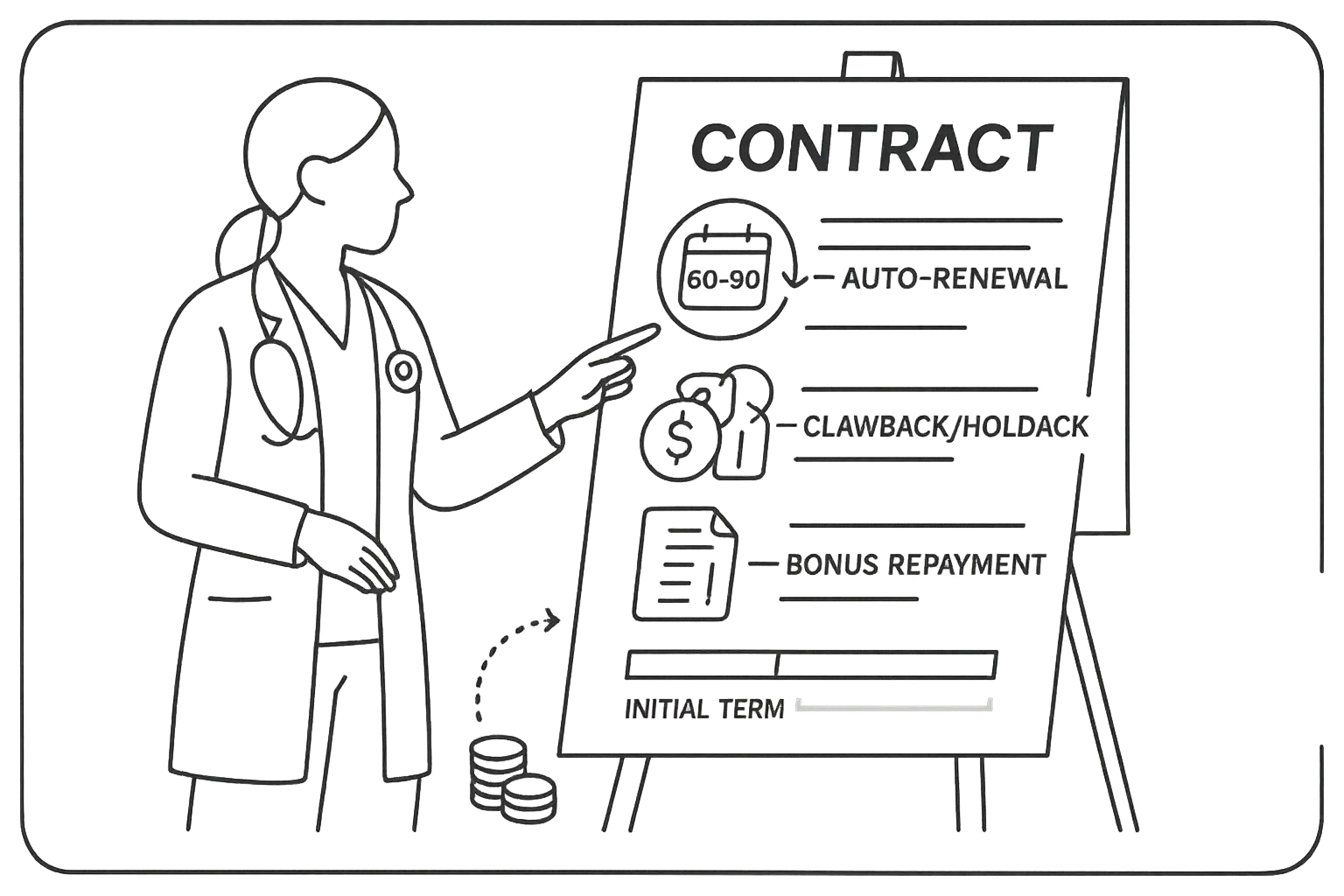
Notice clauses become particularly risky when they are connected to automatic renewal, compensation reconciliation, repayment obligations, or different termination rights for the employer and the PA. The following provisions deserve careful review because their practical effect may not be apparent from the notice language alone.
Automatic Renewal and Evergreen Deadlines
Employers sometimes pair a fixed contract term with language that automatically renews the agreement unless written notice is delivered by a particular deadline. A contract may require notice 60 to 90 days before the current term expires, effectively extending the agreement if the PA misses the window. Continued work, assignment to a service line, or another operational event may also be used as the renewal trigger.
An automatic extension can continue restrictive covenants, repayment obligations, and compensation terms that no longer fit the PA’s plans. Reviewing the agreement’s evergreen and renewal terms can help identify the correct deadline and whether renewal requires affirmative written agreement or occurs automatically.
Compensation Holdbacks, Clawbacks, and Bonus Repayment
Employers commonly use reconciliation language to adjust final pay based on productivity, collections, or advance payments. A draw is an advance against future productivity, while negative accrual language allows the employer to compare compensation already paid with production credited under the contract. If the notice provision changes the measurement period or cuts off credit for pending collections, the PA may face a repayment demand even though performed services generated revenue that has not yet been processed.
- Negative accruals and draws: The contract may require immediate reconciliation when notice is given or employment ends. PAs should understand how negative accrual provisions treat unfinished measurement periods.
- Collections holdbacks: An employer may retain part of the final compensation to address denials, refunds, or chargebacks after termination.
- Bonus repayment: Signing and relocation incentives may become repayable when the PA leaves before a stated date or fails to provide the required notice. The repayment may be full or prorated depending on the agreement.
For example, under an RVU model paying $60 per RVU, 1,200 RVUs would produce $72,000 in productivity-based compensation. If the employer also pays a $3,000 monthly draw and reconciles compensation at separation, leaving during the measurement period could produce a disputed balance if the agreement excludes pending RVUs or collections. A focused review of PA compensation terms can clarify the applicable calculation and payment schedule before a dispute arises.
Financial, Insurance, and Career Consequences
Final Pay and Malpractice Coverage
In collections- or production-based models, compensation may depend on billing cycles and payer remittance timelines. A poorly drafted notice clause can create a mismatch in which the PA performs the services but the related collections arrive outside the employer’s payout window. Holdbacks, shortened measurement periods, and undefined reconciliation procedures can further reduce or delay final compensation.
Notice compliance may also affect malpractice obligations. If employer-provided claims-made coverage ends when employment terminates, tail coverage may be needed for claims reported later that arise from prior services. Some agreements condition employer-paid tail coverage on completing the required notice period or avoiding a contractual breach. The allocation should be evaluated alongside the policy type and the agreement’s broader tail insurance requirements.
Restrictive Covenants and Clinical Transition Duties
The termination date may start the clock for a noncompete or non-solicitation provision. If an evergreen clause extends the contract or the agreement uses different dates for the last day worked and the formal termination date, the PA may have difficulty determining when a restriction begins and ends. Enforceability depends on state law and the specific facts, but PAs should understand how the notice provision interacts with all restrictive covenants in the contract.
Notice also affects patient handoffs, facility privileges, supervision or collaboration arrangements, and the transition of prescribing or other delegated responsibilities. An abrupt end to the clinical relationship without a defined handover process may create continuity-of-care, credentialing, or licensing concerns. The contract should clearly address clinical duties during the notice period and identify who is responsible for completing the transition.
How to Evaluate and Manage a Notice Provision
A notice provision should be evaluated as a risk-allocation term: it determines which party bears financial, compliance, and mobility risks when the relationship ends. The goal is to make termination events, payment calculations, insurance responsibilities, and transition duties clear enough that both parties can predict the consequences of separation.
- Define termination events precisely: Distinguish voluntary resignation, employer-initiated termination, termination without cause, and termination for cause.
- Specify the notice method and effective date: Identify where written notice must be sent, whether email is sufficient, and when notice is considered received.
- Clarify work expectations: State whether the PA must continue normal duties, may be removed from the schedule, or remains eligible for pay and benefits if the employer waives active work.
- Define compensation measurement periods: Explain how RVUs, collections, bonuses, and draws are calculated through termination and when post-termination amounts will be paid.
- Limit repayment uncertainty: Identify the events that trigger repayment and whether signing or relocation bonuses are repaid in full or on a prorated schedule.
- Allocate malpractice responsibility: State who pays for tail coverage under each termination scenario and whether notice compliance changes that obligation.
- Address renewal clearly: Make the renewal deadline easy to identify and specify whether renewal is automatic or requires mutual written agreement.
These provisions often contain cross-references that change the effect of compensation, malpractice, repayment, or restrictive covenant language elsewhere in the agreement. An attorney-led review can identify those connections, explain the likely practical consequences, and help the PA evaluate the financial and professional risks before signing or submitting notice.
Frequently Asked Questions
How long is a typical PA contract notice period?
PA agreements commonly use notice periods of 30, 60, or 90 days, but the contract controls. The PA should also confirm when the period begins, how notice must be delivered, and whether the employer can waive active work during that time.
Can an employer withhold a PA’s final compensation during the notice period?
An agreement may permit holdbacks or reconciliation of productivity pay, collections, draws, refunds, or chargebacks. The contract should define the amount that may be withheld, the reason for the holdback, the reconciliation deadline, and when any remaining compensation must be paid.
What happens if a PA misses an automatic renewal deadline?
If the agreement contains an evergreen clause, missing the nonrenewal deadline may extend the contract for another term. That extension may also continue compensation terms, repayment duties, termination requirements, and post-employment restrictions.
Can insufficient notice make a PA responsible for tail insurance?
It can if the contract conditions employer-paid tail coverage on completing the required notice period or avoiding a breach. The result depends on the policy type, the termination scenario, and the precise allocation of tail responsibility in the agreement.
When does a PA noncompete begin after notice is given?
The triggering date depends on the contract. A restriction may begin when notice is delivered, on the last day the PA performs services, or on the formal termination date. The agreement should use consistent dates so the duration and geographic limits can be evaluated accurately.
Should a PA have the contract reviewed before resigning?
Reviewing the agreement before giving notice can help identify delivery requirements, compensation consequences, repayment triggers, malpractice obligations, and restrictive covenants. Once notice is submitted, some contractual consequences may already have been triggered.
Understand Your PA Notice Obligations Before You Act
Chelle Law reviews physician assistant contracts to identify notice deadlines, final compensation risks, repayment provisions, malpractice obligations, and post-employment restrictions before they create avoidable problems.
Request a Contract Review