
A physician assistant quality bonus can add meaningful compensation, but the headline amount rarely tells the PA how much will actually be earned. Payment may depend on clinical measures, patient-attribution rules, productivity thresholds, group performance, continued employment, and data controlled entirely by the employer. A bonus that appears to offer $5,000 or 10% of salary can produce a much smaller payment if the agreement leaves those mechanics undefined.
The risk is not limited to missing a target. Some agreements allow the employer to revise scores, reconcile payments after an audit, offset a shortfall against future compensation, or recover an alleged overpayment after termination. Operational problems can also affect the result. Staffing shortages, EHR configuration, payer changes, supervision arrangements, and multi-site assignments may prevent a PA from satisfying a metric even when the PA delivers appropriate care.
Before signing, the PA needs to know which measures control, whose performance is being scored, how the data can be verified, and what happens when employment ends. Chelle Law evaluates those provisions as part of a broader PA compensation and productivity review, including the interaction among quality incentives, productivity pay, repayment language, audit rights, and termination terms.
Where a Quality Bonus Fits Within PA Compensation
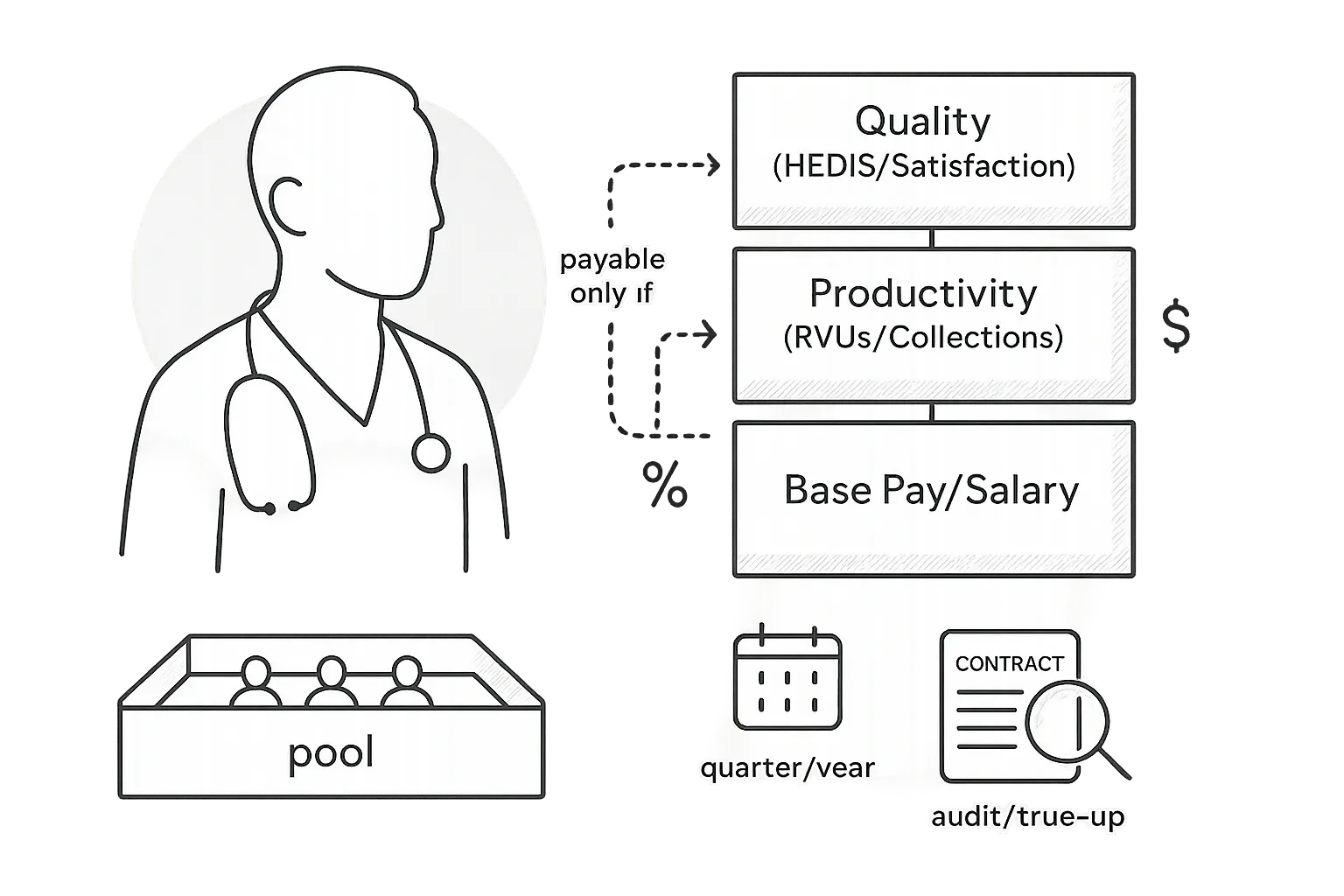
Private bonus formulas and CMS programs are different
An employer-created quality incentive is a contractual compensation formula. It is not automatically the same as a Medicare payment adjustment, even when the agreement refers to MIPS, shared savings, patient experience, or value-based care. The employer may receive or calculate program-level payments and then use a separate formula to decide whether any amount reaches an individual PA.
For the 2026 performance year, traditional MIPS continues to use quality, cost, improvement activities, and Promoting Interoperability categories. CMS also publishes 2026 MIPS Value Pathways, including a pathway that may apply to physician assistants and other nonphysician practitioners. Because specifications and benchmarks can change by performance year, a contract that merely refers to “MIPS quality” does not identify the actual measure version, reporting entity, attribution method, or benchmark.
The agreement also needs to distinguish an individual score from a group, facility, virtual-group, or APM-entity result. If the employer reports at the group level, one clinician’s payment can depend on patients and colleagues the PA did not control. A precise formula explains how the employer converts the reported result into the PA’s bonus and whether the employer can substitute a different measure after the measurement period begins.
Fixed, percentage, and pool-based incentives
Common structures include a fixed payment for meeting several targets, a percentage of base salary adjusted by the number of measures achieved, or a distribution from a practice-wide quality pool. For example, the agreement might promise $5,000 if three targets are met, offer up to 10% of salary on a sliding scale, or allocate a $20,000 pool among clinicians according to relative RVU production.
A quality payment may also sit behind a productivity gate. If the PA must first reach a collections or wRVU threshold, excellent clinical scores alone will not generate payment. The formula must therefore be read with the base-pay and productivity provisions. PAs whose compensation uses work RVUs can consult this explanation of RVU compensation for physician assistants when evaluating the units, conversion factor, threshold, and crediting rules.
Payment timing matters as much as the stated amount. A quarterly calculation may be paid months later, while an annual incentive may remain subject to billing adjustments or a year-end true-up. Deferred payment creates an additional question: must the PA still be employed on the calculation date, the approval date, or the actual payment date?
Contract Terms That Can Reduce or Eliminate the Bonus

Eligibility, forfeiture, and clawback triggers
Eligibility language often creates the first dispute. “Actively employed,” “in good standing,” and “subject to employer policy” can mean different things unless the agreement defines them. A PA may complete the measurement year and meet the targets but lose the payment after resigning during the administrative delay between scoring and payout.
The same issue arises when the employer terminates the PA without cause, reduces the PA’s hours, closes a site, or places the PA on leave. The contract may provide a prorated calculation, require employment through a specified date, or say nothing about an incomplete measurement period. State wage-payment and final-pay rules vary, so a national contract article cannot determine whether a particular earned bonus must be paid. The governing law, the formula, and the facts surrounding separation all matter.
Clawback provisions create a separate obligation. The employer may seek repayment after a billing audit, a revised quality score, a payer recoupment, or an internal finding that the original data were inaccurate. The risk is greater when the employer can declare an “overpayment” without a deadline, supporting records, or a process for disputing the calculation. Any repayment provision needs to be compared with the contract’s deduction, indemnification, and post-termination collection language.
Negative accrual and unilateral adjustment rights
A draw advances compensation before the final result is known. If the PA later falls short, the employer may deduct the deficit from a future bonus, reduce another compensation component, or demand repayment. A negative-accrual provision can carry that shortfall into the next period, turning an incentive into a continuing balance owed to the employer.
Broad discretion can produce the same result without using the term “negative accrual.” Language giving the employer sole authority to interpret measures, change weights, correct data, or modify the plan allows the formula to move after the PA has performed the work. The agreement may also incorporate a compensation policy that the employer can amend without the PA’s written consent. If that policy is not attached, the PA cannot evaluate the complete payment formula before signing.
Discretion over whether to offer a future bonus is different from discretion over a bonus already governed by announced criteria. That distinction affects both contract entitlement and, in some circumstances, payroll treatment. Calling a payment “discretionary” does not by itself resolve how federal wage-and-hour law treats it.
Measurement, Data Access, and Attribution
A workable bonus formula identifies the data source, performance year, numerator, denominator, exclusions, scoring method, and benchmark. “Patient satisfaction,” for example, is incomplete without the survey vendor, response threshold, patient population, attribution rules, scoring scale, and treatment of a sample too small to be reliable. CMS CAHPS for MIPS is optional for eligible groups and virtual groups, while an employer or commercial payer may use a different survey entirely.
Measure version is equally important. Clinical quality specifications, benchmarks, and reporting options can change from one performance year to the next. The compensation exhibit can identify the controlling version and explain what happens if CMS, a commercial payer, or another reporting body retires or revises a measure. Without version control, the employer may attempt to apply a later benchmark to work performed under an earlier standard.
Attribution determines whose patients and results count. A PA transferred between clinics may be measured using the original site, the new site, both sites, or a group-wide score. Multi-site work raises similar questions about encounters, panel assignment, shared visits, and facility-level performance. If the employer chooses the reporting level, the contract can explain whether that choice may reduce the PA’s payment and how credit follows the PA after a transfer.
Consider a $20,000 pool allocated according to each clinician’s RVUs. Results will differ depending on whether the employer uses personally performed wRVUs, total RVUs, billed units, adjusted units, or payer-allowed services. Denials, modifiers, shared procedures, and delayed charge entry can also change the allocation. The label “RVU-based quality pool” does not answer any of those questions.
Data access gives the PA a way to test the calculation. Useful terms identify when scorecards will be provided, whether the PA receives underlying reports, how quickly errors must be raised, and when the employer’s calculation becomes final. An audit window can limit indefinite reconciliation, but the proper period and any right to deduct or recover compensation depend on the agreement and governing state law. A fixed national deadline should not be assumed to work in every jurisdiction.
Employer-Controlled Conditions and Compliance Issues
Quality performance does not occur in isolation. Staffing levels, appointment availability, patient outreach, coding support, EHR prompts, and documentation workflows can determine whether a measure is captured. A PA may provide the appropriate service, yet the score can still fall if the system fails to record it or if patients cannot obtain follow-up appointments. The contract needs a method for addressing targets affected by conditions outside the PA’s control.
Scope and supervision arrangements can create the same mismatch. If a metric assumes that the PA will perform a particular service, the practice must provide the delegation, collaboration, supervision, credentialing, equipment, and coverage required for that work. A bonus should not silently assign the PA responsibility for a result that depends on authority or resources controlled by the employer.
Changes in payer mix and clinical guidance also affect performance. A revised payer denominator, new exclusion, different benchmark, or updated treatment recommendation may alter the score during the year. The formula can address whether a retired or materially changed measure is removed, replaced prospectively, or recalculated using an agreed methodology. Retroactive substitution gives the employer a result the PA could not anticipate while treating patients.
Federal payroll treatment is another checkpoint. According to the U.S. Department of Labor’s bonus guidance, a predetermined quality or performance bonus is generally nondiscretionary and ordinarily enters the regular rate for overtime calculations when the employee is nonexempt, unless an exclusion applies. Payroll may need to allocate a bonus covering several pay periods back across the weeks in which it was earned. Job title alone does not decide whether a PA is exempt, and contract entitlement remains a separate issue from the regular-rate calculation.
Quality, productivity, shared-savings, collections, and referral-related formulas can also raise fact-specific healthcare compliance concerns. Federal physician self-referral and physician-incentive-plan rules depend on the parties, services, referrals, payer arrangement, and statutory definitions. PAs are not treated as “physicians” for every statutory purpose, so the analysis cannot assume that every PA bonus falls under identical rules. The structure may still matter through an employing physician, group, payer, managed-care arrangement, or other applicable law, particularly if an incentive could reward limiting medically necessary services.
Terms to Clarify Before Accepting the Incentive
The most useful clarification starts with the formula itself. The contract or an attached exhibit can identify each measure, its weight, the controlling specification, the performance period, the payment date, and the exact calculation. When productivity is a prerequisite, the documents also need to define the threshold, conversion factor, collections methodology, or RVU type that opens the quality-bonus gate.
- Measurement source: Identify whether the score comes from claims, EHR records, a payer report, MIPS submission, a survey vendor, or an internal dashboard.
- Reporting and attribution: State whether the PA is evaluated individually or through a group, facility, APM entity, patient panel, or shared pool.
- Data review: Establish when reports are available, what supporting information the PA may inspect, and how calculation errors can be raised.
- Plan changes: Explain whether a measure or benchmark can change midyear and how a retired or unavailable measure will be handled.
- Separation from employment: Address proration, completed measurement periods, payment after departure, and any “actively employed” condition.
- Reconciliation and recovery: Define the audit period, notice process, supporting records, offset rights, repayment cap, and treatment of employer or system errors.
If the PA leaves during the measurement period, the quality-bonus language must be read with the without-cause notice provision and final-compensation terms. A 60- or 90-day notice period does not necessarily preserve the bonus if payment also requires employment on a later date. This guide to terminating a physician assistant contract explains additional issues that can arise when compensation, notice, and post-employment obligations overlap.
The PA should also identify every document incorporated into the formula. A compensation plan, quality manual, payer schedule, employee handbook, or EHR policy may contain the operative definition that the employment agreement omits. If those documents can change unilaterally, the stated bonus amount may be less reliable than it appears.
How Contract Review Evaluates Quality-Bonus Risk
A quality incentive cannot be evaluated as a stand-alone paragraph. Chelle Law compares it with base salary, productivity compensation, collections definitions, RVU credit, draw reconciliation, repayment provisions, payroll deductions, and termination language. If one clause promises payment while another authorizes forfeiture or an offset, the interaction controls the financial result.
The analysis also considers whether the PA can realistically satisfy the measures under the assigned schedule, locations, staffing model, and supervision structure. A target tied to annual group performance has a different risk profile from an individual measure calculated monthly. Likewise, an uncapped recovery right is different from a correction limited to a documented mathematical error within a defined period.
PAs comparing a full employment offer can use the physician assistant employment agreement checklist to place the bonus alongside malpractice coverage, call duties, restrictive covenants, benefits, repayment obligations, and exit terms. The final question is not simply whether the agreement offers a quality bonus. It is whether the written formula allows the PA to verify, earn, retain, and receive the compensation.
Frequently Asked Questions
Can an employer change quality metrics during the measurement period?
The answer depends on the agreement and any incorporated compensation plan. Language giving the employer unilateral amendment authority may permit changes, but the contract can distinguish prospective updates from retroactive changes to work already performed.
Does a PA lose a quality bonus by leaving before the payment date?
Possibly. Some agreements require active employment on the payment date, while others provide payment for a completed period or a prorated amount. The contract language, reason for separation, and applicable state wage law all require review.
Can an employer claw back a quality bonus after it has been paid?
A contract may authorize recovery after an audit, payer adjustment, billing correction, or data revision. The scope of that right depends on the repayment language, supporting records, time limits, deduction provisions, and governing law.
Does MIPS automatically determine a physician assistant’s bonus?
No. An employer may use MIPS measures or results as part of its formula, but the PA’s contractual bonus is separate from the CMS payment-adjustment framework. The agreement must explain how reported results translate into individual compensation.
Can a quality bonus affect overtime calculations?
Yes, if the PA is nonexempt and the payment is a nondiscretionary bonus that must be included in the regular rate under federal law. Classification, the bonus terms, and the period over which the payment was earned affect the calculation.
What bonus data should a PA be able to review?
Useful information includes the governing measure specifications, attributed population, numerator and denominator, exclusions, benchmark, score, weighting, productivity data, and reconciliation adjustments. The agreement can also establish a deadline and process for raising errors.
Have Your PA Quality Bonus Terms Reviewed Before You Sign
Chelle Law can review the bonus formula, data rights, eligibility conditions, clawbacks, termination language, and related compensation provisions so you understand how the incentive can be earned, reduced, or forfeited.
Contact Chelle LawExplore Physician Assistant Contract Resources
Review related legal services, educational guides, and state-focused contract information for physician assistants.