
A physician assistant’s role may expand through new procedures, greater clinical responsibility, telehealth services, call coverage, specialty work, or assignments at additional facilities. These changes can create valuable professional and financial opportunities, but they can also alter the legal and practical assumptions underlying the original employment or independent contractor agreement. A job description written for one role may not adequately address the supervision framework, credentials, insurance, workload, or compensation associated with a materially different position.
The risk is not limited to whether a PA is clinically prepared to perform the work. Scope expansion can affect state-law compliance, facility privileges, Medicare billing, malpractice exposure, productivity credit, repayment obligations, termination rights, and post-employment restrictions. Broad language such as “other duties as assigned” may give an employer operational flexibility without explaining what happens when an assignment requires new training, additional call, travel, or a different liability profile.
Before accepting a significant change, the PA needs to understand how the proposed duties interact with the entire agreement and any incorporated policies. Chelle Law’s physician assistant contract review evaluates the written role, compensation, professional liability coverage, restrictive covenants, termination provisions, and other terms that may shift the consequences of an expanded position to the PA.
How an Expanded PA Role Changes Contract Risk
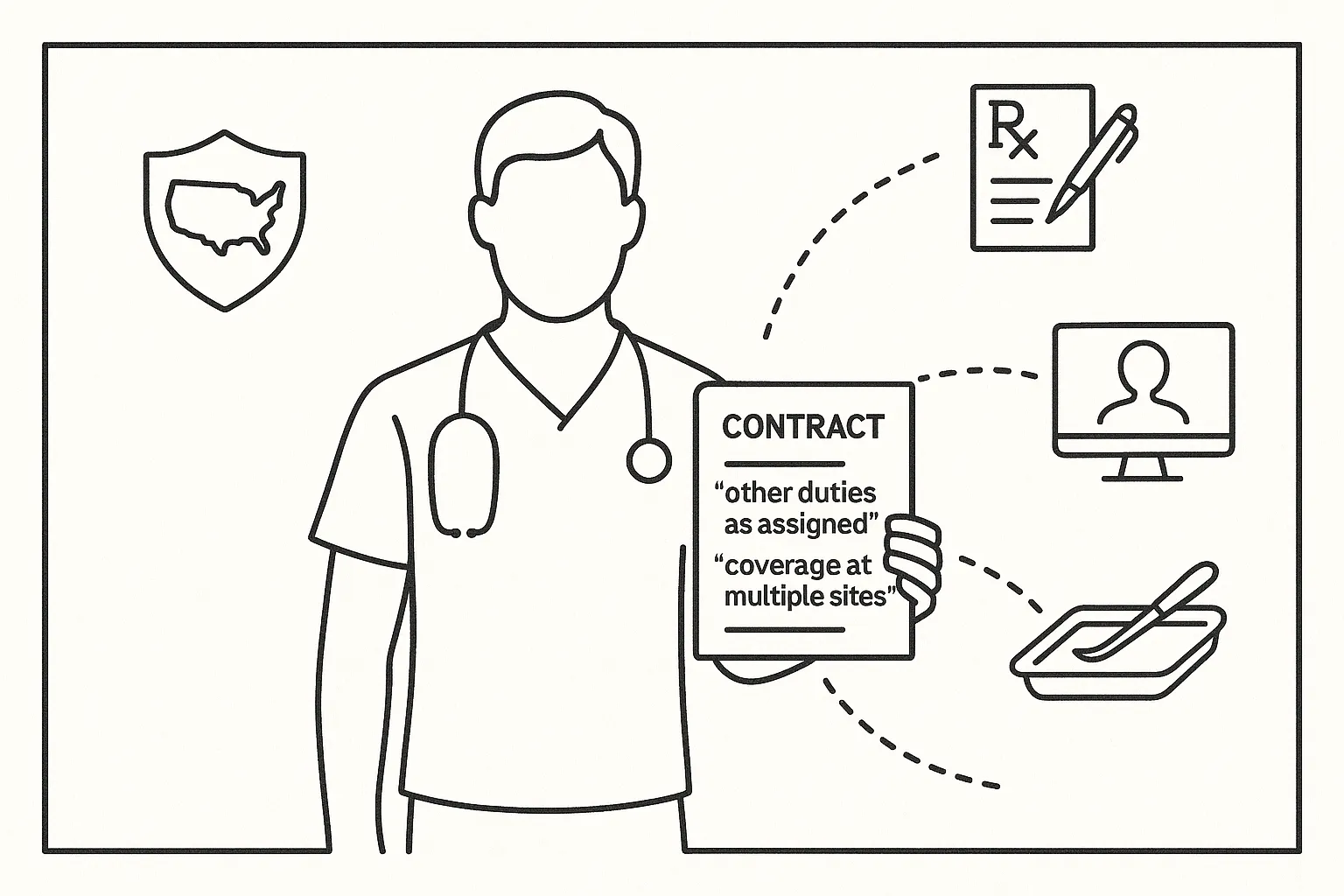
Scope expansion is a meaningful change in the services, settings, responsibility, or availability expected of a PA. It may involve performing procedures not included in the initial job description, managing more complex patients, taking additional call, practicing through telehealth, or rotating among several sites. Expansion can occur through a formal promotion or addendum, but it also may develop gradually as temporary coverage becomes a permanent expectation.
Operational pressures often drive these changes. A practice may need to address staffing shortages, increase access, support a specialty service line, or meet productivity goals. Those objectives do not automatically resolve whether the PA has appropriate authority, credentials, training, insurance, or compensation. Added after-hours responsibilities also need to be compared with the agreement’s provisions concerning call schedules and coverage requirements.
State Practice Authority and Contractual Job Duties Are Different
A contract cannot authorize clinical work that is inconsistent with the law and professional rules governing the place where services are performed. At the same time, a PA’s lawful authority does not necessarily mean the employer has provided the required credentials, resources, insurance, or contractual protections for that work. State requirements may address practice-level scope, collaboration, supervision, delegation, prescribing, proximity, or other professional relationships, and those requirements are not uniform nationwide.
The regulatory landscape continues to change. The American Academy of Physician Associates reports substantial state legislative activity and tracks modernization measures involving practice-level scope, physician-PA ratios, proximity requirements, and mandated relationships. Its state PA practice-law resources illustrate why an agreement should not assume that one traditional supervision or delegation model applies in every jurisdiction. The governing law and board rules for each state where the PA practices require separate consideration.
Telehealth, Multi-Site Work, and Billing Rules Require Separate Analysis
Telehealth and multi-site assignments can raise questions about where the patient and PA are located, which licenses or credentials apply, how consultation is available, and whether each facility has approved the PA’s privileges. The contract also needs to address travel expectations, scheduling, equipment, documentation, and whether additional locations affect call obligations or restrictive covenants.
Clinical authority under state law must be distinguished from federal and payer billing rules. CMS states that covered PA services must be performed consistently with state law and applicable scope requirements, while Medicare billing may also involve the PA’s NPI, reassignment, payment rules, and detailed incident-to conditions. Beginning January 1, 2026, certain Medicare direct-supervision requirements may be satisfied through real-time audio-video presence, subject to stated exclusions and limitations. The CMS telehealth supervision guidance does not create universal authority for a PA to perform any expanded duty or replace state, facility, payer, credentialing, or clinical requirements.

Credentialing, Training, and Malpractice Exposure
New diagnostic, procedural, or decision-making responsibilities may change the frequency or severity of potential claims. Before the work begins, the PA can confirm whether the assigned services fall within the employer’s professional liability policy, whether any exclusions apply, and whether the carrier must be notified. The agreement and policy may also allocate incident reporting, cooperation, defense participation, and responsibility for expenses that are not insured.
Privileges and Insurance Must Match the Actual Work
Credentialing, privileging, proctoring, and documented competency provide different safeguards. A license alone may not establish that a facility has authorized a particular procedure, while general orientation may not substitute for specialty training or supervised experience. Material role changes can therefore require a defined training period, competency review, facility approval, and confirmation of who pays for courses, certifications, credentialing, and time spent completing those requirements.
The insurance analysis begins with whether coverage is occurrence-based or claims-made, the applicable limits, who pays the premium, and which entities or locations are insured. Under claims-made coverage, a later departure may create a substantial extended-reporting obligation. Reviewing the complete malpractice insurance terms can reveal whether the policy and contract address the expanded services, while the separate allocation of tail coverage responsibility determines who bears certain post-employment costs.
Indemnification provisions deserve similar attention. A broadly worded clause may require the PA to reimburse the employer for losses, defense costs, compliance problems, or operational failures even when staffing, billing systems, supplies, or facility policies remain under the employer’s control. The indemnity language, malpractice policy, and defense provisions need to be read together because insurance may not cover every contractual reimbursement obligation.
Compensation Must Account for the Expanded Role
Additional responsibility does not automatically produce additional compensation. The financial effect depends on the contract’s salary, call-pay, collections, bonus, and productivity provisions. A focused PA compensation and productivity review can identify whether new procedures, service lines, sites, or after-hours responsibilities generate pay or merely increase the workload used to satisfy an existing formula.
- Base salary: A fixed salary may not change when the PA assumes more call, travel, administrative work, or higher-acuity care unless an amendment expressly adjusts it.
- Collections compensation: Payment may depend on cash received rather than work completed, making payer mix, denials, billing delays, write-offs, and post-termination collections important.
- RVU formulas: The agreement can define which services receive credit, how shared or split services are handled, the conversion factor, the measurement period, and the records available for verification.
- Call and coverage pay: The documents may distinguish ordinary scheduling from additional call, weekend coverage, emergency response, or work at another location.
- Reconciliation and negative accrual: A draw or productivity shortfall may carry forward, reduce a future bonus, or create a claimed repayment obligation at departure.
A useful formula also addresses payment timing, access to supporting reports, correction of billing errors, and the treatment of earned compensation after termination. Without those details, a PA may be unable to verify whether expanded work generated credit. A higher bonus rate can still produce disappointing results if the employer controls coding, scheduling, collections, and attribution without a transparent accounting process.
Bonuses, Relocation Payments, and Clawbacks Can Outlast the Change
Scope expansion may be accompanied by a retention payment, sign-on incentive, relocation benefit, training expense, or certification reimbursement. These payments often carry service periods and repayment triggers tied to resignation or termination. The documents may use different definitions of termination, apply repayment on a prorated or all-or-nothing basis, or permit deduction from a final paycheck to the extent allowed by applicable law.
The PA should not assume that accepting more responsibility cancels an existing clawback. An amendment can leave earlier repayment terms intact while adding new obligations. Compensation, repayment, termination, and insurance provisions therefore need to be evaluated as one risk allocation rather than as isolated clauses.
Role Expansion Can Affect Future Employment Options
Expanded duties can enlarge the practical reach of a non-compete, nonsolicitation clause, confidentiality provision, or definition of restricted services. A PA who begins practicing at additional facilities or within a new specialty may later face an argument that more locations, patients, referral sources, or service lines fall within the restriction. The wording may also connect the restricted territory to every site where the PA worked rather than to a single primary location.
Restrictive-covenant enforceability remains highly dependent on governing state law, the contract language, and the facts. The FTC confirms that its nationwide Noncompete Rule is not currently in effect or enforceable, so it should not be treated as a nationwide cancellation of PA non-competes. A review of the agreement’s non-compete and related restrictions can assess duration, geography, covered services, locations, nonsolicitation obligations, and exceptions in the context of the applicable state framework.
Termination terms also influence the effect of an expanded role. A PA may need to provide a lengthy notice period while continuing the new duties, repay an incentive, purchase tail coverage, or comply with a restriction after leaving. The agreement may address whether the employer can modify assignments during notice, place the PA on administrative leave, stop scheduling compensable work, or terminate immediately after receiving notice.
Documenting a Material Change in Duties
Informal assurances are difficult to reconcile with an agreement that gives the employer broad discretion. A signed addendum can identify the new procedures, patient populations, locations, schedule, call expectations, training prerequisites, credentialing requirements, supervision or collaboration structure, and effective date. It can also state whether the change is temporary, subject to a trial period, or reversible if credentials, staffing, insurance, or clinical resources are unavailable.
- Define the services, settings, locations, scheduling expectations, and limits associated with the revised role.
- Identify applicable practice relationships, consultation pathways, escalation procedures, and coverage arrangements without assuming one model applies in every state.
- Confirm required training, proctoring, certifications, credentialing, and privileges before independent performance begins.
- Specify salary adjustments, call pay, RVU or collections credit, reporting access, payment timing, and reconciliation rules.
- Verify malpractice coverage for the actual procedures, facilities, and telehealth work, including any tail obligation.
- Review indemnification, bonus repayment, termination, notice, non-compete, and nonsolicitation provisions that continue after the amendment.
An addendum must be read with the original agreement, job description, compensation plan, handbook, insurance policy, and incorporated facility rules. A favorable change in one document may leave conflicting language elsewhere. The amendment can clarify which document controls if provisions differ and whether the employer retains unilateral authority to change compensation, duties, or locations again.
When a Scope Change Warrants Prompt Contract Review
Review is especially important when a PA is asked to perform unfamiliar procedures, work with greater autonomy, add call, cover multiple facilities, begin telehealth services, or accept a revised productivity formula. Other warning signs include undefined consultation support, pressure to begin before credentialing is complete, uncertainty about malpractice coverage, broad indemnification, and compensation calculations that cannot be independently verified.
A proposed change also deserves attention when it affects the consequences of leaving. Claims-made insurance without a clear tail allocation, repayment provisions triggered by resignation, an expanding restricted territory, or an extended notice period may create costs that outweigh an apparent compensation increase. A review of the termination provisions can explain how notice, final compensation, repayment, insurance, and post-employment restrictions operate if the role does not develop as expected.
Frequently Asked Questions
Can an employer expand a PA’s duties through “other duties as assigned” language?
Broad assignment language may give an employer significant operational discretion, but it does not override state law, professional rules, credentialing requirements, facility privileges, or insurance limitations. The practical effect depends on the complete agreement and whether it defines material changes to procedures, locations, scheduling, training, and compensation.
Does a PA automatically receive more pay for an expanded scope?
No automatic compensation adjustment can be assumed. The contract or addendum needs to explain whether added procedures, call, travel, locations, or productivity produce additional salary, separate pay, collections credit, or RVU credit and how the PA can verify the calculation.
Does Medicare virtual supervision authorize expanded PA duties?
No. CMS rules concerning virtual direct supervision address specified federal billing conditions and include limitations. They do not replace state scope-of-practice law, licensure requirements, facility credentialing, payer rules, professional judgment, or the contractual allocation of supervision and clinical responsibility.
What insurance questions matter when a PA begins performing new procedures?
The PA can confirm whether the procedures and locations are covered, whether the policy is occurrence-based or claims-made, the applicable limits, who pays premiums, and how reporting and defense obligations work. If coverage is claims-made, the contract also needs to allocate responsibility for tail or extended-reporting coverage.
Can working at more facilities broaden a PA non-compete?
It may broaden the practical restriction if the covenant measures geography from every worksite or covers services, patients, or referral relationships developed through the expanded role. Enforceability and scope depend on state law, the precise wording, and the facts; there is no currently enforceable nationwide FTC rule invalidating all PA non-competes.
When is the best time to review a proposed PA role expansion?
Review is most useful before the PA accepts the change, begins new procedures, signs an addendum, or relies on an informal compensation or insurance promise. Early review allows the PA to understand how the new role affects authority, credentials, pay, malpractice exposure, repayment, termination, and future employment options.
Review an Expanded PA Role Before Accepting It
Chelle Law reviews physician assistant agreements and addenda to identify how changed duties may affect compensation, credentialing, malpractice coverage, repayment exposure, termination, and future employment options.
Contact Chelle Law