
A physician assistant telehealth agreement does more than authorize remote patient care. It defines where the PA may work, which patients may be treated, how supervision and escalation will function, and whether compensation depends on completed visits, collections, RVUs, or another productivity measure. Those terms can affect income, licensing costs, professional liability, and the PA’s ability to leave the position without an unexpected financial obligation.
Remote practice also creates contractual issues that may be less prominent in a traditional in-person role. Patient location can determine which state’s licensing and scope-of-practice requirements apply, while payer rules may control whether a telehealth service is billable. The agreement may separately allocate responsibility for credentialing, prescribing authority, malpractice coverage, secure technology, documentation, coding, data incidents, and platform downtime.
Chelle Law reviews physician assistant telehealth employment and independent contractor agreements to identify how these provisions work together. A meaningful review looks beyond the stated pay rate and examines the practical assumptions behind the arrangement, including patient volume, coverage territory, classification, supervision, insurance, repayment obligations, and termination rights.
How the Contract Defines the Telehealth Role
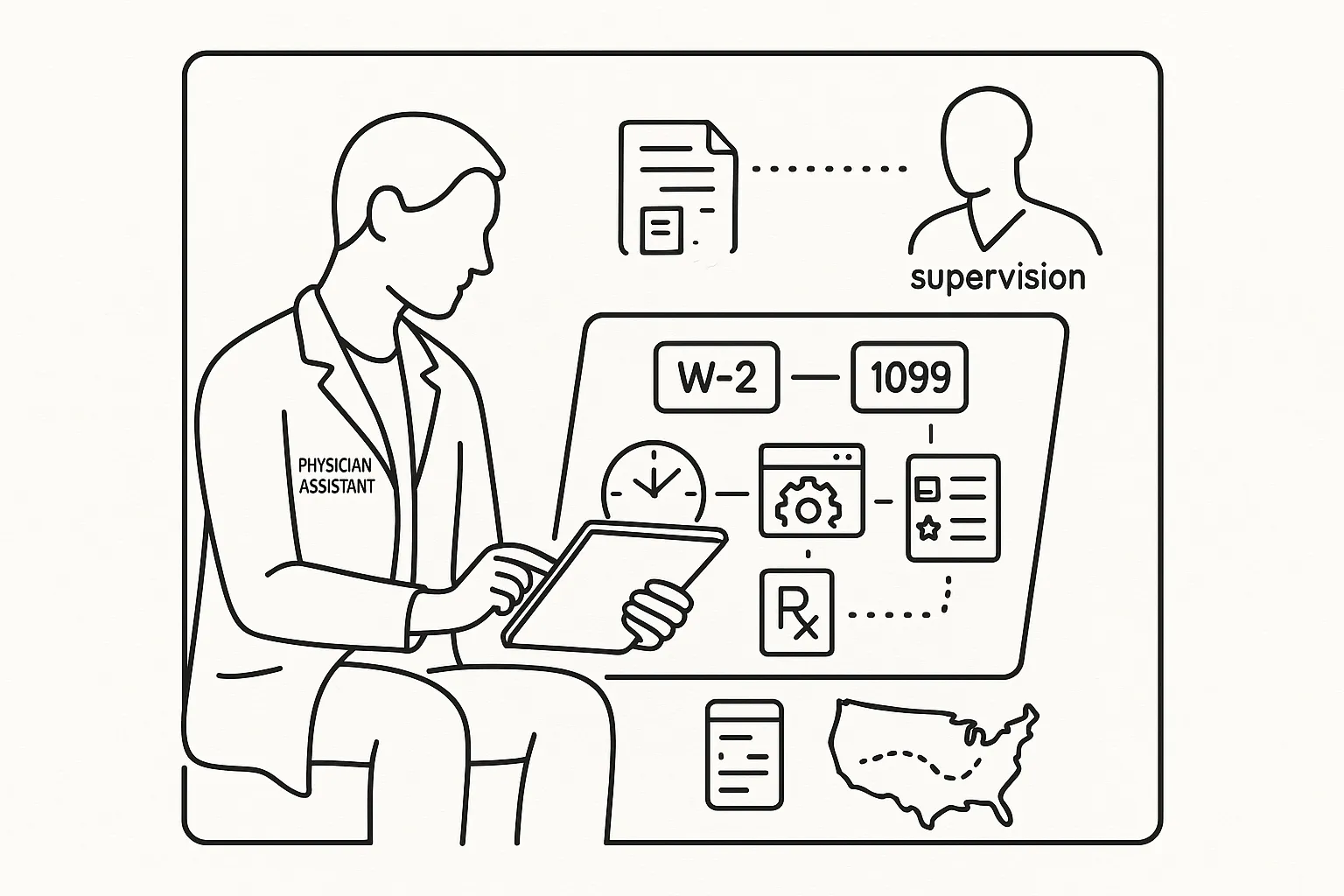
The agreement’s description of the position establishes the operational boundaries of the relationship. Important details include the clinical services covered, patient populations, expected encounter volume, work locations, required availability, documentation standards, and any authority reserved to the employer to expand duties. A broad clause allowing unilateral changes to schedules, service lines, or geographic coverage can materially alter the position after signing.
W-2 Employment and 1099 Classification
A telehealth company may engage a PA as a W-2 employee or an independent contractor, but the document’s label does not resolve the classification question. The IRS control-and-independence framework examines behavioral control, financial control, and the parties’ relationship. Relevant facts can include mandatory schedules, required training, employer-selected technology, evaluation systems, unreimbursed expenses, benefits, permanency, and the opportunity for profit or loss. State tax and wage laws may apply different tests.
Classification also affects payroll taxes, benefits, leave, business expenses, and the allocation of malpractice and technology costs. A thorough W-2 versus 1099 analysis for physician assistants compares the written allocation of risk with the control the organization exercises in practice. A contract drafted as an independent contractor engagement may still impose mandatory shifts, detailed protocols, platform restrictions, and other controls that deserve closer examination.
Scope, Supervision, and Clinical Escalation
Telehealth provisions cannot independently authorize services that state law, licensing rules, or prescribing requirements do not permit. The contract can, however, identify the supervising or collaborating practitioner, required availability, documentation method, consultation process, and procedure for escalating a patient to in-person or emergency care. These terms need to correspond with the states in which patients will be located.
Scope limitations may appear in the main agreement, a job description, clinical protocol, or supervision addendum. The documents may restrict patient categories, prescribing, orders, follow-up care, or specific clinical services. They may also permit the organization to revise protocols without the PA’s consent. Reviewing potential scope expansion and role-change risks can reveal whether new responsibilities could be assigned without corresponding training, support, insurance, or compensation.
Patient Location, Licensure, and Credentialing
Cross-state telehealth analysis ordinarily begins with the patient’s location during the encounter, not merely the location from which the PA logs in. Federal telehealth guidance explains that states may use full licenses, temporary-practice laws, reciprocity, compacts, or telehealth registrations, each with different conditions. The agreement therefore needs a workable method for confirming patient location and preventing assignments in jurisdictions where required authority has not been obtained.
Coverage Territory and License Responsibilities
The contract can specify the initial coverage territory and the process for adding another state. It may also allocate application fees, renewals, controlled-substance registrations, credentialing expenses, continuing education, and time spent completing administrative requirements. If the employer may expand the territory unilaterally, the PA could become responsible for recurring costs and compliance obligations that were not reflected in the original compensation.
The parties also need to understand what happens when an approval is delayed, denied, restricted, or allowed to lapse. Compensation may begin on a fixed date, after credentialing, or only when patient visits start. Because credentialing delays can affect contract rights, the agreement should be examined for delayed start provisions, termination options, notice requirements, and any sign-on or relocation repayment triggered before the PA can begin working.
Hospital-affiliated arrangements may add privileging requirements that are separate from professional licensure. The documents can clarify who initiates the application, supplies supporting records, monitors renewals, and pays associated fees. They can also address whether the PA is paid for nonclinical onboarding work while credentialing remains pending.
Compensation, Payer Rules, and Productivity Risk

Telehealth compensation may be structured as a salary, hourly rate, per-visit payment, collections percentage, RVU formula, or a combination of base and incentive compensation. Each method transfers different risks to the PA. The advertised amount has limited value unless the contract also explains which encounters qualify, when credit is earned, how records may be audited, and whether cancellations, denials, refunds, or coding changes reduce compensation.
How Common Pay Formulas Operate
- Guaranteed salary: A fixed salary provides predictability, but the documents may reduce pay during leave, a credentialing delay, low patient volume, or the period after notice is given.
- Per-visit compensation: The formula needs to address no-shows, late cancellations, documentation time, asynchronous work, care coordination, and encounters that cannot be billed.
- Collections-based compensation: Payment depends on money the organization receives. Timing, payer denials, refunds, recoupments, and post-termination collections can significantly affect the final amount.
- RVU compensation: The contract needs to identify the RVU measure, conversion factor, attribution rules, reporting source, reconciliation period, and audit process. If a formula equals RVUs multiplied by a $40 conversion factor and divided by 1.33, 800 credited RVUs would generate approximately $24,060 before any contractual adjustments.
A PA compensation and productivity review also examines draws, thresholds, chargebacks, and reconciliation language. Negative accrual can carry a production deficit into a later period, while a clawback can allow the organization to recover amounts already paid. Those provisions may make compensation less predictable even when the stated conversion factor or visit rate appears competitive.
Payer rules create an additional layer of risk because professional eligibility to provide or bill for a service does not guarantee reimbursement for every encounter. CMS recognizes physician assistants among the practitioners who may bill for covered Medicare telehealth services, subject to state law and service-specific requirements. However, CMS guidance for 2026 states that, beginning January 31, 2026, Medicare beneficiaries generally must be in a medical facility and rural area for telehealth services, except for behavioral health and other applicable statutory or regulatory exceptions. Contracts tying pay to Medicare volume, patient-home encounters, audio-only visits, or particular codes need current-year verification rather than assumptions based on earlier pandemic-era policies.
Medicare, Medicaid, and commercial payer policies can change independently of the employment agreement. Contract analysis can identify who bears the financial effect of a rule change, coding dispute, service exclusion, or payer recoupment. The PA may also need access to the underlying productivity and billing reports to verify whether compensation has been calculated correctly.
Scheduling, Technology, and Data Responsibilities
Remote work does not necessarily provide control over scheduling. Telehealth agreements may impose fixed shift blocks, minimum availability, weekend coverage, response-time standards, on-call duties, or requirements to remain logged into a platform despite low patient volume. Scheduling terms can also interact with bonus thresholds, contractor classification, exclusivity, and the PA’s ability to maintain another position.
The agreement may give the organization authority to change shifts, add coverage locations, or require reciprocal coverage for absent clinicians. It is important to determine whether administrative time, chart completion, patient messages, prescription follow-up, meetings, and technical interruptions are compensated. A per-visit arrangement can produce a much lower effective hourly rate when substantial unpaid work surrounds each billable encounter.
Technology provisions commonly address employer-selected platforms, computers, cameras, mobile devices, internet access, VPNs, authentication, encryption, recordings, transcripts, cloud storage, and technical support. Electronic protected health information maintained or transmitted through these systems remains subject to applicable HIPAA safeguards. The contract can distinguish the PA’s duty to follow established security procedures from the organization’s responsibility for system selection, risk analysis, vendor management, business associate agreements, and infrastructure security.
Broad breach or indemnification language can improperly shift liability for employer-controlled technology to the PA. Contract terms may also address whether visits may be recorded, where files are stored, who may access transcripts, how incidents must be reported, and who bears losses caused by platform downtime. These provisions deserve coordinated review with confidentiality, privacy, insurance, and limitation-of-liability clauses.
Malpractice Coverage and Allocation of Liability
A telehealth malpractice provision needs to identify the insurer, policy type, limits, covered services, and covered jurisdictions. Multistate work creates an additional question: whether the policy applies in every state where a patient may be located. Coverage should not be assumed merely because the organization assigns the patient or supplies the platform.
Occurrence coverage generally responds to covered incidents occurring during the policy period even if a claim is made later. Claims-made coverage ordinarily requires the claim to be made and reported while the policy is active or during an applicable extended reporting period. If coverage ends with the relationship, the PA may need tail insurance or another form of prior-acts protection. The price of tail coverage varies by insurer, specialty, limits, policy terms, and claims history, so a written quote is more useful than relying on a generalized percentage.
Reviewing tail insurance terms for physician assistants can determine who pays, when proof of coverage is due, and whether an exception applies based on the reason for termination. The review should also compare malpractice protection with indemnification provisions. A broad indemnity may require reimbursement of defense costs, regulatory expenses, data-security losses, or patient claims that exceed or fall outside the insurance policy.
Liability caps, exclusions, notice requirements, and control of the defense can materially change the protection the policy appears to provide. These clauses need to be read together because an employer’s promise to maintain insurance may offer incomplete protection if another provision transfers uninsured losses back to the PA.
Termination and Post-Employment Financial Exposure
Telehealth agreements commonly permit termination for cause, without cause, or after a licensing, credentialing, payer-enrollment, or technology-access problem. The notice period affects how long the PA must remain available and whether the organization can remove scheduled visits while withholding expected compensation. The agreement may also reserve an immediate-termination right for broadly defined policy violations or failures to satisfy performance metrics.
A termination provision review evaluates notice mechanics, final productivity payments, collections received after departure, unused leave, tail obligations, and repayment clauses. Sign-on bonuses, licensing expenses, equipment allowances, training costs, or advances may become repayable if the PA leaves before a specified date. The formula may be prorated, fully recoverable, or triggered even when the organization ends the relationship.
Post-employment restrictions may extend beyond a traditional geographic non-compete. Telehealth contracts can restrict work for competing platforms, solicitation of patients or referral sources, use of confidential business information, or contact with clinicians introduced through the organization. A restriction tied to every state in which the company operates may be far broader than the PA’s actual work territory, so the defined scope, duration, covered activities, and termination trigger warrant careful analysis.
Frequently Asked Questions
Does a 1099 label automatically make a telehealth PA an independent contractor?
No. The practical relationship matters in addition to the contract label. Federal tax analysis considers behavioral control, financial control, and the parties’ relationship, while state classification tests may differ. Mandatory schedules, detailed instructions, required technology, benefits, expenses, permanency, and the opportunity for profit or loss can all be relevant.
Which state’s license matters during a telehealth visit?
The patient’s location is generally central to determining the applicable licensing requirements. States may offer full licensure, registration, reciprocity, compact participation, or limited exceptions, but the conditions vary. The contract should allocate responsibility for confirming patient location and maintaining every required license or registration.
What makes a telehealth productivity formula risky?
Risk increases when the agreement does not define the productivity unit, payment timing, attribution method, reporting source, or treatment of cancellations, denials, refunds, and recoupments. Draws, chargebacks, clawbacks, and negative accrual can also reduce future compensation even when the stated visit rate or conversion factor appears favorable.
Can Medicare telehealth rules affect a PA’s compensation?
Yes. A PA may be an eligible practitioner, but payment still depends on current Medicare coverage, location, service, coding, and billing requirements. Compensation tied to patient-home encounters, audio-only services, Medicare volume, or specific codes should be evaluated against the rules in effect for the applicable year.
Who is responsible for HIPAA-compliant telehealth technology?
The PA may be responsible for following security and privacy procedures, but the organization generally controls its selected platform, vendors, infrastructure, and business associate arrangements. The agreement should distinguish individual compliance duties from responsibility for encryption, authentication, storage, recordings, vendor security, system vulnerabilities, and incident response.
When might a telehealth PA need tail insurance?
Tail coverage may be needed when the PA is insured under a claims-made policy that ends without continuing protection for later-reported claims. The contract should identify the policy type, covered states, reporting requirements, cost allocation, and any exception based on the reason the relationship ends.
Have Your PA Telehealth Agreement Reviewed Before Signing
Chelle Law can analyze compensation, classification, multistate licensing, supervision, malpractice, technology, termination, and repayment terms so you can understand the practical risks within the proposed agreement.
Contact Chelle Law