
A physician assistant’s departure from a practice is governed by more than the sentence stating when employment ends. The agreement may connect resignation, termination for cause, termination without cause, nonrenewal, loss of privileges, or a facility closure to final compensation, benefit eligibility, repayment duties, malpractice coverage, and restrictions on future work. Those consequences can vary significantly depending on the event that ends the relationship and the documents incorporated into the contract.
Termination and restrictive-covenant provisions therefore need to be read together. A PA may comply with the notice period yet still face a bonus clawback, an unresolved productivity calculation, responsibility for malpractice tail coverage, or a non-compete that affects the next position. Conversely, an employer-initiated separation does not automatically eliminate post-employment restrictions unless the agreement or applicable law creates that result.
Chelle Law reviews the complete contract set to identify how these provisions interact, which duties survive separation, and what financial or professional exposure may remain. The analysis can also reveal undefined terms, conflicting addenda, or restrictions whose practical effect is broader than their wording initially suggests. Because enforceability and healthcare-specific limitations differ among states, contract language must be evaluated in the relevant legal and factual context.
Read the Termination Clause and Restrictions as One Framework
A contract may use several provisions to define the consequences of separation. The termination section identifies how the relationship can end, while compensation plans, repayment agreements, malpractice provisions, confidentiality clauses, and restrictive covenants determine what happens afterward. A survival clause may keep selected obligations in force even though the employment relationship has ended.
The reason for separation can change the outcome
Common separation events include resignation, termination for cause, termination without cause, nonrenewal of a fixed term, disability, death, a reduction in force, facility closure, and loss of required licensure or privileges. Each event can produce a different result. Eligibility for severance, unpaid incentives, bonus forgiveness, continued benefits, and a waiver of post-employment restrictions may depend on the specific trigger identified in the agreement.
Cause definitions deserve particular attention because they are often broader than intentional misconduct. A definition may include an alleged policy violation, failure to maintain credentials, breach of contract, criminal conduct, clinical concerns, or failure to meet stated performance requirements. Some agreements permit immediate termination when cause exists, while others provide notice and an opportunity to cure certain breaches. The wording determines whether remediation is available and whether the employer’s characterization of the departure changes the PA’s financial obligations.
Notice requirements and survival language affect the exit
A without-cause provision usually permits one or both parties to end the relationship without proving misconduct after giving the required notice. Contracts commonly use periods such as 30, 60, or 90 days, but the signed agreement controls. The notice clause may regulate delivery method, the effective termination date, scheduling during the notice period, patient transitions, return of property, and whether the employer can remove the PA from duties while continuing or discontinuing pay.
Delivering notice too early, using an unauthorized method, or leaving before the notice period expires can create a dispute over compensation or repayment. The agreement may also permit the employer to accelerate the departure date after receiving notice. A detailed review of PA contract termination requirements can clarify the deadline, delivery procedure, and obligations that remain effective after the last day of work.
Final Compensation, Repayment, and Malpractice Exposure
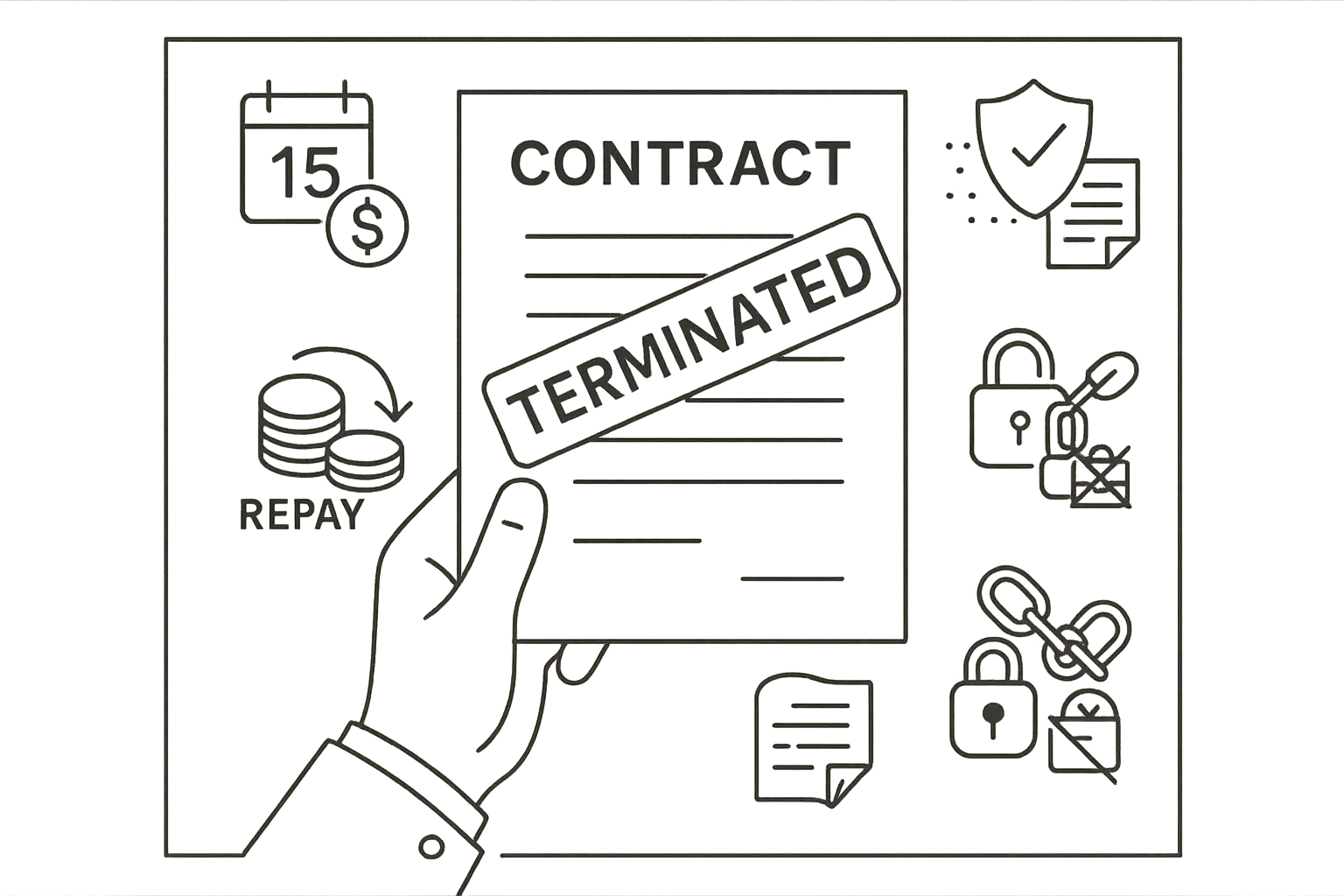
The final paycheck may not resolve every compensation issue. Salary is generally easier to calculate than collections, work RVUs, quality incentives, encounter-based payments, or other productivity compensation. If employment ends during a measurement period, the plan may delay reconciliation until charges are posted, collections mature, or the employer closes its reporting cycle. Important questions include whether work performed before separation remains creditable, when the calculation must occur, how negative balances are treated, and whether the PA can review the underlying data.
The employment agreement and compensation plan must be consistent enough to answer those questions. A discretionary-bonus provision may operate differently from an earned productivity formula, and language conditioning payment on active employment can materially affect an incentive that would otherwise be calculated after departure. A focused compensation and productivity review can identify how the formula, payment timing, reconciliation rights, and termination provisions fit together.
Signing bonuses, relocation assistance, educational benefits, and loan-repayment funds may be governed by clawback language. The repayment obligation might appear in the main contract, an addendum, or a separate promissory note. The documents can establish whether repayment is prorated, whether the balance becomes immediately due, whether interest or collection costs apply, and whether an employer-initiated termination changes the result. Reviewing the specific sign-on bonus repayment terms is essential before assuming that the obligation disappears or remains payable in full.
Malpractice obligations can also continue after the employment relationship ends. Occurrence coverage generally protects covered incidents that happened during the policy period even if a claim is made later. Claims-made coverage typically requires continued protection for prior acts after the policy or the PA’s coverage under it ends. The contract may assign the cost of tail coverage to the employer, the PA, or either party depending on the reason for departure or length of service. The policy form, coverage dates, limits, and allocation language should be confirmed rather than inferred from a general promise to provide insurance. The guide to tail insurance for physician assistants explains these distinctions in greater detail.
Current Non-Compete Law Requires State-Specific Analysis
Scope, duration, geography, and covered work all matter
A non-compete may limit where, when, or in what capacity a PA can work after separation. The provision may use a radius around one or more facilities, identify counties or ZIP codes, name competitors, or prohibit work in a defined specialty. Its practical reach depends on how the contract defines competitive activity, which locations generate a restriction, and whether the covenant applies after every separation event.
A modest-looking radius can still exclude the principal employers in a concentrated healthcare market, especially when the radius applies around every facility at which the PA performed services. Restrictions tied to an employer’s entire network can be more disruptive than a covenant measured from the PA’s primary practice site. A PA non-compete review evaluates the text against the PA’s specialty, expected work locations, local market, and anticipated career path.
State law remains central. Some states prohibit or limit certain non-competes, and healthcare-specific statutes may turn on the worker’s license, compensation, employer type, contract date, specialty, or location. Recent state changes have often focused on physicians or specifically defined healthcare licensees, so a rule protecting physicians cannot automatically be assumed to cover physician assistants. The statutory definition and effective date must be checked for the particular PA and agreement.
The federal rule is vacated, but healthcare enforcement continues
The Federal Trade Commission’s 2024 nationwide Noncompete Clause Rule is not currently in effect or enforceable. According to the FTC’s rule-status page, a federal district court vacated the rule, and the agency took steps in September 2025 to dismiss its appeal and accede to the vacatur. PAs therefore should not assume that a nationwide federal rule automatically invalidates an existing or proposed covenant.
That development does not end federal scrutiny of restrictive agreements. In September 2025, the FTC issued warning letters to healthcare employers and staffing companies concerning potentially unreasonable, overbroad, or anticompetitive restrictions. This activity is not a categorical ban on PA non-competes. It does, however, reinforce that healthcare restraints may be evaluated for their effects on professional mobility, hiring, patient choice, and access to care in addition to their stated duration and geography.
Related Restrictions Can Be as Important as the Non-Compete
A contract can restrict post-employment conduct without using the label “non-compete.” Non-solicitation clauses may regulate contact with patients, employees, contractors, referral sources, or other clinicians. No-hire and non-recruitment provisions can affect whether a PA may bring colleagues to a new practice. Broad definitions of solicitation may also create uncertainty about public announcements, responses to unsolicited inquiries, patient notifications, and ordinary professional networking.
Confidentiality provisions protect patient information, proprietary business material, pricing, strategic plans, and other protected information. They must be distinguished from provisions that attempt to prevent ordinary professional activity. The survival section can reveal whether confidentiality, non-disparagement, repayment, indemnification, non-solicitation, and non-compete duties remain in effect and for how long. A broader review of restrictive covenants in PA agreements can help identify restraints that are easy to miss when the analysis focuses only on the paragraph labeled “Non-Competition.”
Telehealth and locum tenens work require separate attention. A covenant may attempt to regulate services delivered to patients located in the restricted territory even when the PA performs those services elsewhere. A clause may also cover indirect work, administrative duties, consulting, or services provided through a staffing company. The definitions of territory, patient location, competitive services, and covered employer determine whether those arrangements fall within the restriction.
The career consequences can extend beyond a lawsuit. A prospective employer may delay hiring or credentialing after learning of a covenant, even when enforceability is disputed. The PA may need to consider a different specialty, a position outside the restricted area, temporary assignments, or a delayed start date. These practical effects make clarity valuable before signing, not only after a dispute develops.
Issues to Clarify Before Signing or Giving Notice
Before signing, the PA can evaluate whether the termination and restrictive-covenant provisions reflect the intended employment relationship. Relevant revisions may include a narrower cause definition, a cure period for correctable breaches, mutual without-cause termination rights, a defined notice procedure, or continued compensation when the employer elects not to schedule the PA during the notice period. The agreement can also specify whether an employer-initiated termination without cause, nonrenewal, reduction in force, or facility closure releases the PA from a covenant.
Restrictions may warrant clearer definitions of the territory, restricted facilities, prohibited services, covered patient groups, and competing employers. Potential carve-outs can address locations where the PA never worked, telehealth services outside the territory, locum tenens assignments, academic work, or employment in a different specialty. Severance or compensation during the restricted period may reduce income disruption, but the agreement must define eligibility, payment timing, included compensation, and any release required as a condition of payment.
When departure is already being considered, the first step is assembling the complete document set. That collection may include the signed agreement, amendments, compensation plans, bonus documents, promissory notes, malpractice materials, incorporated policies, and relevant supervision or delegation documents. Payroll records, productivity reports, bonus calculations, and correspondence about performance or discipline may also be important when the separation is disputed.
The review should confirm the notice deadline and delivery method, anticipated final compensation, repayment exposure, benefit end dates, return-of-property duties, malpractice obligations, and restrictions on communications after departure. A comprehensive physician assistant contract review considers those provisions together, including addenda that may modify the main agreement. Until the language is evaluated, the PA should avoid assuming that an informal assurance, prior practice, or the title of a provision overrides the signed documents.
Frequently Asked Questions
What should a physician assistant review before resigning?
Review the notice deadline, permitted delivery method, effective termination date, final compensation terms, repayment provisions, malpractice coverage, restrictive covenants, and duties that survive separation. Include every amendment, addendum, compensation plan, and incorporated policy in the review before delivering notice.
Does termination without cause automatically cancel a PA non-compete?
No. Some contracts apply a non-compete after any separation, while others create an exception for termination without cause, nonrenewal, or another employer-initiated event. The result depends on the contract language and the state law applicable to that PA and agreement.
Did the FTC ban all physician assistant non-competes?
No. The FTC’s 2024 nationwide rule was vacated and is not currently enforceable. Physician assistant non-competes must still be evaluated under applicable state law, the specific contract language, ordinary contract principles, and any relevant case-specific federal enforcement concerns.
Can a PA receive productivity compensation after employment ends?
Possibly. The compensation plan may address whether work completed before separation remains eligible, how collections or RVUs are reconciled, whether active employment is required on the payment date, and when the final calculation occurs. The signed agreement and compensation documents control the analysis.
Who pays for malpractice tail coverage after a PA leaves?
The contract may assign the cost to the employer, the PA, or either party depending on the reason for termination or length of service. Tail coverage is generally relevant when claims-made protection for prior acts would otherwise end, so the policy form and contractual allocation both require review.
Can non-solicitation or telehealth terms restrict a PA’s next job?
They can. Non-solicitation, no-hire, patient-contact, and telehealth provisions may limit communications, recruiting, or services involving patients within a defined area. Their effect depends on the definitions, factual circumstances, applicable state law, and whether the restriction extends beyond traditional in-person clinical work.
Have Your PA Exit Terms Reviewed Before You Act
Chelle Law can review your termination, compensation, repayment, malpractice, and restrictive-covenant provisions and explain which terms may affect your departure and next position.
Contact Chelle Law