
Call compensation can become one of the most contested parts of a physician assistant employment or independent contractor agreement. The main contract may require evening, weekend, remote, or in-house coverage while leaving the payment formula to a separate addendum. If those documents do not define eligible shifts, payable duties, schedule changes, or the relationship between call work and ordinary productivity compensation, the PA may receive less than expected or face a later repayment demand.
The financial terms are only part of the analysis. Call duties may affect billing attribution, credentialed privileges, state-specific practice requirements, malpractice coverage, and the final compensation calculation after employment ends. A stipend that initially appears straightforward can operate very differently when it is offset against collections, RVUs, advances, or a negative balance carried through the employer’s compensation plan.
Chelle Law reviews the call-pay addendum together with the underlying agreement and incorporated compensation documents. That broader analysis can identify conflicting provisions, calculations that cannot be independently verified, open-ended clawbacks, and obligations that continue after termination. The goal is to understand the actual allocation of financial and professional risk before a disagreement develops.
How Call Compensation Fits Into a PA Contract
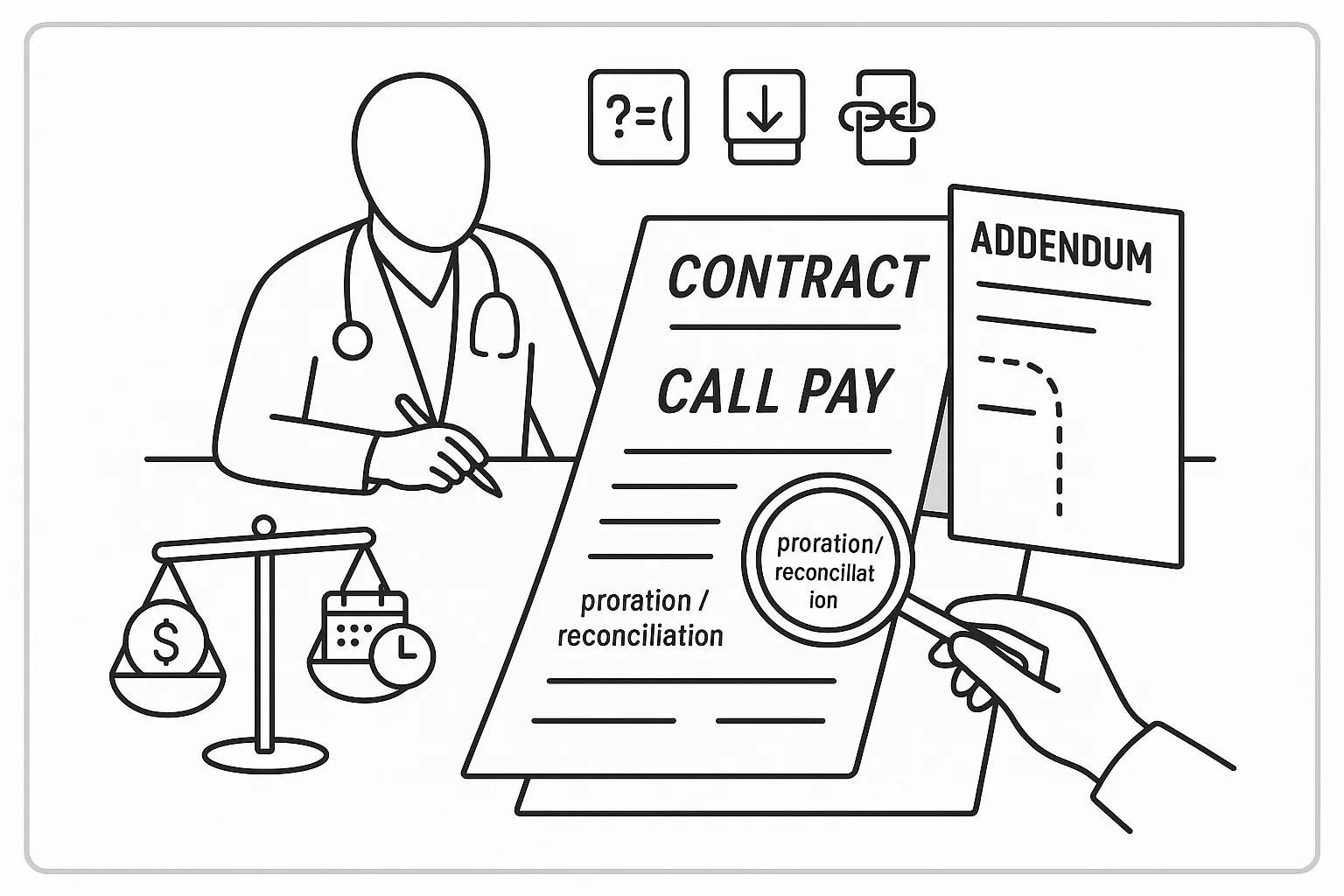
Call pay generally compensates a PA for availability or clinical work outside the ordinary schedule. Depending on the arrangement, call may involve remaining reachable from home, answering patient or staff questions, reporting to a facility within a specified time, or staying in-house for emergency coverage. The contract needs enough detail to distinguish these obligations from regular shifts, overtime, administrative availability, and uncompensated professional responsibilities.
Compensation may take the form of a flat amount per shift, an hourly availability rate, a per-encounter payment, a percentage of collections, or additional credit under an RVU formula. Some agreements combine a guaranteed stipend with production-based compensation. When call-generated work enters the broader compensation formula, the addendum must be evaluated alongside the PA’s compensation and productivity terms.
No federal rule establishes a universal PA call stipend, hourly rate, collection percentage, or reconciliation method. Professional compensation surveys, including current AAPA salary materials, can provide market context for paid call availability, but survey data does not create a contractual entitlement or guarantee that a particular employer will use the same structure. The signed documents ultimately determine the payment obligation, subject to applicable federal and state law.
Why Physician Assistant Call-Pay Disputes Develop

Scheduling and Eligibility Disagreements
A schedule can change without the contract explaining how the change affects compensation. For example, an addendum may promise a weekly stipend but fail to identify the number or length of covered shifts. Questions then arise about partial rotations, substitute coverage, holiday assignments, remote availability, cross-coverage, and shifts that begin during ordinary hours but continue overnight.
Multi-site assignments create another source of uncertainty. The employer may move the PA among hospitals, clinics, or service lines with different response times and coverage expectations. A careful review of the call schedule and coverage requirements can determine whether the agreement identifies covered locations, reassignment rights, schedule-change notice, and the events that trigger additional pay.
Billing, Collections, and Productivity Conflicts
Disputes frequently involve the difference between performing call work and receiving contractual credit for it. An emergency shift may generate billed services, but the employer’s compensation records may attribute the encounter, RVUs, or collections to another clinician or cost center. If the addendum does not explain attribution, the PA may be unable to determine whether call activity supports a separate stipend, counts toward an ordinary production threshold, or offsets an advance.
Billed charges, RVUs, Medicare allowed amounts, and actual collections are not interchangeable. Collections can be reduced by payer adjustments, denials, refunds, or delays, while RVU formulas depend on the specific units and conversion factor identified in the compensation plan. A contract using production-based call pay needs to define its data source, calculation period, attribution rules, and the PA’s access to supporting reports. The same concerns arise when call compensation is incorporated into a productivity bonus calculation.
Classification can further complicate the dispute. Calling a PA an independent contractor does not, by itself, resolve the worker’s legal status, tax treatment, schedule control, or eligibility for benefits. Federal and state classification standards may apply, and state wage-deduction rules can affect attempts to recover alleged overpayments. The contract label therefore cannot substitute for reviewing the working relationship and the applicable law.
Terms a Call-Pay Addendum Needs to Address
Payment Triggers, Proration, and Reconciliation
The addendum needs an identifiable compensation formula. For a flat stipend, important questions include whether payment attaches to the scheduled shift, completed coverage, patient contact, an in-person response, or a billable encounter. An hourly model needs a method for recording time and addressing interrupted or partial shifts. A per-episode formula must define the event being counted and explain whether multiple contacts concerning the same patient qualify separately.
RVU- and collections-based provisions require additional detail. The documents can identify the applicable RVU measure, conversion factor, collection source, crediting date, exclusions, and treatment of denied or later-adjusted claims. They also need to explain whether call production is added to regular productivity, applied against a threshold, used to offset the stipend, or excluded from the ordinary formula. Without that coordination, the same work may be omitted from both payment systems or counted in a way the PA did not anticipate.
Reconciliation language determines when preliminary payments become final. If the employer advances a monthly stipend or draw, the agreement can specify the measurement period, calculation method, records supporting an adjustment, deadline for asserting a balance, and process for contesting the result. Open-ended negative accrual provisions deserve particular attention because a shortfall may carry into later periods or become a repayment demand after termination.
Duties, Locations, Billing, and Document Priority
The operational terms need to match the payment language. The addendum can define remote availability, in-house presence, response times, phone triage, patient encounters, covered facilities, substitution procedures, and the effect of a canceled or reassigned shift. It can also distinguish ordinary scheduled work from additional call coverage so that the same hours are not classified differently depending on which compensation provision the employer applies.
Billing provisions need to identify who submits claims, how services are attributed, when data becomes available, and how payer reversals affect compensation. If payment depends on collections, the agreement can address contractual adjustments, uncollectible accounts, chargebacks, refunds, and collections received after the PA leaves. The PA also needs sufficient access to reports to verify the calculation rather than relying on a number that cannot be traced to underlying encounters.
Finally, the addendum must fit within the rest of the contract. An integration or priority clause can explain whether the addendum replaces a compensation exhibit, supplements the main agreement, or controls only when provisions directly conflict. The review also needs to account for handbooks, compensation plans, credentialing policies, and schedules incorporated by reference, especially when the employer reserves the right to revise those documents.
Medicare Billing Rules Do Not Automatically Set Call Pay
Contractual call compensation must be separated from payer reimbursement. Under current CMS guidance for physician assistant services, Medicare payment depends on requirements that include medical necessity, personal performance by the PA, and legal authorization under the law of the state where the service is furnished. Medicare generally pays covered PA services outside hospital or skilled nursing facility settings at 85% of the physician fee schedule amount, but that reimbursement rule does not automatically determine what the employer contractually owes the PA for call coverage.
The 2026 Medicare Physician Fee Schedule final rule updated conversion factors, RVUs, geographic adjustments, and malpractice RVUs for services furnished on or after January 1, 2026. Those changes may affect collections or calculations tied to current Medicare values. They do not revise a private stipend or productivity formula unless the contract incorporates the affected Medicare measure in a way that causes the formula to change.
CMS also finalized permanent real-time audio-video direct supervision for specified services, subject to important limitations. That billing policy is not the same as contractual call availability, and it does not establish that every remotely supervised call service is billable or within a PA’s permitted practice. Personally performed PA services, incident-to arrangements, and other supervised services can carry different billing and documentation requirements. State law, credentialed privileges, delegation arrangements, facility policies, and the actual clinical service remain central to the analysis.
Malpractice, Clawback, and Termination Exposure
Call assignments may involve higher-acuity encounters, emergency responses, or services at locations not listed in the original offer. The contract analysis can determine whether those duties fall within the PA’s credentialed privileges and state-specific practice framework. It can also identify whether the employer’s professional liability policy covers every location and activity assigned during call.
When coverage is claims-made, the policy’s retroactive date, reporting requirements, termination provisions, and extended reporting options matter. There is no universal rule requiring every PA or employer to purchase tail coverage. Responsibility depends on the policy and contract language, making a review of the PA’s tail insurance obligations important before accepting an open-ended post-employment expense.
Termination can also trigger a final call-pay reconciliation. The employer may attempt to deduct an asserted shortfall from final wages, recover a stipend advance, reverse earlier productivity credit, or delay payment while claims remain uncollected. Applicable law may restrict deductions, and the contract may impose notice or dispute deadlines. These provisions need to be read with the agreement’s broader termination and repayment terms.
Call-pay language warrants closer review when it includes any of the following features:
- A stipend with no definition of the shifts, duties, locations, or events that qualify for payment.
- Collections-based compensation without a payment timeline, attribution method, supporting reports, or dispute process.
- Employer discretion to revise call assignments or compensation without explaining how existing obligations are affected.
- Unlimited retrospective reconciliation, negative accrual, or repayment rights.
- Broad indemnification or malpractice obligations that are not coordinated with the applicable insurance policy.
- Call duties that may exceed credentialed privileges, state-authorized practice, or the facility’s approved scope.
- An addendum that conflicts with the main agreement without identifying which provision controls.
Responding to a Call Compensation Dispute
A useful first step is to assemble the complete contract record. That file may include the signed employment or contractor agreement, compensation exhibits, call-pay addenda, later amendments, incorporated policies, schedules, call logs, time records, pay statements, productivity reports, billing data, and written communications about assignments or calculations. Preserving the versions in effect during the disputed period is especially important when an employer changed a policy or formula.
The PA can compare the amount paid with the contract’s eligibility, attribution, proration, and reconciliation provisions. A written request for the employer’s calculation and underlying records can help determine whether the disagreement concerns missing shifts, an incorrect rate, delayed collections, an RVU-credit issue, or an asserted offset. Communications are generally more useful when they identify the specific contractual provision and calculation at issue rather than relying only on an estimated total.
The agreement may require notice to a designated person, an internal grievance, mediation, arbitration, or another dispute process. Deadlines and available remedies depend on the contract and applicable law. Legal review may be appropriate when compensation is withheld, the employer seeks a material repayment, the calculation cannot be verified, malpractice obligations are disputed, or a formal dispute-resolution provision has been invoked.
Frequently Asked Questions
What information should a physician assistant call-pay addendum contain?
The addendum should identify covered duties, eligible shifts and locations, the compensation formula, payment timing, proration rules, schedule-change procedures, billing attribution, reconciliation terms, and post-termination treatment. It should also explain how its terms interact with the main agreement and which document controls if provisions conflict.
Can an employer count call work toward a PA’s productivity compensation?
Yes, if the contract establishes that arrangement. The documents need to clarify whether call-generated RVUs or collections count toward an ordinary threshold, produce separate compensation, offset a stipend, or are excluded from the productivity formula. Without clear coordination, the PA may not receive the expected credit.
Does Medicare reimbursement determine how much call pay a PA receives?
No. Medicare payment rules govern reimbursement for covered services, not the amount an employer contractually owes for call coverage. Medicare values may affect compensation if the agreement expressly uses RVUs, allowed amounts, or collections, but changes to those values do not automatically revise a private stipend.
Why can reconciliation language lead to a call-pay clawback?
A clawback can arise when a stipend is treated as an advance subject to later adjustment. Risk increases when the contract does not define the measurement period, calculation method, supporting records, deadline for asserting a shortfall, or limits on carrying a negative balance into later periods.
What records are useful in a physician assistant call-pay dispute?
Useful records include the signed contract and addenda, compensation plans, call schedules, time records, call logs, pay statements, billing or productivity reports, incorporated policies, and communications about assignments or calculations. The PA should preserve the versions that applied during the disputed period.
How can termination affect call pay and malpractice coverage?
Termination may trigger a final compensation calculation, collection delay, repayment demand, deduction dispute, or responsibility for extended reporting coverage under a claims-made policy. The outcome depends on the contract, applicable law, and actual insurance terms, including the policy’s retroactive date and reporting provisions.
Have Your PA Call-Pay Terms Reviewed Before a Dispute Develops
Chelle Law reviews physician assistant contracts and call-compensation addenda to identify unclear payment formulas, scheduling obligations, reconciliation exposure, malpractice terms, and post-termination risks.
Contact Chelle Law