
Physician assistant credentialing is not a single approval. A new position may depend on state licensure, payer enrollment, hospital or facility privileges, prescribing authority, employer onboarding, and verification of education, certification, work history, and malpractice claims. Each process has its own decision-makers and requirements. When one approval remains pending, a PA may be unable to begin clinical work or generate billable services even though the employment agreement has already taken effect.
That delay can create financial and professional consequences well beyond a postponed start date. Salary and benefits may not begin, productivity targets may remain unchanged, malpractice coverage may be uncertain, and signing-bonus or relocation repayment provisions may become relevant if the relationship ends. The result depends on the contract, applicable employment law, payer requirements, facility bylaws, and the state rules governing PA practice.
A careful contract review examines who controls each credentialing task, when compensation begins, and what happens if approval is denied or takes longer than anticipated. It also considers how credentialing language interacts with termination rights, bonus formulas, malpractice insurance, repayment obligations, and any proposed interim duties. Those connections determine whether the delay remains an administrative inconvenience or becomes a substantial economic risk for the PA.
Credentialing Involves Several Separate Approvals

Credentialing commonly includes primary-source verification of a PA’s license, education, certification, employment history, references, controlled-substance registrations, and claims history. The precise documents and approvals vary by payer, facility, position, and state. Supervision, collaboration, delegation, prescribing, chart-review, and physician-contact requirements also differ across jurisdictions, so a credentialing plan that works in one state may not be sufficient in another.
No nationwide rule establishes a standard completion period for every PA application. Facility workload, payer backlogs, committee schedules, requested privileges, missing records, and primary-source verification can all affect timing. Any estimate supplied by a recruiter or credentialing department is therefore best treated as a planning assumption rather than a guaranteed deadline.
Payer Enrollment, Reassignment, and Medicare Billing
Payer enrollment determines whether services can be submitted to a particular insurance program, but it is distinct from hospital privileging and employer onboarding. Current CMS guidance for physician assistants recognizes that a PA may bill Medicare under the PA’s own National Provider Identifier or permit an employer or contractor to bill reassigned services when the applicable requirements are satisfied. Medicare enrollment and employment-arrangement information are now handled through PECOS or the applicable CMS enrollment application rather than the former stand-alone CMS-855R reassignment process.
An employer’s ability to submit claims does not automatically eliminate the PA’s enrollment or reporting obligations. Incident-to billing is also a separate framework with its own supervision, documentation, setting, and service requirements. A contract cannot make a service billable merely by declaring that employment has begun, so compensation provisions need to account for the possibility that the PA is ready to work before the payer permits billing.
Hospital Privileges, Temporary Authority, and Verification
Hospital privileging authorizes the PA to provide identified services within a facility. The Joint Commission states that PAs performing medical-level care or decision-making in accredited organizations are subject to Medical Staff credentialing and privileging requirements and must receive privileges before providing that care. Privileging is therefore a patient-care authorization issue, not simply a billing formality.
Temporary privileges are not an automatic solution whenever the ordinary process takes longer than expected. Under current Joint Commission guidance on temporary privileges, an organization may use them for an important patient-care need or for a complete, non-problematic new application awaiting review. Temporary privileges for a new applicant are limited to no more than 120 consecutive days and remain subject to the organization’s defined approval process. Focused Professional Practice Evaluation may also begin when privileges, including temporary privileges, are granted, which can limit workflow or productivity during the initial period.
Certification status may be verified through the NCCPA’s real-time PA-C verification system. Current primary-source verification is more reliable than relying on an older certificate, wallet card, or saved letter, particularly because NCCPA verification documents have included enhanced security seals since March 2025. The PA can reduce avoidable delays by confirming that current records are available before the employer begins its review.
Where Credentialing Delays Create Financial Exposure
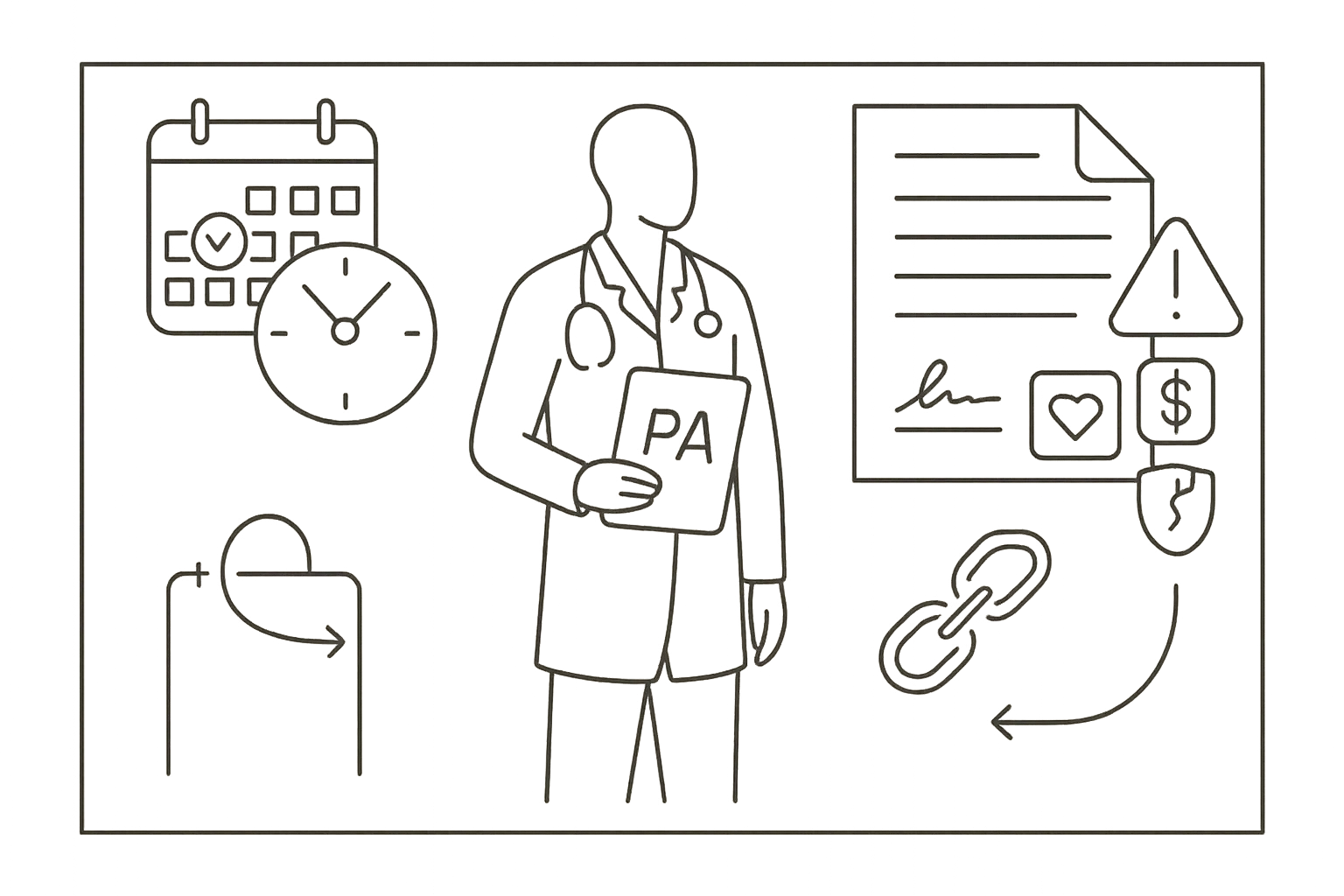
A delayed approval may affect several contract provisions at once. The agreement may use different dates for execution, effectiveness, employment, orientation, clinical services, and compensation. If those terms are not coordinated, the PA could become contractually committed while salary, benefits, bonus eligibility, and malpractice coverage remain inactive.
Salary, Benefits, and Productivity Compensation
A salary provision may begin on a fixed date, on the first day of employment, or only after all credentials and privileges are approved. The distinction determines whether the PA receives guaranteed compensation during a waiting period. Health insurance, retirement eligibility, paid time off, and probationary periods may use yet another definition of the start date, leaving an unexpected gap even when the PA has stopped working elsewhere in reliance on the new position.
Productivity compensation introduces additional risk. A PA who cannot see or bill patients may lose time to generate work relative value units, charges, or collections. Collections-based formulas can produce a second delay because payment may arrive well after enrollment becomes effective. A focused review of PA compensation and productivity terms can identify how guarantees, draws, reporting periods, reconciliation, billing lag, and credentialing contingencies interact.
The contract also needs to address whether a bonus measurement period moves with the clinical start date. If the original period remains unchanged, the PA may have fewer productive months in which to reach an annual threshold. Retroactive enrollment or claim submission does not necessarily resolve the problem unless the compensation formula explains when the resulting work or collections receive credit.
Malpractice Coverage and Interim Duties
Credentialing can affect when malpractice coverage attaches and which activities fall within the insured role. Beginning patient care before the relevant privileges, state-law arrangements, and coverage are effective may create significant exposure. Conversely, if claims-made coverage begins before full approval and the relationship ends soon afterward, the agreement may attempt to assign responsibility for tail insurance to the PA. Reviewing PA malpractice insurance provisions can clarify the policy type, effective dates, covered services, and post-termination obligations.
An employer may suggest orientation, administrative work, telehealth, limited patient care, or another interim assignment while approvals remain pending. Before accepting, the PA needs written clarification of the duties, compensation, billing treatment, malpractice coverage, productivity credit, and applicable supervision or collaboration requirements. Temporary facility privileges do not necessarily authorize unrestricted practice, and payer approval does not establish that a proposed duty is permitted under state law or facility policy.
Contract Terms That Allocate the Risk of Delay
A credentialing contingency may prevent clinical duties from beginning until all required approvals are in place, but that protection does not necessarily guarantee compensation. Language allowing the employer to postpone the start date indefinitely, without pay or an exit right, places most of the timing risk on the PA. The better analytical question is not simply whether the contract mentions credentialing, but whether it explains the consequences of a delayed, limited, or denied approval.
- Responsibility: Identify who prepares and submits applications, pays fees, communicates with payers and facilities, and supplies status updates.
- Deadlines: Distinguish deadlines controlled by the PA from estimated completion dates controlled by a payer, hospital, employer, or verification source.
- Compensation and benefits: State which event activates salary, insurance benefits, PTO, retirement eligibility, and productivity measurements.
- Interim work: Define authorized duties, pay, supervision or collaboration, billing treatment, and malpractice coverage while approvals remain pending.
- Denial or prolonged delay: Address whether the start date changes, whether either party may terminate, and whether notice or an opportunity to cure applies.
- Surviving obligations: Explain whether restrictive covenants, repayment clauses, or tail obligations apply when clinical work never begins.
Termination language deserves particular attention. Some agreements characterize any failure to obtain credentials or privileges as cause for immediate termination, even when the PA submitted a complete application and the delay arose elsewhere. A review of termination provisions can determine how credentialing events affect notice, cure rights, compensation through the termination date, and continuing obligations.
Signing bonuses, relocation assistance, education expenses, and other advances can compound the loss. The repayment clause may be triggered by termination before a service period ends, regardless of who caused the credentialing problem. The agreement may also require immediate repayment rather than prorating the obligation. PA-specific guidance on sign-on bonus repayment terms explains why the trigger, repayment schedule, and exceptions matter.
Reducing Credentialing Risk Before the Planned Start Date
Risk reduction begins with a written inventory of every required approval. The list may include a state license, controlled-substance registration, payer applications, Medicare enrollment or employment-arrangement reporting, hospital privileges, facility access, prescribing permissions, and the state-required supervision or collaboration arrangement. Each item needs an identified owner, submission date, status, and anticipated decision point.
The PA can also assemble complete and current source documents, respond promptly to requests, verify references, and retain copies of submissions. Written communications help distinguish a missing-PA-information problem from a payer, facility, or employer delay. Because generalized timeline estimates are not binding deadlines, the parties may want to establish practical status checkpoints and a date on which either side can reconsider the arrangement if approval remains unresolved.
Compensation protections must fit the payment model. A guaranteed-salary agreement might address a compensated waiting period or revised start date. An RVU or collections arrangement may need an adjusted measurement period, a minimum guarantee, and a rule for late-posted claims. Draw and negative-accrual language warrants close review so that compensation advanced during a credentialing delay does not unexpectedly become personal debt.
Recruiter emails and verbal assurances may be useful for understanding expectations, but they may not amend the signed agreement. Material promises about waiting-period pay, bonus credit, benefits, or repayment relief are more dependable when included in the contract or a signed addendum. A comprehensive physician assistant employment contract review can evaluate credentialing language alongside compensation, malpractice insurance, restrictive covenants, and termination terms.
Responding to a Delay After the Contract Is Signed
When a delay develops, the PA can create a contemporaneous record of application submissions, verification requests, committee notices, payer communications, and documents supplied to the employer. That record may establish whether the unresolved issue involves missing information, primary-source verification, an employer process, a payer backlog, a facility decision, or a state-law prerequisite.
The next step is to compare the current status with the contract’s notice, start-date, compensation, and termination provisions. Any revised date, interim role, waiting-period payment, or bonus adjustment is best confirmed in writing. If the agreement contains a formal notice process, failing to follow its delivery method or deadline could complicate a later request for a contractual remedy.
A PA should not begin patient care solely because the employer proposes an informal workaround. The relevant privileges, scope-of-practice requirements, prescribing authority, supervision or collaboration arrangement, payer status, and malpractice coverage still require confirmation. If the employer proposes an amendment, the PA also needs to determine whether it changes the contract term, compensation formula, benefits eligibility, repayment schedule, termination rights, or post-employment restrictions.
When Credentialing Language Warrants Attorney Review
Legal review is particularly useful when the agreement creates an indefinite unpaid waiting period, conditions all guaranteed compensation on credentialing, permits immediate for-cause termination for any failure to obtain privileges, or imposes repayment even when the PA did not cause the delay. Other concerns include unclear malpractice dates, uncapped clawbacks, negative accrual, fixed productivity thresholds that do not move with the start date, and restrictive covenants that apply even if clinical work never begins.
Credentialing provisions cannot be evaluated in isolation. The practical result often depends on how the contingency interacts with the definitions section, compensation exhibit, benefits plan, malpractice clause, termination language, and bonus documents. Broader physician assistant contract red flags may reveal additional obligations that become important if the anticipated position is delayed or never starts.
An attorney can identify ambiguous triggers, inconsistent dates, and provisions that allocate risk without explaining the remedy. Review before signing gives the parties an opportunity to clarify those terms before the PA leaves another position, relocates, or accepts an advance. Post-signing review may also be appropriate if a delay leads to unpaid time, a proposed amendment, threatened termination, or a repayment demand.
Frequently Asked Questions
Can a physician assistant be required to wait without pay during credentialing?
The answer depends on the agreement’s effective date, compensation terms, credentialing contingency, and applicable law. One contract may postpone pay until all approvals are complete, while another provides guaranteed compensation or a paid waiting period. The language needs to distinguish the contract date, employment start date, clinical start date, and date on which salary and benefits begin.
What is the difference between payer enrollment and hospital privileging?
Payer enrollment concerns participation in and billing of a particular insurance program. Hospital privileging authorizes the PA to perform specified services within a facility. The processes may occur at the same time, but they involve different applications and decision-makers, and completion of one does not necessarily satisfy the other.
Can a PA work under temporary privileges while full approval is pending?
Possibly, but temporary privileges are not automatically available. The facility must follow its credentialing process, and the PA’s application, requested duties, state-law requirements, supervision or collaboration arrangement, and malpractice coverage still matter. Temporary privileges may also involve monitoring and may not permit the PA to perform every duty contemplated by the employment agreement.
How can a credentialing delay affect a PA’s productivity bonus?
A delay may leave the PA with less time to generate RVUs, charges, or collections during the bonus period. Collections formulas can be affected further by payer payment lag. The contract needs to explain whether the measurement period changes, how late-posted services receive credit, and whether a guarantee or adjustment applies during the delayed start.
Can bonus or relocation repayment be triggered by a credentialing problem?
It can if the repayment clause is tied broadly to termination before a stated service period ends. The analysis depends on the trigger, the reason the relationship ended, any exceptions, and whether repayment is prorated. The provision needs to distinguish a PA’s failure to supply required information from a delay caused by an employer, payer, facility, or verification process.
When should a PA seek legal review of credentialing provisions?
Review is most useful before signing when compensation, benefits, malpractice coverage, productivity credit, repayment, or termination depends on credentialing. It may also be appropriate after signing if the delay produces unpaid time, an interim-work proposal, a contract amendment, threatened termination, or a demand to repay an advance.
Review PA Credentialing Risks Before You Sign
Chelle Law reviews physician assistant agreements for credentialing contingencies, delayed compensation, productivity formulas, malpractice obligations, repayment clauses, and termination risks.
Contact Chelle LawExplore Physician Assistant Contract Guidance
Review related legal services, practical resources, and state-focused contract information for physician assistants.