
A physician assistant offer letter may summarize salary, schedule, benefits, and a proposed start date in only a few pages. Accepting it, however, can establish expectations that carry into a much longer employment agreement. The two documents may not define compensation, duties, malpractice coverage, or termination rights in the same way. A salary described in the offer can become a recoverable draw in the contract, while a promised bonus may depend on billing information or performance standards that the employer has not yet provided.
The financial terms are only part of the analysis. Employee-versus-contractor language can shift taxes, expenses, insurance obligations, and administrative burdens to the PA. Broad clinical duties may conflict with training, credentialing, or state-specific practice requirements. Restrictive covenants can affect the next job, and termination provisions may connect departure to bonus repayment, unpaid incentives, tail coverage, or a lengthy notice period.
A meaningful review examines the offer letter, employment agreement, compensation plan, job description, malpractice documents, and incorporated policies as one transaction. Chelle Law analyzes how those documents interact, identifies provisions that may create financial or professional exposure, and explains which terms may warrant clarification or revision before acceptance. The objective is to understand the complete exchange of compensation, responsibilities, protection, and post-employment restrictions—not merely the headline salary.
Read the Offer Letter and Employment Agreement Together
A common mistake is treating the offer letter as an informal summary that no longer matters once the employment agreement arrives. Its legal significance depends on its wording and the circumstances surrounding acceptance. Even a preliminary letter may contain an expiration date, credentialing contingency, confidentiality obligation, exclusivity provision, repayment condition, or statement that acceptance creates a commitment. Other letters expressly provide that a later agreement controls if the documents conflict.
The employment contract may narrow what the offer appeared to promise. A stated annual salary might depend on maintaining a particular schedule, covering several locations, completing credentialing by a deadline, or satisfying productivity requirements. Benefits may remain subject to plan documents or policies that can change. The review therefore needs to distinguish firm contractual commitments from estimates, discretionary programs, and references to materials that have not been supplied.
Compensation exhibits, employee handbooks, call schedules, bonus plans, supervision documents, and malpractice certificates can materially alter the value of an offer. If the contract incorporates those materials, accepting the agreement without obtaining them leaves important obligations undefined. A comprehensive healthcare employment contract review can identify inconsistent provisions and determine which document controls before the PA relies on a favorable statement found in only one part of the package.
Define Compensation Before Comparing Offers
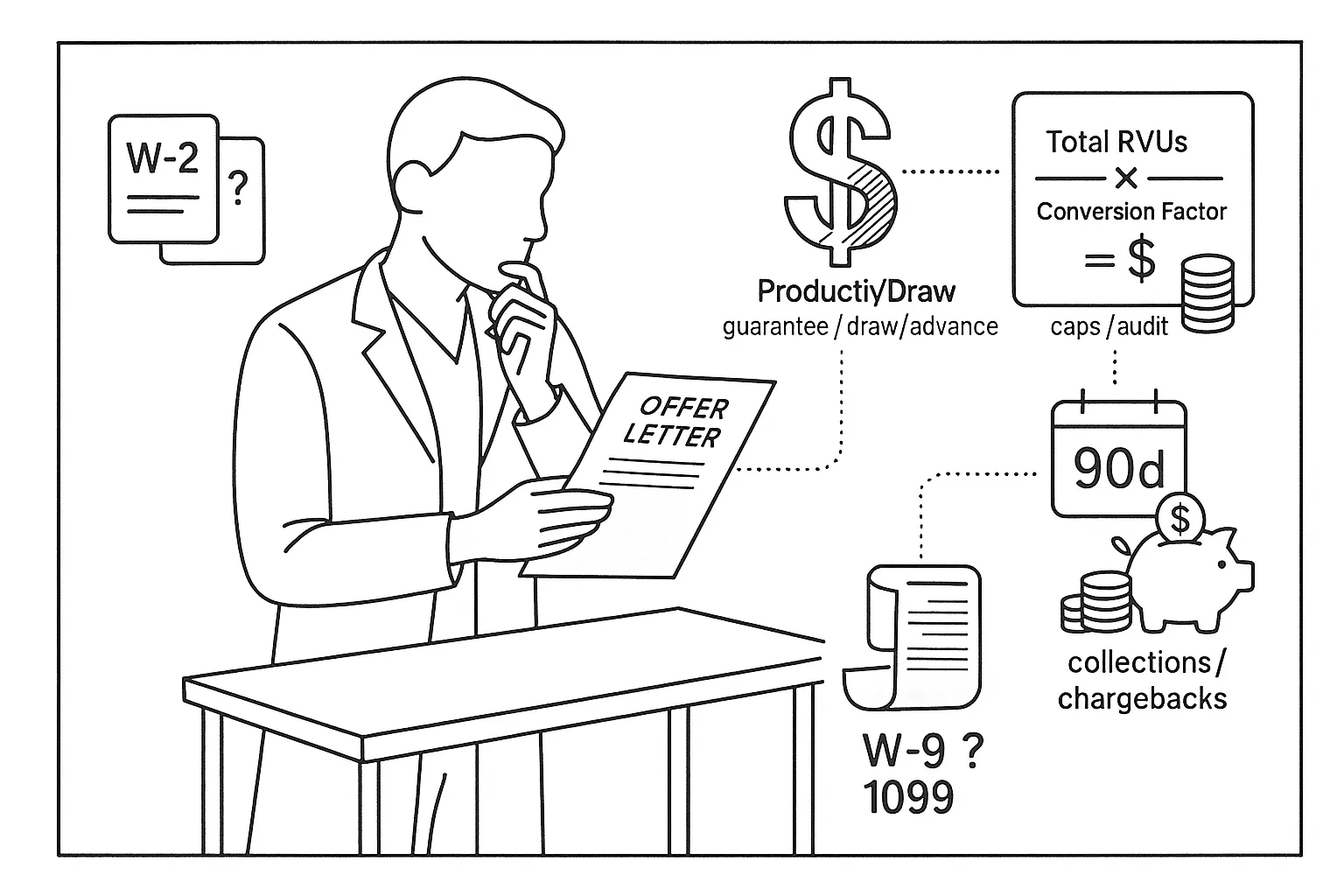
Salary, Draws, Bonuses, and RVU Formulas
A dollar figure does not establish whether compensation is guaranteed. The agreement may call the payment a base salary, minimum guarantee, advance, or draw subject to later reconciliation. A guaranteed salary offers more predictable cash flow than a recoverable draw that creates a negative balance when production falls below a target. Important questions include whether the initial guarantee expires, what formula replaces it, and whether the employer can collect a deficit from future wages or after termination.
Variable compensation requires precise definitions. An RVU formula needs to identify the RVU type, source year, code set, conversion factor, attribution method, modifiers, quality adjustments, and reconciliation schedule. It also needs to address procedures, telehealth encounters, shared services, and work performed at another location. For example, 4,000 credited RVUs multiplied by a contractual rate of $35 equals $140,000, but that illustration is meaningful only if the plan credits all 4,000 units and applies the rate without an undisclosed threshold, cap, or offset.
A contractual conversion factor is not necessarily the same as the Medicare conversion factor. CMS publishes annual Physician Fee Schedule relative value files, and the 2026 payment framework uses separate conversion factors for qualifying Advanced APM participants and other practitioners. Payment can also depend on work, practice-expense, and malpractice RVUs, geographic adjustments, code-specific policies, and payer rules. The compensation plan should explain whether and how later CMS updates affect the formula rather than allowing an external schedule to change the PA’s pay automatically and without notice.
Collections, Billing Attribution, Deductions, and Payment Timing
Collections-based compensation creates different risks. The agreement should distinguish billed charges, allowed amounts, payments actually received, and net collections after refunds, denials, or allocated expenses. It should also define the accounts-receivable period and the method for assigning credit when services are billed under another clinician’s NPI, processed as shared services, or submitted under incident-to rules.
Medicare billing rules and an internal compensation formula are not interchangeable. CMS states that covered PA services must comply with applicable state scope-of-practice requirements. PA professional services outside specified billing arrangements are generally paid at 85% of the physician fee schedule amount, while incident-to billing has separate requirements concerning the treatment course, physician involvement, supervision, setting, and billing professional. The contract should specify whether compensation credit is based on personally performed services, incident-to services, billed charges, allowed amounts, or revenue actually collected.
Payment timing can be just as important as the formula. Quarterly reconciliation, retrospective coding changes, denial-related chargebacks, and recovery of alleged overpayments can delay or reduce compensation. The PA needs to know when an incentive becomes earned, whether employment on the payment date is required, what happens to receivables after departure, and whether supporting production reports are available. Deductions for benefits, equipment, licensing, malpractice premiums, or administrative expenses can further reduce the apparent value of an offer.
Classification and Clinical Duties Require Separate Analysis

A W-2 or 1099 Label Does Not Decide Worker Status
Employee and independent-contractor arrangements allocate taxes, benefits, expenses, insurance, and administrative responsibility differently. A 1099 engagement may require the PA to handle estimated taxes, health coverage, retirement planning, licensing costs, equipment, and other overhead that an employer might otherwise pay. Comparing offers therefore requires evaluating net economic value rather than placing an employee salary and contractor rate side by side without accounting for those differences.
The contract label is not conclusive. Under the Department of Labor rule effective March 11, 2024, classification for Fair Labor Standards Act purposes uses a totality-of-the-circumstances economic-reality analysis. Relevant considerations include opportunity for profit or loss, investments, permanence, control, whether the work is integral to the business, and the worker’s skill and initiative. The Department of Labor’s worker-classification guidance applies to the FLSA, while tax, unemployment, workers’ compensation, and state laws may use different standards.
Federal tax classification is a separate inquiry. The IRS applies common-law principles focused on behavioral control, financial control, and the relationship between the parties. Set schedules, mandatory systems, detailed protocols, employer-provided equipment, billing through the practice, and long-term integration into the employer’s clinical operation may all be relevant, but no single fact supplies a universal answer. The contract also needs to align classification language with benefits, expense reimbursement, malpractice coverage, and the parties’ actual working relationship.
Scope, Supervision, Call, and Worksite Provisions
Job descriptions often reserve broad authority to assign additional responsibilities. Language requiring the PA to perform any duties assigned by the employer may permit uncompensated role expansion or reassignment into a setting that requires different training, privileges, or support. The contract is more useful when it identifies the specialty, primary location, expected procedures, patient volume, administrative duties, and circumstances under which the employer can change those terms.
PA scope, prescribing authority, delegation, physician involvement, chart review, collaboration, and supervision are jurisdiction-specific. Not every state uses the same terminology or requires a traditional collaborative agreement, and requirements can change through legislation or board rules. Contract duties and associated practice documents must fit the law governing the actual location and services. They should also identify responsibility for maintaining any required agreement, registrations, credentialing, and documentation without implying that one national supervision model applies to every PA.
Scheduling provisions need similar precision. Phrases such as “on call as needed” or “at locations designated by the employer” can produce substantial obligations without additional compensation. The agreement should address regular hours, weekends, holidays, call frequency, call pay, telehealth, travel, and notice before reassignment. Multi-site language deserves particular attention because it can affect commute time, productivity credit, reimbursement, credentialing, and restrictive-covenant geography. These concerns are examined further in Chelle Law’s discussion of physician assistant multi-site assignments.
Malpractice Terms Must Address Coverage After Employment
A promise to provide malpractice insurance is incomplete unless the documents identify the insurer or program, policy type, limits, retroactive date, exclusions, and responsibility for post-employment claims. Occurrence coverage generally responds to covered incidents occurring during the policy period, even if the claim is made later. Claims-made coverage generally depends on both when the incident occurred and when the claim is reported, subject to the policy’s precise wording.
When claims-made coverage ends, continued protection may come from an extended-reporting endorsement, commonly called tail coverage, or from prior-acts coverage under a replacement policy. Tail is not an automatic nationwide statutory benefit, and its cost cannot be estimated reliably from a universal percentage. Price and availability can vary by specialty, limits, insurer, claims history, jurisdiction, retroactive date, and the length and terms of the reporting period.
The employment agreement should allocate responsibility for obtaining and paying for any required extended-reporting protection. Responsibility may change depending on whether the PA resigns, is terminated without cause, loses a license, retires, or remains employed for a specified period. The review should also examine whether the policy covers licensing-board matters or administrative proceedings, whether defense expenses reduce policy limits, who controls settlement, and whether indemnification language creates obligations beyond available insurance.
Broad indemnification provisions can require the PA to reimburse the employer for losses, defense expenses, billing disputes, or alleged misconduct. The practical risk depends on the trigger, available defenses, exclusions, insurance coordination, and whether the obligation is limited to the PA’s own conduct. A clause that makes the PA responsible for the employer’s negligence or systemic billing practices can transfer risk far beyond ordinary professional liability coverage.
Post-Employment Restrictions Depend on Current Law and Exact Wording
Noncompete provisions can restrict geography, duration, specialties, patient populations, and the types of organizations a PA may join after leaving. A restriction tied to every employer location can be much broader than one measured from the PA’s actual practice site. Even when enforceability is uncertain, a covenant may delay a job transition, affect hospital privileges, require relocation, or create litigation expense. The analysis therefore needs to consider both legal enforceability and the practical burden created by the text.
There is no operative nationwide FTC ban that automatically invalidates physician assistant noncompetes. The FTC’s Noncompete Rule is not currently in effect or enforceable; a federal district court stopped enforcement in August 2024, and the FTC took steps to dismiss its appeal in September 2025. State law, profession-specific statutes, contract language, and the facts surrounding the employment relationship remain central. A general article cannot determine whether a particular covenant will be enforced in a specific jurisdiction.
Non-solicitation provisions may reach patients, referral sources, employees, contractors, or business relationships. Ambiguous definitions of “solicit,” “patient,” or “contact” can turn routine announcements and professional networking into disputed conduct. Confidentiality language may create additional restrictions if it defines patient information, pricing, operational data, or general experience too broadly. These provisions need to be read together because an agreement can impose significant mobility limits even when the formal noncompete appears narrow.
Other continuing obligations may include cooperation with audits or litigation, return of records and equipment, transition assistance, intellectual-property assignments, and limits on public statements. Evergreen renewal language can also extend the contract automatically unless notice is delivered within a specified window. Chelle Law’s analysis of physician assistant evergreen terms explains why renewal and notice provisions must be calendared before the agreement rolls into another term.
Termination Terms Can Trigger Multiple Financial Consequences
Termination provisions need to be evaluated as a system rather than as an isolated notice clause. For-cause termination may permit an immediate end to employment after events such as loss of licensure, exclusion from a government program, fraud, or certain criminal conduct. Problems arise when the definition also includes subjective standards such as failing to satisfy the employer or violating any policy, particularly when the PA has no notice or opportunity to cure an alleged breach.
Without-cause termination usually permits either party to end the relationship after written notice. The agreement should explain whether the employer can remove the PA from the schedule during that period, whether salary and benefits continue, and whether the PA may begin another job before the notice period expires. The delivery method matters as well. Notice sent to the wrong address, by an unauthorized method, or without the required lead time may not satisfy the contract.
Departure can activate several provisions at once. A signing bonus, relocation payment, education benefit, retention award, or training expense may become repayable. The PA may lose an unpaid productivity bonus, become responsible for tail coverage, or remain bound by a restrictive covenant. Repayment provisions deserve particular attention when they demand the full amount rather than prorating the obligation based on time served or when they permit the employer to deduct an asserted debt from final compensation.
Performance metrics and probationary periods can create additional termination risk. Objective measures should identify the data source, measurement period, exclusions, and consequences of falling short. If the employer controls scheduling, staffing, billing, or patient allocation, a productivity threshold may not reflect factors within the PA’s control. Cure periods, progressive remediation, and access to the supporting data can determine whether a performance provision is a genuine improvement process or a broad termination mechanism.
Arbitration, venue, governing law, and fee-shifting clauses affect how disputes are resolved after termination. A distant forum or requirement to pay part of the arbitration expense can make a claim more costly to pursue. The agreement may also authorize injunctive relief for restrictive-covenant or confidentiality disputes while limiting the PA’s remedies to arbitration. Those provisions should be considered before a dispute exists, when clarification or revision may still be possible.
Frequently Asked Questions
Is a physician assistant offer letter legally binding?
It can be, depending on its wording, the parties’ conduct, and applicable law. Some letters are expressly nonbinding summaries, while others contain binding confidentiality, exclusivity, repayment, or acceptance provisions. The letter and later employment agreement must be reviewed together to determine which terms control.
What compensation details should a PA confirm before accepting an offer?
The documents should define guaranteed pay, productivity formulas, RVU or collections attribution, bonus thresholds, payment dates, deductions, reconciliation rights, and compensation after termination. Any referenced plan or exhibit should be obtained and reviewed before acceptance.
Does calling a PA a 1099 contractor make the classification valid?
No. The written label alone does not determine worker status. Federal wage law, federal tax law, and state laws may apply different tests that examine control, economic dependence, financial arrangements, permanency, and the parties’ actual working relationship.
Does every physician assistant need the same supervision or collaborative agreement?
No. Scope, supervision, collaboration, delegation, prescribing, and documentation requirements vary by jurisdiction and may change. The contract and practice documents need to align with the rules governing the PA’s actual location, specialty, and services.
Who pays for malpractice tail coverage when a PA leaves?
Responsibility depends on the employment agreement, insurance policy, endorsements, replacement coverage, and circumstances of termination. The documents should identify the policy type, retroactive date, limits, and who must obtain and pay for any extended-reporting or prior-acts protection.
Are physician assistant noncompetes automatically unenforceable under federal law?
No. The FTC’s nationwide Noncompete Rule is not currently in effect or enforceable. The effect of a particular restriction depends primarily on applicable state law, any profession-specific rule, the contract’s wording, and the facts of the employment relationship.
Review Your Physician Assistant Offer Before You Accept
Chelle Law can analyze the offer letter and employment agreement, identify financial and professional risks, and explain provisions that may warrant clarification or revision before you commit.
Contact Chelle LawExplore More Contract Guidance
Review Chelle Law’s contract services, educational resources, and state-focused attorney pages.