
An offer letter and the attached employment agreement set the financial, clinical, and legal terms that will govern a physician assistant’s practice for months or years. We frequently see PAs accept initial language without fully understanding how compensation mechanics, malpractice obligations, restrictive covenants, and termination provisions translate into real income and professional risk. This article explains common offer-letter and contract mistakes we encounter, how specific clauses create financial, compliance, or mobility exposure, and why an attorney-led, line-by-line review is a prudent risk-management and income-protection decision before you sign.
Compensation Structures And Payment Details
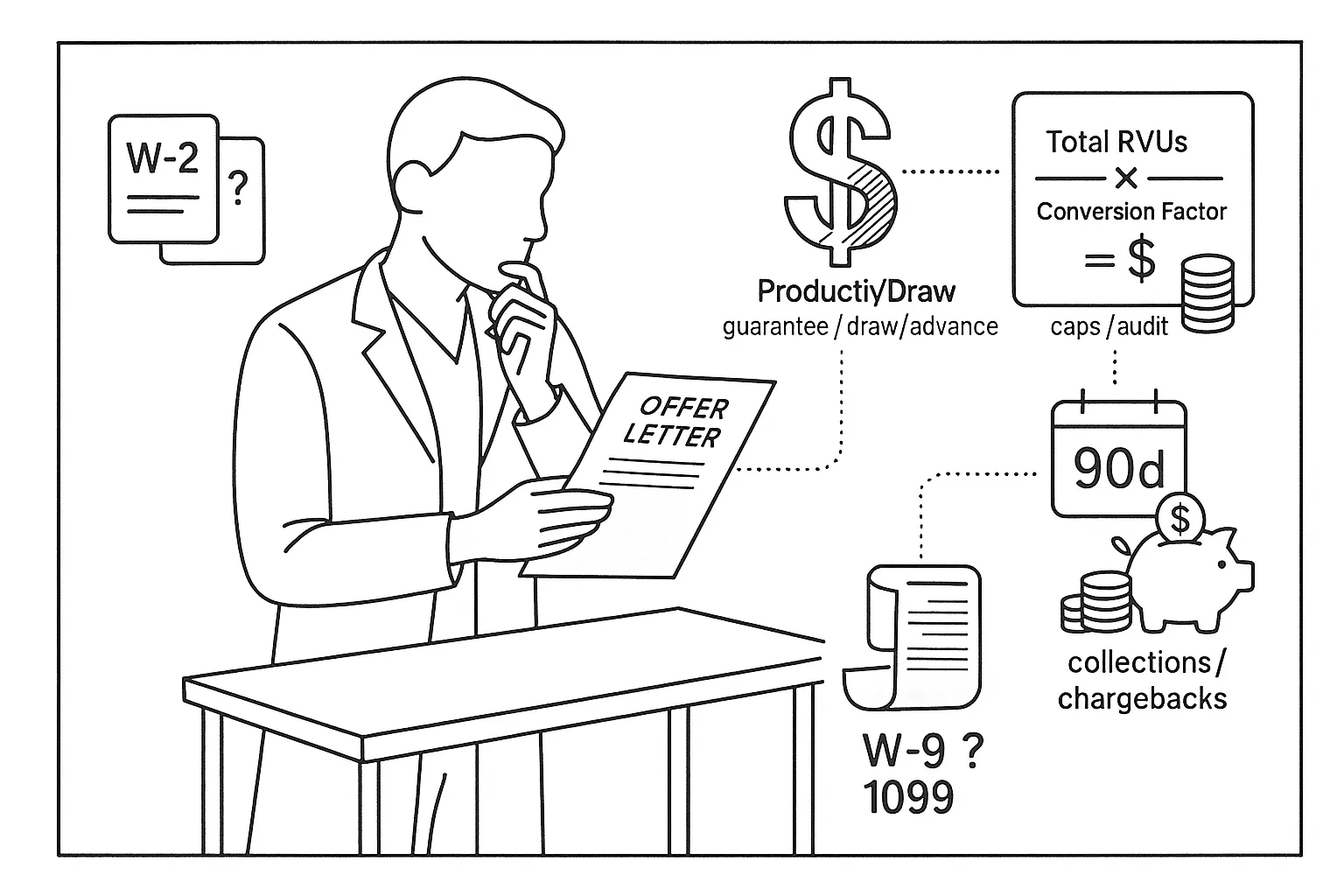
Unclear Base Salary Versus Productivity Pay
Many offer letters present a single dollar figure without clarifying whether it is a guaranteed base salary, a draw against future production, or an at-risk guarantee tied to productivity. That distinction matters: a guaranteed W-2 base provides predictable cash flow and benefits eligibility, whereas a draw or advance against productivity can create a negative accrual that you must repay. We review whether the document references “guarantee,” “draw,” “advance,” or “base salary,” and whether any guarantee converts to production-based pay after a set period.
Ambiguous Bonus, Commission, And RVU Language
Bonus formulas and RVU (relative value unit) calculations are frequently vague. A typical RVU formula might read: “Compensation = Base + (Total RVUs × Conversion Factor).” What often gets omitted is the definition of “Total RVUs” (physician vs. APP-coded RVUs), the conversion factor value, and whether quality adjustments apply. For example, if the conversion factor is $35 per RVU and a PA produces 4,000 RVUs annually, the RVU component equals $140,000, but only if RVUs are attributable and paid as stated. We watch for caps, retrospective adjustments, and audit rights that permit employers to recoup previously paid incentives.
Billing, Collections, And Pay Timing Issues
Collections-based compensation creates cash-flow and timing risk. An offer that ties pay to “collections” should define collection timing (e.g., 90-day receivable window), identify billable codes attributed to the PA, and state whether chargebacks occur for denials or patient nonpayment. A collections model may leave a PA waiting months for earned pay and vulnerable to retroactive deductions. We also examine payroll timing, reconciliation periods, and whether the employer reserves the right to offset future pay against prior overpayments.
Overlooked Deductions, Withholdings, And Tax Classification
Offer letters sometimes omit explicit statements about deductions for benefits, malpractice premiums, or equipment. Equally critical is the worker classification language: whether you are a W-2 employee or a 1099 independent contractor. Misclassification affects tax withholding, employer-paid benefits, retirement contributions, and unemployment protections. We identify ambiguous tax-language and explain the practical income impact of A-to-B reclassifications or downstream audits.
Employment Status, Classification, And Contractor Risks

W-2 Employee Versus 1099 Independent Contractor
The offer letter should clearly state whether you will be a W-2 employee or a 1099 independent contractor. This classification changes who pays payroll taxes, who withholds benefits, and which labor protections apply. Independent contractor engagements often shift liability, administrative burdens, and compliance obligations to the PA. We analyze indicia of employment, set schedules, supervision levels, billing under employer NPI/TIN, that may contradict a contractor label and expose you to misclassification risk.
Misclassified Benefits, Taxes, And Liability Implications
When an employer characterizes a PA as a 1099 worker but exercises employment controls consistent with a W-2 relationship, the PA may lose access to employer-paid health insurance, retirement matching, paid leave, and unemployment coverage while remaining subject to tax liabilities. Misclassification also affects malpractice risk: contractors may be required to carry their own insurance and could face gaps in coverage or denied claims if employer policies contain exclusions for non-employees. We highlight how payment language, benefits clauses, and expense reimbursement rules create practical consequences for take-home pay and professional exposure.
Control, Hours, And Clinical Autonomy Clauses To Watch For
Terms that dictate hours, mandatory use of employer EHRs, required participation in meetings, or detailed clinical protocols are evidence of employer control. Such clauses may limit clinical autonomy and suggest an employment relationship regardless of the label. Conversely, clauses promising unfettered autonomy can create compliance risk if they conflict with state supervision or collaborative agreement requirements. We assess these provisions for regulatory harmony and to identify where contractual duties could trigger discipline or administrative exposure.
Scope Of Practice, Supervision, And Job Duties
Vague Or Overbroad Job Descriptions
Offer letters often attach job descriptions that are intentionally broad to allow managerial flexibility. Overbroad language like “perform duties as assigned” creates scope-of-practice and credentialing risk: duties might include procedures outside your training or state-authorized practice. We flag imprecise role language that can lead to uncompensated duty expansion or discipline if you are asked to practice beyond applicable licensure limits.
Supervision, Delegation, And Collaborative Agreement Requirements
Supervision and delegation clauses must align with state laws and any required collaborative or supervisory agreements with a supervising physician. The contract should specify supervisory ratios, who signs the collaborative agreement, whether the employer or PA maintains that agreement, and how supervision affects credentialing and malpractice coverage. Failure to define these terms can shift regulatory responsibility to the PA and create exposure in licensing board proceedings.
Productivity Expectations, Call, And Scheduling Obligations
Productivity metrics, call obligations, and scheduling mandates should be explicit. Broad statements about “on-call as needed” or unspecified productivity thresholds can become a basis for discipline or termination for perceived underperformance. We review whether call pay, premium rates, overtime treatment, and multi-site coverage obligations are addressed and how they intersect with compensation structures (e.g., are RVUs credited for telehealth visits or site-hopping?).
Malpractice Insurance, Liability, And Tail Coverage
Occurrence Versus Claims-Made Policies Explained
Malpractice policies are either occurrence-based (cover incidents occurring during the policy period regardless of when claim is filed) or claims-made (cover claims filed while the policy is active). Claims-made policies require “tail” or run-off coverage after termination to protect against late-filed claims. An apparent offer of malpractice coverage is incomplete without specifying policy type, limits, and who is responsible for post-termination exposure.
Employer Responsibility For Tail Or Run-Off Coverage
Employers sometimes promise to provide malpractice insurance but remain silent on tail coverage responsibility. If the employer provides claims-made coverage while you work but does not pay for tail should you leave, you can face substantial out-of-pocket tail premiums, often 100–300% of annual premium depending on specialty risk and market conditions. We identify whether the employer assumes tail costs on termination, whether they provide a tail only for certain termination events (e.g., termination without cause), or whether the PA is placed on an indemnification island responsible for future claims.
Indemnification, Defense Costs, And Limitations On Coverage
Indemnification clauses that require the PA to reimburse employer costs or pay defense expenses raise immediate financial risk. We look for provisions that limit defense selection rights, require pre-approval for settlement payments, or impose monetary caps on defense. We also evaluate whether the policy’s limits are primary and non-contributory, whether punitive damages are excluded, and whether coverage extends to corporate or administrative defense events.
Restrictive Covenants, Non-Competes, And Non-Solicitation
Scope, Geographic Breadth, And Duration Concerns
Restrictive covenants often determine future mobility more than compensation terms. Broad geographic radii, multi-site applicability, and long durations can effectively limit where you can practice after employment. Although enforceability varies by state and fact pattern, we explain how overly broad restrictions impose material career risk by restricting patient panels, hospital privileges, and employment options.
Client, Patient, And Employee Non-Solicitation Clauses
Non-solicitation provisions may prohibit contact with patients, referral sources, or employees for extended periods. Ambiguities about who qualifies as a “patient” or what constitutes “solicit” can create civil exposure for routine post-employment networking. We flag sweeping language that reaches passive patient lists or general recruitment and explain the practical consequences for building a practice or joining a new employer.
Enforceability Risks And Negotiation Priorities For PAs
We do not provide state-specific enforceability conclusions in this general overview, but we evaluate whether a covenant’s scope aligns with an employer’s legitimate protectable interest (patient relationships, specialized trade secrets). In practice, overly broad or unclear covenants create litigation risk and uncertainty. Our review identifies clauses that materially restrict mobility and quantifies the career and income implications so a PA understands the stakes before signing.
Termination, Repayment, And Performance Triggers
Termination For Cause Versus Without Cause And Notice Provisions
Termination language commonly includes narrow “for cause” definitions and short or no notice for termination without cause. Immediate termination triggers, conviction, loss of license, fraud allegations, are reasonable: but, vague triggers such as “failure to meet employer standards” permit subjective enforcement. We assess notice periods, severance eligibility, and whether compensation continues through the notice period.
Repayment Clauses, Signing Bonuses, And Education/Relocation Clawbacks
Signing bonuses, relocation payments, and education loan assistance frequently include repayment obligations if employment terminates within a set period. Repayment provisions sometimes accelerate upon resignation or leave no allowance for pro rata forgiveness based on time served. We flag one-sided clawbacks and negative accrual language that allows employers to withhold future pay or demand immediate repayment, explaining how these clauses can create unanticipated financial liabilities.
Performance Metrics, Probationary Periods, And Cure Rights
Contracts often establish probationary periods and performance-based termination rights. We scrutinize whether metrics are objectively defined, how performance is measured, and whether the PA is afforded cure periods or progressive remediation. A lack of defined cure rights increases the risk of abrupt termination and associated income loss.
Remedies, Dispute Resolution, And Governing Law
Arbitration, venue selection, choice-of-law, and fee-shifting provisions affect your practical ability to challenge employer actions. Mandatory arbitration clauses with employer-favorable rules or distant governing law can increase litigation costs and reduce bargaining power. We identify these clauses and explain how they affect dispute resolution options and potential remedies.
Conclusion
Physician assistant offer letters frequently contain employer-favorable language that, when left unexamined, can materially affect compensation, liability exposure, regulatory compliance, and future mobility. We approach each contract as a risk-management exercise: clarifying compensation mechanics (base, RVU, collections, bonuses), identifying repayment exposures and negative accrual loops, confirming malpractice coverage and tail responsibility, and assessing restrictive covenants and termination mechanics. At Chelle Law, our attorney-led, line-by-line reviews translate contractual language into concrete financial and regulatory consequences so you understand income risk and career impact before committing. If you are evaluating an offer, a focused contract review protects your compensation, license, and long-term professional flexibility, and helps you make an well-informed choice with clear expectations about the legal and financial trade-offs involved.