
Scope expansion occurs when a physician assistant (PA) assumes duties beyond prior role boundaries, including new procedures, greater clinical responsibility, telehealth services, call coverage, or work at additional locations. Expanded practice can increase autonomy and earning potential, but it may also create legal, financial, regulatory, and patient-safety risks when the employment or independent contractor agreement does not keep pace with the new responsibilities. Before accepting altered duties, a PA should understand how the proposed change affects supervision, credentialing, compensation, malpractice coverage, repayment obligations, and post-employment restrictions. An attorney-led physician assistant contract review can identify provisions that transfer these risks to the PA.
What Scope Expansion Means for Physician Assistants
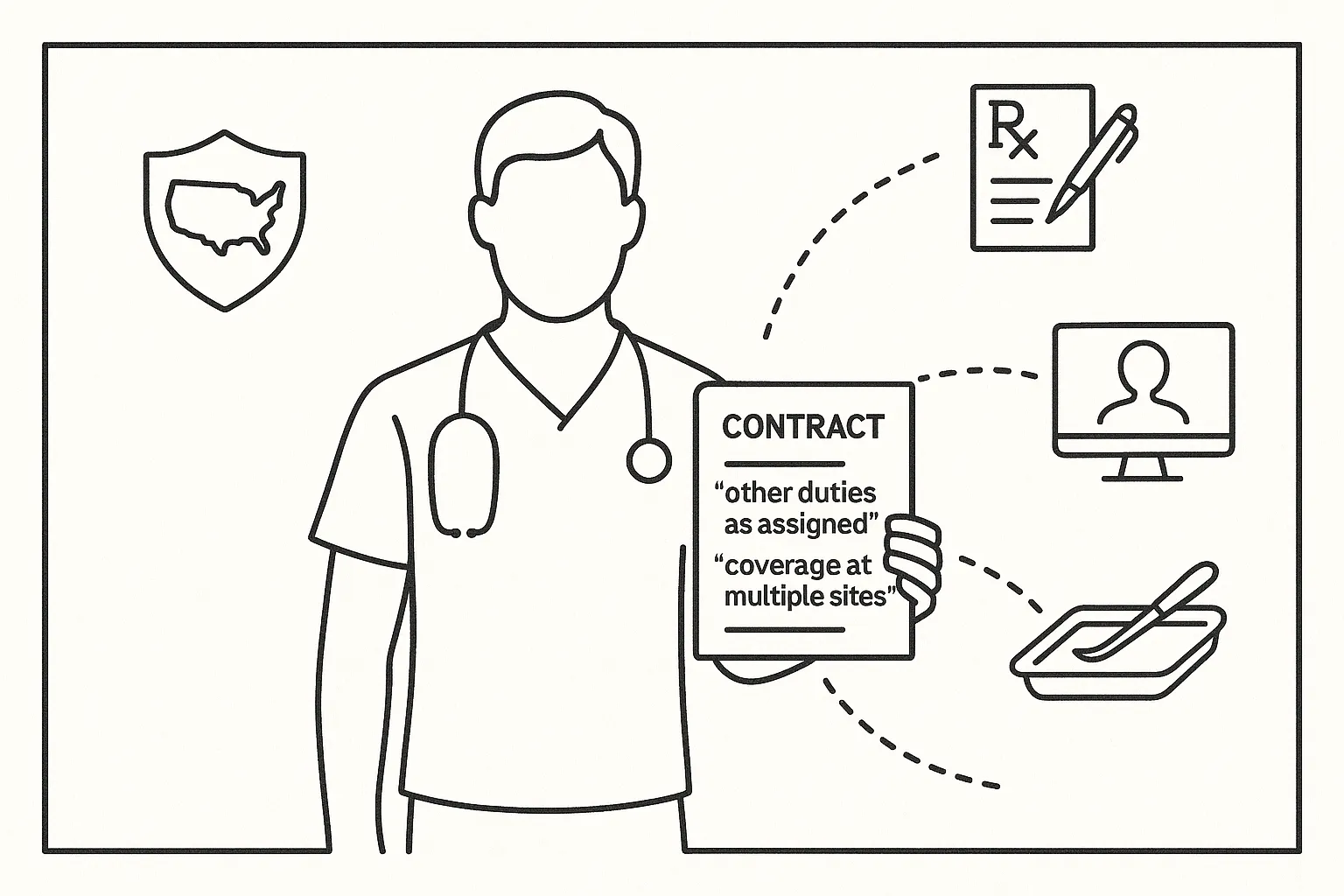
Scope expansion refers to a substantive change in a PA’s professional duties, such as performing new procedures, exercising greater decision-making authority, gaining additional prescriptive responsibilities, providing telehealth services, or covering more clinical locations. It can happen gradually when a PA begins handling more complex cases, assumes additional on-call responsibilities, or performs procedures previously handled by physicians. Any added call or after-hours obligation should also be evaluated against the agreement’s call schedule and coverage requirements.
Scope changes commonly appear in job descriptions, addenda, delegation agreements, or broad provisions permitting “other duties as assigned.” Language allowing procedures “as required” or coverage at multiple sites can give an employer significant discretion unless the agreement defines the limits, supervision structure, credentialing prerequisites, and related compensation. Scope expansion is not inherently improper, but it becomes risky when the contract, insurance, training, or operational safeguards do not align with the responsibilities being assigned.

Workforce shortages, staffing costs, productivity targets, specialty practice needs, and telehealth growth can all drive expanded PA responsibilities. Practices may rely on PAs to maintain access, increase collections, cover procedural services, or support remote care. These operational incentives can outpace the protections offered to the PA, resulting in higher expectations without defined training, compensation, supervision, or liability allocation.
Regulatory and Contractual Risks of Expanded Duties
Expanded duties can alter the regulatory, contractual, and indemnity landscape. Employer-drafted terms may affect a PA’s license, income, liability exposure, and ability to accept another position. The agreement should therefore be reviewed alongside the state rules, facility requirements, and delegation arrangements that govern the actual work.
Supervision, Delegation, and State Practice Requirements
State PA practice requirements and facility bylaws may govern allowable duties, supervision, collaboration, delegation, and prescriptive authority. A general promise to comply with the law does not resolve ambiguous language that changes the practical supervision structure. Risk increases when the agreement permits an employer to change supervising physicians without notice, requires work beyond the applicable scope framework, or assigns multi-site and telehealth coverage without documented delegation and supervisory availability.
- The supervising or collaborating relationship should be identified with enough clarity to understand responsibility and availability.
- New procedures and clinical settings should remain subject to applicable licensure, credentialing, and facility requirements.
- Changes in supervising personnel, locations, or service lines should be communicated and documented.
- Telehealth and multi-site assignments should include workable protocols for consultation, escalation, and coverage.
Indemnification and Restrictive Covenant Exposure
Broad delegation and indemnification clauses may shift malpractice, compliance, or operational risk to the PA even when the employer controls staffing, systems, and clinical resources. A provision requiring the PA to reimburse defense costs or indemnify the employer for broadly defined losses deserves careful review, particularly when the PA has limited authority over the underlying decision or system failure.
Expanded duties may also enlarge the services, locations, or patient relationships covered by a restrictive covenant. Broadly drafted non-compete and non-solicitation provisions can reduce future employment options after a PA provides specialty or higher-acuity services across several facilities. Because enforceability depends on state law and the facts, the practical effect of the agreement’s restrictive covenant terms should be evaluated before the expanded role begins.
Clinical Safety, Credentialing, and Malpractice Exposure
New diagnostic, procedural, or decision-making responsibilities can increase the frequency or severity of potential malpractice claims. The agreement should identify who provides coverage, whether the policy is occurrence-based or claims-made, the applicable limits, and any obligation to purchase supplemental insurance. It should also address incident reporting, defense participation, and cooperation requirements after a claim.
Insurance, Tail Coverage, Training, and Privileging
A PA working under claims-made coverage may face substantial post-employment exposure if the contract assigns tail insurance to the PA or remains silent. Reviewing the complete malpractice insurance provisions, including responsibility for premiums, defense, and reporting, helps reveal costs that may continue after the employment relationship ends. If claims-made coverage applies, the agreement should also clearly allocate responsibility for extended reporting or tail coverage.
Credentialing, privileging, training, and documented competency should accompany any material scope change. Appropriate safeguards may include proctoring for new procedures, a defined supervised-practice period, completion of required training before independent performance, and clear performance standards. The agreement or related policies should identify who provides and pays for the necessary training and credentialing rather than expecting the PA to assume complex duties without documented preparation.
Compensation, Productivity, and Career Consequences
Expanded scope may increase revenue for a practice without automatically increasing the PA’s compensation. Base salary plus productivity, collections-based pay, and relative value unit formulas each create different risks. A focused compensation and productivity review can determine whether the payment formula accounts for the additional procedures, call duties, locations, and clinical responsibility.
Productivity Credit, Repayment Terms, and Mobility
- Collections-based compensation: Payment depends on cash collected, so delays, denials, and payer mix can leave the PA uncompensated for completed work unless accounting and payment rules are clear.
- RVU compensation: The contract should define which services generate credit, how shared visits are treated, the conversion factor, and how calculations can be verified.
- Negative accrual and draws: Reconciliation provisions can allow an employer to carry productivity shortfalls forward or seek repayment from future compensation or a final paycheck.
- Bonus and relocation clawbacks: Expanded duties do not necessarily eliminate repayment obligations tied to resignation, termination, or failure to complete a service period.
The agreement should explain payment timing, access to productivity records, reconciliation procedures, and the effect of termination on earned compensation. Scope expansion can also affect long-term mobility if the employer treats new service lines, facilities, or patient groups as part of a broader restricted practice. Compensation improvements should therefore be considered together with repayment provisions and post-employment limits rather than in isolation.
Contract Protections for a Proposed Scope Change
Risk can be reduced through specific contract language and aligned operational safeguards. The goal is to ensure that the agreement accurately describes the work, assigns responsibility to the appropriate party, and prevents an employer from materially expanding duties without addressing supervision, training, insurance, and compensation.
- A precise job description identifying the procedures, settings, locations, and limits associated with the expanded role.
- Clear supervision and delegation terms explaining who provides oversight, how changes are communicated, and when consultation must be available.
- Credentialing, privileging, proctoring, and training requirements that must be completed before new duties begin.
- Compensation terms defining RVU credit, collections accounting, call pay, bonus measurements, payment timing, and reconciliation mechanics.
- Malpractice insurance and tail provisions allocating premiums, reporting obligations, defense responsibilities, and post-employment coverage.
- Reasonable indemnification, repayment, and clawback language that does not transfer employer-controlled operational risks to the PA.
Changes should be documented in a signed agreement or addendum rather than left to informal assurances. Any amendment should also be read together with the original contract because existing termination, repayment, and restrictive covenant provisions may continue to apply to the expanded role.
When Expanded Duties Require Immediate Contract Review
Attorney review is particularly important when the employer requests procedural autonomy beyond prior practice, changes the compensation formula, adds call or multi-site coverage, or introduces broad delegation language. Immediate review is also appropriate when claims-made insurance lacks a clear tail commitment, productivity calculations lack concrete examples, supervision is undefined, or restrictive covenants expand with the PA’s new duties.
If the proposed terms create unmanageable liability, uncertain compensation, substantial repayment exposure, or career-limiting restrictions, declining the scope change or the position may be prudent. A review should explain the legal and financial consequences before the PA commits, including how a later departure would operate under the agreement’s termination provisions.
Frequently Asked Questions
What contract language can allow an employer to expand a PA’s duties?
Broad phrases such as “other duties as assigned,” permission to perform procedures “as required,” and open-ended multi-site coverage provisions may give an employer substantial discretion. The agreement should define the procedures, settings, supervision, training, and compensation connected to material duty changes.
Should expanded PA duties require additional compensation?
Additional compensation is not automatic, so the contract should explain whether new procedures, call coverage, locations, or productivity receive separate pay or credit. The financial terms should also define accounting access, payment timing, and any reconciliation or negative accrual provisions.
How can scope expansion affect malpractice insurance?
New procedures or greater clinical responsibility may increase malpractice exposure and may require confirmation that the assigned duties are covered. The contract should identify the policy type, limits, premium responsibility, reporting obligations, defense terms, and responsibility for tail coverage when claims-made insurance applies.
Why do credentialing and training matter before new duties begin?
Credentialing, privileging, proctoring, and documented training help establish that the PA is authorized and prepared to perform the new work. Beginning complex duties without those safeguards can create patient-safety, licensing, and liability concerns.
Can expanded duties make a non-compete more restrictive?
They can broaden the services, facilities, geographic areas, or patient relationships an employer claims are covered by a restrictive covenant. The practical effect and enforceability depend on the contract language, applicable state law, and the facts surrounding the employment relationship.
When should a PA seek legal review of a scope change?
Review is advisable before accepting new procedures, greater autonomy, additional locations, call obligations, compensation changes, or revised delegation terms. It is especially important when insurance, supervision, repayment, productivity, termination, or restrictive covenant provisions are unclear.
Review Expanded PA Duties Before You Agree
Chelle Law reviews physician assistant agreements to identify how proposed scope changes affect supervision, compensation, malpractice coverage, repayment exposure, and future employment options.
Contact Chelle Law