
Severance can provide a physician assistant with meaningful financial protection after employment ends, but the word “severance” alone promises very little. The employment agreement must identify which separation events qualify, how the payment is calculated, when it becomes due, and what the PA must sign or continue doing to receive it. A benefit that appears substantial may lose much of its value if the formula excludes productivity pay, the employer can apply broad offsets, or payment depends on compliance with restrictive covenants.
Federal law does not generally require an employer to offer severance. The U.S. Department of Labor explains that severance is ordinarily controlled by the employment agreement, an employer plan or policy, and applicable law. That makes the precise contract language especially important. Termination definitions, notice requirements, release terms, signing-bonus repayment, malpractice coverage, and post-employment restrictions can all affect whether the PA receives the stated amount and keeps it.
A careful review therefore considers more than the number of salary weeks offered. It examines the source of the benefit, the conditions attached to it, and how the severance provision interacts with the rest of the agreement. State law can also affect cause definitions, restrictive covenants, wage deductions, repayment rights, and other provisions, while PA licensure and practice requirements vary by jurisdiction. Chelle Law reviews these connected terms so physician assistants can understand the financial and professional consequences before signing an agreement or release.
When a PA Has a Right to Severance

Severance is usually a contractual or employer-promised benefit rather than an automatic payment required whenever employment ends. The right may appear in the employment agreement, a separate severance plan, an offer letter, or an employer policy incorporated by reference. Those documents need to be read together because the agreement may reserve the employer’s ability to amend a policy or may impose eligibility conditions that do not appear in the severance paragraph itself.
Common qualifying events include an employer-initiated termination without cause, elimination of the PA’s position, or a reduction in force. Some agreements also provide severance when a PA resigns after a defined material breach by the employer. Voluntary resignation and termination for cause are commonly excluded, although the result depends on the wording of the documents governing the benefit.
The practical need for transition income may be greater when the PA has a long contractual notice period, a geographically broad non-compete, or credentialing requirements that could delay the next position. A severance clause is most useful when its eligibility rules and payment obligations are objective enough to provide predictable protection rather than leaving payment entirely to employer discretion.
Termination Language Determines Eligibility
Without-Cause Termination, Cause Definitions, and Cure Rights
Many agreements limit severance to a termination initiated by the employer without cause. That protection can be undermined by an expansive cause definition covering policy violations, performance concerns, loss of credentials, failure to maintain licensure, contract breaches, or conduct the employer considers detrimental. If the definition is subjective, the employer may have considerable discretion to characterize a separation as one that disqualifies the PA from payment.
Important questions include whether the employer must give written notice, whether the notice must identify the alleged breach, and whether the PA receives time to correct a curable problem. The contract may also distinguish conduct permitting immediate termination from less serious issues subject to a cure period. A focused review of PA termination provisions can identify how those definitions affect severance and continued compensation.
Resignation, Position Elimination, Notice Pay, and WARN
A PA who resigns voluntarily generally will not qualify unless the agreement creates a specific exception. For example, a contract may address resignation after an uncured material employer breach, a substantial compensation reduction, or a significant change in duties. These provisions often require prompt written notice and an opportunity for the employer to cure the issue before resignation can trigger severance.
Position elimination and reductions in force are more common triggers, but the agreement may not explain whether reassignment, relocation, a reduced schedule, or a material change in responsibilities counts as an elimination. Those distinctions matter when the employer offers a different role instead of ending employment outright.
Severance must also be distinguished from compensation owed during a contractual notice period, pay in lieu of notice, earned wages, and potential obligations arising from a qualifying mass layoff or facility closing. The federal WARN Act has separate coverage and notice rules, and Department of Labor WARN guidance explains that severance does not automatically replace or offset WARN liability. The treatment of a payment may depend on whether it was already contractually required or was voluntary and unconditional, as well as on applicable federal and state law.
Calculating the Real Value of a Severance Package
Base Salary, Productivity Pay, Call Compensation, and Bonuses
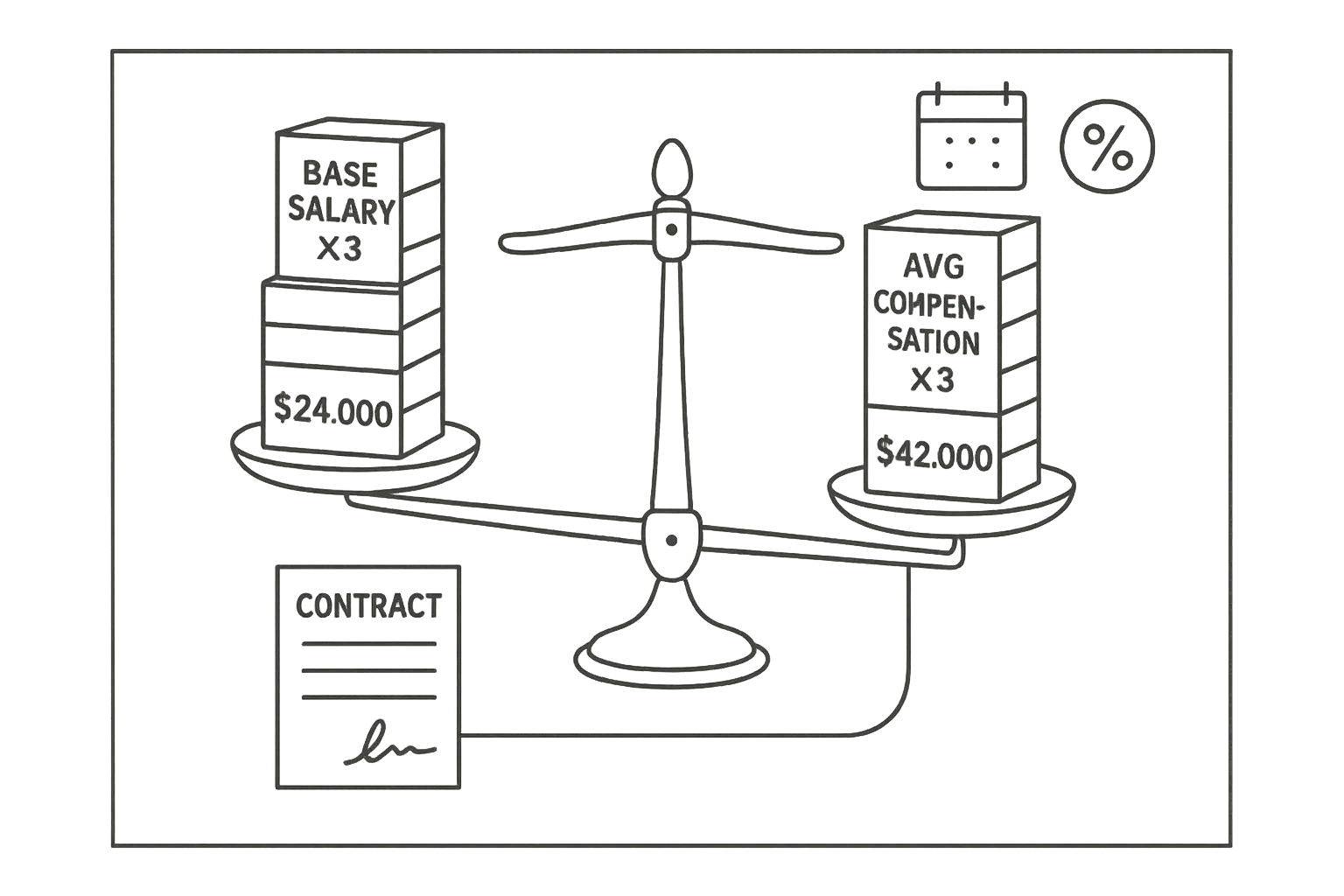
A common formula provides a fixed number of weeks or months of base salary. That method is easy to administer, but it can understate a PA’s normal earnings when productivity incentives, call pay, shift differentials, collections-based compensation, or bonuses represent a significant part of total compensation. An average-earnings formula may be more representative, provided the contract defines the measurement period and identifies every included payment category.
- Base-salary multiple: A fixed number of weeks or months calculated from salary, typically excluding variable compensation unless expressly included.
- Average compensation: Average earnings over a stated lookback period, which may include salary, productivity pay, call compensation, or other specified income.
- Bonus treatment: Language explaining whether earned, accrued, discretionary, or future incentive payments are included in or paid separately from severance.
- Minimum and maximum amounts: A floor, cap, or service-based schedule that changes the payment according to tenure.
For example, a PA earning $8,000 in monthly salary and an average of $6,000 in monthly RVU incentives would receive $24,000 under a three-month base-salary formula. The same period would produce $42,000 if the formula included both components. This difference illustrates why compensation and productivity review is relevant to evaluating the actual value of severance.
Payment Timing, Withholding, Benefits, and Setoffs
Severance may be delivered as a lump sum, salary continuation, periodic installments, benefits support, or a combination of these forms. A lump sum provides immediate funds, while installments can expose future payments to suspension if the employer alleges a later breach. The agreement or release needs to identify the payment deadline, any conditions that delay payment, and whether the PA must remain available for transition or cooperation duties.
Severance is generally taxable, but payroll withholding is not the same as the employee’s final tax liability. Current IRS guidance treats severance as supplemental wages for federal withholding purposes and also addresses applicable payroll taxes. A PA can consult a qualified tax professional about individual consequences rather than relying on the amount withheld as a final calculation.
Health coverage requires separate analysis. COBRA may allow continuation of qualifying employer group coverage after a covered event, but severance does not itself guarantee free continued insurance. A package might instead subsidize all or part of the COBRA premium for a limited period. The documents need to distinguish the legal right to elect continuation coverage from the employer’s separate promise to pay premiums.
Setoff language can materially reduce the amount delivered. Employers may seek to deduct advances, loans, alleged overpayments, equipment charges, signing-bonus obligations, or other amounts claimed to be due. The provision may also permit an offset before a dispute over the underlying debt is resolved, making the scope and timing of the deduction important.
Conditions That Can Reduce or Recover Severance
Employers frequently condition severance on signing a release of employment-related claims. The release may also impose confidentiality, non-disparagement, cooperation, return-of-property, and continuing compliance obligations. Contract analysis can determine which claims are being released, whether the release adds duties beyond the original agreement, and whether the employer can withhold or recover payment after an alleged breach.
Special federal requirements apply when a release includes Age Discrimination in Employment Act claims by an employee who is at least 40 years old. As summarized in EEOC guidance on ADEA waivers, a valid waiver must use clear language, specifically reference ADEA rights, provide consideration beyond an existing entitlement, and advise the employee in writing to consult an attorney. An individual offer generally provides at least 21 days for consideration, while certain group termination programs require 45 days and additional disclosures. The employee must also receive seven days to revoke after signing.
Restrictive covenants can create another condition on payment. A clawback may require repayment if the employer alleges that the PA competed in a restricted area, solicited patients or employees, disclosed confidential information, or violated another post-employment obligation. The enforceability and scope of these provisions vary significantly by state, so the severance language needs to be evaluated with the agreement’s non-compete and restrictive-covenant terms.
Signing bonuses and relocation payments may create a separate repayment obligation. An employer-initiated termination does not necessarily cancel that obligation if the contract says otherwise, and setoff language may allow the employer to subtract it from severance. Reviewing the sign-on bonus repayment formula can reveal whether the amount is prorated, which separation events trigger repayment, and whether one obligation could eliminate the other.
Malpractice coverage is also separate from severance. If the PA is insured under a claims-made policy, tail coverage may be necessary for claims reported after the policy ends. Responsibility depends primarily on the policy and contract rather than on a universal severance rule. A cash payment may offer limited transition protection if the PA simultaneously becomes responsible for a substantial insurance expense, which is why tail coverage obligations belong in the same financial review.
Questions to Resolve Before Accepting Severance Terms
A useful severance provision provides enough detail to calculate the payment and determine eligibility without relying on unwritten assumptions. The clause also needs to be read against the termination, compensation, benefits, insurance, repayment, and restrictive-covenant sections. Before accepting the provision, consider whether the documents answer the following questions:
- Source of the right: Is severance guaranteed by the agreement, governed by a separate plan, or left to employer discretion?
- Qualifying events: Does eligibility cover termination without cause, position elimination, a reduction in force, or resignation after a defined employer breach?
- Cause procedure: Are cause events objective, and do correctable issues receive notice and a cure period?
- Calculation: Does the formula include productivity incentives, bonuses, call pay, and other regular earnings?
- Payment deadline: When does payment begin, and what can delay, suspend, or terminate installments?
- Release and continuing duties: Which claims are released, and what post-employment obligations can trigger forfeiture or repayment?
- Offsets: Can the employer deduct signing bonuses, relocation assistance, advances, overpayments, or disputed amounts?
- Benefits and insurance: Does the employer subsidize continuation coverage, and who is responsible for any necessary malpractice tail policy?
The significance of each issue depends on the amount offered, the PA’s compensation structure, the governing state law, and the restrictions that apply after separation. A complete physician assistant employment contract review can evaluate these provisions together and identify terms that may warrant clarification or revision before the agreement is signed.
Frequently Asked Questions
Is an employer legally required to pay a physician assistant severance?
Federal law does not generally require severance pay. Eligibility ordinarily depends on the employment agreement, an employer severance plan or policy, and applicable state law. Other payments, such as earned wages, contractual notice pay, or qualifying WARN Act obligations, may arise from separate legal or contractual requirements.
When does a PA usually qualify for contractual severance?
Common triggers include employer-initiated termination without cause, elimination of the PA’s position, or a reduction in force. Voluntary resignation and termination for cause are often excluded. Some agreements also cover resignation after a defined employer breach, usually subject to written notice and an opportunity to cure.
Should severance be calculated from base salary or total compensation?
The answer depends on the PA’s compensation model and the contract language. A base-salary formula may materially understate normal earnings when productivity incentives, call pay, or bonuses are significant. An average-compensation formula can be more representative, but it needs a clear measurement period and a precise list of included payments.
Can an employer deduct a signing bonus or relocation repayment from severance?
Potentially, if the agreement authorizes the offset. The documents need to explain whether repayment is prorated, which separation events trigger it, and whether an employer-initiated termination changes the obligation. Broad setoff language may allow other advances, overpayments, or claimed debts to reduce the payment as well.
Does a severance package automatically include COBRA premiums or malpractice tail coverage?
No. COBRA continuation rights are distinct from an employer’s promise to subsidize premiums, and a package may provide cash severance without paying for continued health coverage. Malpractice tail responsibility is generally governed by the insurance policy and employment agreement, especially when the PA had claims-made coverage.
What should a PA review before signing a severance release?
The PA can review which claims are being released, the consideration offered, the payment date, confidentiality and non-disparagement terms, cooperation duties, restrictive covenants, and any clawback. Employees age 40 or older also need to consider whether a waiver of ADEA claims satisfies the applicable federal requirements for clear language, review time, counsel advice, and revocation.
Have Your PA Severance Terms Reviewed
Chelle Law reviews severance, termination, compensation, release, repayment, restrictive-covenant, and malpractice provisions so you can understand how the terms work together.
Contact Chelle Law