
Telehealth roles for physician assistants introduce contract provisions that differ materially from traditional in-person employment agreements. These contracts commonly intertwine compensation mechanics, supervision frameworks, multistate licensure obligations, technology and HIPAA responsibilities, and malpractice allocation in ways that affect income, compliance, and future mobility. We write from experience reviewing hundreds of PA agreements to explain how key telehealth contract terms operate, the financial and regulatory risks they may create, and why an attorney-led, line-by-line review can be an important risk-management and income-protection step before signing.
Employment Classification and Telehealth Scope of Practice
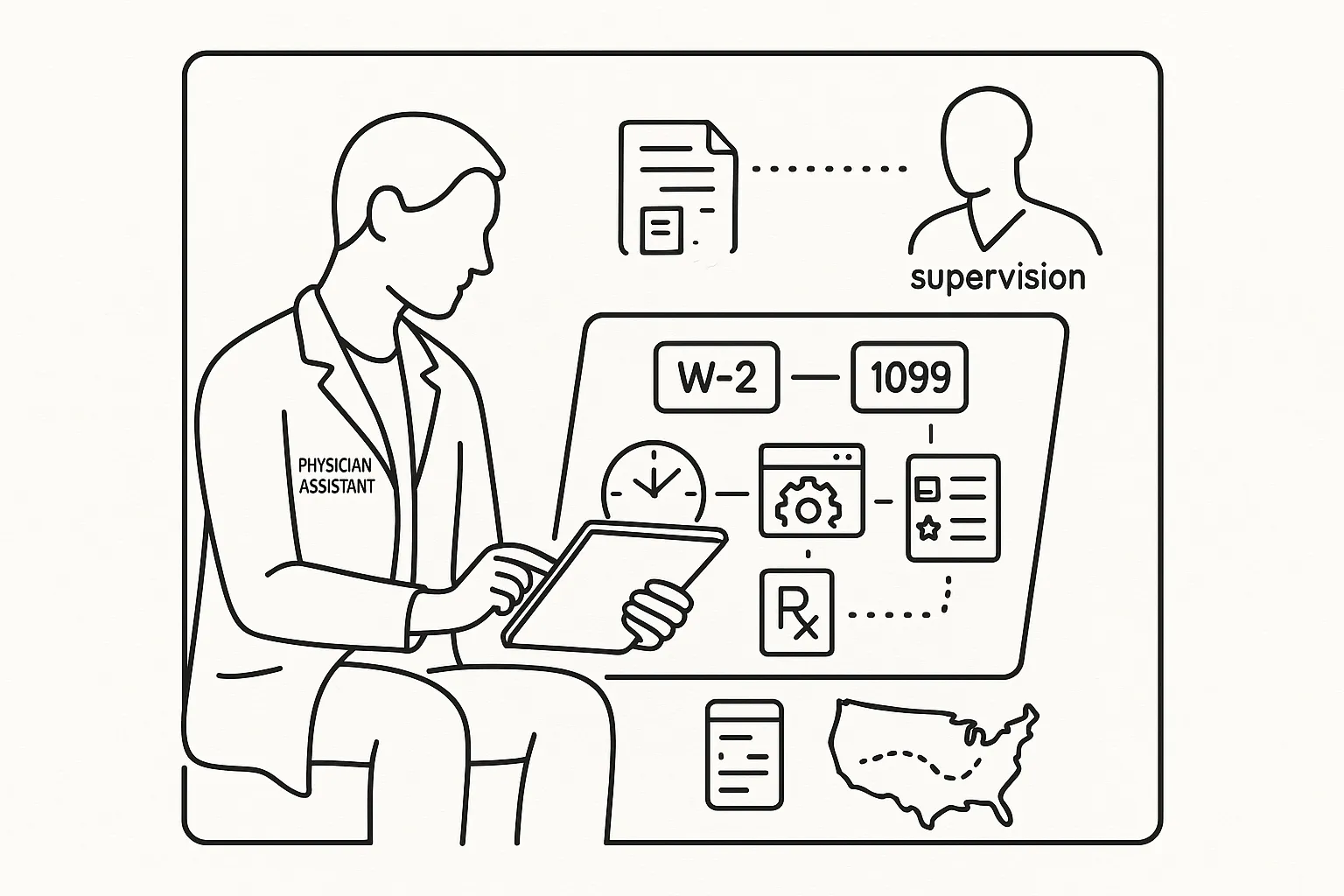
W-2 Employment vs. 1099 Independent Contractor Status
Telehealth agreements may present the relationship as either W-2 employment or a 1099 independent contractor arrangement. The label in the document is not necessarily dispositive because the contract’s operative terms determine how the relationship functions. A careful W-2 versus 1099 review should consider control over scheduling, mandatory use of employer platforms, performance metrics, supervision language, tax obligations, benefits, and liability allocation.
Classification concerns can affect payroll taxes, paid leave, employer-provided benefits, and malpractice protection. When an agreement is drafted as a 1099 engagement but imposes tight operational controls, mandatory shifts, restricted hours, and detailed clinical protocols, the practical relationship may differ from the employer-favorable allocation of risk in the contract.
Supervision, Delegation, and Prescriptive Authority
Telehealth contracts routinely address supervision structures, delegation agreements, and prescriptive authority limitations. The agreement should identify who is responsible for supervising telehealth encounters, how remote supervision is documented, and what clinical or administrative support will be available when questions arise.
Scope limitations are often embedded in a job description or separate supervision addendum. These provisions affect the services a PA may provide remotely, how orders and prescriptions are transmitted, and which patient populations the PA may treat. Because state regulatory frameworks vary, ambiguous supervision language can create compliance exposure during cross-state practice. Broad clauses may also narrow the PA’s practical scope or impose unusual documentation duties, making it important to assess potential scope-of-practice and role expansion risks before signing.
Telehealth Compensation, Productivity, and Scheduling

Salary, RVU, Collections, and Per-Visit Pay Models
Telehealth compensation models range from guaranteed base salary to productivity-based systems using collections, visit fees, or RVU formulas. Each model redistributes financial risk between the employer and the PA, so a PA compensation and productivity review should examine both the advertised rate and the provisions governing calculation, reconciliation, and payment.
- Base salary: Provides predictability, but the agreement should clarify whether guarantees are gross or net of deductions and how compensation is handled during leave or after termination.
- Collections-based pay: Ties compensation to amounts collected by the employer. This creates timing risk and may permit offsets for denials, refunds, chargebacks, or patient cancellations.
- RVU compensation: Converts measured work into compensation using a contractual formula. For example, if compensation equals (RVUs × conversion factor) ÷ 1.33, producing 800 RVUs with a $40 conversion factor results in approximately $24,060. The contract should define whether the formula uses billed, credited, or paid RVUs and explain audits and adjustments.
- Per-visit compensation: Often appears in on-demand telehealth arrangements, where visit complexity, cancellation policies, documentation time, and coding mix can materially affect the effective hourly rate.
Employer-drafted agreements may also contain reconciliation provisions, draws against future earnings, clawbacks for uncollected amounts, or negative accrual terms. These mechanisms can permit an employer to carry a production shortfall forward or recover it from future compensation, converting an attractive headline rate into unpredictable net income.
Availability, Shift Requirements, and Coverage Duties
Telehealth agreements commonly include availability windows, mandatory shift blocks, or on-call expectations. For W-2 employees, overtime and exempt-status questions depend on applicable wage laws and the employer’s classification. For contractors, required schedules and extensive platform controls may conflict with the independence contemplated by the agreement.
Contracts may also impose minimum-hour requirements, reciprocal coverage obligations, or multi-site assignments. These terms should be evaluated for their effect on income, particularly when scheduling requirements interact with productivity thresholds, cancellation policies, or bonus eligibility.
Cross-State Licensure, Credentialing, and Privileging
Telehealth work frequently crosses state lines. The contract should expressly allocate responsibility for obtaining and maintaining required professional licenses, DEA registration or state controlled-substance authorization, and any applicable telehealth credentials. It should also explain whether the employer reimburses application fees and compensates the PA for time spent completing licensing and credentialing requirements.
Hospital-affiliated telehealth arrangements may involve separate privileging requirements. The agreement should identify who initiates the process, who pays the associated costs, and what happens if privileges are denied or delayed. Because credentialing delays can create contract risks, the start date, compensation commencement, termination rights, and repayment obligations should not depend on an undefined process outside the PA’s control.
Interstate practice also implicates differences in supervision, collaboration, delegation, and scope of practice. A provision appropriate in one state may conflict with another state’s requirements. When an employer requires cross-state coverage, the contract should address responsibility for maintaining compliance and the consequences of a license or authorization lapse.
Malpractice Coverage and Contractual Liability
Malpractice terms can significantly affect a PA’s exposure after the relationship ends. Occurrence policies generally cover incidents that happen during the policy period regardless of when the claim is filed, while claims-made policies ordinarily require the claim to be reported while the policy remains active or during an applicable extended reporting period.
Telehealth contracts may provide claims-made coverage while shifting responsibility for tail insurance to the PA upon termination. Tail premiums can be substantial and may range from 100% to 300% of an annual premium depending on specialty and claims history. For example, a $3,000 annual claims-made premium could result in a $9,000 tail cost if an insurer charges 300% for an extended reporting endorsement. Reviewing the agreement’s tail insurance provisions is therefore essential to understanding post-employment costs.
The agreement should identify who pays for tail coverage, whether the employer provides extended reporting protection, and whether the PA is an insured under the employer’s policy. Indemnification clauses also require close attention because broadly drafted language may obligate the PA to reimburse defense costs or losses arising from regulatory investigations, patient claims, alleged protocol violations, or data-security incidents. Liability limitations, damage caps, and gaps between personal and employer coverage should be evaluated together rather than as isolated provisions.
Technology, HIPAA, Billing, and Operational Responsibilities
Telehealth contracts allocate responsibility for platform access, equipment, connectivity, data security, and clinical documentation. They commonly require use of an employer-selected platform and may regulate personal devices, encryption, remote-work locations, recordkeeping, and documentation workflows. The agreement should clarify who supplies hardware, pays for internet or VPN access, provides technical support, and bears the financial effect of platform downtime.
HIPAA and data-breach provisions deserve particular attention when the employer controls the underlying system. A PA may be required to follow security protocols, but language assigning responsibility for software failures or system-level vulnerabilities can create unexpected exposure. The contract should distinguish between the PA’s responsibility for complying with established procedures and the employer’s responsibility for the technology it selects and maintains.
Operational terms may also address coding, billing, audit rights, equipment reimbursement, and continuing education allowances. Employers sometimes reserve broad recovery rights for alleged billing errors, upcoding, noncompliance, refunds, or retrospective adjustments. When these provisions interact with collections-based compensation, chargebacks, and post-termination reconciliation, they can materially reduce the PA’s net pay and should be reviewed as part of the overall compensation structure.
Frequently Asked Questions
How does W-2 or 1099 status affect a PA telehealth contract?
Classification affects taxes, benefits, scheduling control, malpractice protection, and the allocation of business expenses. The contract should be reviewed based on its operative terms, including platform requirements, mandatory shifts, supervision, and performance controls, rather than relying only on the W-2 or 1099 label.
Who should pay for licenses required for cross-state telehealth practice?
The agreement should expressly state whether the employer or PA pays application, renewal, credentialing, and related registration fees. It should also address the time required to obtain those approvals and what happens if a required license or privilege is delayed or denied.
What should a PA review in a telehealth productivity formula?
The contract should define the productivity unit, conversion factor, payment timing, audit process, and treatment of denials, cancellations, refunds, and chargebacks. Any draw, reconciliation, clawback, or negative accrual provision should also be evaluated because it can reduce future compensation.
Does a PA need tail insurance after leaving a telehealth employer?
Tail coverage may be necessary when the employer provides a claims-made malpractice policy and coverage ends with the relationship. The contract should identify the policy type, who pays for extended reporting coverage, and whether any exception applies based on the reason for termination.
What technology and HIPAA terms belong in a telehealth agreement?
The agreement should allocate responsibility for platforms, devices, secure connections, technical support, documentation, security procedures, and breach response. It should not automatically transfer responsibility for employer-controlled software or system vulnerabilities to the PA.
What happens if telehealth credentialing delays the PA’s start date?
The contract should explain whether compensation begins on a fixed date or only after credentialing, who manages the process, and whether either party may terminate if approval takes too long. It should also address whether a delay triggers repayment, notice, or other financial obligations.
Review Your PA Telehealth Contract Before You Sign
Chelle Law reviews telehealth employment and independent contractor agreements for compensation, licensing, supervision, malpractice, technology, and termination risks. Get clear guidance about how the proposed terms may affect your income, liability, and professional flexibility.
Contact Chelle Law