
Malpractice insurance is a central part of professional risk management for physician assistants. The coverage available when a patient makes a claim depends on more than the limits printed on a declarations page. Policy type, insured status, reporting requirements, covered services, practice locations, defense costs, and exclusions can all determine whether protection is available when it is needed.
These issues become particularly important when a PA accepts a first position, changes employers, begins contractor work, adds telehealth or moonlighting responsibilities, or moves into a higher-risk specialty. A gap between the employment agreement and the insurance policy can leave the PA responsible for tail coverage, contractual indemnification, legal expenses, or claims involving work the policy does not cover. Employer-funded insurance also does not necessarily protect every outside activity, licensing matter, or contractual obligation.
This guide explains how claims-made and occurrence coverage operate, when tail or prior-acts protection may be necessary, and how employer insurance differs from personal coverage. It also addresses self-insured arrangements, potential Federal Tort Claims Act protection at qualifying health centers, policy limits, defense provisions, and the contract language that allocates insurance costs. Chelle Law reviews these terms in the context of the complete agreement so a PA can understand the financial and professional exposure associated with the position.
How Malpractice Coverage Protects a Physician Assistant
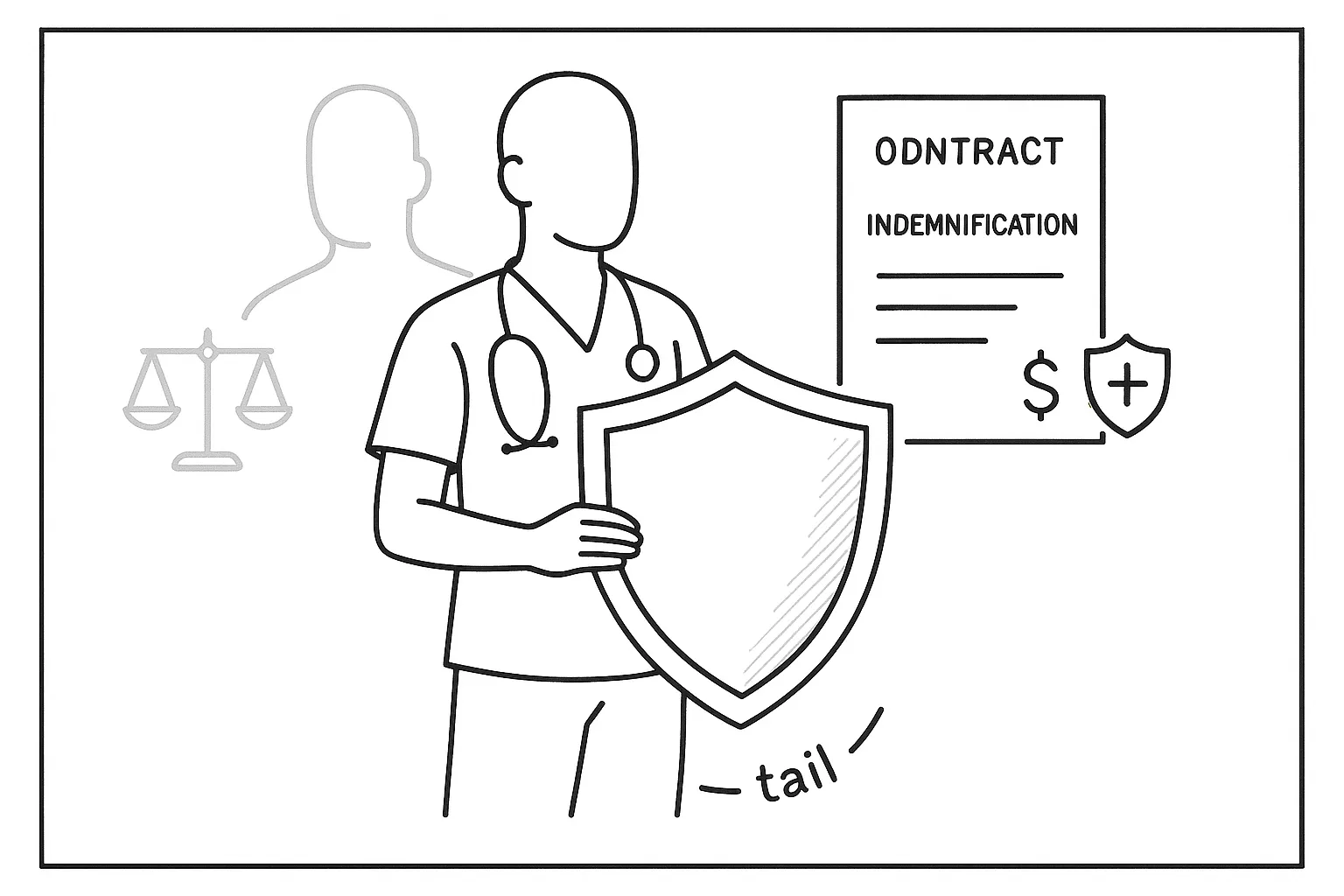
A malpractice claim can generate attorney fees, expert costs, settlement exposure, and substantial demands on the clinician’s time. It may also lead to credentialing questions, an employer investigation, or a licensing-board inquiry. Even a claim that is dismissed can have professional consequences, which makes the scope of defense and related protections as important as the amount available for a settlement or judgment.
Coverage must correspond to the PA’s actual work. The policy materials can identify the insured individuals, covered entities, locations, clinical services, exclusions, effective dates, and claim-reporting requirements. The employment or contractor agreement separately determines who obtains the insurance, pays the premium, reports incidents, cooperates with the defense, and funds continuing coverage after the relationship ends.
Those documents do not always align. An agreement may require coverage for every assigned facility while the policy applies only to listed locations, or it may impose indemnification obligations that are broader than the insurer’s promise to defend. A comprehensive physician assistant contract review can identify inconsistencies among the agreement, declarations page, endorsements, and other coverage materials before the PA accepts the position.
Claims-Made and Occurrence Policies

Policy Timing, Retroactive Dates, and Reporting Rules
A claims-made policy generally responds when a covered claim is made or reported during the active policy period, subject to the policy’s specific wording. The underlying professional service ordinarily must also have occurred on or after the applicable retroactive date. Policies differ in how they define a claim, when notice must be provided, and whether an incident or circumstance that could produce a future claim must be reported before the policy ends.
The retroactive date is therefore critical. If a replacement policy advances that date, earlier work may no longer be protected. Ending a claims-made policy without an extended reporting endorsement or qualifying prior-acts coverage can create a similar gap when a patient brings a claim after the PA has changed jobs.
Occurrence coverage is tied primarily to when the covered professional service or incident occurred. If the event took place during the policy period and otherwise satisfies the policy, a later claim may remain covered even after the policy has ended. Tail coverage is generally unnecessary for the covered occurrence-based acts, but the PA still needs to verify that the policy included the relevant person, service, location, and activity. Other post-employment liabilities may remain outside the occurrence policy.
Premium comparisons alone can be misleading because claims-made and occurrence policies allocate long-term risk differently. Specialty, jurisdiction, claims history, procedures, patient volume, policy limits, and the insurer’s underwriting standards may affect price. The American Academy of PAs’ malpractice insurance guidance likewise emphasizes verifying the type and scope of employer-provided protection rather than assuming that employment alone establishes adequate coverage.
Employer, Contractor, and Federal Coverage Arrangements
Employer Insurance, Self-Insurance, and FTCA Protection
Hospitals, health systems, medical groups, and other employers often insure employed PAs through a master policy. The PA may be a named insured, fall within a defined class of insured clinicians, or receive coverage through an endorsement. The declarations and policy language can clarify insured status, applicable limits, covered locations, and whether the employer’s policy responds to services at affiliates, outside facilities, or remote sites.
Some organizations use self-insurance, a captive insurer, or another risk-financing arrangement rather than a conventional commercial policy. Those structures can differ in how defense counsel is selected, settlements are approved, claims are documented, and protection continues after employment. The agreement should not be evaluated on the assumption that every employer-funded arrangement functions like a standard malpractice policy.
A separate pathway may apply to eligible PAs working for entities deemed under the Health Center Federal Tort Claims Act program. For covered medical services performed within the scope of qualifying employment and the approved health-center project, federal protection may substitute for conventional malpractice coverage. Eligibility is fact-specific, however, and a PA should not assume that a clinic is covered merely because it receives federal funding. Current deeming status, the PA’s status as a covered individual, the approved scope of project, and any excluded activities require confirmation. The Health Resources and Services Administration’s FTCA guidance explains the program’s coverage requirements and limitations.
FTCA protection may follow qualifying acts performed during deemed employment, which can change the analysis of post-employment reporting and tail coverage. It does not necessarily protect moonlighting, services outside the approved project, every contractor relationship, or other non-covered activity. A health center may therefore maintain private gap insurance, and the PA should obtain written confirmation of how potentially uncovered work is handled.
Independent Contractors and Portable Personal Policies
Independent contractor agreements commonly require the PA to purchase professional liability insurance, maintain specified limits, provide certificates of insurance, and notify the contracting entity if the coverage changes. The entity may also request additional-insured status, although that designation and the protection it provides depend on the policy and endorsement. These expenses and administrative obligations belong in the broader comparison of W-2 employment and 1099 work for physician assistants.
A personal policy can provide portability and may include protections not offered by an employer’s program, such as certain license-defense benefits. It does not automatically insure every contractual indemnity, employment dispute, regulatory proceeding, or non-clinical activity. Policy language controls, and overlapping employer and personal policies may contain provisions determining which insurer responds first.
Failure to maintain contractually required coverage may constitute a breach even if no malpractice claim has occurred. A PA considering contractor work can use an independent contractor agreement review to evaluate premiums, required limits, proof-of-coverage provisions, tail obligations, additional-insured language, and the relationship between insurance requirements and indemnification.
Tail Coverage and Protection When Employment Ends
Tail coverage is an extended reporting endorsement associated with a claims-made policy. It generally permits qualifying claims to be reported after the original policy ends when the underlying services occurred during the covered period and after the applicable retroactive date. Tail coverage does not create protection for work that was excluded from the original policy, and its reporting period, limits, and other terms depend on the endorsement.
The employment agreement may assign the cost based on how the relationship terminates. An employer might pay following termination without cause but shift the expense to the PA after resignation or termination for cause. Other contracts make the PA responsible in every circumstance or do not address employer closure, insolvency, acquisition, or a change in insurance carriers. The required coverage method, purchasing deadline, duration, limits, and proof of coverage all warrant attention.
Prior-acts coverage, sometimes called nose coverage, can provide another solution when a new insurer preserves the earlier retroactive date and accepts the prior exposure. It is not interchangeable with tail coverage in every situation, and availability depends on the incoming carrier. The new employer’s promise to arrange prior-acts protection is most useful when it appears in writing and identifies the work and dates that will be covered.
Because this obligation may become a substantial departure cost, it needs to be considered together with notice requirements, repayment provisions, and post-employment restrictions. The guide to tail insurance for physician assistants examines the allocation of tail expenses and transition coverage in greater detail.
Policy Limits, Defense Costs, and Contractual Liability
Reading Limits, Settlement Terms, and Indemnification Together
Malpractice policies commonly state a limit for each claim and a separate aggregate limit for the policy period. A $1 million per-claim and $3 million aggregate structure is a familiar market example, but it is not a universal legal or professional requirement. Appropriate and required limits vary by employer, facility, specialty, credentialing standards, insurer, contract, and jurisdiction.
The treatment of defense costs can materially change the value of those limits. If attorney fees and litigation expenses are paid inside the limit, a prolonged defense may reduce the amount left for settlement or judgment. If defense costs are outside the limits, they may not erode the stated indemnity amount. The PA can also determine whether the policy contains a consent-to-settle provision, who selects counsel, and whether refusing a recommended settlement changes the insurer’s obligations.
Indemnification and hold-harmless clauses create a separate layer of risk. Such a provision may require the PA to reimburse the employer for losses, claims, or defense expenses arising from specified conduct. If the obligation includes contractual breaches, regulatory matters, excluded services, or another party’s conduct, it may exceed what the malpractice policy covers. The clause should be read alongside the insurance section rather than treated as unrelated boilerplate. Chelle Law’s discussion of PA indemnification and defense-cost risks explains how these provisions can shift uninsured liability.
Reporting duties also need to align. The agreement may require immediate notice to the employer, while the policy may separately require prompt notice to the insurer of a claim, incident, subpoena, or circumstance that could lead to a claim. Unclear or inconsistent instructions can create avoidable disputes, especially near the end of employment.
Matching Coverage to the PA’s Actual Practice
The scope of coverage needs to reflect the PA’s specialty, procedures, patient population, schedule, locations, and clinical authority. Emergency, surgical, obstetric, procedural, and other high-acuity roles may present risks different from those of lower-acuity outpatient work. A material expansion of duties may also warrant confirmation that the existing policy and premium classification still correspond to the position.
Multiple-location provisions deserve particular attention. The agreement may permit reassignment throughout a health system, but the insurance documents may cover only listed facilities or services performed for a particular entity. Similar questions arise with affiliated practices, temporary coverage, call duties, volunteer activities, and moonlighting. Written confirmation is more reliable than a general statement that the employer “provides malpractice.”
Telehealth can involve patients located in more than one jurisdiction, and coverage may depend on licensing, policy territory, and the services provided. The agreement and policy can be compared to determine whether remote care, prescribing, cross-state services, and platform-related work fall within the insured activities. The same analysis applies when a PA’s duties, supervision, collaboration, or delegation arrangements change over time.
Insurance does not resolve whether a clinical responsibility is permitted under applicable law or within the PA’s authorized role. Contract terms describing scope and supervision need to be evaluated in the context of the jurisdiction and practice setting. Coverage for an activity does not necessarily establish that the activity is professionally authorized, while an authorized service can still fall outside a poorly matched policy.
Malpractice Insurance Checklist Before Signing
Before accepting an offer, a PA can request the declarations page, relevant endorsements, certificate of insurance, and written confirmation of insured status. The review can then identify the policy type, effective dates, retroactive date, per-claim and aggregate limits, covered entities, locations, services, exclusions, and treatment of defense costs.
- Confirm whether the arrangement uses commercial insurance, self-insurance, a captive program, FTCA protection, or a combination of coverage mechanisms.
- Determine who pays premiums and whether the PA must maintain a separate or supplemental policy.
- Compare the policy’s reporting rules with the agreement’s incident-notice obligations.
- Identify whether telehealth, moonlighting, call coverage, affiliated facilities, and temporary assignments are included.
- Establish who purchases tail or equivalent continuing coverage under each possible termination scenario.
- Ask whether prior-acts coverage may replace tail and require written confirmation before relying on it.
- Review indemnification, defense, settlement, cooperation, and reimbursement provisions for obligations outside the policy.
- Retain policy documents and communications concerning insured status, reporting, and post-employment protection.
Insurance terms also interact with termination, compensation, repayment, and restrictive-covenant provisions. For example, an expensive tail obligation can increase the practical cost of leaving even when the contract allows termination without cause. A review of PA contract termination obligations can help place the insurance expense within the agreement’s complete exit framework.
Attorney review is particularly valuable when the employer will not provide policy documents, the insured arrangement is unclear, the contract contains broad indemnification language, or the PA could face substantial post-employment expense. Evaluating the complete agreement with available insurance materials helps distinguish an ordinary coverage requirement from a provision that may transfer significant uninsured risk.
Frequently Asked Questions
Do physician assistants need their own malpractice insurance?
It depends on the work arrangement and the protection the employer actually provides. An employed PA may be insured under an organizational policy, self-insured program, or another qualifying arrangement, while an independent contractor may have to purchase personal coverage. The policy documents and agreement should confirm insured status, covered activities, limits, exclusions, and any need for supplemental protection.
What is the difference between claims-made and occurrence coverage?
Claims-made coverage generally depends on a covered claim being made or reported during the active policy or an applicable extended reporting period, with the clinical act occurring after the retroactive date. Occurrence coverage generally applies to covered incidents that took place during the policy period even if the claim is reported later. The exact notice and coverage requirements depend on the policy language.
When might a physician assistant need tail coverage?
Tail coverage may be necessary when a claims-made policy ends and no replacement insurer provides qualifying prior-acts protection. The employment agreement may allocate the cost differently depending on resignation, termination without cause, termination for cause, employer closure, or another event. The endorsement’s reporting period, limits, deadline, and covered services also need to be confirmed.
Can prior-acts coverage replace a tail policy?
Prior-acts or nose coverage can sometimes preserve protection by having the new insurer accept qualifying services performed before the new policy began. It is not available in every situation, and the new carrier may impose conditions or exclusions. A PA should obtain written confirmation of the retroactive date and covered prior work before treating it as a substitute for tail coverage.
Does FTCA protection cover every PA working at a health center?
No. FTCA protection for Health Center Program entities depends on current HRSA deeming, the individual’s qualifying status, the approved scope of project, the nature of the services, and other federal requirements. A PA should confirm coverage in writing and determine whether private gap insurance applies to moonlighting, outside services, or other activities that may fall beyond federal protection.
Why must indemnification language be compared with the insurance policy?
An indemnification clause may require the PA to reimburse an employer for losses, defense costs, contractual breaches, or claims that the malpractice policy does not insure. Comparing the clause with the policy can reveal exclusions, uncovered contractual liability, and obligations that exceed the available limits. Insurance and indemnification provisions therefore need to be evaluated together.
Review Your PA Malpractice Insurance Obligations Before Signing
Chelle Law can review the agreement and available coverage documents to identify tail costs, indemnification exposure, policy limitations, and insurance terms that may warrant clarification or revision.
Contact Chelle LawExplore Physician Assistant Contract Guidance
Review legal services, practical resources, and state-focused contract information for physician assistants.