
Physician assistants (PAs) frequently evaluate employment offers that include a guaranteed base salary, production pay, or a hybrid of both. These structures affect more than the headline compensation figure: they determine income stability, payment timing, administrative complexity, and the financial risk assigned to the PA. Contract definitions for RVUs, collections, productivity thresholds, and reconciliation can materially change how much compensation is ultimately earned.
This guide explains how common PA compensation models operate, compares their advantages and disadvantages, and identifies provisions that may create repayment or post-employment exposure. The objective is not to promote one model over another, but to show why the underlying formula, reporting process, malpractice obligations, and termination language must be reviewed together. A focused PA compensation and productivity review can help determine whether an offer’s stated earning potential is supported by clear and workable contract terms.
How Base Salary, Production Pay, and Hybrid Compensation Work
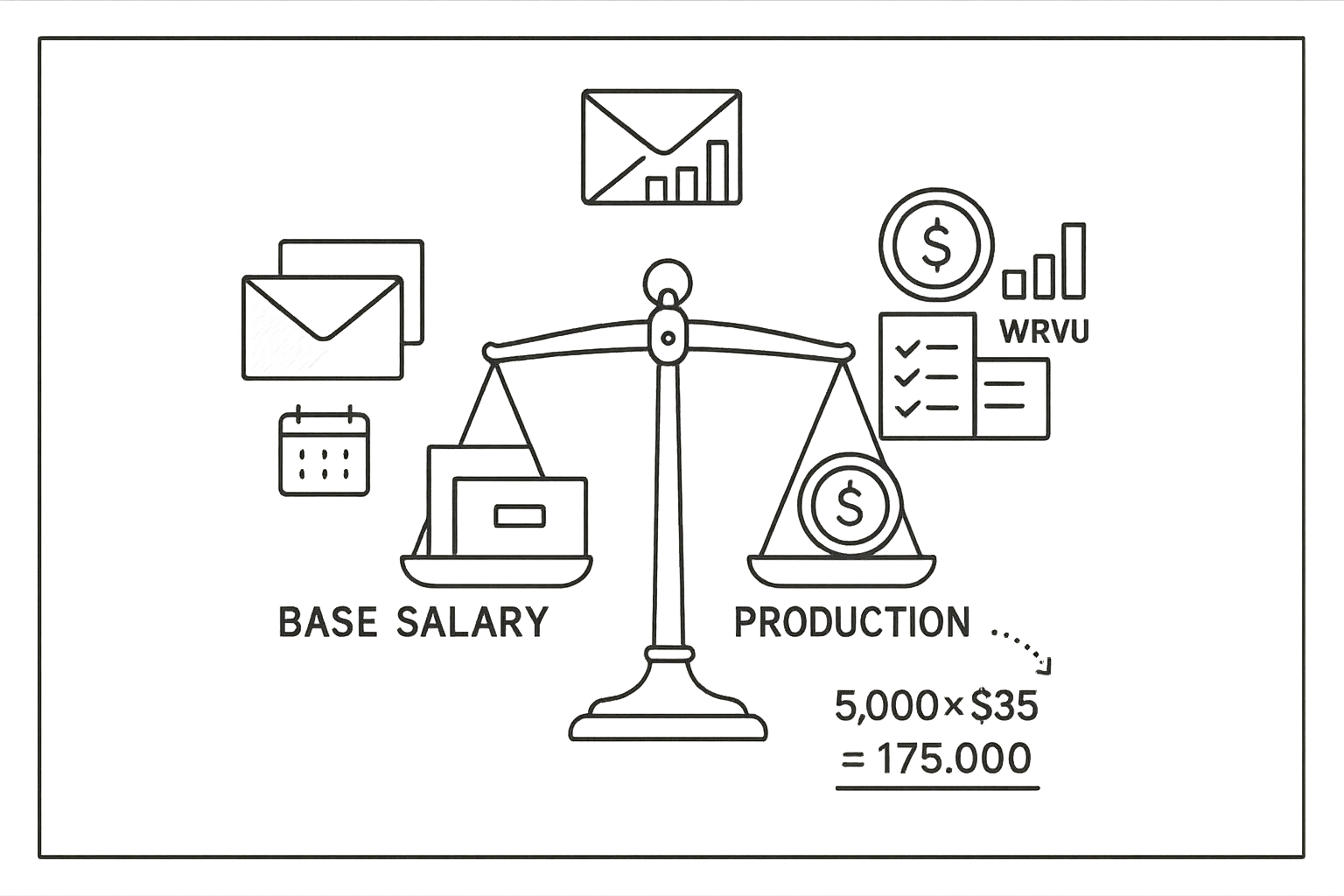
Physician assistant compensation generally falls into three categories: guaranteed salary, production-based pay, and hybrid compensation. Each model allocates income variability and revenue risk differently. The written agreement should explain not only the amount or percentage offered, but also how compensation is earned, measured, reported, reconciled, and paid.
Guaranteed Base Salary
A base salary is a guaranteed compensation amount, typically stated as an annual figure and paid through regular payroll for a W-2 employee. It provides predictable income because short-term changes in patient volume, reimbursement, or payer mix generally do not alter each paycheck.
A salary agreement may still contain productivity expectations, patient-volume requirements, or quality metrics. Those standards can affect bonuses, renewal decisions, future salary adjustments, or continued employment even when regular compensation is guaranteed. The entire agreement—not merely the offer letter—must therefore be reviewed to understand the employer’s expectations.
RVU- or Collections-Based Production Pay
Production pay ties compensation to measurable clinical output. A collections model pays a percentage of revenue the employer actually receives for the PA’s services. An RVU model measures clinical activity through relative value units and applies a conversion factor that translates those units into compensation. PAs considering an RVU formula should examine the broader rules governing RVU compensation for physician assistants, including thresholds, measurement periods, and reporting access.
For example, an agreement that pays $35 per work RVU would generate $175,000 from 5,000 wRVUs. That calculation is straightforward only if the contract clearly identifies the wRVU source, conversion factor, credited services, applicable threshold, and payment schedule. Collections formulas require similar precision because gross charges, net collections, contractual adjustments, refunds, and write-offs can produce very different results.
Production systems may offer greater earning potential, but payment can be affected by billing cycles, payer reimbursement, claim denials, coding, and employer operations outside the PA’s direct control. Collections-based compensation may also lag behind the services performed, while later refunds or payer adjustments can create chargebacks.
Hybrid Salary and Productivity Models
Hybrid models combine a guaranteed base salary with an incentive based on RVUs, collections, patient encounters, quality measures, or another stated metric. This structure can provide income stability while preserving an opportunity to earn more when production exceeds a defined threshold.
The incentive component should specify when bonus eligibility begins, how frequently performance is measured, whether unused production carries forward, and when earned compensation is paid. Some arrangements use a salary draw against future productivity rather than a true guaranteed base. If the draw exceeds actual production, reconciliation language may permit the employer to offset future earnings or demand repayment.
Physician assistant compensation commonly combines salary and productivity measures, an approach also discussed in analyses of advanced practice provider compensation models. Regardless of the model, the contract must provide enough information for the PA to verify the calculation.
Base Salary vs. Production Pay: Side-by-Side Comparison

| Compensation Element | Base Salary | Production Pay |
|---|---|---|
| Predictability | High: regular payroll amounts | Low to moderate: varies with production, reimbursement, and payer mix |
| Cash Flow | Generally stable | May be affected by measurement periods, billing cycles, and collections lag |
| Administrative Complexity | Lower: compensation is not primarily dependent on production reports | Higher: requires accurate RVU or collections reporting and reconciliation |
| Revenue Risk | Employer generally retains more short-term revenue risk | PA may bear more risk from volume, denials, write-offs, and delayed payment |
| Earning Potential | Limited unless the agreement includes meaningful incentives | Potentially higher when production is strong and the formula is favorable |
| Adjustments | Usually fewer routine compensation adjustments | May include thresholds, chargebacks, negative accrual, or repayment provisions |
| Employment Classification | Commonly associated with W-2 employment | May appear in W-2 or 1099 arrangements, with different tax and benefit consequences |
A base salary offers predictable income and reduces exposure to payer delays, but it may provide limited upside when the PA consistently generates substantial clinical revenue. Production pay more directly connects output to earnings, although the PA may assume greater risk from factors such as staffing, scheduling, billing performance, and patient volume.
Neither model is automatically better. The practical value depends on the specialty, expected volume, support resources, assigned schedule, payer mix, and the definitions used in the contract. Classification also matters: PAs comparing employee and contractor offers should separately evaluate the tax, benefit, insurance, and expense implications of W-2 versus 1099 status.
Compensation Formula and Payment Risks
The compensation formula should identify the productivity metric, reporting source, measurement period, payout date, and treatment of adjustments. A collections model should state whether compensation is calculated from gross charges, actual net collections, or another amount after contractual adjustments. An RVU model should identify the applicable RVU schedule, conversion factor, threshold, and whether the formula can be changed during the contract term.
Bonus language also requires careful review. A bonus may be discretionary, formula-based, or conditioned on the PA remaining employed on the payment date. The agreement should explain whether a bonus becomes guaranteed once earned, whether quality measures can reduce the payout, and whether later adjustments permit a clawback. Reviewing how physician assistant productivity bonuses are calculated can help distinguish a meaningful incentive from an uncertain projection.
Draws, Reconciliation, Chargebacks, and Negative Accrual
A draw is an advance against expected production rather than necessarily guaranteed compensation. At the end of a month, quarter, or year, the employer may compare the draw with actual productivity. If the PA did not generate enough production, the agreement may carry the deficit forward, offset future compensation, or require repayment.
This form of negative accrual can materially reduce the value of an offer, especially when low production results from delayed credentialing, inadequate staffing, scheduling limitations, or other circumstances outside the PA’s control. The contract should address how deficits are calculated, whether balances reset, and what happens to a negative balance when employment ends.
Chargeback provisions can create similar exposure when claims are denied, payments are refunded, or insurers later adjust reimbursements. Important details include the look-back period, the treatment of patient refunds and payer write-offs, and whether the PA receives reports sufficient to audit the employer’s calculation.
Contract Clauses That Can Change the Value of Compensation
Compensation cannot be evaluated in isolation. Several provisions elsewhere in the employment agreement may affect whether the PA can meet productivity expectations, retain earned income, or leave the position without substantial expense.
- Malpractice insurance: The agreement should identify the policy type, premium responsibility, coverage limits, and responsibility for tail insurance after termination. A claims-made policy may create a significant post-employment expense if the PA must purchase tail coverage.
- Restrictive covenants: Noncompete and nonsolicitation clauses can limit future employment and may be tied to termination events or repayment obligations. Their enforceability depends on state law and the specific language, but the practical effect should be assessed before signing.
- Scope, supervision, and delegation: Contractual limits on clinical duties may make productivity targets difficult to reach. The duties, assigned sites, available support, and productivity expectations should be consistent with the PA’s actual practice arrangement and applicable requirements.
- Call and coverage: Uncompensated call, additional locations, or coverage duties may increase workload without increasing credited production. The agreement should explain whether these responsibilities generate separate compensation or count toward productivity.
- Termination: The contract should state whether earned but unpaid production compensation will be paid after separation, when final reconciliation occurs, and whether a draw balance or other repayment obligation accelerates at departure.
Termination language is particularly important when collections arrive after the PA leaves. A detailed review of post-termination compensation and notice terms can clarify whether the PA forfeits revenue generated before departure or remains exposed to later reconciliation.
How to Evaluate a Physician Assistant Compensation Offer
Evaluating an offer requires more than comparing annual salary figures. The PA should test how the compensation system operates under realistic production levels and consider whether the employer controls variables that affect the result. The following review points help reveal whether the stated earning opportunity is sufficiently defined:
- Identify the model and employment status. Confirm whether compensation is guaranteed salary, production pay, a hybrid arrangement, or a recoverable draw, and determine whether the role is W-2 employment or an independent contractor arrangement.
- Verify the formula. Locate the RVU source, conversion factor, collections definition, thresholds, tiers, quality measures, and credited services.
- Review payment timing and reports. Determine how often production is calculated, when payment occurs, and whether the PA can inspect the data used by the employer.
- Model downside risk. Examine draws, negative accrual, chargebacks, clawbacks, and repayment terms under lower-than-expected production.
- Assess operational assumptions. Consider scheduling, staffing, credentialing, assigned sites, payer mix, call, and clinical limitations that may affect achievable production.
- Examine separation terms. Determine how earned compensation, collections received after departure, tail insurance, restrictive covenants, and repayment obligations are handled when employment ends.
Attorney review is especially useful when an agreement contains a complex bonus formula, a draw, repayment exposure, unclear reporting rights, restrictive covenants, or uncertain malpractice obligations. A comprehensive physician assistant employment contract review can translate those provisions into practical financial and professional consequences before the agreement is signed.
Frequently Asked Questions
Is base salary or production pay better for a physician assistant?
Neither model is universally better. Base salary generally offers greater predictability, while production pay may provide more earning potential with greater variability. The better structure depends on the formula, expected volume, practice support, specialty, payer mix, and the PA’s tolerance for income risk.
How does wRVU compensation work for physician assistants?
A wRVU model credits clinical work with work relative value units and applies a stated conversion factor. The contract should identify the RVU schedule, conversion rate, applicable threshold, measurement period, credited services, and payment timing so the PA can verify the calculation.
What should a collections-based compensation formula define?
It should define which receipts count as collections and how contractual adjustments, payer write-offs, refunds, denied claims, and later chargebacks are treated. It should also state when collections are measured, when compensation is paid, and whether the PA can review supporting reports.
Can a physician assistant owe money under a production-pay agreement?
Yes, if the agreement uses a recoverable draw, negative accrual, chargebacks, or another repayment mechanism. The specific language determines whether a deficit carries forward, reduces future compensation, or becomes payable when employment ends.
Will earned production compensation be paid after termination?
That depends on the agreement. The termination and compensation provisions should explain whether the PA receives bonuses or collections earned before departure, when final reconciliation occurs, and whether continued employment on the payment date is required.
What can an attorney review in a PA compensation agreement?
An attorney can review the compensation formula, reporting rights, bonus conditions, draws, repayment obligations, malpractice coverage, restrictive covenants, scope-related terms, and post-termination payment provisions. The review helps show how those clauses work together and where the agreement assigns financial risk.
Understand Your PA Compensation Before You Sign
Chelle Law reviews salary, production formulas, bonus terms, repayment provisions, and related contract risks so you can evaluate the full value of your offer.
Request a Contract Review