
Call obligations can materially change the value and demands of a physician assistant employment offer. A clause that appears to address scheduling may determine when the PA must remain available outside ordinary clinical hours, how quickly the PA must respond, whether an onsite return is required, and which facilities or service lines the PA must cover. Those responsibilities can affect workload, personal availability, compensation, and professional liability even when the stated base salary remains unchanged.
The greatest risks often arise from broad phrases such as “coverage as needed” or “participation in the call rotation.” Without defined limits, call frequency may increase as staffing changes, remote coverage may expand into multiple locations, or standby time may interfere with time off without generating additional pay. Call terms also interact with productivity formulas, timekeeping rules, malpractice insurance, credentialing, physician availability, patient handoffs, and the consequences of an alleged missed response.
This guide explains common call models, compensation structures, operational standards, and regulatory issues that may affect a PA’s coverage duties. A physician assistant contract review can evaluate these provisions within the complete agreement, identify language that leaves important questions unanswered, and help the PA understand which terms may warrant clarification before signing.
How Call Terms Can Change a Physician Assistant Employment Offer

Call is not merely an operational detail. It can determine whether a PA must remain reachable by phone, perform remote triage, return to a hospital, cover another clinician’s patients, or work at a location outside the usual schedule. The provision may also control how patient responsibility transfers at the beginning and end of a shift and whether call-related work is included in salary, paid separately, or credited toward productivity.
An agreement that gives the employer unrestricted discretion to change the rotation can create substantial workload uncertainty. Occasional backup coverage may become frequent call during a staffing shortage, while a nominally remote assignment may involve repeated patient contacts or onsite returns. If compensation does not change with the workload, the PA’s effective hourly compensation can decline even though the annual salary remains the same.
Call clauses can also carry disciplinary consequences. An agreement may characterize delayed responses, incomplete documentation, missed assignments, or an inability to report onsite as performance failures or grounds for termination. Reviewing the provision alongside the duties, scheduling, compensation, and termination sections is therefore essential. The related discussion of call coverage and contract disputes explains how inconsistent documents and informal expectations can create disagreement after employment begins.
Common Call and Coverage Models
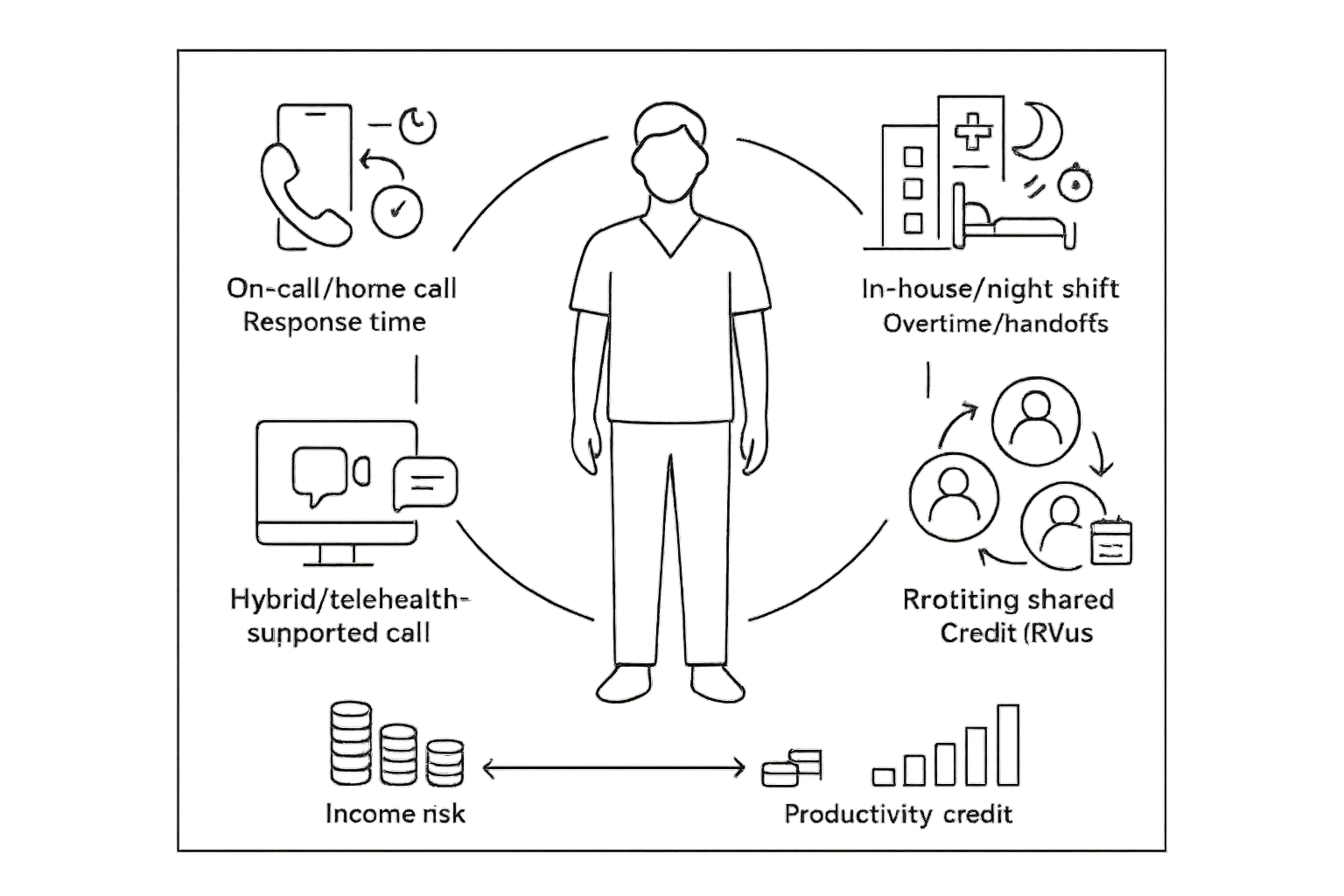
Healthcare employers use several recurring call structures, but the same label can describe very different obligations. The written agreement and any incorporated scheduling policy need to be read together to determine the expected availability, active work, travel, response time, and compensation associated with each model.
Home Call and Remote Response
Home call generally requires the PA to remain reachable outside regular working hours. Depending on the clinical setting, the PA may answer patient or staff questions, review records, conduct a telehealth assessment, enter orders where authorized, coordinate care, or determine whether an onsite evaluation is necessary. The practical burden depends on both the number of contacts and the restrictions imposed during the standby period.
The contract can define the required response interval, approved communication method, geographic availability, remote-access resources, documentation process, and circumstances requiring a return to the facility. It is also important to determine whether telephone work, chart review, electronic messages, and remote encounters receive compensation or productivity credit. A requirement to remain within a narrow travel radius may materially restrict the PA even during a quiet shift.
In-House, Overnight, and Weekend Coverage
In-house coverage requires the PA to remain physically present at a hospital or other facility for the assigned period. It is common in emergency, surgical, inpatient, and other hospital-based services. The agreement may treat these hours as part of the regular schedule or as an additional obligation compensated through hourly pay, a shift differential, overtime, or an overnight premium.
Relevant terms include shift length, weekend and holiday assignments, mandatory extensions, patient handoffs, relief coverage, and whether a call shift follows a regular clinical day. The agreement may also address rest periods or scheduling protections between shifts. Without that detail, the PA may be expected to complete a full daytime schedule before or after overnight coverage.
Rotating, Shared, Hybrid, and Multi-Site Call
Many practices distribute call among physicians and PAs through a rotating pool. A useful provision identifies the expected frequency, the clinicians participating in the rotation, and what happens when the group becomes smaller because of turnover, leave, or a vacant position. It can also clarify whether the PA must personally locate replacement coverage for vacation, illness, or another approved absence.
Hybrid arrangements combine remote triage with possible onsite service. Multi-site arrangements add questions about travel time, mileage, simultaneous requests, remote access, and which location receives priority. If a PA may cover facilities where the PA does not ordinarily work, the contract analysis must also consider credentialing, privileges, access to records, malpractice coverage, and the availability of an appropriate physician escalation pathway.
Operational Terms a Call Provision Needs to Address
A clause stating only that the PA will “participate in call” leaves the most important operational questions unresolved. Terms such as “backup,” “immediate response,” “reasonable rotation,” and “cross-coverage” may carry different meanings across employers and clinical settings. Contract review can identify whether the operative language, job description, handbook, call policy, and compensation addendum use consistent definitions.
- Frequency and assignment: The anticipated number or range of call shifts, how the schedule is created, and whether any maximum applies.
- Response expectations: The time allowed to acknowledge a request, begin remote work, contact a physician, or report onsite.
- Clinical duties: Whether call includes triage, telehealth, admissions, rounding, procedures, orders, patient messages, or cross-coverage for another service.
- Locations: The hospitals, clinics, or service areas included in the assignment and the process for adding another site.
- Schedule changes: The employer’s authority to modify frequency, hours, staffing, or locations and whether material changes require written documentation.
- Absence coverage: Whether the employer or PA arranges a substitute during vacation, illness, leave, or continuing education.
- Handoffs and documentation: When responsibility begins and ends, how unresolved matters transfer, and which records must be completed.
- Coverage failures: The standards used to evaluate a missed shift, delayed response, incomplete handoff, or alleged refusal to report.
Response language requires particular attention. An “immediate” response standard is difficult to apply unless the governing documents identify the communication channel and measurable interval. The PA also needs to understand whether the assignment restricts travel or other personal activity and whether an onsite-return requirement is realistically compatible with the stated response time.
Patient handoffs can be equally consequential. The documents can clarify when responsibility transfers, who follows pending test results, how urgent matters are escalated, and whether the outgoing clinician remains responsible until the next provider expressly accepts the handoff. These details are particularly important when multiple clinicians, facilities, or service lines share a coverage system.
Call Compensation, Productivity Credit, and Timekeeping
Call may be included in base salary or paid through a flat stipend, per-shift premium, hourly rate, overtime structure, productivity credit, or a combination of methods. A flat stipend provides predictable compensation but may not reflect a shift involving frequent calls or an onsite return. A per-shift premium connects pay to the number of assignments, while an hourly structure requires clear rules for recording active work, travel, and other compensable time.
Productivity-based compensation adds another layer of risk. Telephone triage, staff coordination, chart review, documentation, patient messages, and standby time may consume significant time without generating RVUs or collections. A PA compensation and productivity review can examine which call services receive credit and how the formula treats work performed outside the regular schedule.
The complete formula may include a threshold, conversion factor, draw, offset, bonus period, and final reconciliation. If call work reduces the PA’s opportunity to perform other productive services, additional coverage can make a bonus harder to earn or contribute to a negative reconciliation balance. The agreement also needs to explain when call stipends are paid and whether completed assignments remain payable after notice or termination.
Federal Wage-and-Hour Treatment of Call Time
A salary, flat stipend, or contractual label does not by itself determine whether call-related time is compensable. Under U.S. Department of Labor guidance on hours worked, on-premises call or home call subject to sufficiently restrictive conditions may count as working time, while a requirement to remain reachable at home does not automatically make the entire standby period compensable. Time spent actively responding, documenting, or reporting to a facility may be treated differently from unrestricted waiting time.
Employee classification and the particular facts matter. Nonexempt employees generally must receive minimum wage and overtime for covered hours worked, including qualifying call-response time. The Department of Labor’s healthcare overtime guidance explains that covered employees ordinarily receive overtime at one and one-half times the regular rate for hours over 40 in a workweek. The contract and employer policy can clarify timekeeping expectations, but they cannot alone determine the governing wage-and-hour result.
Paid time off also needs practical analysis. The agreement or incorporated policy may determine whether approved leave removes the PA from the rotation, whether the PA must arrange a substitute, and whether an absence triggers a later makeup shift. These details can substantially affect the value of the stated PTO benefit.
Scope of Practice, EMTALA, and Professional Liability
An employment agreement cannot independently expand a PA’s legal scope of practice or facility authority. Call duties remain subject to applicable state law, required supervision or collaboration arrangements, credentialing, prescribing authority, medical-staff bylaws, and granted clinical privileges. The assignment of a facility or procedure in a schedule does not establish that the PA is authorized or prepared to perform it.
Federal emergency-care requirements add a separate layer. A hospital’s obligation to maintain an EMTALA on-call list is not identical to a PA’s contractual duty to respond. CMS guidance addressing PA participation in on-call coverage recognizes that a designated physician may direct a qualified PA or another licensed nonphysician practitioner to respond when hospital policy, state scope-of-practice law, medical-staff bylaws, and privileges permit it. The designated physician remains responsible for ensuring necessary services and may need to appear personally when clinically necessary or requested by the treating physician.
Accordingly, a PA call provision can identify the responsible physician, the escalation process, the required physician availability, and the circumstances in which physician presence is necessary. EMTALA does not establish a universal call frequency or staffing ratio for every hospital. Facilities maintain call procedures based on available services, patient needs, resources, and applicable regulatory requirements.
Critical access hospitals operate under additional facility-specific emergency-services requirements. CMS guidance indicates that a PA with appropriate emergency-care training or experience may satisfy certain availability requirements under specified conditions, including immediate telephone or radio availability and qualifying onsite response arrangements. Those rules are not a universal standard for every PA or hospital, so the facility type and governing policy matter when evaluating a particular assignment.
Call also increases professional-liability exposure because decisions may occur after hours, under time pressure, or with limited resources. The agreement can confirm whether employer-provided malpractice insurance for physician assistants covers remote responses, telehealth, cross-coverage, and services at every assigned location. Relevant details include policy limits, exclusions, the identity of insured providers, and whether the policy is occurrence-based or claims-made.
Claims-made coverage may require extended reporting protection after employment ends. The allocation of that expense can create a significant departure cost, particularly when call duties involve several facilities or higher-risk services. The guide to tail insurance for physician assistants explains how policy type and contract wording affect that analysis.
Evaluating Call Duties Before Signing or Leaving
The written call clause needs to be compared with the employer’s actual operating model. Useful questions include how often current PAs take call, how frequently remote shifts lead to onsite returns, whether call has increased during past staffing shortages, and how the organization handles simultaneous demands. Informal explanations can reveal practical expectations, but any representation important to the decision should be reconciled with the agreement and incorporated policies.
- How many call shifts are anticipated each month, and is there a contractual maximum?
- Is call included in base salary, paid separately, or credited toward productivity?
- Which remote, onsite, weekend, holiday, and multi-location duties are included?
- What response interval applies, and when is an onsite return required?
- Who arranges replacement coverage during PTO, illness, or leave?
- Which physician is responsible for escalation, and when must that physician appear?
- Do credentialing, privileges, and malpractice insurance cover every assigned service and location?
- Can the employer materially change call frequency or location without a written amendment?
- How are unpaid stipends, productivity credit, and insurance obligations handled at departure?
Termination language deserves separate attention because a PA may remain responsible for call throughout a lengthy notice period. The agreement may also address schedule removal, final stipends, bonus eligibility, productivity reconciliation, malpractice coverage, and tail responsibility. The resource on terminating a physician assistant contract provides additional context for evaluating those exit obligations.
Call terms should ultimately be evaluated with the entire compensation plan, job description, restrictive covenants, insurance provisions, and incorporated policies. A broader list of questions to ask before signing a PA agreement can help identify related provisions affecting workload, income stability, and professional mobility.
Frequently Asked Questions
What details should a physician assistant call provision define?
The provision should identify the type and anticipated frequency of call, response intervals, onsite-return requirements, covered locations, assigned duties, compensation, absence coverage, handoff procedures, and the employer’s authority to change the schedule. It should also explain the standards used to evaluate missed assignments or delayed responses.
Are physician assistants always paid separately for call coverage?
No. Call may be included in base salary or compensated through a stipend, per-shift premium, hourly rate, overtime, productivity credit, or a combination of methods. Employee classification, actual work performed, and restrictions during the call period may also affect whether time is compensable under applicable wage-and-hour rules.
How can call duties affect productivity compensation?
Some call services generate RVUs or collections, while triage, coordination, record review, documentation, patient messages, and standby time may not. The compensation formula needs to identify which activities receive credit and how call work affects thresholds, bonuses, offsets, and reconciliation.
Can a PA satisfy a hospital’s EMTALA on-call obligation?
PA participation depends on hospital policy, medical-staff bylaws, privileges, applicable state scope-of-practice requirements, and the coverage arrangement. CMS guidance permits a designated physician to direct an appropriately qualified PA to respond in certain circumstances, but the physician remains responsible for ensuring necessary services and may need to appear personally.
What malpractice terms matter when a PA takes call?
The PA needs to determine whether employer-provided insurance covers remote responses, telehealth, cross-coverage, and services at every assigned location. The agreement may also identify policy limits, whether coverage is occurrence-based or claims-made, and who pays for tail coverage when extended reporting protection is required.
What happens to call obligations after a PA gives notice?
The agreement may require the PA to continue taking call throughout the notice period. The termination and compensation provisions can also determine how unpaid stipends, earned productivity compensation, final reconciliation, malpractice coverage, and any tail obligation are handled when employment ends.
Review Your PA Call and Coverage Terms
Chelle Law reviews physician assistant agreements to identify unclear scheduling duties, compensation risks, scope and coverage concerns, and exit obligations before they create unexpected problems.
Contact Chelle Law