
Physician assistants encounter compensation structures ranging from fixed salaries and hourly rates to collections-based formulas, Relative Value Unit (RVU) systems, and hybrid models that combine guaranteed pay with productivity incentives. The model stated in an employment or independent contractor agreement affects more than the headline salary: productivity thresholds, conversion factors, deductions, bonus timing, benefits, and repayment provisions can materially change what a PA ultimately earns.
Understanding these terms before signing is important because compensation formulas also allocate financial risk between the physician assistant and the practice. A guaranteed salary may later be reconciled against production, while a collections formula may depend on billing performance and payer timing outside the PA’s control. This guide explains the principal compensation models, the contract provisions that affect take-home pay, and the related classification, insurance, termination, and restrictive-covenant risks. An attorney-led PA compensation and productivity review can clarify how those provisions work together before the agreement is signed.
What Makes Up a Physician Assistant Compensation Package?

A physician assistant’s total compensation usually includes direct pay and employer-provided benefits. Evaluating only the annual salary can obscure significant differences between offers, particularly when one position includes stronger insurance, retirement, paid leave, or professional-expense benefits and another relies more heavily on variable compensation.
- Base salary or hourly pay: Guaranteed cash compensation expressed as an annual salary, hourly rate, or shift rate. The agreement may allow the guarantee to be reconciled against future productivity.
- Productivity compensation: Incentive pay tied to collections, billed charges, RVUs, work RVUs, patient volume, or another measurable output.
- Bonuses and stipends: Signing, relocation, retention, quality, call, and student-loan payments may supplement regular compensation but can include conditions or repayment triggers.
- Benefits and professional expenses: Health coverage, retirement contributions, paid time off, continuing medical education allowances, and payment of licensing or registration fees can add meaningful value.
- Malpractice coverage: The value and risk depend on the policy type, coverage limits, premium responsibility, and whether tail coverage may be required when employment ends.
These components do not operate in isolation. Termination clauses, repayment obligations, productivity reconciliation, and negative accrual provisions can alter the practical value of the package. Compensation structures for advanced practice providers also continue to evolve as practices balance guaranteed income with measurable clinical output, an issue discussed in analyses of advanced practice provider compensation models.
Common PA Compensation Models and How They Work
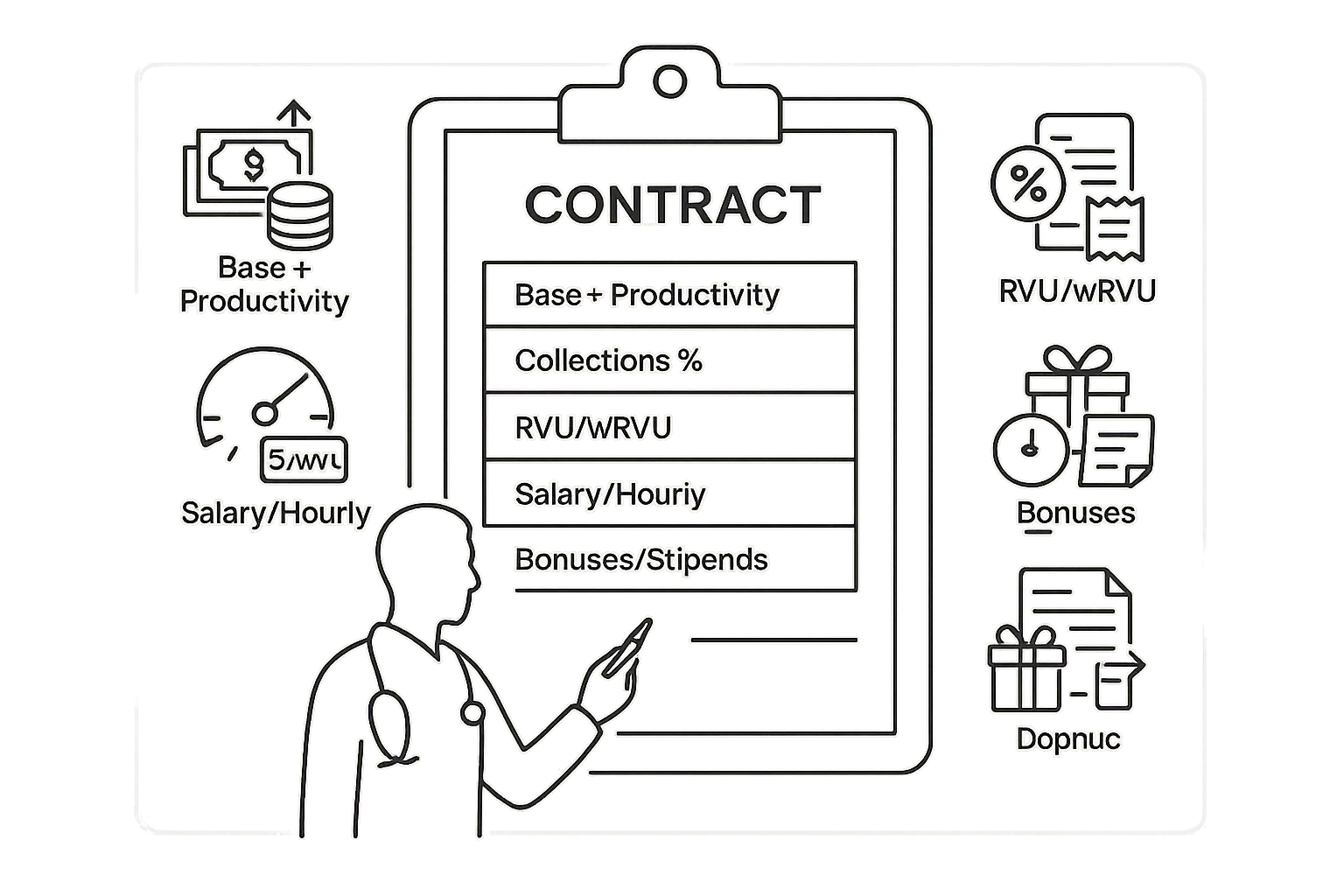
Fixed Salary, Hourly Pay, and Base-Plus-Productivity Models
A salary-only arrangement provides predictable income, but its value depends on the workload attached to that salary. Call coverage, extended schedules, additional locations, and administrative duties can reduce the effective hourly value of the compensation. Hourly and shift-based arrangements are common in urgent care, emergency medicine, and hospital settings; the contract should identify the applicable rate and any differential compensation for nights, weekends, overtime, or on-call work.
Many employers instead offer a guaranteed base salary plus a productivity bonus. The base provides stability while the incentive rewards output above a stated threshold. Comparing base salary and production pay requires reviewing the threshold, measurement period, calculation method, reporting process, and payment date—not merely the advertised bonus percentage.
Collections-Based Compensation and Percentage Splits
Collections-based compensation pays a PA a percentage of revenue actually received for services attributed to the PA’s work. A formula might provide a stated percentage of collections after payer adjustments or after a contractual threshold has been reached. Because payment depends on money received by the practice, insurance delays, claim denials, recoupments, and billing performance may cause income to vary between periods.
The agreement should precisely define “collections.” Some definitions exclude contractual write-offs, secondary payments, shared professional fees, facility revenue, or other categories. The contract should also address how payments are attributed when services are billed under another clinician, how later payer adjustments are handled, and whether the PA can inspect the reports used to calculate compensation.
RVU and Work RVU Compensation Formulas
RVU compensation measures productivity through standardized values assigned to medical services. A typical model combines a salary guarantee with additional pay generated after the PA exceeds a work RVU threshold. The formula may be expressed as:
Total compensation = base guarantee + (work RVUs above the threshold × conversion factor)
For example, a contract with a $90,000 guarantee, a threshold of 2,250 work RVUs, and a $40 conversion factor would produce $70,000 in additional compensation if the PA generated 4,000 work RVUs, for total compensation of $160,000 before other adjustments. The result depends entirely on how the agreement defines the threshold, conversion factor, measurement period, reconciliation, and credit for personally performed or shared services. A detailed guide to RVU compensation formulas can help PAs assess those variables.
RVU models are less sensitive to payer payment timing than collections formulas, but they still depend on accurate coding, service attribution, and reporting. The contract should state whether the employer may change the conversion factor or threshold and whether a change applies prospectively or to a measurement period already underway.
Bonuses, Stipends, and Repayment Conditions
Supplemental compensation may include productivity bonuses, quality incentives, signing bonuses, relocation assistance, retention payments, loan repayment, and call stipends. Each payment should have an identifiable amount or formula, eligibility standard, measurement period, and payment date. When a bonus depends on multiple performance measures, the agreement should make clear whether every measure must be satisfied and whether the employer retains discretion to alter the criteria.
Productivity incentives deserve particular attention because a bonus can appear valuable while remaining difficult to earn. PAs should review the threshold, conversion factor, reporting frequency, exclusions, and reconciliation method. The employer’s ability to adjust the formula, attribute services, or withhold payment after termination can be as important as the stated bonus rate. More detail about these provisions is available in the guide to productivity bonus terms.
Signing, relocation, and loan-repayment incentives frequently include service commitments or clawback provisions. The contract should specify the repayment period, whether the obligation decreases over time, which termination events trigger repayment, and whether the employer may deduct an alleged balance from final compensation. A large upfront payment may create substantial financial exposure if the PA later needs to leave the position.
Contract Terms That Can Reduce Take-Home Pay
Compensation disputes often begin with an undefined or incomplete formula. A contract should explain whether productivity is based on gross charges, allowed amounts, collected revenue, RVUs, or work RVUs. It should address payer adjustments, facility fees, shared services, refunds, coding corrections, and revenue received after employment ends. If the employer controls the billing system, the PA should understand what reports will be provided and whether discrepancies can be challenged.
Guaranteed compensation may also be subject to a later true-up. When production exceeds the guarantee, the PA may receive additional pay; when it falls short, the employer may attempt to carry forward a deficit or recover part of the guarantee. Draw and negative-accrual language should define the reconciliation period, repayment method, treatment of deficits between periods, and whether an alleged balance survives termination.
Other provisions may permit deductions for overhead, administrative charges, billing adjustments, payer denials, refunds, or recoupments. The agreement should identify permitted deductions rather than leaving them entirely to employer discretion. It should also allocate responsibility for credentialing delays, billing errors, and coding decisions, particularly when those processes are controlled by the practice.
Benefits must be evaluated alongside cash compensation. Health premiums, retirement contributions, paid time off, continuing education allowances, and professional-fee payments may make a lower salary more valuable than an offer with higher direct pay but limited benefits. Eligibility dates, vesting requirements, and the treatment of unused benefits when employment ends should be reviewed as part of the total package.
Employment Classification and Malpractice Insurance Risks
Employee Versus Independent Contractor Compensation
Classification affects taxes, benefits, business expenses, insurance, and the structure of compensation. Employees commonly receive payroll withholding and employer-provided benefits, while independent contractors are generally responsible for their own tax payments, insurance, and operating expenses. A higher contractor rate therefore should not be compared directly with an employee salary without accounting for the expenses and benefits shifted to the PA.
The label in the agreement does not by itself resolve classification. Scheduling control, supervision, billing arrangements, required participation in employer programs, and the actual working relationship may all be relevant. PAs considering contractor compensation should review the practical differences between W-2 and 1099 classifications as well as the payment formula.
Malpractice coverage is another component with direct financial consequences. The contract should identify the policy type, who pays the premium, whether coverage applies to all required duties and locations, and who is responsible for post-employment protection. Claims-made coverage may require tail insurance after employment ends, while occurrence coverage generally protects incidents that occurred during the policy period even when a claim is later reported. Responsibility for tail insurance obligations should be stated clearly rather than left for resolution at termination.
Termination, Repayment, and Post-Employment Restrictions
Termination provisions determine when compensation ends, whether earned bonuses remain payable, and whether repayment obligations are triggered. The agreement should address notice periods, for-cause and without-cause termination, compensation during the notice period, final reconciliation, and the deadline for paying amounts earned before separation. A review of the contract’s termination provisions can identify conflicts between bonus language, repayment clauses, and the employer’s right to end the relationship.
Clawbacks may apply to signing bonuses, relocation assistance, salary advances, loan payments, or other incentives. The contract should clarify whether repayment is triggered by resignation, employer termination, or both; whether the amount is prorated; and whether repayment is accelerated immediately. These details can materially change the value of compensation that appears guaranteed at the start of employment.
Non-compete, non-solicitation, and related restrictions may not reduce current pay, but they can affect future income and career mobility. Their scope commonly depends on the restricted activities, geographic area, duration, and circumstances of termination, with enforceability varying by state law and the specific facts. PAs should evaluate restrictive covenants in the agreement together with the compensation and termination package.
PA Compensation Contract Review Checklist
Before accepting an offer, a physician assistant should be able to determine how each compensation component is earned, measured, reported, and paid. Important questions include:
- Is the base salary guaranteed, or can it be reconciled against future productivity?
- What threshold, conversion factor, percentage, or other formula determines incentive compensation?
- How are collections, RVUs, shared services, refunds, denials, and payer adjustments attributed?
- How often will the PA receive compensation reports, and is there a process for disputing errors?
- Can the employer modify the formula, threshold, schedule, or assigned locations?
- What deductions, overhead allocations, deficits, or repayment obligations are permitted?
- Are earned bonuses payable after notice is given or employment ends?
- Who pays for malpractice coverage and any required tail insurance?
- How do benefits, paid leave, retirement contributions, and professional allowances affect total value?
- Do termination or restrictive-covenant provisions create financial or career risks that offset the compensation offered?
Compensation language should be reviewed as part of the entire agreement rather than as a standalone number. At Chelle Law, an attorney-led physician assistant contract review can identify unclear formulas, discretionary terms, repayment exposure, and post-employment restrictions before the PA commits to the position.
Frequently Asked Questions
Which physician assistant compensation model provides the most predictable income?
A fixed salary generally provides more predictable income than a collections or productivity model. However, the contract should still be reviewed for reconciliation, schedule, call, location, and repayment terms that may affect the salary’s practical value.
How is a PA work RVU bonus usually calculated?
A work RVU bonus commonly applies a stated conversion factor to work RVUs generated above a contractual threshold. The agreement should define the threshold, measurement period, service attribution, reporting process, payment date, and treatment of later coding adjustments.
What should a collections-based compensation clause define?
It should define which revenue counts as collections, how services and shared payments are attributed, which adjustments or deductions apply, when collections are measured, and whether the PA can review the records used to calculate compensation.
Can an employer require a PA to repay guaranteed compensation?
A contract may treat guaranteed compensation as a draw or advance subject to reconciliation. Whether repayment is required depends on the agreement’s negative accrual, true-up, termination, and survival language, so those provisions should be reviewed together.
How should benefits be compared with a higher salary offer?
Compare the salary with the value of health coverage, retirement contributions, paid leave, continuing education, professional fees, and malpractice insurance. Eligibility, vesting, and post-termination terms can also affect the package’s total value.
When should a physician assistant seek legal review of compensation terms?
Review is especially useful before signing an agreement with productivity formulas, employer discretion, negative accrual, bonus clawbacks, independent contractor classification, malpractice obligations, restrictive covenants, or complex termination provisions.
Understand Your PA Compensation Before You Sign
Chelle Law reviews salary, productivity, bonus, repayment, malpractice, termination, and restrictive-covenant terms so you can evaluate the full financial impact of a proposed agreement.
Contact Chelle Law